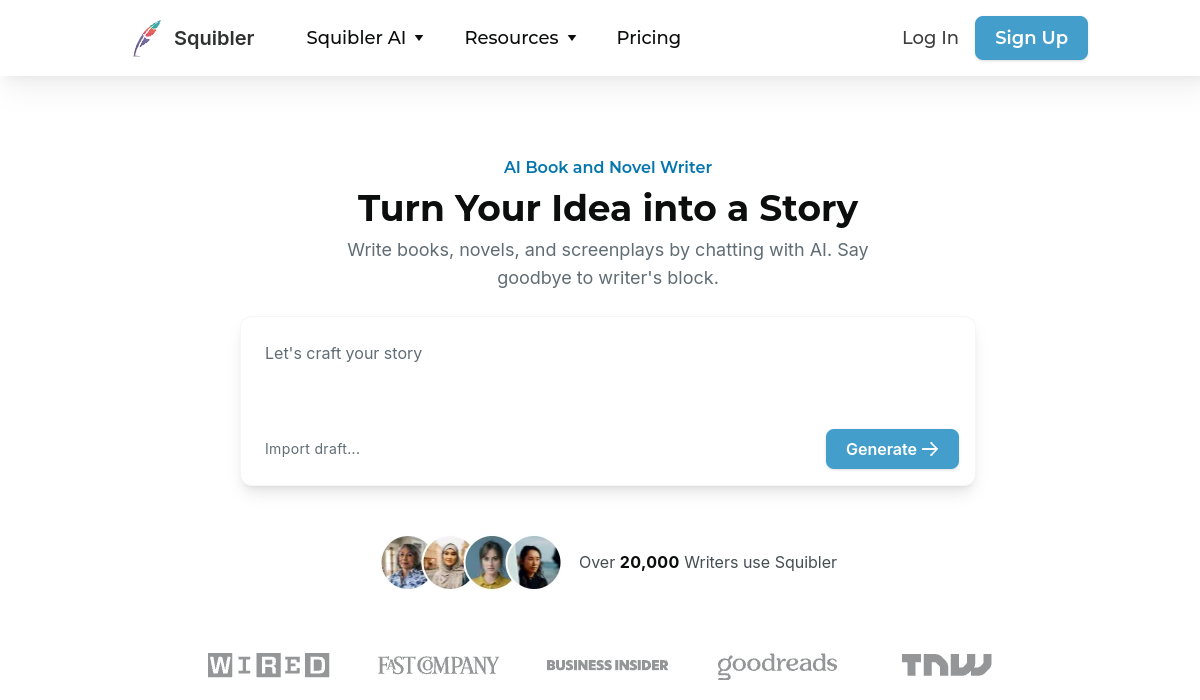
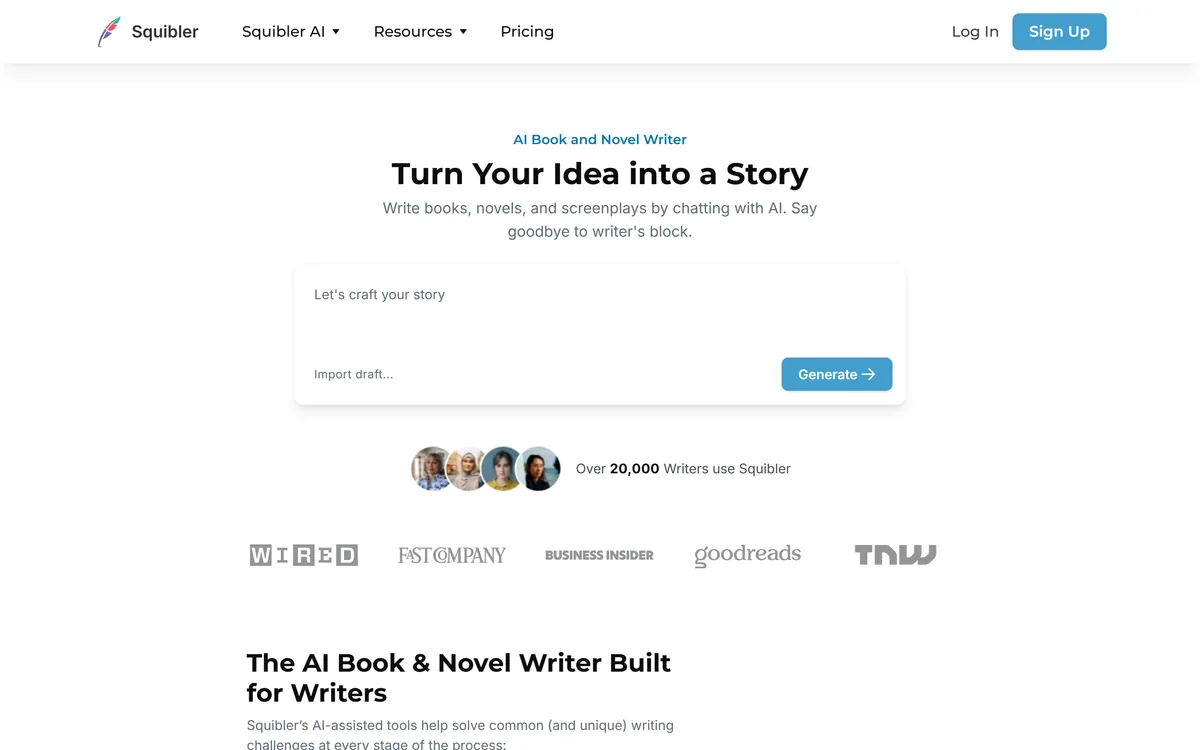
Squibler is an AI writing platform for long-form fiction and screenplays. It generates full books organised into chapters and scenes, drafts formatted screenplays, builds outlines, keeps characters and settings consistent, and adds AI images and short video from your text.
Everyone who has tried to write a novel with a general chat model has hit the same wall in roughly the same place. The first chapter is fine. By chapter nine the protagonist's sister has changed name, the timeline has drifted, and the voice has quietly become the model's rather than yours.
That is not a prompting failure, and switching to Claude or another general model does not fix it either. It is what happens when a tool has no structural model of a book — no notion that chapter nine has to remain consistent with chapter two, because it has no representation of either.
Squibler is built around that specific gap. This review covers what chapter-and-scene structure actually changes, why the consistency tracking is the feature that matters, what to make of the image and video generation, and the honest limits of machine-drafted fiction.
It solves the blank page decisively. The blank page was never the hard part of a novel.
What Squibler Actually Produces
Squibler is an AI writing tool for long-form fiction and screenplays — it generates full-length books structured into chapters and scenes rather than passages you then have to assemble.
Structure is the differentiator. Outline generation, chapter and scene organisation, and character, setting and element tracking that holds consistency across a manuscript.
Screenplays get real support, with formatted scenes and dialogue rather than prose that happens to contain speech.
It generates images and short video from your text, aimed at pitching and promotion rather than at the book itself.
More than 20,000 writers use it per the vendor, with coverage cited from Wired, Fast Company, Business Insider, Goodreads and TNW.
Structure Is The Whole Argument
The meaningful difference between Squibler and a general model is not prose quality. It is that Squibler knows what a book is.
Generating into chapters and scenes rather than into a continuous stream sounds cosmetic and is not. It means the document has addressable parts — you can regenerate scene four of chapter eleven without touching anything else, which is impossible in a single long conversation where the only unit is the next message.
Outline generation before drafting follows the same logic and matches how most working novelists actually operate. An outline is a set of constraints, and constraints are what keep a long narrative from wandering.
The character, setting and element tools are the ones doing the real work. They give the system a persistent record of who exists, what they are like and what has been established — so chapter nine can be written against chapter two rather than against a fading context window.
This is the same architectural insight that separates purpose-built tools from general models across every long-form domain: the model is not the product, the structure around it is.
The honest caveat is that consistency tracking handles facts far better than it handles voice. A character's eye colour stays fixed; whether they still sound like themselves in chapter nine is a judgement no tracker makes.
A general model forgets your protagonist's sister by chapter nine. That is not a prompting failure — it is a tool with no idea that a book has chapters.
Screenplay Support Is A Real Distinction
Formatted screenplay generation with scenes and dialogue is worth calling out, because screenplay formatting is a genuinely unforgiving convention rather than a style preference.
Scene headings, action lines, character cues, parentheticals, dialogue blocks — each has prescribed placement and spacing, and the whole thing exists because a correctly formatted page runs roughly a minute of screen time. That equivalence is why the format is enforced so strictly: it makes a script's length mean something.
A screenplay that is not properly formatted signals amateur before anyone reads a line, which is why dedicated software exists at all in an era of general word processors.
So a tool that outputs correctly formatted scenes is doing something a general model does inconsistently at best. Whether the output is any good is a separate question, but at least it arrives in the right shape.
The 80+ language support via translation sits alongside this. Treat it as a convenience for reach rather than as literary translation — rendering fiction into another language well is authored work, which is exactly what tools like Ailaysa are built to support rather than replace.
The Images And Video Are For Pitching, Not For The Book
Generating images and short video sequences from passages of text is on the feature list, and it is worth being clear about what it is for.
It is not illustration for the book. Publishers commission cover art and interior illustration through their own processes, and a self-published author using generated cover art faces a market where readers increasingly recognise it — with a growing number of platforms and awards asking authors to disclose it.
What it is genuinely useful for is everything around the book. A visual for a pitch deck, something for a social post, a mood board that communicates tone to a collaborator faster than three paragraphs of description.
The vendor is reasonably clear about this framing, describing the assets as suitable for pitching and promotion, which is the honest positioning.
The one point worth adding: rights in AI-generated images are unsettled and vary by jurisdiction, and in several the output may not attract copyright protection at all. For promotional material that rarely matters. For a cover you intend to defend, it does.
Good for: pitch decks, mood boards and social promotion
Good for: communicating tone to a collaborator quickly
Risky for: self-published cover art, which readers increasingly identify
Unsettled: copyright in generated images differs by jurisdiction
Irrelevant for: traditionally published books, where the publisher commissions art
The Tiers, Structurally
This site does not publish plan prices. The shape is what stays useful, and Squibler's is a conventional three-step ladder.
There is a free tier with limited capability, then two paid levels — Squibler Plus and Squibler Pro — with the top tier carrying the full feature set. Annual payment is offered alongside monthly.
What differs between tiers in tools like this is usually generation volume, access to image and video generation, and the depth of the AI editing features. The free level exists to let you judge prose quality, which is the right thing to judge before paying anything.
One point specific to writing software rather than to pricing: your manuscript is the asset, and the platform is not. Before committing a book-length project to any writing tool, confirm you can export the full manuscript in a standard format and that doing so does not require an active subscription.
That is not a criticism of Squibler in particular — it is the discipline for every cloud writing tool, and the people who learn it the hard way learn it at the worst possible moment.
Manuscript import is supported after you create an account, so bringing existing work in is possible; test the round trip in both directions early.
What A Machine Cannot Draft For You
Being specific here is more useful than encouragement or dismissal, and it applies to every tool in this category.
Revision tools like ProWritingAid can critique a manuscript, but not supply this. Voice is the point of fiction and it is the hardest thing to generate. A model trained on published prose produces competent published-sounding prose, which is precisely the problem — the whole value of a novel is that it sounds like one person and not like the average of everyone.
Structural instinct does not transfer. Knowing that a scene is not working, that a chapter should be cut, that the story actually starts on page forty — this is the craft, and it is judgement rather than output.
The specific detail comes from you. The observations that make a book feel true are drawn from having been somewhere, known someone, noticed something. A model can supply plausible detail; plausible is not the same as true.
Where it genuinely helps is real and worth naming. Getting past a stuck chapter. Drafting a scene you already know the shape of. Producing a synopsis, which most writers loathe. Testing whether an outline holds together. Writing the connective passages between the scenes you actually care about.
Assistive tools such as Sudowrite start from the same premise. The writers who get value here treat output as raw material to be rewritten. The ones who do not are the ones who publish it.
Generate an outline for a story you already know well, and see whether it finds the right shape.
Draft one scene and rewrite it entirely in your own voice — compare the two side by side.
Test consistency deliberately: establish a detail in chapter two and check it survives to chapter nine.
Export the full manuscript early and confirm the file is complete and usable.
Decide before you start whether you are drafting or generating, because the two produce different books.
Is This The Right Drafting Tool?
Start Drafting Here If
You are writing something book-length and general chat models keep losing the thread
You want structure — outline, chapters, scenes — rather than a long text box
You write screenplays and want correct formatting without learning the conventions
Getting a first draft down is your bottleneck rather than revising one
You will rewrite the output rather than publish it
Write It Yourself If
Voice is the point of your work, which is the hardest thing to generate
You want illustration or cover art you intend to defend commercially
You need publishing, audiobook or sales tooling, which is not here
You would publish generated prose without a full rewrite
You write short-form, where the structural advantage disappears
Output, Tools And Reception
Category
AI writing for long-form fiction and screenplays
Output formats
Full-length books organised into chapters and scenes, and formatted screenplays with scenes and dialogue
Planning
Story outline generation with narrative structure mapping
Consistency tools
Character, setting and element creation that carries across the manuscript
Editing
AI Smart Writer for iterative revision and rewriting suggestions
Visual generation
AI images and short video sequences generated from passages of text
Language support
80+ languages via translation
Import
Manuscript import available after account creation
Stated user base
More than 20,000 writers, per the vendor
Press cited on site
Wired, Fast Company, Business Insider, Goodreads, TNW
Not included
Audiobook production, publishing management and sales tracking
Charging model
Free limited tier, then Squibler Plus and Squibler Pro, monthly or annual; no prices published here
Key features of Squibler
Full-length book generation structured into chapters and scenes
Formatted screenplay generation with scenes and dialogue
Story outline generation with narrative structure mapping
AI Smart Writer for iterative editing and revision
Character, setting and element tracking for consistency
AI image generation from text passages
Short video sequence generation from scenes
80+ language translation
Manuscript import
Accept, reject or refine every AI suggestion
Pros & cons
Pros
6
Chapter and scene structure makes parts of a manuscript addressable rather than a single stream
Character and setting tracking directly attacks the consistency failure of general models
Screenplay formatting is a genuine distinction, since the conventions are strict and unforgiving
Outline-first drafting matches how most working novelists actually operate
A free tier lets you judge prose quality before paying anything
The vendor is upfront about what the platform does not do, which is unusually honest
Cons
5
Consistency tracking holds facts well and voice poorly, and voice is what fiction is
Generated cover art is increasingly recognised by readers and unsettled in copyright terms
No publishing, audiobook or sales tooling — it stops at the manuscript
Translation across 80+ languages is convenience, not literary translation
Your manuscript lives in a cloud platform, so export terms matter more than features
Best For
Writers whose bottleneck is finishing a first draft
Screenwriters who want correct formatting without learning it
Self-published authors producing at pace
Anyone stuck partway through a long manuscript
Writers who want an outline tested before committing months to it
Squibler Beside Other Fiction Tools
These differ mainly in how much they generate versus how much they organise what you write.
Most finished books touch a drafting tool, an editing tool and something for translation or promotion.
Sudowrite — the assistive alternative, built around helping you write rather than generating
Novelcrafter — manuscript organisation with far more control over the model
ProWritingAid — the revision pass, including manuscript-level story critique
Ailaysa — proper long-form translation if the book goes into other languages
Claude — the general model many writers use directly, with their own structure
Provenance Of This Assessment
Last checked . Read from squibler.io during this check, with the screenshot above captured at the same time.
Positioned on site as an AI book and novel writer, generating stories by chatting with AI
Full-length book generation organised into chapters and scenes stated on site
Screenplay drafts with formatted scenes and dialogue stated on site
Story outline generation with narrative structure mapping stated on site
AI Smart Writer named for iterative editing and revision suggestions
Character, setting and element creation described as maintaining consistency
AI image and short video generation from text passages stated on site
Language support stated as 80+ via translation
Manuscript import stated as available after account creation
More than 20,000 writers cited on the homepage, with Wired, Fast Company, Business Insider, Goodreads and TNW shown as coverage
Vendor states the platform does not include audiobook production, publishing management or sales tracking
A free limited tier plus Squibler Plus and Squibler Pro, monthly or annual; no plan prices published here, in line with this site's pricing policy
User counts and press mentions are as cited by the vendor and were not independently verified; logos shown as coverage are not endorsements. Copyright in AI-generated text and images is unsettled and differs by jurisdiction — check the position for your market before relying on generated material commercially, and confirm you can export your full manuscript before committing a book-length project to any cloud writing tool.
Editor's Verdict
3.7/5
Squibler has an AInexfinder Editor Score of 3.7/5.
Squibler pricing
AInexfinder does not list plan prices or billing details. For current pricing, plans, and trials, visit the official Squibler website.
Vendor pricing, credits, and billing policies change over time. Always confirm on the official site before you buy.
Frequently asked questions
Can Squibler write a whole book?
It generates full-length manuscripts organised into chapters and scenes, which is more than a general chat model will do coherently. Whether the result is a book worth reading depends entirely on how much of it you rewrite.
Is Squibler free?
There is a free tier with limited capability, then Squibler Plus and Squibler Pro, billed monthly or annually. Use the free tier to judge prose quality, and test the manuscript export before committing a long project.
Does Squibler write screenplays properly formatted?
Yes — formatted scenes and dialogue rather than prose containing speech. That matters because screenplay formatting is a strict convention, not a style: a correctly formatted page runs roughly a minute of screen time, which is why the rules are enforced.
How does Squibler keep a long story consistent?
Through character, setting and element tracking that persists across the manuscript, so later chapters are written against what was established earlier rather than against a fading context window. It holds facts reliably; whether a character still sounds like themselves is your judgement.
Squibler vs Sudowrite — which should I use?
Squibler leans toward generating a draft from an idea; Sudowrite leans toward assisting a writer who is already writing. If your bottleneck is producing pages, Squibler. If it is continuing pages you have started, Sudowrite.
Can I use AI-generated images as my book cover?
You can, and there are two reasons to think twice. Readers increasingly recognise generated cover art, and several platforms and awards now ask for disclosure. Copyright in generated images is also unsettled and varies by jurisdiction, which matters if you need to defend it.
Will AI-written fiction be any good?
The prose will be competent and that is exactly the problem — models produce published-sounding writing, and a novel's value is sounding like one specific person. Treat output as raw material to rewrite, and it helps enormously. Publish it as it comes and it reads like everything else.
Daniel reviews AI tools the slow way — by actually using them on real projects. His reviews cover what works, what breaks, and who each tool is genuinely a good fit for.
Daniel and the AInexfinder editorial team research Squibler using public product information, listing evidence, and (when available) hands-on checks. Scores reflect listing completeness and transparency — not paid placement.
Listings may include affiliate or sponsored placements, which are labeled when present. Editorial scores and cons are not sold. See our affiliate disclosure and review methodology.
Talefy, from AIcberg Labs, is an interactive AI storytelling platform. Readers make choices that change the plot, and creators build characters, worlds and branching narratives across fantasy, sci-fi, romance, horror and comedy.
Type.ai is an AI editor built for long-form creative writing, with a draft and AI assistant deeply integrated, story notes for characters and settings, custom style rules, offline mode and export to DOCX, PDF or narrated audio.
AuthorFlows is browser-based novel-writing software combining a paginated manuscript editor, story map, timeline, character bible and an AI Story Analyzer that scores chapters for strengths and weaknesses. Exports to five formats, and the AI can be switched off entirely.
Copy.ai has become an AI-native go-to-market platform: workflows and agents that run prospecting, lead processing, deal coaching, ABM, and CRM enrichment across Salesforce, HubSpot, Gong, Outreach, and 2,000+ integrations.
Writesonic has become an AI search growth platform — tracking whether your brand appears across 10 AI platforms, running optimisation and citation work through an Action Center, and reporting results against traffic and revenue.
MailMaestro is an AI email assistant from Maestro Labs that drafts replies, summarizes threads and triages your inbox directly inside Outlook and Gmail, offering three drafts per request in your tone across 20+ languages, with enterprise-grade security.