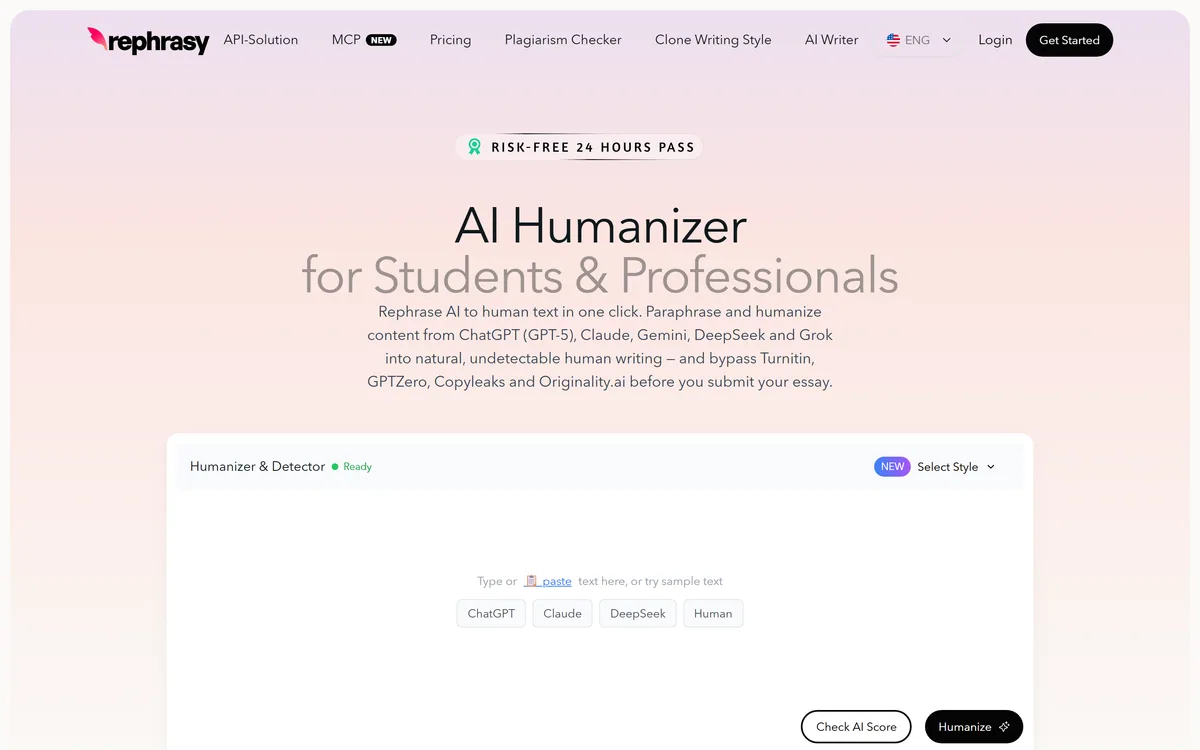
Rephrasy rewrites AI-generated text from models including ChatGPT, Claude, Gemini and DeepSeek, with a built-in detector scoring output against tools such as GPTZero, Copyleaks and Originality.ai. It offers style cloning, an AI writer and an API, and is marketed explicitly at students submitting essays.
rephrasy.ai7 viewsAdded October 11, 20258K visitors
There is a category of tool built to make generated text read as though a person wrote it, and it exists because institutions started checking. Rephrasy is one of the more prominent examples.
The technology is real and the paraphrasing is competent. The question is what it is for, and here the site answers that plainly rather than leaving it implied: it names Turnitin, it names essays, and it names students.
That framing is what this review has to address directly, because the tool's capability and its marketed purpose are separable and only one of them is defensible.
Rephrasy's homepage, captured 9 September 2026, showing the humanizer and detector interface.
Rephrasy: An AI Humanizer Aimed At Students
Rewrites output from ChatGPT, Claude, Gemini, DeepSeek and Grok into text intended to read as human-written.
A built-in detector scoring against GPTZero, Originality.ai, Copyleaks, Winston, Pangram, ZeroGPT and others.
Marketed explicitly at students, with bypassing Turnitin before submitting an essay stated on the homepage.
Style cloning, an AI writer, a plagiarism checker and an API, plus an MCP integration.
125,000+ students and professionals claimed, with a displayed 4.8 rating from 6,000+ users.
What Is An AI Humanizer Actually For?
Rephrasy describes converting AI to human text in one click, paraphrasing content from ChatGPT, Claude, Gemini, DeepSeek and Grok into natural, undetectable human writing.
Stripped of framing, the underlying operation is paraphrasing — rewriting text so it says the same thing with different structure and vocabulary. That is a normal editing operation with a long, unremarkable history.
What makes this category distinct is the objective. It is not rewriting to be clearer, shorter or better suited to an audience; it is rewriting specifically so that a classifier does not identify the origin.
That objective determines the design. Detector scores are shown before and after, competitors are listed as bypass targets, and the value proposition is measured in classifier output rather than in whether the writing improved.
There are genuinely legitimate reasons to rewrite generated text, and they are covered further down. They are not what this product leads with, and a review that pretended otherwise would be describing a different tool.
The operation is paraphrasing, which is unremarkable. The objective is classifier evasion, which is what makes this a different kind of product.
Why Detector Evasion Is An Unstable Promise
The site lists a dozen detectors it measures against and states that its scores are based on finetuned models.
That last phrase is more revealing than it appears, and it explains why the promise cannot hold.
The built-in detector is an approximation of the real ones. It is a model trained to predict what GPTZero or Turnitin would say, which means the score you see is a guess about another system's behaviour rather than that system's actual verdict.
Detectors also update. They are adversarial by design and their operators know humanizers exist, so text that scored clean last term may score differently this term against a revised classifier — with no notification and nothing you can do about it retrospectively.
The consequence is that the guarantee being sold is structurally unavailable. Nobody can promise an outcome from a third party's system that changes without warning, and anyone relying on that promise is carrying a risk they were told did not exist.
The Academic Integrity Problem Nobody Solves
Rephrasy's homepage states its purpose in terms that leave nothing to interpretation: bypass Turnitin, GPTZero, Copyleaks and Originality.ai before you submit your essay, and it describes itself as the number one AI humanizer for students.
We will be direct about this rather than hedging. Submitting work generated by a model and rewritten to avoid detection, as your own, is a breach of academic integrity at essentially every institution, and no amount of rewriting changes what was submitted.
The detection question is separate from the integrity question, and conflating them is the specific error this category encourages. Whether you are caught and whether you have done something prohibited are unrelated facts.
The consequences are also asymmetric in a way the marketing does not mention. A student who is not caught receives a grade for work they did not do and reaches the next module without the skill; a student who is caught faces penalties that can end a degree.
Institutions have also moved on from relying solely on detectors, adopting oral defence of submitted work, in-person assessment and version-history requirements — none of which any rewriting tool addresses, and all of which fail for exactly the same reason.
Read your institution's AI policy — undetected is not the same as permitted.
Understand that a built-in detector predicts another system rather than reporting it.
Expect detector behaviour to change without notice, retrospectively.
Use paraphrasing to improve your own writing, not to disguise its origin.
Assume oral defence of your work is possible, because increasingly it is.
Where Rewriting AI Text Is Legitimate
It is worth being fair about the uses that are entirely defensible, because they exist and the tool serves them.
Non-native speakers editing their own work is the clearest. Somebody who wrote a paper in their second language and used a model to improve the phrasing has produced their own argument in better English, which is what a human editor has always done.
Style adaptation for professional writing is another. Marketing copy, product descriptions and internal documents produced with AI assistance and rewritten to match a house voice is ordinary commercial work with no integrity dimension at all.
Removing the tells is a third and genuinely useful case. Generated prose has recognisable characteristics — uniform paragraph lengths, hedged phrasing, a certain evenness — and editing those out makes the writing better rather than merely different.
None of those uses require a detector score, which is the tell. A tool built for legitimate editing would measure whether the writing improved; one built around bypassing named classifiers is measuring something else, and general writing tools such as Scribeist and LogicBalls serve the editing case without that framing.
Detection Itself Is Unreliable In Both Directions
One thing worth saying in defence of anyone caught up in this: AI detectors are not good, and the harm from that runs the other way too.
False positives are well documented. Detectors flag human writing as generated with meaningful frequency, and they do so unevenly — non-native English writers, people with plain or formulaic styles, and technical writing are all more likely to be misclassified.
That is a genuine injustice affecting students who did nothing wrong, and it is a reasonable grievance about institutions treating detector output as evidence rather than as a signal.
It does not, however, justify the humanizer category, because two unreliable systems do not produce a fair outcome. A student rewriting honest work to avoid a false positive and a student disguising generated work use the same product, and the institution cannot distinguish them.
The better answer to unreliable detection is what institutions are increasingly doing — assessment that does not depend on classifiers at all — and that direction removes the market for this category rather than escalating it.
The same dynamic plays out in social writing, with far lower stakes. Tools like Phantomwriter advertise undetectability for LinkedIn posts, where no institution is checking and the only judge is a reader noticing that a hundred posts sound identical — which is a useful illustration that detectability was never the real problem.
Reading An AI Humanizer Honestly
If you are evaluating this category at all, the useful thing is to be clear-eyed about what you are buying and what risk sits with you.
This is not a how-to. It is the set of questions that determine whether a use is defensible.
Establish what your institution or employer actually permits, in writing.
Separate two questions: is this permitted, and would it be detected. Only the first matters.
If the answer is your own writing improved, a general editing tool serves you better.
If the answer requires a detector score, reconsider what you are actually doing.
Assume any detector guarantee expires without notice, because it does.
Remember that the risk of a breach sits with you and not with the vendor.
Rephrasy: Claims And Detectors Named
Product type
AI humanizer and paraphrasing tool
Positioning
AI Humanizer for Students & Professionals
Source models handled
ChatGPT, Claude, Gemini, DeepSeek and Grok, per the site
Detectors named
GPTZero, Originality.ai, Copyleaks, Winston AI, Pangram, ZeroGPT, Crossplag, Sapling, Content At Scale, GPTRadar and others
Built-in detector
Stated as based on finetuned models rather than the detectors themselves
Other tools
Plagiarism checker, style cloning, AI writer
Developer access
An API and an MCP integration
Users claimed
125,000+ students and professionals; 100,000+ professionals stated elsewhere on the page
Displayed rating
4.8 out of 5 from 6,000+ users
Languages
Interface offered in fourteen languages
Marketing
Named comparison pages against seven competing humanizers
Key features of Rephrasy
Paraphrasing of AI-generated text
A built-in AI detection score
Style cloning from a supplied sample
An AI writer
A plagiarism checker
An API and MCP integration
Interface in fourteen languages
Free re-humanising if output is unsatisfactory, per the site
Pros & cons
Pros
7
The underlying paraphrasing is competent and handles output from several model families
Style cloning is genuinely useful for matching an established house voice
A built-in detector score, read correctly, at least shows what a classifier might say
Legitimate editing uses exist and the tool serves them adequately
An API and MCP integration for teams with a defensible workflow
Interface available in fourteen languages
It is unusually explicit about its purpose, which makes evaluation straightforward
Cons
7
Marketed primarily for a use that breaches academic integrity at most institutions
The built-in detector predicts other systems rather than reporting them
Detectors update without notice, so any guarantee expires silently
Undetected is presented as equivalent to permitted, which it is not
Institutions increasingly use oral defence and in-person assessment, which this does not address
No operating company named on the pages we read
What happens to submitted text is not described
Best For
Non-native speakers improving the English of work they wrote
Commercial writers matching AI-assisted drafts to a house style
Teams editing internal documents where authorship is not assessed
Anyone removing the recognisable tells from their own drafting
Professionals whose employer permits AI assistance explicitly
Rephrasy Against Other Text Tools
Writing tools differ by what they optimise for, and that difference is the whole story here.
Last checked . Read from rephrasy.ai in a browser session on the date above, with the screenshot captured alongside.
Positioned as an AI Humanizer for Students & Professionals
Stated as rephrasing AI to human text in one click
ChatGPT, Claude, Gemini, DeepSeek and Grok named as source models
Stated purpose includes bypassing Turnitin, GPTZero, Copyleaks and Originality.ai before submitting an essay
Described as the number one AI humanizer for students
A built-in free AI detector described, with a note that detector scores are based on finetuned models
GPTZero, Originality AI, Copyleaks, Writer, GPTRadar, Winston AI, Content At Scale, Pangram, ZeroGPT, Crossplag and Sapling listed in the detector interface
125,000+ students and professionals claimed, alongside 100,000+ professionals stated elsewhere
A 4.8 out of 5 rating from 6,000+ users displayed
A plagiarism checker, style cloning and AI writer listed in the navigation
An API solution and an MCP integration listed
Footer lists comparison pages against seven competing humanizer products
What we could not confirm: pricing; the operating company, which the pages we read do not name; how the built-in detector's finetuned models were trained or how closely they track the real detectors; what is retained of text submitted for rewriting; and whether the two user figures on the same page refer to different populations. Nothing here is advice on how to use this tool against any institution's policy, and anyone considering it should read their own institution's rules first.
Should Anyone Use An AI Humanizer?
A defensible use when
You wrote the work yourself and want the English improved.
You are producing commercial copy where authorship is not being assessed.
You want the recognisable tells edited out of your own drafting.
Your employer permits AI assistance and you are matching a house style.
You are rewriting internal documents where no integrity question arises.
Never appropriate when
The work will be submitted as your own for academic assessment.
Your institution prohibits generated content, whether or not it is detected.
You are relying on a detector score as evidence something is acceptable.
You could not defend the content if asked about it in person.
The purpose is disguising origin rather than improving writing.
More Writing And Editing Tools
Alternatives that serve the legitimate editing case without the evasion framing.
Scribeist — content writing and editing without detector framing
LogicBalls — varied writing tasks with clarifying questions
LabReportAI — the same academic line, drawn differently
Coddy — learning the thing rather than producing it
Editor's Verdict
2.4/5
This is a capable tool with a marketed use case we cannot recommend. The headline positioning is explicit — rewrite AI output so it passes Turnitin before you submit your essay — and that is not a grey area but a description of submitting work as your own that is not. The score reflects that, not the engineering. There are legitimate uses for a paraphrasing tool, and they exist alongside a promise that cannot hold: detector evasion is an arms race against systems that update, so today's undetectable output is a coin flip next term with your degree attached to it. AInexfinder Editor Score: 2.4/5.
Rephrasy pricing
AInexfinder does not list plan prices or billing details. For current pricing, plans, and trials, visit the official Rephrasy website.
Vendor pricing, credits, and billing policies change over time. Always confirm on the official site before you buy.
Frequently asked questions
What is Rephrasy?
Rephrasy is an AI humanizer that rewrites text generated by ChatGPT, Claude, Gemini, DeepSeek and Grok, with a built-in detector scoring output against tools including GPTZero, Copyleaks and Originality.ai. It also offers style cloning, an AI writer, a plagiarism checker and an API.
What does an AI humanizer actually do?
Paraphrasing — rewriting text so it says the same thing with different structure and vocabulary. That operation is unremarkable. What makes the category distinct is the objective: rewriting specifically so a classifier does not identify the origin.
Is using this for coursework acceptable?
No. Submitting work generated by a model and rewritten to avoid detection, as your own, breaches academic integrity at essentially every institution. No amount of rewriting changes what was submitted, and the site's own marketing describes exactly that use.
But what if it is not detected?
Detection and permission are unrelated questions, and conflating them is the specific error this category encourages. Whether you are caught and whether you have done something prohibited are separate facts, and only the second is within your control.
Can any tool guarantee it will pass a detector?
Structurally, no. Detectors are adversarial by design and update without notice, so text that scored clean last term may score differently this term against a revised classifier — retrospectively, with nothing you can do about it.
How accurate is the built-in detector?
It is an approximation. The site notes its scores are based on finetuned models, meaning it predicts what GPTZero or Turnitin would say rather than reporting their actual verdict. That is a guess about another system's behaviour.
Are AI detectors themselves reliable?
No, and this is a genuine problem in the other direction. Detectors flag human writing as generated with meaningful frequency, and unevenly — non-native English writers and plain or technical styles are more likely to be misclassified, which is a real injustice.
Does that justify using a humanizer?
It does not, because two unreliable systems do not produce a fair outcome. A student rewriting honest work to avoid a false positive and one disguising generated work use the same product, and an institution cannot tell them apart.
What are the legitimate uses?
Non-native speakers improving the English of work they wrote themselves, commercial copy matched to a house voice, and editing the recognisable tells out of your own drafting. None of those require a detector score — which is the tell about what a tool is really built for.
What should I use instead for honest editing?
A general writing tool that measures whether the writing improved rather than what a classifier says. That serves the legitimate case directly and avoids a product whose entire framing is about disguising origin rather than improving prose.
Daniel reviews AI tools the slow way — by actually using them on real projects. His reviews cover what works, what breaks, and who each tool is genuinely a good fit for.
Daniel and the AInexfinder editorial team research Rephrasy using public product information, listing evidence, and (when available) hands-on checks. Scores reflect listing completeness and transparency — not paid placement.
Listings may include affiliate or sponsored placements, which are labeled when present. Editorial scores and cons are not sold. See our affiliate disclosure and review methodology.
Undetectable AI rewrites AI-generated text so it reads as human-written and is less likely to be flagged by detectors. It also sells detection tools of its own — for text, images, voice, video and deepfakes — plus a suite of writing utilities and a Chrome extension.
RewritePal is a free online writing assistant for paraphrasing, grammar and spelling correction, tone adjustment, and making AI-generated text read more naturally, with a 40,000-character editor and no account required.
Free AI Humanizer is a tool on CopyChecker that rewrites AI-generated text to read more naturally, with controls for mode, readability level, purpose, and strength, capped at 500 words per run and usable without signup.
Decopy AI is a free suite of writing and study utilities covering text humanizing, AI detection, summarisation of documents, video and audio, speech conversion, a maths solver, flashcard and worksheet creation, and story and article generation — usable without creating an account.
Copy.ai has become an AI-native go-to-market platform: workflows and agents that run prospecting, lead processing, deal coaching, ABM, and CRM enrichment across Salesforce, HubSpot, Gong, Outreach, and 2,000+ integrations.
Writesonic has become an AI search growth platform — tracking whether your brand appears across 10 AI platforms, running optimisation and citation work through an Action Center, and reporting results against traffic and revenue.