RewritePal is a free online writing assistant for paraphrasing, grammar and spelling correction, tone adjustment, and making AI-generated text read more naturally, with a 40,000-character editor and no account required.
Undetectable AI
Verified
Undetectable AI rewrites AI-generated text so it reads as human-written and is less likely to be flagged by detectors. It also sells detection tools of its own — for text, images, voice, video and deepfakes — plus a suite of writing utilities and a Chrome extension.
3.3Editor Score
undetectable.ai8 viewsAdded October 15, 2025219K visitors
On academic and workplace use. This listing describes what the product does and where it can be used legitimately. Using any humanizer to misrepresent AI-generated work as your own breaches the academic integrity policy of essentially every institution and the acceptable-use policy of most employers. That is a decision with real consequences and the tool cannot carry them for you.
What The Product Actually Is
- Undetectable AI is a text humanizer — it rewrites AI-generated writing to vary sentence structure, vocabulary and tone so that detectors are less likely to flag it, alongside a detector of its own.
- It sells both sides. The same company offers AI detection for text, images, voice, video and deepfakes, plus fake PDF, receipt and ID detection.
- 50+ languages are supported, with English described as the most accurate.
- A wide utility suite sits around it: paraphraser, essay writer, stealth writer, plagiarism checker, watermark remover, SEO writer, human typer, AI job applier and a Chrome extension.
- Free tier with limited usage, then subscription plans; the vendor cites 24 million users and a Forbes mention.
How Humanizing Works, And Why It Can Work At All
Understanding the mechanism explains both what the tool can do and why the whole category is unstable.
Detectors classify text statistically. Language models pick likely next words, which produces prose with an identifiable signature — vocabulary clustered around the probable, sentence lengths evened out, and the irregularity of human writing smoothed away. Detectors are trained to spot that flatness.
A humanizer attacks the signature directly. It varies sentence length, substitutes less predictable vocabulary, restructures clauses and introduces the small irregularities that machine text lacks. It is not hiding a watermark, because there is no watermark — it is making the statistics look less machine-like.
That is why it works, and it is also why nothing about it is permanent. Detectors retrain on humanized output, humanizers adapt to the retrained detectors, and the cycle continues. Any claim about current effectiveness is a snapshot, not a property.
There is a second, quieter cost that the marketing never mentions. Rewriting text to look less predictable makes it worse prose. The substituted vocabulary is often less precise, the restructured sentences less direct, and the result reads slightly off in a way readers notice even when detectors do not.
So the honest framing is that you are trading clarity for a statistical property, and whether that trade is worth making depends entirely on what you are using it for.
It is not removing a watermark, because there is no watermark. It is making your sentences less predictable — which is also what makes them worse.
Selling Both The Detector And The Evasion
This deserves stating plainly because it is the most interesting thing about the company and it is not addressed anywhere on the site.
Undetectable AI sells a humanizer that helps text evade detection, and it sells detection tools that identify AI content. Those two products have directly opposing purposes, and a customer of one is the adversary of a customer of the other.
It is a defensible commercial position — you cannot build a good humanizer without understanding detection intimately, and the same research serves both. It is also, unavoidably, a conflicted one.
The practical implication for a buyer is specific rather than moral. If you are considering their detector, understand that it is built by a company whose other product is designed to defeat detectors. Whether it is tuned to catch its own humanizer's output is a question only they can answer, and the incentive runs in an awkward direction.
If you need detection for a consequential purpose, using a vendor that does not also sell evasion — Originality.ai or GPTZero — avoids the question entirely.
The broader detection suite is genuinely broad, covering images, voice, video, deepfakes, and fake PDFs, receipts and IDs. That last group is aimed at document verification rather than at academic integrity, which is a legitimately different and growing problem.
The Uses That Are Fine, And The Ones That Are Not
Being specific here is more useful than either endorsing or condemning the category, because the legitimate uses are real and narrower than the marketing implies.
Legitimate: rescuing falsely flagged human writing. Detectors misclassify formal, technical and non-native English writing at meaningful rates. Someone whose own work has been wrongly flagged has a genuine problem, and rewriting to clear a broken check is a defensible response to a broken check.
Legitimate: your own commercial content. If you draft marketing copy with AI and want it to read less machine-generated before publishing, nobody is being deceived — you own the work and there is no integrity claim attached.
Legitimate: testing your own detection policy. If your organisation screens submissions, running humanized text through your own detector tells you how weak the screen actually is.
Not legitimate: coursework and assessments. Submitting AI-generated work as your own breaches the integrity policy of essentially every institution, and the humanizer does not change what you submitted. The consequence is not being detected; it is having claimed authorship you do not have.
Not legitimate: work your employer believes you wrote. Most acceptable-use policies now address this directly, and discovery tends to happen through the work itself rather than through a detector.
The distinction is not technical, and no feature can make it for you. It is whether someone is being misled about who wrote something.
- Fine: clearing a false positive on writing that is genuinely yours
- Fine: polishing your own commercial copy before publishing it
- Fine: stress-testing a detection policy you are responsible for
- Not fine: coursework, assessments and anything with an authorship declaration
- Not fine: work submitted to an employer who believes you wrote it unaided
Free Words, Then A Subscription
This site does not publish plan prices. The structure here is the standard shape for the category.
There is a free tier with limited usage, then subscription plans that raise the limits and unlock the wider tool suite. The meter is words processed, which is the natural unit for a rewriting tool.
Two things are worth establishing before subscribing. First, whether the detection tools are included at your tier or priced separately, since the suite is broad and bundling varies. Second, what the word allowance actually is per month, because humanizing frequently takes several passes on the same text to get an acceptable result — and each pass consumes the allowance.
That second point is easy to underestimate. If the first output reads badly or still flags, you rewrite again, so effective throughput is lower than the headline allowance suggests.
One data-handling question specific to this product: you are pasting text into a third-party service, and in the academic case that text is frequently something you would rather nobody logged. Read the retention terms before pasting anything you would not want stored.
Reading The Company's Own Numbers
Two claims sit prominently on the site and both need proportionate handling.
24 million users, with a weekly new-user counter. That is an enormous figure for this category and it is self-reported. A live counter is a marketing device rather than an audited metric, and user counts in freemium tools typically count registrations rather than active use.
Rated number one best AI detector by Forbes. Publications run roundups, and appearing well in one is a real thing that happened. It is not an independent benchmark, it reflects a moment in time, and it is worth remembering that the same company also sells the tool designed to defeat detectors like it.
Neither claim is dishonest. Both are the kind of statement that should inform your expectations rather than your decision.
What would actually be useful — published false positive rates, an independent evaluation, a statement of how the detector performs against their own humanizer — is not on the site. In a category where Originality.ai does publish its error rates, that absence is a fair thing to weigh.
- Decide first whether your use involves anyone being misled about authorship — that settles it before any feature does.
- If you are clearing a false positive, keep your drafts and version history; they are far better evidence than a rewrite.
- Test the free tier on text you own and read the output aloud, checking for precision lost in the rewriting.
- Count how many passes it takes to get an acceptable result, and multiply your expected volume accordingly.
- Read the retention terms before pasting anything you would not want stored by a third party.
Is There A Defensible Use Here For You?
A Defensible Use Exists If
- Your own genuinely human writing has been falsely flagged by a detector
- You are polishing commercial copy you own, where nobody is being misled
- You are stress-testing a detection policy you are responsible for enforcing
- You need broad forgery detection across images, voice, video, PDFs and IDs
- You want a paraphrasing and utility suite and understand what you are buying
Do Not Touch It If
- The output goes into coursework, an assessment or anything with an authorship declaration
- Your employer's acceptable-use policy covers AI-assisted work and you would be concealing it
- You need detection for consequential decisions — use a vendor that does not also sell evasion
- Precision matters in the writing, because humanizing costs clarity
- You would be pasting text you cannot allow a third party to retain
Tools, Coverage And Claims
| Category | AI text humanizing and AI content detection |
|---|---|
| Core function | Rewrites AI-generated text by varying sentence structure, vocabulary and tone to reduce detector flagging |
| Detection tools | AI text detector, AI image detector, AI voice detector, video detector, deepfake detection, fake PDF detector, fake receipt detector, fake ID detector |
| Writing suite | Paraphrasing tool, AI essay writer, AI stealth writer, AI plagiarism checker, AI text watermark remover, AI SEO content writer, human typer, AI job applier |
| Browser support | Chrome extension |
| Languages | 50+, with English described as the most accurate |
| Stated user base | 24 million users, with a live weekly new-user counter, per the vendor |
| Cited recognition | Vendor cites a Forbes ranking as best AI detector |
| Not published | False positive rates, independent evaluations, or how its detector performs against its own humanizer |
| Charging model | Free tier with limited usage, then subscription plans metered on words; no prices published here |
Key features of Undetectable AI
AI text humanizing to reduce detector flagging
AI text detection with sentence-level flagging
AI image detection
AI voice and video detection, including deepfakes
Fake PDF, receipt and ID detection
Paraphrasing tool
AI essay and stealth writer
AI plagiarism checker
AI text watermark remover
AI SEO content writer
Human typer and AI job applier
Chrome extension
50+ language support
Pros & cons
Pros
5- Genuinely broad detection coverage across text, image, voice, video and forged documents
- The document verification tools address a real and growing problem separate from academic integrity
- A free tier lets you judge output quality before paying
- Clearing a false positive on your own writing is a legitimate need this serves
- 50+ languages is wider coverage than most competitors in either direction
Cons
6- Selling both the humanizer and the detector is an unavoidably conflicted position
- No published false positive rates or independent evaluation, unlike some competitors
- Humanizing costs precision — the rewritten prose is usually worse writing
- The headline use case breaches academic and most workplace integrity policies
- Effectiveness is a snapshot in an arms race, not a durable property
- Multiple passes are often needed, so the real word allowance is lower than it looks
Best For
- Writers whose genuine work has been falsely flagged by a detector
- Marketers polishing their own AI-drafted commercial copy
- Organisations stress-testing their own detection policies
- Teams needing document and identity verification
- Anyone wanting a broad paraphrasing and writing utility suite
Both Sides Of The Detection Arms Race
Two of these detect, one evades, and one does both — which is the distinction that matters most.
| Tool | What it sells | Publishes error rates | Suits |
|---|---|---|---|
| Undetectable AI | Humanizing and detection | No | Rescuing false positives, own commercial copy |
| Originality.ai | Detection, plagiarism and fact checking | Yes, including false positive rates | Publishers and agencies screening content |
| GPTZero | Detection | Publishes research and cautions | Education and general users |
| Free AI Humanizer | Humanizing only | Not applicable | The same job at no cost |
| Copyleaks | Detection and plagiarism at scale | Publishes accuracy claims | Enterprise and education |
The Rest Of This Category
Detection and evasion are the same market seen from opposite ends; both are worth understanding before choosing either.
- Originality.ai — detection from a vendor that publishes its false positive rates
- GPTZero — the best-known detector, weighted toward education
- Copyleaks — enterprise detection and plagiarism with LMS integrations
- Free AI Humanizer — the same humanizing function without a subscription
- ProWritingAid — improving writing on its merits rather than its statistics
Undetectable's Claims, Read Carefully
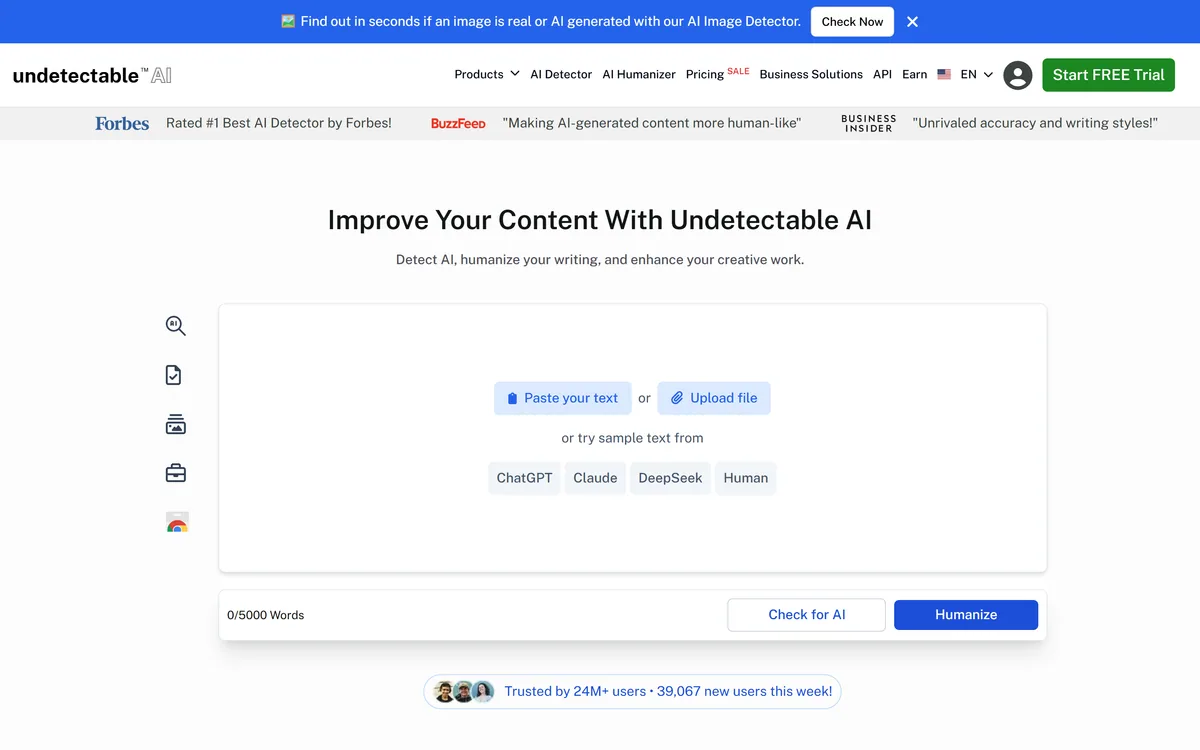
Last checked . Read from undetectable.ai during this check, with the screenshot above captured at the same time.
- Humanizing described as rewriting flagged text by varying sentence structure, enriching vocabulary and adjusting tone
- Detection tools listed on site for text, images, voice, video, deepfakes, and fake PDFs, receipts and IDs
- Writing suite listed including paraphraser, essay writer, stealth writer, plagiarism checker, watermark remover, SEO writer, human typer and AI job applier
- Chrome extension offered
- Language support stated as 50+, with English noted as most accurate
- User base stated as 24 million with a live weekly new-user counter
- A Forbes ranking as best AI detector is cited by the vendor
- Free tier with limited usage and paid subscription plans referenced; no plan prices published here, in line with this site's pricing policy
- No false positive rates, independent evaluations, or statement of detector performance against its own humanizer were published on the pages reviewed
User counts and the cited ranking are the vendor's own and unaudited. This company sells both a humanizer and a detector, which are opposing products — if you need detection for a consequential decision, a vendor that does not also sell evasion avoids the conflict. Using any humanizer to misrepresent authorship breaches academic integrity policy at essentially every institution and most employers' acceptable-use policies; that consequence sits with the user, not the tool.
Editor's Verdict
3.3/5The product works at what it advertises and the breadth is genuine, with detection across text, image, voice and video alongside the humanizer. The score is held down because the headline use case — defeating academic and workplace integrity checks — is one the tool cannot make legitimate, because selling both the evasion and the detection is a conflicted position, and because the whole category rests on an arms race with no stable outcome. AInexfinder Editor Score: 3.3/5.
Undetectable AI pricing
AInexfinder does not list plan prices or billing details. For current pricing, plans, and trials, visit the official Undetectable AI website.
Visit official website for pricingVendor pricing, credits, and billing policies change over time. Always confirm on the official site before you buy.
Frequently asked questions
What does Undetectable AI do?
It rewrites AI-generated text — varying sentence structure, vocabulary and tone — so that detectors are less likely to flag it. The same company also sells detection tools for text, images, voice, video and forged documents.
Is using an AI humanizer cheating?
It depends entirely on whether anyone is being misled about authorship. Polishing your own commercial copy misleads nobody. Submitting AI-generated coursework as your own breaches essentially every institution's integrity policy, and the rewriting does not change what you submitted.
Can Undetectable AI reliably beat AI detectors?
It works against current detectors and that is a snapshot rather than a property. Detectors retrain on humanized output and humanizers adapt in turn, so any effectiveness claim describes a moment in an ongoing arms race.
Does humanizing make my writing worse?
Usually, slightly. The mechanism works by making text less statistically predictable, which in practice means less precise vocabulary and less direct sentences. Readers often notice the result reads slightly off even when detectors do not flag it.
Should I trust a detector from a company that sells a humanizer?
It is a fair question to ask them directly. Building a good humanizer requires understanding detection intimately, so the expertise is real — but whether the detector is tuned to catch their own humanizer's output is something only they can answer. For consequential decisions, a vendor that does not sell both avoids the issue.
Is Undetectable AI free?
There is a free tier with limited usage, then subscription plans metered on words. Budget for more than the headline allowance, because getting an acceptable result often takes several passes on the same text.
My essay was wrongly flagged as AI — will this help?
It may clear the flag, and it is not your strongest response. Detectors misclassify formal and non-native English writing at meaningful rates, and your draft history and version timeline are far better evidence of authorship than a rewritten document. Raise the false positive rather than only working around it.
Reviews
Log in to write a review.
User Reviews
No reviews yet. Be the first to share your experience with Undetectable AI.
Reviewed by Daniel Reed
Assigned reviewer
Daniel ReedSenior AI Tools Reviewer
Daniel reviews AI tools the slow way — by actually using them on real projects. His reviews cover what works, what breaks, and who each tool is genuinely a good fit for.
Hands-on reviewsProduct testingAI software
Daniel and the AInexfinder editorial team research Undetectable AI using public product information, listing evidence, and (when available) hands-on checks. Scores reflect listing completeness and transparency — not paid placement.
- Last verified
- Methodology
- How we review AI tools
- Sources used
- undetectable.ai
- AInexfinder listing fields (features, pros/cons, description)
- Public vendor pages when available
- Editorial policy
- Listings may include affiliate or sponsored placements, which are labeled when present. Editorial scores and cons are not sold. See our affiliate disclosure and review methodology.
Related tools

Free AI Humanizer is a tool on CopyChecker that rewrites AI-generated text to read more naturally, with controls for mode, readability level, purpose, and strength, capped at 500 words per run and usable without signup.
FreemiumWriting & Content
Decopy AI is a free suite of writing and study utilities covering text humanizing, AI detection, summarisation of documents, video and audio, speech conversion, a maths solver, flashcard and worksheet creation, and story and article generation — usable without creating an account.
FreemiumWriting & Content

Copy.ai has become an AI-native go-to-market platform: workflows and agents that run prospecting, lead processing, deal coaching, ABM, and CRM enrichment across Salesforce, HubSpot, Gong, Outreach, and 2,000+ integrations.
FreemiumWriting & Content

Writesonic has become an AI search growth platform — tracking whether your brand appears across 10 AI platforms, running optimisation and citation work through an Action Center, and reporting results against traffic and revenue.
FreemiumWriting & Content
Talefy, from AIcberg Labs, is an interactive AI storytelling platform. Readers make choices that change the plot, and creators build characters, worlds and branching narratives across fantasy, sci-fi, romance, horror and comedy.
FreemiumWriting & Content
Compare:Undetectable AI vs RewritePalUndetectable AI vs Free AI HumanizerUndetectable AI vs Decopy AIUndetectable AI vs Copy.ai
Undetectable AI alternatives Explore More
Embed this listing on your site
Featured on AInexfinder