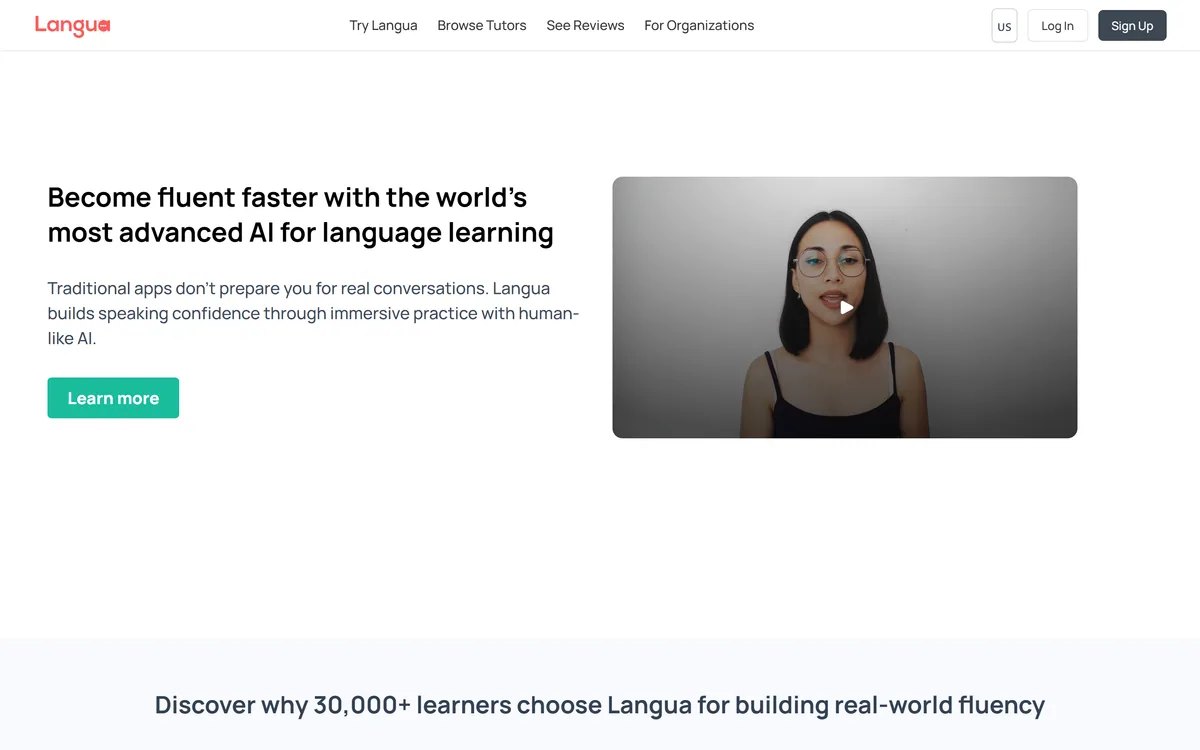
Langua from LanguaTalk offers AI conversation practice in over 20 languages with human-like voices, instant corrections, adjustable speech speed, saved vocabulary feeding into flashcards, and human tutors alongside the AI.
languatalk.com9 viewsAdded June 28, 202545K visitors
Almost everyone learning a language hits the same wall. Reading improves, listening improves, vocabulary grows — and speaking stays stuck, because speaking requires another person and another person requires scheduling, money, and the willingness to be bad in front of them.
Langua targets exactly that gap. It provides a conversation partner with human-like voices that corrects you instantly, never gets impatient, and is available at two in the morning.
This review covers why unlimited low-stakes practice matters more than lesson quality, what the corrections and vocabulary system add, where an AI partner genuinely cannot substitute for a person, and how the human tutors fit.
Langua's whole design targets the one thing textbooks cannot give you — someone to talk to.
Langua In Practice
What it solves: the speaking gap — most learners can read and understand far better than they can talk, because talking needs a patient partner.
How: AI conversation with human-like voices, instant corrections with explanations, and adjustable speech speed.
Coverage: over 20 languages, many with multiple dialects — Spanish, French, German, Japanese, Chinese, Korean, Arabic, Thai and more.
Vocabulary compounds: words you save feed into flashcards and stories rather than sitting in a list.
Human tutors too. LanguaTalk began as a tutoring service in 2021, so the AI sits alongside real teachers rather than replacing them.
Embarrassment Is The Real Barrier
The thing that stops adults speaking a new language is rarely knowledge. It is the discomfort of sounding foolish in front of someone whose time you are paying for.
That discomfort produces avoidance, avoidance produces less practice, and less practice keeps speaking permanently behind reading. It is the central failure loop in adult language learning.
An AI partner breaks it for a simple reason: there is no social cost. You can repeat the same sentence eleven times, ask what a word means for the fourth time, and abandon a conversation halfway through. None of that is possible with a human tutor without feeling it.
The best language partner is not the most knowledgeable one. It is the one you are willing to be bad in front of.
The Features That Support Actual Learning
Several details separate this from simply talking to a general chatbot in another language.
Instant corrections with explanations — being told what was wrong and why, in the moment it happened
Adjustable speech speed — natural pace is what defeats intermediate learners, and slowing it keeps you in the conversation
Hands-free call mode — practice while walking or driving, which is where habit actually forms
Saved vocabulary into flashcards — words encountered in conversation, reviewed later
Stories built from your vocabulary, so review is contextual rather than a list
Guided Course and Guided Mode — structure for beginners who cannot yet hold a free conversation
Why The Vocabulary Loop Matters
The design decision worth noticing is that saved words do not just accumulate — they feed flashcards and stories.
That closes a gap most language apps leave open. Words learned in isolation are forgotten; words encountered in a real conversation, saved, then reviewed and met again in a story have three retrieval contexts rather than one.
It also means the vocabulary you practise is yours — the words you actually reached for and lacked — rather than a generic list ordered by frequency. That relevance is a large part of why anything sticks.
Practising In A Way That Works
Unlimited access is only useful if you use it in the right shape, and most people do not.
Practise briefly and often — fifteen minutes daily beats two hours on Sunday for speaking specifically.
Slow the speech speed until you can follow comfortably, then raise it a notch every week.
Speak past your ability deliberately; the corrections are the point, so producing errors is productive.
Save every word you wanted and did not have, rather than words you merely did not recognise.
Use call mode while walking, which removes the sitting-down barrier that kills most practice habits.
Review the saved flashcards before the next conversation, so you get a chance to use them.
What An AI Partner Cannot Give You
Cultural nuance is the clearest gap. Knowing when a phrase is too formal, faintly rude, or something only your grandmother would say is knowledge that lives in native speakers, not in a model.
Pronunciation feedback is also weaker than a good teacher's. An AI can tell you a word was wrong; a human hears which sound your mouth is not making and can show you how to make it.
Real conversation is unpredictable in ways practice is not. People interrupt, mumble, use slang, and change the subject — and the confidence built in a patient AI conversation does not fully transfer to a busy market.
Langua's own position is sensible here: it offers human tutors alongside, describing the two as complementary. That is the right framing rather than a hedge.
The Tutoring Heritage
LanguaTalk started as a human tutoring service in 2021 and added AI later. That order matters more than it might appear.
A tutoring company building an AI practice partner is designing around what tutors know learners actually struggle with. A pure AI product designs around what the model can do.
The site states only the top 5% of tutor applicants are accepted, which we report as their claim. Having both under one roof means the AI can absorb the repetitive practice while a human handles pronunciation and cultural judgement — which is genuinely how the labour should divide.
Vendor pricing, credits, and billing policies change over time. Always confirm on the official site before you buy.
Frequently asked questions
How is Langua different from talking to a general chatbot?
Learning design. It gives instant corrections with explanations, lets you slow the speech speed, saves vocabulary into flashcards and stories, and offers guided modes for beginners. A general chatbot will converse but teaches nothing systematically.
How many languages does Langua support?
Over 20, many with multiple dialects — including Spanish, French, German, Italian, Portuguese, Japanese, Chinese, Korean, Russian, Arabic, Dutch, Greek, Romanian, Swedish and Thai.
Can AI practice replace a human tutor?
Not entirely, and Langua does not claim it does — it offers human tutors alongside and describes the two as complementary. AI handles unlimited low-stakes repetition; humans handle pronunciation, cultural nuance, and register.
Why does practising with AI help if it is not a real person?
Because the barrier is usually embarrassment rather than knowledge. You can repeat a sentence eleven times, ask the same question four times, and quit halfway through — none of which is comfortable with a human whose time you are paying for.
Is there a free trial?
Yes — five days on a monthly plan or seven on annual. A card is required but the site states no charge is taken during the trial, and web subscriptions carry a 30-day money-back guarantee.
Does Langua help with pronunciation?
Somewhat, but it is not its strength. An AI can tell you a word was wrong; a human teacher hears which sound your mouth is not making and can show you how to produce it. For accent work specifically, a dedicated pronunciation tool is better.
Is it useful for complete beginners?
There are Guided Course and Guided Mode options for beginners, but conversation practice inherently needs some vocabulary to work with. Absolute beginners will get more from foundational study first, then switch to Langua once they can attempt sentences.
Daniel reviews AI tools the slow way — by actually using them on real projects. His reviews cover what works, what breaks, and who each tool is genuinely a good fit for.
Daniel and the AInexfinder editorial team research Langua using public product information, listing evidence, and (when available) hands-on checks. Scores reflect listing completeness and transparency — not paid placement.
Listings may include affiliate or sponsored placements, which are labeled when present. Editorial scores and cons are not sold. See our affiliate disclosure and review methodology.
Praktika teaches languages through conversation with AI avatar tutors who speak your native language, adapt to a personal study plan, and give instant corrections on pronunciation, grammar and word choice. It states 30M+ learners and a 4.8 rating from 1.2M+ ratings, on iOS and Android.
PolyChat teaches 17 languages through dialogue-based lessons with no energy system limiting how much you practise, offering A1-C2 paths with a stated 5,000-plus lessons per language, a custom lesson creator, an AI chat tutor, a translator and an Adult Mode for slang and real-world speech.
ELSA Speak is an English speaking app that listens to your voice and gives instant, word-level pronunciation feedback. It personalises lessons by level, goal, preferred accent and industry, offers a bilingual tutor that lets beginners start in their own language, and runs AI role-play across everyday scenarios.
Talkio AI is a language-learning app focused on speaking: you practise conversations with AI tutors at your level through guided courses or open chats, get feedback and pronunciation practice, and track progress, from a Denmark-based team behind Voice Control for ChatGPT.