Data Report: Where New AI Tools Get Discovered in 2026 (17 Weeks of Launch Data)
Product Hunt is no longer the default place to launch an AI tool. This guest data report pairs 17 weeks of launch and submission data from Nick Launches with sourced facts on Uneed, BetaList, Fazier, Peerlist and TAAFT.
On this page6 sections
If you are building an AI tool, you have probably asked the same question everyone in this space asks the week before shipping: where do I actually put this thing?
Product Hunt used to be the default answer.
It no longer is, and the reasons are worth understanding before you spend a launch day on the wrong platform.
This report combines two kinds of evidence.
First, real submission and launch data from inside one weekly-cycle launch directory, Nick Launches, covering the 17 weeks from May 18 to September 7, 2026.
Second, sourced facts about the major launch platforms and AI directories founders actually use: Product Hunt, BetaList, Uneed, Peerlist, Fazier and There's An AI For That (TAAFT).
Every number below is either measured directly, sourced with a link, or flagged as a gap at the end.
What Product Hunt Still Gets Right, and What Changed
Product Hunt remains the highest-authority place to launch, with a Domain Rating of 91, well above every alternative in this report.
Submitting is free, and a strong launch day still produces the biggest single traffic spike available anywhere in the ecosystem.
Two things changed the calculus for founders in 2026. The first is volume: estimates of daily submissions vary widely depending on what is counted.
Product Hunt features 50+ curated launches on its front page each day, while total daily submissions across all categories are reported anywhere from 500 to nearly 790.
Whichever number is closer to true, the free queue for a good launch day now books out weeks in advance, pushing many founders toward paid scheduling tools just to get a slot.
The second is the link itself.
Product Hunt's outbound links are nofollow: your listing page, maker profile, and embeddable badge all carry no SEO weight.
It is a visibility and social-proof event, not a link-building one.
The SEO value people associate with a Product Hunt launch mostly comes from second-order coverage: journalists and newsletter writers who monitor the front page and link to what they find, with their own dofollow links attached.
That effect is real, but indirect, and depends on your launch being good enough to get noticed twice.
A crowded free queue plus a link that does nothing for search is the biggest reason the "alternatives" conversation exists in 2026.
Where Builders Went Instead
Nobody serious has stopped using Product Hunt entirely. What changed is that it stopped being the only stop.
A handful of platforms picked up the founders who wanted an easier queue, a dofollow link, or both.
Uneed rebuilt the model around the idea that a single 24-hour spike is the wrong shape for a launch. Products stay listed and keep surfacing in daily, weekly, monthly and yearly leaderboards instead of disappearing after one day. Uneed closed its free waiting line in August 2026: a launch date now costs $14.99 for a Uneed-assigned slot roughly two weeks out, or $29.99 to pick your own day. Paid launches include a dofollow backlink, and the top three performers each week get pushed to a 19,000+ subscriber newsletter.
BetaList stayed the pre-launch and early-adopter option it always was. Submission is free, with a paid priority-review option reported anywhere from roughly $29 to $129 depending on the source. Its listings are dofollow, and the audience skews toward angel investors and tech journalists rather than a general upvote crowd.
Peerlist Launchpad is free and runs weekly, aimed at developers and designers building in public. Its links are nofollow by default, with a reported exception where the top five projects each week receive a backlink (dofollow status unconfirmed, see Gaps).
Fazier runs a tiered model: a free "Basic" tier that requires embedding a Fazier badge on your own site and waiting roughly 15 days for a queue slot, a $29 "Lite" tier that skips the badge without guaranteeing a dofollow link, and a $49 "Premium" tier that guarantees a dofollow backlink from its DR 83 domain.
There's An AI For That, the largest AI-specific directory, charges a $49 one-time review fee for a basic listing, with a $347 tier buying a spot in a newsletter claimed at 2.5 million-plus subscribers. General launch boards now compete directly with AI-only directories like this one for the same submissions.
17 Weeks Inside a Weekly Launch Directory
Here is what we actually measured, from Nick Launches' own database, covering products with status: "live" and a launchDate between May 18 and September 7, 2026 (17 calendar weeks).
Launch volume climbed steadily. Weekly live launches went from 32 in the first week of the window to a peak of 103 in the week of August 31, before easing to 97 and then 85 in the final two weeks. That is roughly a 3x increase in weekly launch volume over four months, on one mid-sized directory alone.
Submissions grew faster than launches did. Weekly submission counts (by createdAt) climbed from around 81-90 per week early in the window to 200-308 per week by August, consistently outpacing the number of products that actually went live that same week. That is a queue forming, the same dynamic behind Uneed's move to paid launch slots and Product Hunt's weeks-long free-queue wait.
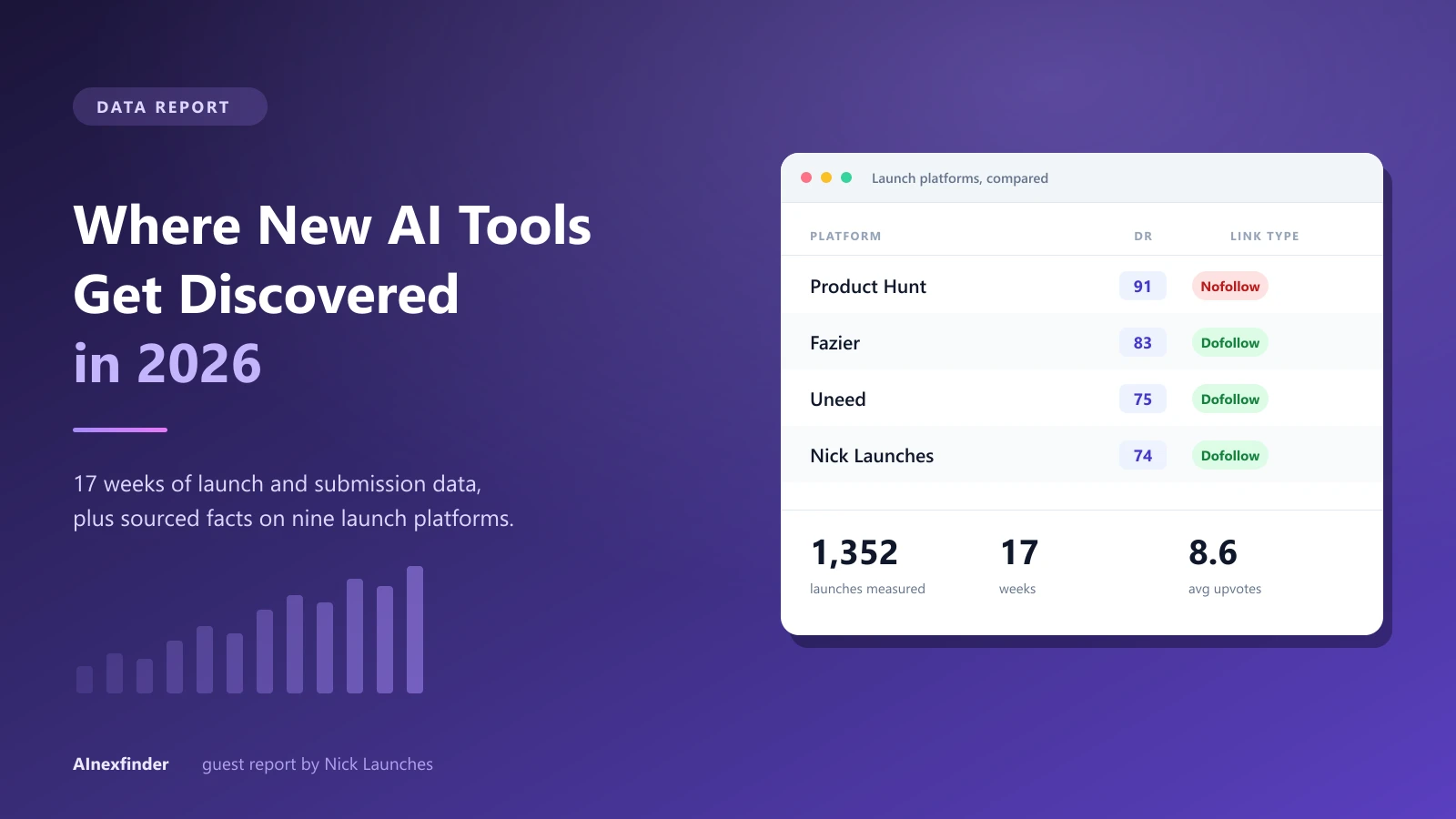
Most listings get modest engagement, and that is normal. Across 1,352 live launches, the average product received 8.6 upvotes; the median was around 6. Only 13 listings (about 1%) crossed 100 upvotes, and the top performer, an education tool called Lesson Maker Pro, reached 214. If you are launching expecting a viral outcome, that is the exception here, not the baseline.
Category mix confirms this is an AI-and-productivity-heavy corner of the market. Of 1,352 live listings, 48.3% carried an "AI" tag and 43.6% carried "Productivity" (products can carry more than one category), followed by Marketing (20.9%), Developer Tools (19.2%) and Analytics (11.6%).
None of this proves anything about the launch-platform category as a whole.
It is one directory's real numbers, offered as a grounded example of what launch volume and engagement actually look like on a smaller, weekly-cycle board, next to the higher-authority, higher-volume platforms above.
Comparing the Major Launch Platforms
Domain Rating figures below were checked directly against each domain at time of writing.
| Platform | DR | Link type | Cost | Cadence / queue | What you realistically get |
|---|---|---|---|---|---|
| Product Hunt | 91 | Nofollow | Free (paid tools exist to jump the queue) | Free slots book out weeks ahead; 50+ featured/day | Large one-day spike, no direct SEO value, indirect press pickup is the real prize |
| Fazier | 83 | Dofollow only on $49 Premium tier | Free (badge required) / $29 / $49 / $119 | ~15-day queue on free tier, instant on paid | Guaranteed dofollow only if you pay for it |
| Indie Hackers | 81 | Community, not a launch queue | Free | Ongoing discussion, no formal launch slot | Long-tail visibility among builders, not a launch spike |
| SaaSHub | 80 | Varies by listing tier | Free / paid | Rolling submissions | Steady directory presence, low single-day traffic |
| Peerlist Launchpad | 77 | Nofollow (reported exception for weekly top 5) | Free | Weekly | Developer-heavy audience, feedback more than traffic |
| TAAFT | 77 | Not confirmed (see Gaps) | $49 basic / $347 featured | Rolling review | Largest AI-specific audience, pay-to-play for real reach |
| BetaList | 76 | Dofollow | Free (paid priority review, $29-$129 reported) | Reviewed within days | Investor- and journalist-heavy early-adopter audience |
| Uneed | 75 | Dofollow | Free queue closed Aug 2026; $14.99-$29.99 | Daily, 30 launches/day, persists in weekly/monthly leaderboards | Launch doesn't expire after 24 hours; newsletter reach for top 3/week |
| Nick Launches | 74 | Dofollow (free with badge, or paid without one) | Free / $39 Pro | Weekly cycle, listing surfaces across this-week/last-week/last-month buckets | A straightforward Product Hunt alternative for a launch that compounds across weekly buckets instead of spiking once |
Nick Launches sits in the middle of this table on every axis: lower authority than Product Hunt, comparable authority to Uneed and BetaList, a dofollow-for-free-with-conditions structure similar to Fazier's, and a weekly cadence that keeps a listing surfacing rather than expiring after a single day.
What This Means if You're Deciding Where to Launch
The pattern across every platform here is the same trade: higher authority and bigger spikes come with a nofollow link, a longer queue, or both.
Dofollow links cluster on the mid-authority, weekly-cadence boards, several of which now charge for the privilege after their free queues filled up.
A sequence beats a single bet. Product Hunt alone gets one day of attention and no direct link value.
A smaller directory alone gets a link but a much smaller audience.
The founders getting the most out of 2026's landscape run both: a Product Hunt or Uneed launch for the spike, paired with two or three dofollow directory listings for the compounding link profile, rather than treating any single platform as sufficient on its own.
Gaps
Claims that could not be backed with a specific verified number or confirmed fact are marked here rather than guessed at in the body of the report:
- TAAFT link type: could not confirm whether There's An AI For That's standard listing link is dofollow or nofollow. Needs a direct check of a live TAAFT listing's page source.
- Peerlist top-5-weekly backlink type: Peerlist's help center confirms the top five weekly Launchpad projects receive "a backlink," but not whether it is dofollow.
- Product Hunt daily submission volume: reported figures range from 50+ (curated front page) to 500-790 (all submissions), depending on what is counted. A single authoritative figure from Product Hunt itself would tighten this.
- BetaList priority-review price: sources disagreed, from roughly $29 to $129. Needs a direct check of BetaList's current submission page.
- Independent traffic figures for every platform in the table: no verified per-listing traffic data is published here for any platform, including Nick Launches. The "what you realistically get" column describes positioning and mechanics, not measured traffic, and should be read that way.
- SaaSHub and Indie Hackers: included for DR context only; cost and submission mechanics were not fully researched, so treat those two rows as lighter-weight than the rest.
About
Olivia Bennett
AI Tools Comparison Analyst
Olivia runs side-by-side comparisons and benchmarks, digging into pricing, features, and real-world performance so readers can choose between competing AI tools with confidence.
View profile