Snov.io review on AInexfinder — freemium AI tool for Business & Marketing. Features, pricing notes, and alternatives.
Business & Marketing Review
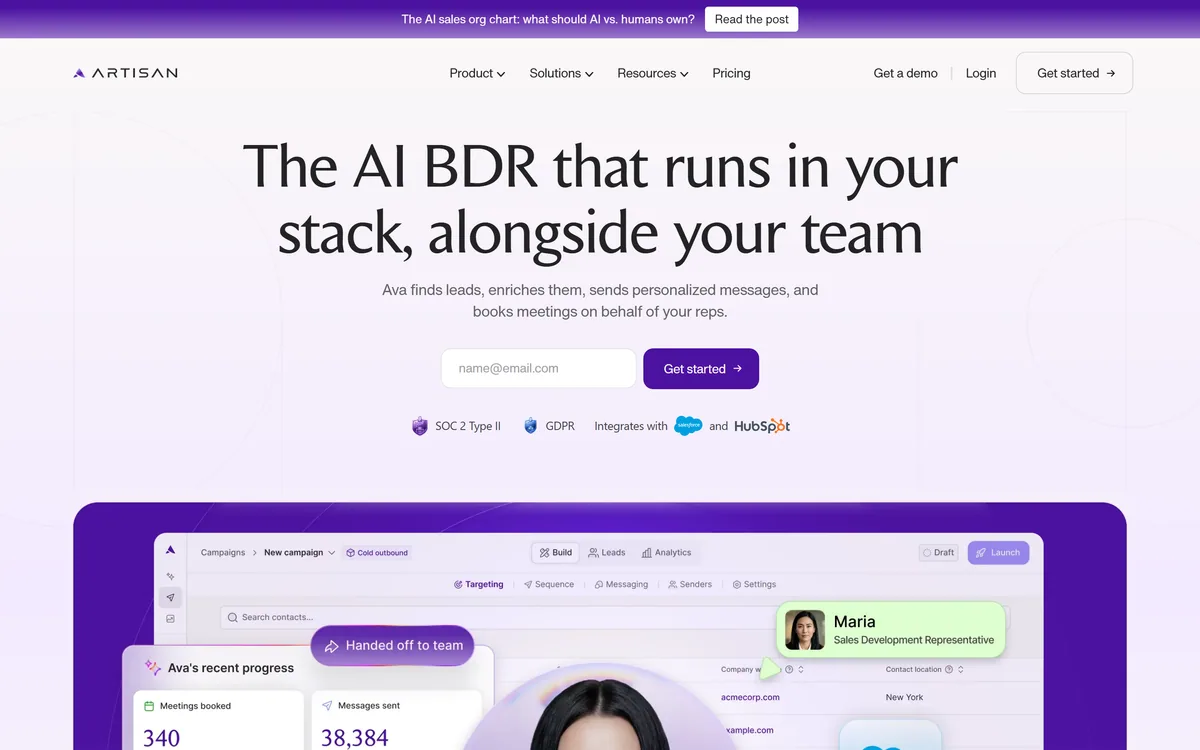
Artisan builds AI workers it calls Artisans. The first, Ava, is an autonomous business development rep that sources and enriches B2B leads, writes and sends personalised outreach across email and LinkedIn, handles replies and books meetings — consolidating the data, deliverability and sequencing stack into one product.
Good
Artisan has an AInexfinder Editor Score of 3.8/5.
Best for: Startups without budget for a full SDR team; Sales teams with a large, well-defined addressable market
The visit link goes to artisan.co, the official site. Paid placements on AInexfinder are always labelled. How we make money
Outbound sales is one of the few white-collar functions built almost entirely out of repeatable steps. Find companies matching a profile. Find the right person. Verify the email. Research something specific enough to open with. Write. Send. Follow up four times. Handle the reply. Book the meeting.
Every one of those steps has a software vendor attached to it, which is why a typical outbound stack is five or six tools with a junior rep in the middle moving data between them and doing the parts nothing automates.
Artisan's argument is that the person in the middle is the wrong shape for the job. This review covers what consolidating that stack actually fixes, why deliverability is the constraint everyone underestimates, how to read the AI-employee framing, and the specific conditions where Clay or a human rep remains the better answer.
The headline is the autonomous agent. The more defensible value is the stack it collapses, and it is worth separating the two.
A functioning outbound operation typically runs a contact database, an enrichment layer, an email verification and deliverability service, a sequencing platform, an intent-data provider and a dialler. A typical stack pairs Apollo.io for data with Instantly for sending. Six contracts, six renewal dates, six admin surfaces, and integration seams between all of them.
Those seams are where outbound actually breaks. Data goes stale between the database and the sequencer. A contact gets emailed twice by two different sequences. Deliverability degrades and nobody notices for a fortnight because the tool that sends is not the tool that monitors.
One system holding all of it can, in principle, close those gaps — it knows what it sent, to whom, from which domain, and how that domain is performing.
The honest caveat is that consolidation always trades depth for coherence. A specialist enrichment platform will do enrichment better than a bundled one; a dedicated deliverability service will monitor more carefully. You are buying fewer seams at the cost of some ceiling on each component, which is the same bargain every all-in-one suite offers.
Outbound rarely fails because the copy was bad. It fails in the joins between six tools, which is exactly what nobody is watching.
Any tool that makes sending easier runs into the same wall, and it is worth understanding before you evaluate any product in this category.
Email providers have spent two decades getting good at detecting bulk unsolicited mail. Volume from a new domain, low reply rates, spam complaints, and identical message bodies are all signals that route mail to a folder nobody opens.
The cruel arithmetic is that a tool which lets one person send ten times more email does not produce ten times more meetings. It produces more sending, worse engagement metrics, and eventually a domain that cannot reach an inbox at all — including for the humans who share it.
This is why deliverability appears in Artisan's own list of consolidated functions, and why it is the right thing to interrogate hardest in a demo. Ask specifically: does it use separate sending domains, how is warm-up handled, what happens to sending when reply rates fall, and can it be configured to stop rather than push through.
The signal to look for is a product that limits sending on your behalf. A system with no brakes is not more powerful — it is a faster route to a burned domain.
Personalisation helps here and only partially. Genuinely researched outreach earns replies; personalisation tokens filled from a database do not, and recipients tell the difference immediately.
Artisan names its products Artisans and gives them human names. That is a deliberate positioning choice and it is worth being clear-eyed about what it does.
The framing is useful in one respect: it sets the right expectation about scope. Ava is not a feature you add to a workflow, it is an attempt to own an entire function end to end. Buyers who evaluate it as a sequencer will misjudge it.
The framing is misleading in another. An employee exercises judgement, learns your market by talking to people in it, notices that a segment has gone quiet and asks why. An agent executes a defined loop very consistently. Those are different things, and the gap shows up specifically in strategy — deciding who to target and what to say — rather than in execution.
In practice the good outcome is not that you stop needing a person. It is that one person can own the strategy for what previously took a team to execute: choosing segments, writing the positioning, reading what came back, and adjusting.
That is a genuinely valuable change and it is a smaller claim than the marketing makes. Teams that buy it expecting to remove headcount rather than redirect it tend to be disappointed.
Assisted rather than autonomous tools like Amplemarket make a smaller version of the same bet. The backing suggests the market takes the category seriously — a $25 million Series A led by Glade Brook Capital, with HubSpot Ventures participating, which is a notable investor for a product living next to a CRM.
This site does not publish plan prices. The structure matters more anyway, and Artisan's is genuinely different from the tools it replaces.
Artisan charges on a credit-based model, with tiers spanning startup through enterprise. You are buying the agent's capacity to work rather than a licence for a person to log in.
That is the correct shape for the product and it changes how you budget. Seat-based tools cost the same whether a rep sends ten emails or a thousand; a credit model scales with activity, which means cost tracks volume rather than headcount.
It also means the failure mode is different. With seats, waste looks like an unused licence. With credits, waste looks like capacity spent on a badly chosen segment — you can burn a month's allocation on outreach to the wrong people far faster than a human rep could.
Three things to establish before signing: what specifically consumes a credit (contacts sourced, emails sent, enrichments, replies handled — they are not equivalent), whether unused credits roll over, and what the annual commitment is. Enterprise tiers in this category are usually annual.
Because targeting quality now directly determines cost efficiency, the discipline that used to be about protecting a rep's time is now about protecting your balance.
Being specific here is more useful than another feature list.
Complex, high-value, few-target sales. If your total addressable market is 200 companies and each deal is transformative, automated outreach is the wrong instrument. Those relationships are built by a person who knows the industry, and volume tooling actively damages them.
Anything requiring genuine domain credibility. Selling to clinicians, engineers or lawyers means the first message has to demonstrate that you understand their work. Generated research reads as generated to a specialist audience faster than to anyone else.
When your problem is targeting, not sending. If you do not yet know who buys from you, automating outreach scales a guess. Clay and similar data-first tools are built for working that out.
Regulated and consent-based markets. Cold outreach obligations differ sharply by jurisdiction — the rules covering unsolicited commercial email in the EU and UK are materially stricter than in the US, and automation does not change who is responsible for compliance.
Autonomous lead sourcing against an ideal customer profile
Contact enrichment built into the same system
Personalised outreach writing across email and LinkedIn
Automated sending with deliverability handled in-platform
Reply handling and conversation continuation
Meeting booking without human intervention
Intent signal incorporation
Dialler functionality within the consolidated stack
Enterprise-oriented Ava 2.0 generation
These sit at different points on one axis: how much of the loop the software owns versus how much a person still drives.
| Tool | What it owns | Who drives it | Best when |
|---|---|---|---|
| Artisan | Sourcing, writing, sending, replies, booking | The agent, with human strategy | You want the function owned end to end |
| Clay | Data enrichment and list building | A person, in depth | Targeting is the hard part |
| Apollo.io | Contact database plus sequencing | A rep | You want data and sending in one place |
| Instantly | Sending and deliverability at volume | A rep | Deliverability is your bottleneck |
| Amplemarket | Data, sequencing and intent signals | A rep, AI-assisted | You want assistance rather than autonomy |
| Company | Artisan, founded 2023, San Francisco |
|---|---|
| Founder | Jaspar Carmichael-Jack |
| Category | AI-driven outbound sales and business development |
| Product framing | AI workers called Artisans; the first is Ava, an autonomous AI BDR |
| Current generation | Ava 2.0, positioned for enterprise teams |
| What Ava does | Finds and enriches B2B leads, writes and sends personalised outreach, handles replies, books meetings |
| Stack consolidated | B2B contact data, enrichment, email deliverability, sequencing, dialler and intent signals |
| Channels | Email and LinkedIn |
| Series A | $25 million, led by Glade Brook Capital |
| Other investors named in coverage | HubSpot Ventures, Y Combinator, Day One Ventures, BOND, Soma Capital, Oliver Jung |
| Charging model | Credit-based, with tiers from startup through enterprise; no prices published here |
Artisan aims to replace several of these at once, which makes them the right comparison set.
Last checked . Read from artisan.co during this check, with the screenshot above captured at the same time and funding details corroborated against independent coverage.
Capability claims are the vendor's own and were not independently tested. Cold outreach is regulated differently by jurisdiction and automation does not transfer responsibility for compliance — the rules covering unsolicited commercial email in the EU and UK are materially stricter than in the US. Take your own advice before running volume outreach into a new market.
AInexfinder does not list plan prices or billing details. For current pricing, plans, and trials, visit the official Artisan website.
Visit official website for pricingVendor pricing, credits, and billing policies change over time. Always confirm on the official site before you buy.
Artisan earns an AInexfinder Editor Score of 3.8/5 (good). Best for: Startups without budget for a full SDR team; Sales teams with a large, well-defined addressable market; Companies already paying for several overlapping outbound tools.
Visit ArtisanLog in to write a review.
No reviews yet. Be the first to share your experience with Artisan.
Assigned reviewer
Daniel ReedSenior AI Tools Reviewer
Daniel leads AInexfinder's tool reviews. He researches each tool from its own pricing, documentation and policies, checks its claims against independent sources, and writes up what it does well, where it falls short and who it genuinely suits.
Daniel and the AInexfinder editorial team research Artisan from its own website, pricing, documentation and policies, checked against independent sources. This review is research-based: unless its method note says otherwise, we have not bought a plan or run hands-on tests. The Editor Score is our editorial judgement, and payment never changes it.
Similar Tools
Snov.io review on AInexfinder — freemium AI tool for Business & Marketing. Features, pricing notes, and alternatives.
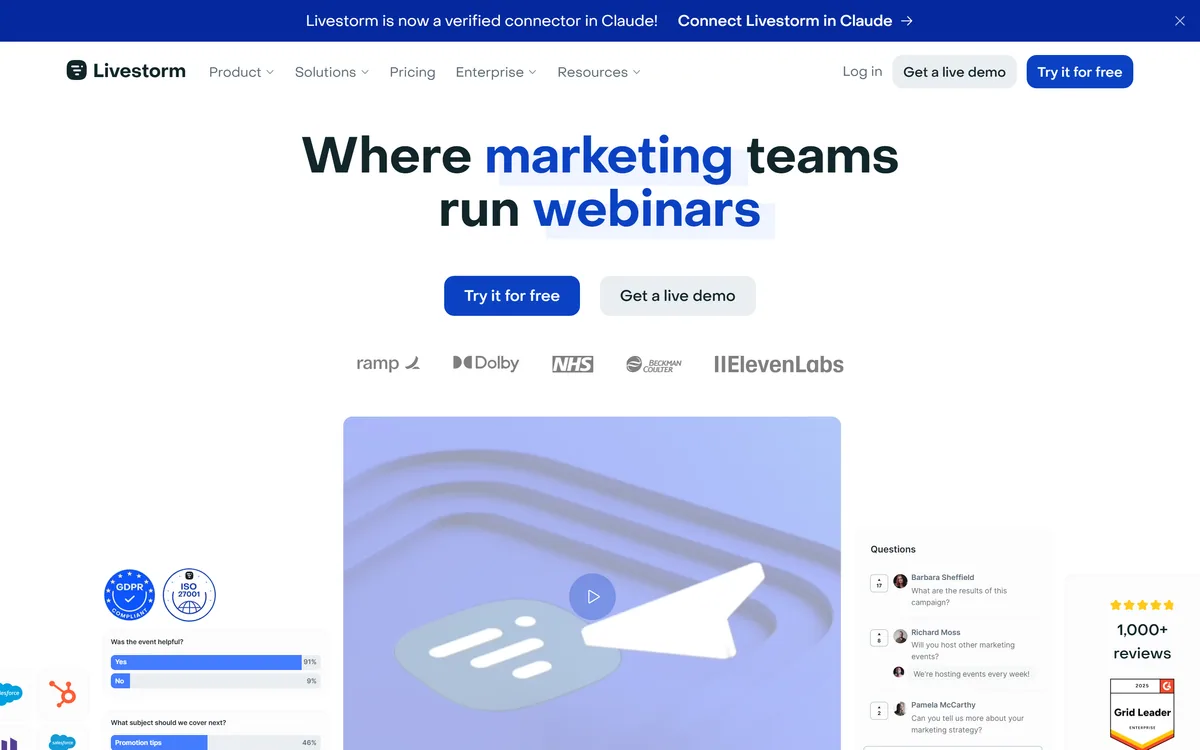
Livestorm is a browser-based, all-in-one webinar and video-engagement platform that runs the full event lifecycle, registration, live engagement, AI transcription, on-demand replays and analytics, with CRM integrations and an EU-hosted, ISO 27001 posture, aimed at marketing teams.
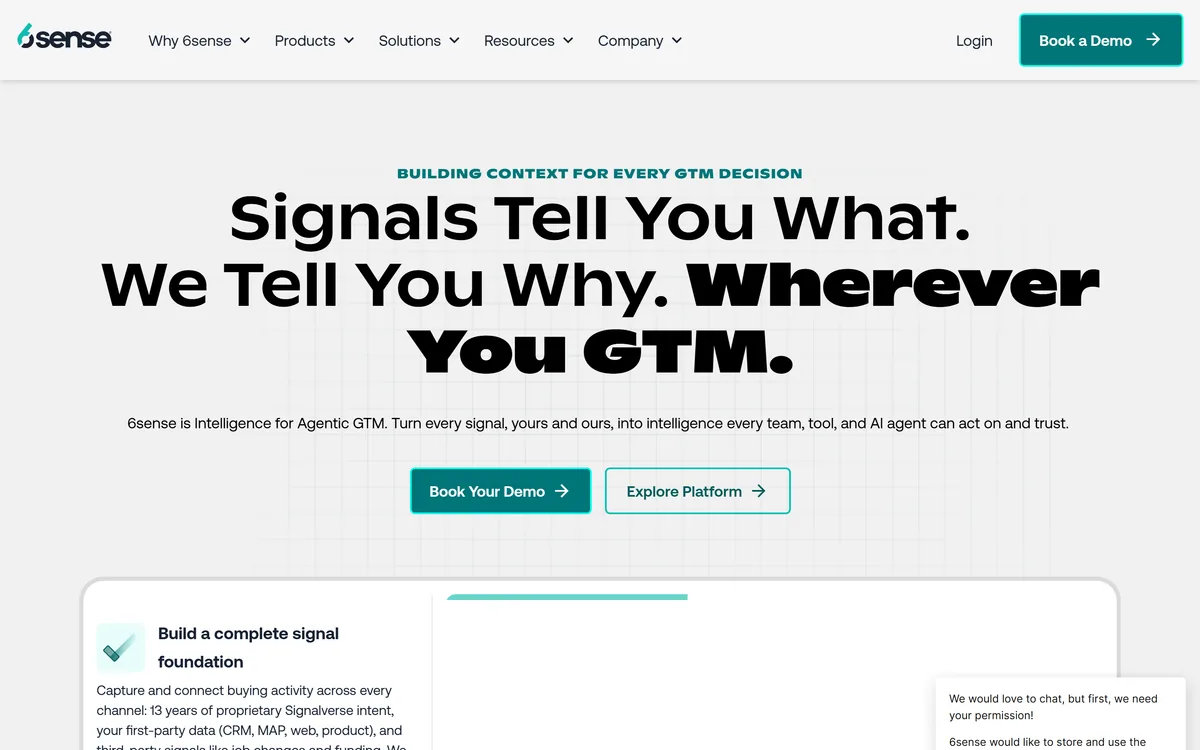
6sense is an account-based marketing and revenue-intelligence platform that captures buying signals, resolves identities and predicts buying stages, turning raw data into cited GTM intelligence delivered to sales, marketing, ads and AI agents via APIs and MCP.
Clay is go-to-market data infrastructure built around waterfall enrichment: instead of one provider, it queries a marketplace of more than 200 in sequence until a field is filled. Claygent AI agents research companies and people, and the results push into a CRM, ad platforms or a native sequencer.

HubSpot AI is branded Breeze — an assistant plus a set of agents for prospecting, content, customer service, campaigns, nurture, and revenue, all running on live CRM data, with an Agent Builder for custom ones.

Surfer SEO analyses top-ranking results to guide content optimisation through its Content Editor and Content Score, and has expanded into AI visibility — tracking brand mentions in ChatGPT, Claude, Gemini, Perplexity, and Google AI Overviews.
Related Pages