There is an uncomfortable truth under every AI writing tool: the writing was never the expensive part. Anyone can generate two thousand words about anything, and the market has been able to for years.
The expensive part is knowing which two thousand words are worth generating — which query has demand, which has weak incumbents, and which will never rank no matter how good the article is.
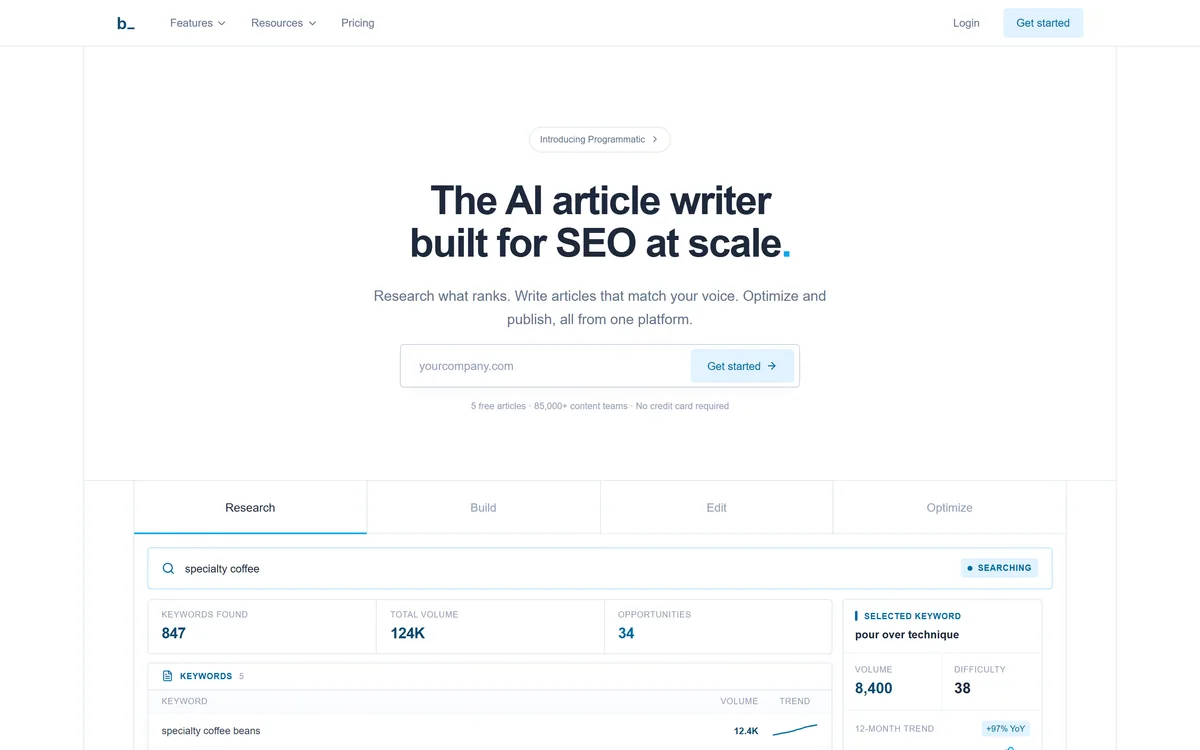
Byword's structure suggests it understands this, because research is the first tab rather than a bolt-on. This review covers what the four-stage loop actually does, why brand voice matching matters more than it sounds, what programmatic SEO is and when it goes badly wrong, and where volume content stopped working.
Workflow, Output And Scale
| Category | AI SEO article writing and publishing at scale |
|---|
| Workflow stages | Research, Build, Edit, Optimize |
|---|
| Research outputs | Keywords found, total search volume, opportunity counts, per-keyword volume, difficulty and trend |
|---|
| Writing | Articles matched to your existing brand voice |
|---|
| Programmatic mode | Generation of large page sets from structured input |
|---|
| Publishing | Direct publishing from the platform to your site |
|---|
| Onboarding | Enter a company domain to generate a tailored starting point |
|---|
| Free entry | A small number of free articles with no credit card required |
|---|
| Stated user base | More than 85,000 content teams, per the vendor's homepage |
|---|
| Charging model | Freemium, then subscription tiers metered on articles and connected sites; no prices published here |
|---|
Volume SEO Writing, Summarised
- Byword is an AI article writer built for producing SEO content in bulk rather than one considered piece at a time — the whole product is shaped around volume.
- The workflow is four stages: Research, Build, Edit and Optimize, which is the sequence a competent content strategist follows manually.
- Keyword research is built in, surfacing search volume, difficulty and opportunity counts rather than expecting you to arrive with a list.
- It writes in your voice and publishes to your CMS, closing the loop from keyword to live page.
- Free articles to start with no card required, then subscription tiers metered on article volume; the homepage cites more than 85,000 content teams.
Research First Is The Right Order
Most AI writing tools — KoalaWriter and Autoblogging.ai among them — open with a text box. You type a topic, you get an article, and the tool has no opinion about whether that topic was worth writing about.
Byword opens with research: enter a seed term and it returns keywords found, total volume, and a count of opportunities, with difficulty and trend data on each. Only then do you build.
That ordering is not cosmetic. It changes what the tool is for — from a writing assistant into something closer to a content operation, where the decision about what to publish is part of the product rather than a prerequisite you bring from elsewhere.
It also means you can evaluate the tool honestly on the step that matters. Ask it for keywords in your category and look at what it returns. If the suggestions are terms you already knew, the research layer is not earning its place. If it surfaces queries with genuine volume and weak results, that alone is worth more than the drafting.
Dedicated planning tools like MarketMuse sell this step on its own. The difficulty and trend figures deserve the same scepticism you would apply to any SEO tool's estimates. Search volume is modelled, not measured, and difficulty scores are proprietary heuristics that differ substantially between vendors. Use them to rank options against each other, not as absolute truths.
Generating the article was never the bottleneck. Knowing which article to generate is the entire job, and it is the step most of these tools skip.
Brand Voice Is Doing More Work Than It Appears
Writing articles that match your voice sounds like a nicety. In practice it is what determines whether the output is publishable without a rewrite.
Generic AI prose has a recognisable texture — even paragraph lengths, hedged claims, transitional phrases that connect nothing, and a relentless neutrality. Readers detect it, and increasingly so do the people deciding what to link to.
Matching an existing site's voice means the model has real material to imitate: your vocabulary, your sentence rhythm, the level of assumed knowledge, the things you never say. That is a far more useful constraint than a tone slider offering professional, casual or friendly.
The honest limit is that voice is not expertise. A model can reproduce how you write and cannot reproduce what you know that is not already published. On any topic where your advantage is knowing something the open web does not, matched voice makes the gap harder to spot rather than smaller.
The practical test is to have the tool write about something you know intimately, then read it as a specialist. Whether it is thin will be obvious in about ninety seconds.
Programmatic SEO, And How It Fails
Byword's homepage flags a programmatic capability, and it is worth explaining properly because it is the most powerful and most dangerous thing in this category.
Programmatic SEO means generating large numbers of pages from structured data against a template. Best restaurants in every city. Compatibility between every pair of products. A page for every combination of two attributes. Done well, it is how comparison sites, directories and marketplaces built enormous organic footprints.
It works when each generated page answers a real query with genuinely different information. A page per city works if the restaurants differ, which they do.
It fails when the pages are the same page with a noun swapped. Search engines have been explicit about this for years, and the current guidance targets scaled content abuse — producing many pages primarily to manipulate rankings rather than to help anyone — regardless of whether a human or a machine generated them.
The distinction is not how the page was made. It is whether the page contains something. A thousand pages each holding real data is an asset; a thousand pages each holding the same paragraph with a different city name is the thing the policy exists to demote.
So the question to ask before switching this on is simply: what is different on page 400 compared with page 399? If the answer is only the noun, do not do it.
- Run the research step on your own category before writing anything, and judge the tool on that alone.
- Generate one article on a topic you know deeply, then read it as a subject expert.
- Check whether the internal links and structure would survive an editor rather than just a crawler.
- If you are considering programmatic pages, write out what genuinely differs between two adjacent pages.
- Publish ten manually and watch them for a month before letting anything run to volume.
What The Meter Counts
This site does not publish plan prices. The structure is what stays true, and here it is conventional for the category.
Byword offers a small number of free articles to start with no card required, then subscription tiers. The meter is articles, and typically also the number of connected sites — those two together are what push you up a tier.
Per-article metering has a specific consequence worth planning around: you pay for articles generated, not articles published. Every regeneration, every abandoned draft, every experiment with a different angle consumes the same allowance as a piece that goes live.
That makes the research step doubly valuable, because it is the cheapest place to avoid waste. Choosing the wrong topic costs you an article either way; choosing it before generating costs you nothing.
Two things to confirm before upgrading: whether unused articles roll over month to month, and whether the site connection limit is separate from the article limit, since agencies almost always hit the site cap first.
The free articles are a genuine test rather than a teaser, because you can judge both research quality and prose quality inside them. Use them on your real category, not on a demo topic.
Where Volume Content Still Works
The honest position in 2026 is that this category has narrowed considerably, and being specific about where it still works is more useful than either enthusiasm or dismissal.
It still works on informational queries with settled answers and weak incumbent pages — the long tail where the current results are thin affiliate posts from 2019. A well-structured, accurate, genuinely helpful 1,500 words beats those, and there are a lot of them.
A closed-loop publisher like BlogBuster automates further still. It still works as supporting content around pages that are written by humans: the explainers and definitions that surround a product, building topical coverage so the money pages have context to sit in.
It has stopped working on competitive commercial queries, where the incumbents are well-resourced and the bar is genuine expertise or original data. Volume alone does not move those and has not for some time.
It never worked in health, legal and financial territory, where being wrong has consequences and where search engines apply the highest scrutiny to who is publishing.
The structural point worth holding on to: when generating an article costs almost nothing, articles stop being scarce and therefore stop being valuable on their own. Whatever remains scarce — original data, real expertise, a genuine point of view — is where the return moved.
- Works: long-tail informational queries with weak, dated incumbent pages
- Works: supporting and definitional content around human-written commercial pages
- Works: local and regional variants where the underlying facts genuinely differ
- Fails: competitive commercial queries against well-resourced incumbents
- Fails: anything in health, legal or financial territory
- Fails: templated pages where only the noun changes between them