Every B2B marketing team has the same unanswerable question at the end of a quarter: which of this spend produced the revenue? The ad platforms each claim the same deals, the CRM disagrees with all of them, and the spreadsheet reconciling it is somebody's least favourite afternoon.
The reason it is hard is structural. A B2B purchase takes months, involves several people, and touches a dozen surfaces before anyone signs — while the ad platforms only see the last thing that happened inside their own walls.
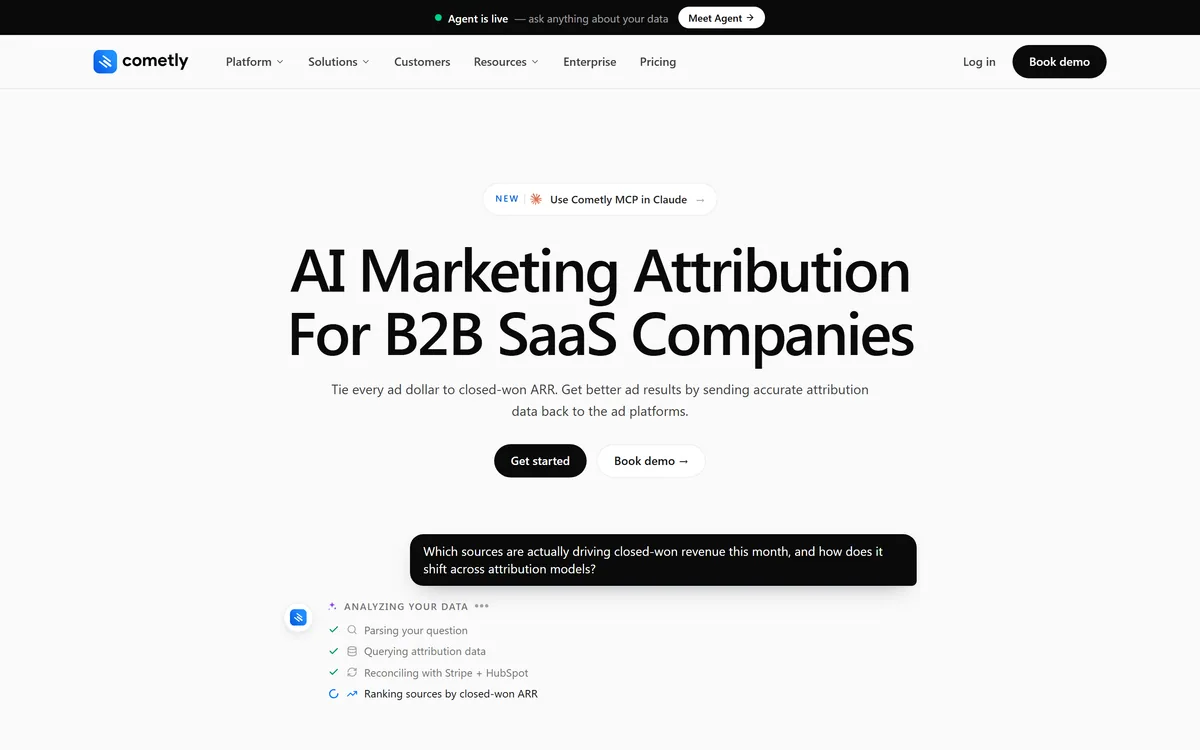
Cometly's pitch is to close that loop: connect the payment system and the CRM to the ad accounts, and follow a deal from first touch to closed-won ARR.
Why Is B2B Attribution So Hard?
Cometly's positioning is tying every ad dollar to closed-won ARR, and mapping spend to MQL, SQL, opportunity and closed-won inside HubSpot or Salesforce without spreadsheets.
The difficulty is not measurement, it is time and identity. A B2B deal takes months, so the click that started it happened two quarters before the revenue, and by then the cookie has expired and the person has changed devices twice.
Identity is worse. The person who clicked the ad is often not the person who books the demo, who is not the person who signs. Consumer attribution assumes one buyer; B2B has a committee, and only one of them ever touches your tracking.
The result is that every ad platform reports a version of events flattering to itself, because each one only sees interactions inside its own network. Sum them and you have credited more revenue than you earned.
Connecting the payment system and the CRM is the only structural fix, because those hold the one fact everybody agrees on — money arrived, on this date, from this account. Everything upstream is inference, and the honest version of attribution admits that.
It is worth being clear about which number is the anchor. Revenue recognised in the ledger — the figure accounting platforms such as Puzzle exist to produce — is the only one finance will defend, and an attribution model that cannot reconcile against it will lose every argument it enters.
Every ad platform reports a version of events flattering to itself. Sum them and you have credited more revenue than you actually earned.
Cometly states that it gets better ad results by sending accurate attribution data back to the ad platforms, and lists a Conversion API and server-side tracking among its features.
This is the part that distinguishes attribution as reporting from attribution as infrastructure, and it is the more valuable half.
The platforms optimise bidding against whatever conversion signal you feed them. If that signal is a form fill, they will get very good at finding people who fill in forms, including everyone who will never buy.
Feeding closed-won revenue back changes the objective. The platform starts optimising towards people who resemble your actual customers rather than your actual leads, and in B2B those populations differ enormously.
The lag is the practical problem nobody mentions in the sales call. If your sales cycle is four months, the signal arrives four months late, and the bidding algorithm is learning from a market that has moved. It still beats optimising for form fills, but it is not a real-time loop.
First Touch, Last Touch, Different Answers
The site's own example makes the point better than any critique could: it shows Google Ads leading under last touch, while Google Organic and LinkedIn Ads climb under first touch.
That is not a flaw in the product. It is the honest fact about attribution, and putting it on the homepage is more candid than most vendors manage.
First touch credits the channel that started the relationship, which favours awareness and content. Last touch credits the channel that closed it, which favours branded search and retargeting. Both are answers to different questions.
The failure is picking one model, forgetting you picked it, and then reallocating budget as though the number were a measurement rather than a modelling choice. Cutting the channel that always starts relationships because it never finishes them is how pipelines quietly die two quarters later.
The disciplined approach is to look at several models, treat large disagreements between them as information, and change budget slowly. Attribution is directional evidence — better than instinct, worse than an experiment, and no substitute for occasionally turning a channel off to see what happens.
- Read every attribution number as a modelling choice, not a measurement.
- Compare first touch and last touch, and treat disagreement as information.
- Feed closed-won revenue back to the ad platforms, not form fills.
- Expect signal lag equal to your sales cycle before bidding improves.
- Test big reallocations by turning a channel off, not by trusting a model.
An MCP Server For Your Attribution Data
Cometly lists an MCP server among its features and promotes using it inside Claude, which is an unusually current thing for an attribution vendor to ship.
The reasoning is sound. Attribution data is exactly the kind of thing people want to ask questions of in natural language, and exactly the kind of thing that gets locked inside a dashboard with the wrong filters.
Questions like which sources drove closed-won ARR this month, and how that shifts across models, are tedious in a reporting interface and trivial in a conversation. Making the data reachable from an assistant removes the analyst bottleneck for routine questions.
It also changes who can ask. A founder or a finance lead who would never learn a reporting tool will ask a question in a chat window, and the answer being grounded in your own connected systems is what makes it trustworthy.
The risk is the same one that applies to any conversational data access: a confidently phrased answer to a subtly wrong question. The data being real does not make the interpretation right, which is why attribution literacy matters more, not less, once the interface gets easy.
The Questions Attribution Cannot Answer
Attribution answers where revenue came from. It does not answer several adjacent questions that people expect it to.
It does not tell you whether the content was any good. A blog post that ranks and converts and a blog post that ranks and does not are both just sources in a table, and improving the second is an editorial problem addressed by tools like MarketMuse rather than a measurement one.
It does not tell you whether you are visible where buyers now look. An increasing share of B2B research happens inside AI assistants that leave no referrer at all, which is the gap platforms such as Conductor exist to measure.
It does not fix the CRM. Attribution inherits whatever hygiene your pipeline has, so if opportunity stages are applied inconsistently, the model will faithfully report nonsense with excellent formatting.
And it does not make the decision. A model showing LinkedIn underperforming is one input; whether that means cut the spend or fix the creative is a judgement no attribution platform can make for you.
Setting Up Attribution That Survives Scrutiny
The most common attribution failure is not a bad tool — it is a beautiful dashboard nobody trusts, because the numbers never matched what finance said.
This order connects the source of truth first and leaves reallocation until the data has earned some credibility.
- Connect the payment system first, since revenue is the one fact nobody disputes.
- Fix CRM stage hygiene before connecting it, or the model will report your inconsistencies.
- Reconcile a completed month against finance's numbers before believing anything.
- Compare first touch and last touch on the same period to see the spread.
- Turn on conversion feedback to the ad platforms and wait one sales cycle before judging it.
- Change budget slowly, and validate any large reallocation with a hold-out test.
Cometly: Ad Spend Tied To Closed Won
- Built specifically for B2B SaaS, mapping spend to MQL, SQL, opportunity and closed-won rather than stopping at a lead.
- Sends data back to the ad platforms through conversion APIs, which improves bidding rather than just reporting.
- Stripe, HubSpot and Salesforce plus six or more ad platforms, per the site.
- An MCP server so the attribution data can be queried from an AI assistant directly.
- Comet LLC, trading as Cometly, with server-side tracking, a pixel and multi-touch attribution.
Cometly: Integrations And Company
| Operating company | Comet LLC, doing business as Cometly |
|---|
| Product type | Marketing attribution for B2B SaaS |
|---|
| Positioning | Tie every ad dollar to closed-won ARR |
|---|
| Revenue sources | Stripe, HubSpot, Salesforce |
|---|
| Ad platforms | Six or more, including Google Ads, Meta Ads and LinkedIn Ads |
|---|
| Tracking | Pixel plus server-side tracking |
|---|
| Feedback loop | Conversion API sending attribution data back to ad platforms |
|---|
| Models | Multi-touch attribution across first touch, last touch and others |
|---|
| AI access | An MCP server, promoted for use inside Claude |
|---|
| Segments | Product-led trial-to-paid, sales-led lifecycle, and founder or CMO reporting |
|---|
| Setup claim | Hours, not weeks |
|---|
| Copyright | © 2026 Comet LLC |
|---|