For most of a decade, seller software meant pulling reports and reading them yourself. Helium 10 built its name on being the deepest set of those reports for Amazon sellers, and it still is. What changed in 2026 is that the reports now talk back.
The platform spans the whole job of selling on a marketplace: finding a product, researching keywords, writing and optimising the listing, running the ads, and keeping inventory and refunds under control. On top of that sits a new agent, Helium, and a connector that pushes your data into whatever AI model you already use.
This review covers what the agent actually does, what the underlying tool stack still does better than anything bolted onto it, how the plans are structured, and the honest question of whether a seller needs this much suite.
Helium 10 In Four Seller-Focused Takeaways
- Helium 10 is an all-in-one marketplace seller suite for Amazon, Walmart and TikTok Shop, spanning research, listings, ads, operations and analytics.
- The new part is Helium, an AI agent you ask about your own account — it reads your data and points at the change likely to move sales or margin.
- An MCP connector now pipes your Helium 10 data into Claude, ChatGPT or another model, so the analysis happens where you already work.
- It is a lot of suite. A single-product seller will use a fraction of it; established brands are the ones who get full value.
Meet Helium, The Agent Now Running Inside Helium 10
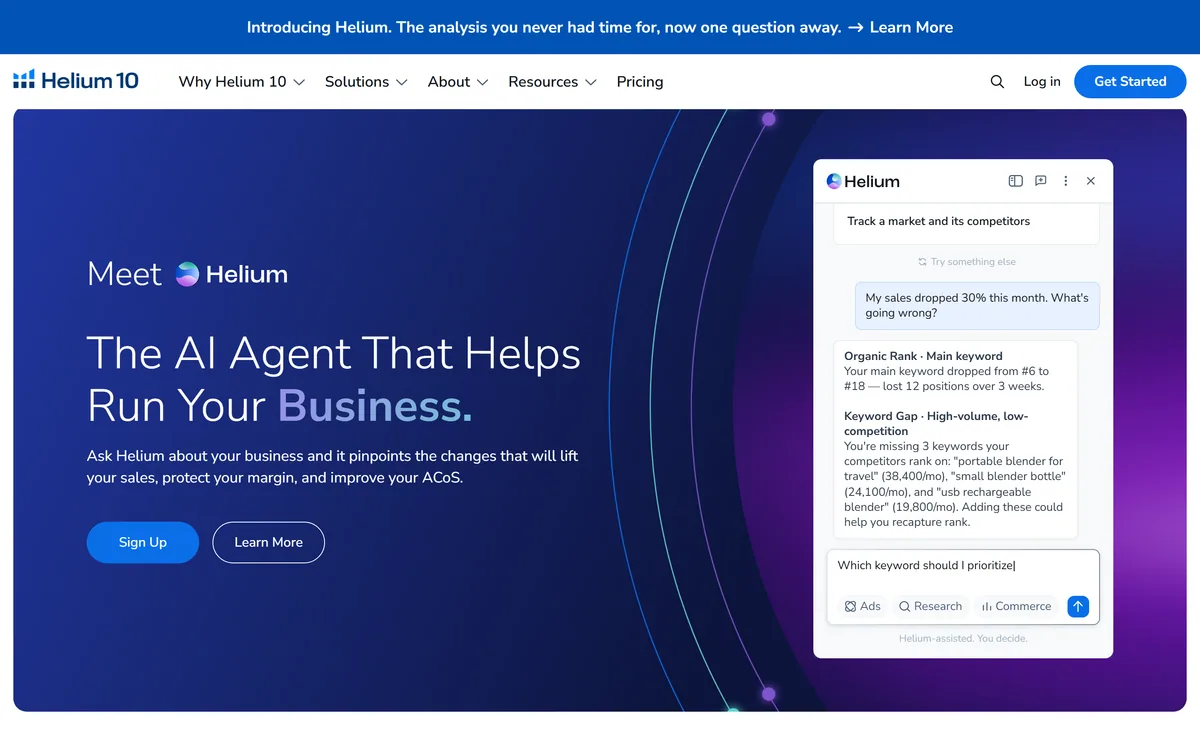
The headline addition is Helium, described on the homepage as an agent that helps run your business rather than a chatbot bolted to the side.
The difference it is reaching for is direction. A dashboard shows you that organic rank fell; the agent is pitched to tell you the main keyword dropped from position six to eighteen over three weeks, name the high-volume keywords your competitors rank on and you do not, and suggest what to change. The homepage frames every output as Helium-assisted and you deciding — which is the right framing, because the data behind the suggestion is the part worth trusting, not the suggestion itself.
Treated as a faster way to the question worth asking, an agent like this earns its place. Treated as an oracle that makes the call for you, it will eventually cost you money on a marketplace where the model cannot see your supplier terms, your cash position or your brand strategy.
The data behind the suggestion is the part worth trusting. The suggestion is a starting point, not a decision.
Underneath the agent is the suite that made Helium 10's name, and it is still the reason most people pay. It is organised around the stages of selling rather than a pile of disconnected utilities.
Product And Keyword Research That Feeds Decisions
Product research tools weigh market demand, competition and revenue signals to validate an opportunity before you commit stock to it, which is where most first-time sellers lose money. Keyword research then surfaces the search terms driving demand across Amazon, Walmart and TikTok so a listing targets the phrases buyers actually type.
This is the part of the suite that most rewards depth. Helium 10's data set — billions of data points processed daily by the company's own account — is what you are really paying for, and it is a different proposition from a general assistant guessing at demand. If search visibility is your wider concern, a marketplace suite complements rather than replaces a web-SEO tool like Surfer SEO.
Advertising And Operations In One Console
The advertising tools build campaigns, automate bidding with rules, and track performance next to your keyword and profit data so spend is judged against outcomes rather than in isolation. Operations pulls inventory, refunds and day-to-day running into one place to catch problems while they are still small.
The value here is less any single feature than the fact that ad spend, profit and inventory sit in the same system. Brands that also run a CRM such as HubSpot AI on the marketing side will recognise the pattern — one console beats five browser tabs once the catalogue grows.
How Helium 10 Plugs Into Claude And ChatGPT Over MCP
The quietly significant feature is the Helium 10 MCP connector. It lets your Helium 10 data flow into Claude, ChatGPT or your preferred model, so the analysis you would otherwise redo by hand happens inside the workflow you already have.
This matters because it stops the tool from being a walled garden. You can already ask a general assistant like Perplexity AI a question, but it cannot see your account; the MCP connector is what gives a model the live, specific data to answer about your catalogue rather than the category in the abstract.
For sellers already automating with an LLM, this is the feature that turns Helium 10 from a destination you visit into a data source your own agents can draw on. It is also early, and how well it works depends on how disciplined your prompts and your data hygiene are.
How Helium 10 Structures Its Seller Plans
Helium 10 runs on a subscription model with a free tier to start, then paid plans that widen limits and unlock the heavier tools. It does not sell perpetual licences, and the free tools plus the Chrome extension are a genuine way to try the data before committing.
The thing to budget for is not only the headline plan but the shape of your usage. The suite rewards sellers who use many of its tools; if you only ever touch keyword research, you are paying for a lot of console you do not open. AInexfinder does not publish plan prices because they change and the vendor states them best — check the current tiers on the pricing page and match them to the specific tools you will actually use.
Confirm what your plan includes for marketplaces beyond Amazon, since Walmart and TikTok Shop coverage and the automation features are the kind of thing that varies by tier.
Putting Helium 10 Through A Live Catalog Test
If you are evaluating the suite, judge it against your own catalogue rather than the homepage demo. A focused hour tells you more than a week of reading.
- Install the Chrome extension and the free tools, and pull demand and competition figures for three products you already sell or are considering.
- Run keyword research on your best listing and note how many relevant, high-volume terms it surfaces that you were not already targeting.
- Open the Helium agent and ask it a real question about a genuine problem — a rank drop, a margin slip — and read whether the answer cites your data or stays generic.
- Cross-check one of the agent's claims against the raw report behind it; treat the claim as useful only if the underlying number holds up.
- If you use an LLM already, connect the MCP and ask the same question there to see whether the data flows cleanly.
- Pass/fail: the suite earns a paid plan only if at least one of these steps surfaces a decision you would not have reached on your own.
- Finally, check that the marketplaces and automation you need are in the tier you are considering before you upgrade.