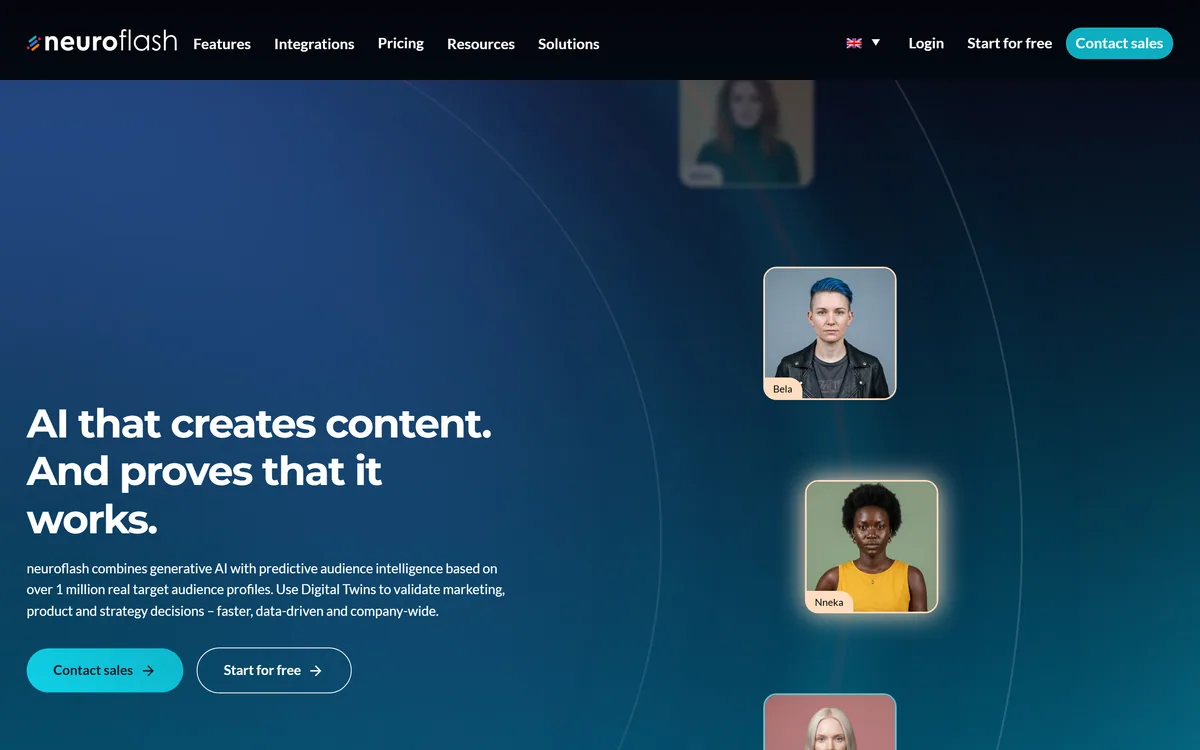
neuroflash is a German audience intelligence and AI content platform. Alongside its ChatFlash, ContentFlash and ImageFlash modules it runs Digital Twins — simulated respondents built on over a million real survey profiles — for testing copy before it ships.
The visit link goes to neuroflash.com, the official site. Paid placements on AInexfinder are always labelled. How we make money
neuroflash started as a German AI copywriting tool competing with the American incumbents on language coverage and data residency. It is now presenting itself as an audience intelligence platform that also writes copy, and that reordering tells you where the company thinks its advantage is.
The reason is Digital Twins: simulated respondents built on survey data the company has been collecting since 2017, used to test a headline or a campaign concept before it goes anywhere near a customer. It is a different bet from every other content tool, which competes on how good the first draft is.
This review covers what the twins are actually built from, where the generation modules stand against the crowd, why German data residency is a real commercial advantage rather than a footnote, and which claims here deserve caution.
neuroflash Without The Marketing Language
It is two products stapled together: a competent multilingual content generator, and an audience-testing layer that is the actual differentiator.
Digital Twins simulate respondents using more than a million real survey profiles collected since 2017, rather than asking a language model to imagine a persona.
Feedback arrives in about twenty seconds from up to twenty simulated respondents at once — the speed is the point, not the sample size.
Germany-based with German servers, GDPR compliance and ISO/IEC 27001:2022 certification — which is why it wins in DACH procurement.
Accuracy claims are the company's own. neuroflash states 85–98% agreement with real humans; treat that as a vendor figure, not an independent one.
Real signal, but retrospective rather than pre-test
Enterprise options vary
Digital Twins Are The Reason To Look
Every AI tool will happily role-play a customer persona. Ask ChatGPT to react to your headline as a 34-year-old procurement manager and it will produce something fluent and entirely invented.
neuroflash's argument is that its twins are anchored in something: over a million real survey profiles gathered since 2017, with up to 255 data points per person. The twins respond from that base rather than from a model's general impression of what a procurement manager sounds like.
Practically, you can ask a question and get reasoning back, upload several content variants for ranking and segment-level analysis, or wire the whole thing into a workflow through the API or an MCP interface. Up to twenty simulated respondents answer at once, in roughly twenty seconds.
The honest framing is not "replaces research" — it is "kills the eleven bad ideas before you pay to test the twelfth".
How Much Weight Those Results Can Carry
This is the part to be careful about, and it is where a review earns its keep.
neuroflash states accuracy of 85–98% against real humans, compared with roughly 55% for generic LLM personas, and describes results as comparable to a representative focus group. Those are the company's own figures. They are plausible in direction — anchoring on survey data really should beat inventing a persona — but a vendor's benchmark of its own product is not independent evidence, and no reader should treat it as one.
The sensible use is triage rather than proof. Simulated feedback is excellent for narrowing twelve subject lines to three, catching a concept that lands badly with a segment you were not thinking about, and getting a directional read on a Tuesday afternoon instead of in three weeks. It is not the thing you present to a board as evidence that a positioning works.
There is also a coverage limit worth knowing: the audience segments available are a defined set rather than an arbitrary population, and the survey base is strongest where the company has been collecting longest — which is the German-speaking market.
Good for: narrowing a shortlist, catching an obviously bad variant, segment-level directional reads
Reasonable for: pre-testing before committing real research spend
Weak for: anything you will be held to as evidence, or any audience outside the covered segments
Not a substitute for: talking to actual customers, which remains the only way to hear the thing you did not think to ask about
The Generation Side, Honestly Assessed
The content modules are named rather than merged: ChatFlash for conversational work, ContentFlash for longer copy, ImageFlash for visuals inside the same workflow, and PerformanceFlash on the performance side. There is an API, and MCP support so the platform can be driven from Claude, Cursor or a similar client.
On raw output quality this is a competitive but not distinctive product. The generation layer is roughly where the category is; if you are choosing purely on how good a first draft reads, the decision will come down to taste and habit.
Where it does pull ahead is language breadth — over twenty languages including German, Spanish, French, Italian, Dutch, Portuguese, Polish, Swedish and Chinese — with German quality that reflects a German company rather than an English tool that also speaks German. Anyone who has watched an American generator produce technically correct, unmistakably translated German knows why that matters.
Why Data Residency Wins Deals
neuroflash keeps data on German servers, states GDPR compliance, holds ISO/IEC 27001:2022 certification, and says customer data is not used to train public models. Enterprise features include SSO, custom roles and permissions.
In an English-language review this reads like boilerplate. In a German or Austrian procurement process it is frequently the whole decision. A works council or a data protection officer who will not approve a US-hosted tool will approve this one, and no amount of superior output quality changes that calculation.
That is the commercial logic behind the company's DACH concentration, and it is a real moat rather than a marketing line — but it is a moat in a specific market. Outside Europe, the residency argument carries much less weight and you are back to comparing the product on its merits.
Getting A Useful Read In An Afternoon
The twins reward a specific way of working, and it is not the way most people first use them.
Start with a real decision you are stuck on, not a test question — the output is only interesting when you actually do not know the answer.
Check which audience segments are available before designing the test, since coverage is a defined set rather than anything you can describe.
Submit genuine variants rather than one idea and three straw men, or you will get the result you built in.
Read the reasoning attached to responses, not just the ranking. The reasoning is where an objection you had not considered shows up.
Treat a strong result as permission to test properly with real people, not as a substitute for doing so.
Wire it into your workflow through the API or MCP only once you trust the reads — automating a signal you have not validated just scales the error.
Four Terms This Page Depends On
The audience-testing claim is only assessable if these are clear.
Digital Twin
A simulated respondent whose answers are anchored in real survey data rather than generated from a model's general impression of a demographic. The anchoring is the entire distinction.
Synthetic research
Testing content against simulated respondents instead of recruited people. Fast and cheap; directionally useful; not evidence in the sense a researcher would accept.
MCP
Model Context Protocol — a standard that lets an external tool be driven from an AI client such as Claude or Cursor, so the twins can be queried from where you already work.
Data residency
Where data physically lives. German servers plus ISO/IEC 27001:2022 is often the deciding factor in European enterprise procurement, independent of product quality.
Two Markets, Two Very Different Verdicts
A Strong Fit When
You market in German-speaking Europe and output quality in German actually matters
Data residency or GDPR posture is a procurement requirement rather than a preference
You make frequent messaging decisions and want a fast directional read before committing spend
Your audience falls inside the covered survey segments
You want content generation and pre-testing in one place rather than two subscriptions
A Poor Fit When
You need research evidence that will stand up to scrutiny rather than a directional signal
Your audience sits outside the available segments, where the survey base is thinnest
You work only in English and have no residency requirement — the differentiators mostly evaporate
You are choosing purely on first-draft quality, where the field is level
You would treat simulated feedback as a reason to stop talking to real customers
Tools That Cover Nearby Ground
Some compete with the writing, some with the testing, none with both.
Jasper AI — marketing agent platform aimed at larger teams and brand governance
Copy.ai — go-to-market workflows rather than audience simulation
Writesonic — content built around search and AI visibility
Brandwatch — audience insight from what people actually posted, not simulated responses
Outset — AI-moderated research with real participants rather than synthetic ones
What We Read Before Writing This
Last checked . Taken from neuroflash's own site, including its Digital Twins product page, during this check. The screenshot above was captured at the same time.
Positioning as an audience intelligence and AI content platform, quoted from the homepage
Digital Twins built on over one million real survey profiles collected since 2017, with up to 255 data points per profile, from the Digital Twins page
Response time of around 20 seconds and up to 20 simultaneous simulated respondents, stated by neuroflash
The 85–98% accuracy figure and the comparison against generic LLM personas are neuroflash's own claims and are described as such throughout this page
Module names ChatFlash, ContentFlash, ImageFlash and PerformanceFlash, plus API and MCP support, listed on the site
Language coverage of over 20 languages, listed on the site
GDPR compliance, German server location, ISO/IEC 27001:2022 certification and the statement that customer data is not used to train public models
Company, legal, terms and privacy pages confirmed present in the site footer
No plan prices published here, in line with this site's pricing policy
We have not independently validated the Digital Twins accuracy figures, and say so plainly rather than repeating them as fact. Segment coverage changes over time — check the current list against your own audience before relying on it.
Neuroflash Pricing
AInexfinder does not list plan prices or billing details. For current pricing, plans, and trials, visit the official Neuroflash website.
Vendor pricing, credits, and billing policies change over time. Always confirm on the official site before you buy.
Frequently Asked Questions
What exactly is a Digital Twin here?
A simulated respondent whose answers are anchored in real survey data — neuroflash cites over a million profiles collected since 2017, with up to 255 data points each — rather than a language model improvising a persona from a description you typed.
Can Digital Twins replace real audience research?
No, and it would be a mistake to use them that way. They are excellent for narrowing options fast and catching a variant that lands badly. They are not evidence, they cannot surface the thing you did not think to ask, and no simulated panel should be presented as a research finding.
How reliable is the 85–98% accuracy claim?
It is neuroflash's own published figure, benchmarked by neuroflash. The direction is plausible — anchoring on survey data should beat an invented persona — but a vendor measuring its own product is not independent evidence, and we have not validated it.
Is neuroflash only useful if I work in German?
No, but that is where it is strongest. It covers over twenty languages, and German output quality is noticeably better than what English-first tools produce. If you work only in English with no data residency requirement, most of its distinguishing advantages do not apply to you.
Where is my data stored?
On German servers. neuroflash states GDPR compliance, holds ISO/IEC 27001:2022 certification, and says customer data is not used to train public models. Enterprise deployments add SSO and custom role controls.
Can I use it from Claude or Cursor?
Yes — there is MCP support alongside a standard API, so the platform can be driven from an AI client you already work in rather than only through its own interface.
How does it compare with Jasper or Copy.ai?
On generation, closely — all three produce competent marketing copy and the choice comes down to workflow and taste. On audience testing, they are not competing: neither Jasper nor Copy.ai offers a survey-anchored simulation layer, which is neuroflash's actual reason to exist.
4.2/5
Bottom Line
Neuroflash earns an AInexfinder Editor Score of 4.2/5 (very good). Best for: Marketing teams operating in German-speaking Europe; Organisations where GDPR posture and data residency decide procurement; Performance marketers who make frequent messaging decisions under time pressure.
Daniel leads AInexfinder's tool reviews. He researches each tool from its own pricing, documentation and policies, checks its claims against independent sources, and writes up what it does well, where it falls short and who it genuinely suits.
Daniel and the AInexfinder editorial team research Neuroflash from its own website, pricing, documentation and policies, checked against independent sources. This review is research-based: unless its method note says otherwise, we have not bought a plan or run hands-on tests. The Editor Score is our editorial judgement, and payment never changes it.
Listings may include affiliate or sponsored placements, which are labeled when present. Editorial scores and cons are not sold. See our affiliate disclosure and review methodology.
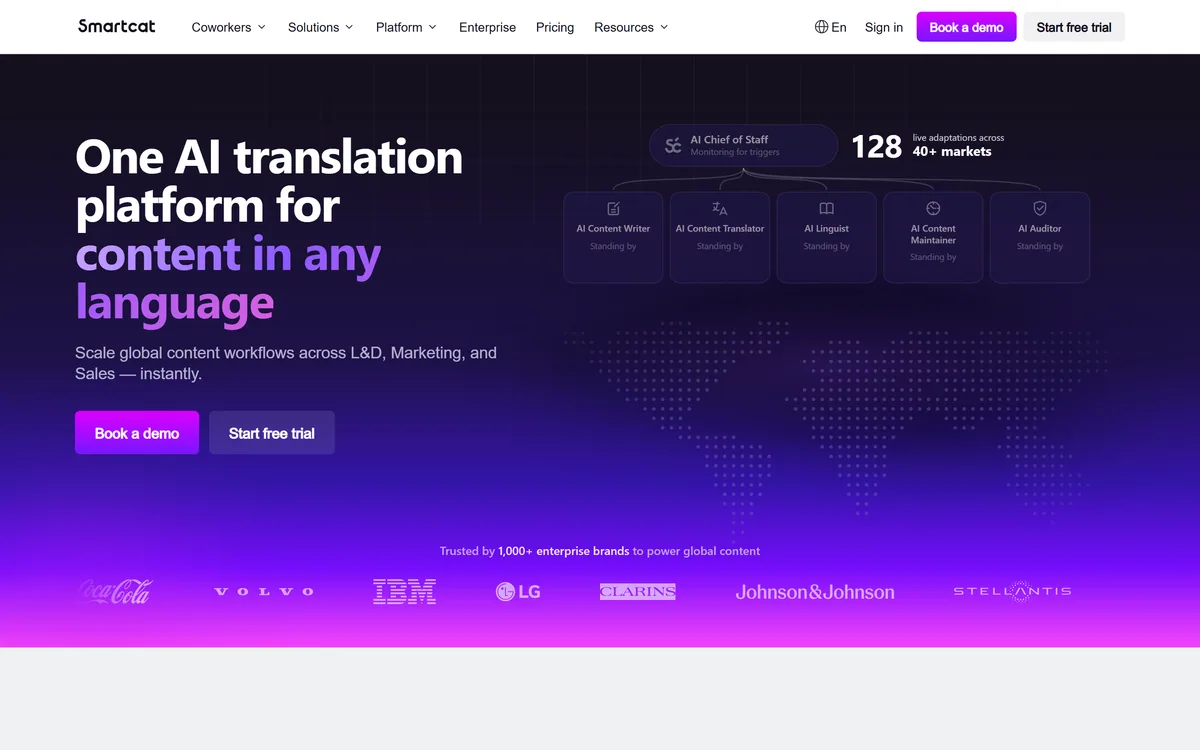
Smartcat combines AI translation across 280+ languages with a CAT tool, translation memory, a marketplace of 500,000+ linguists, and AI agents for writing, auditing and maintaining content — integrated with Figma, Contentful, WordPress, Git and Salesforce.
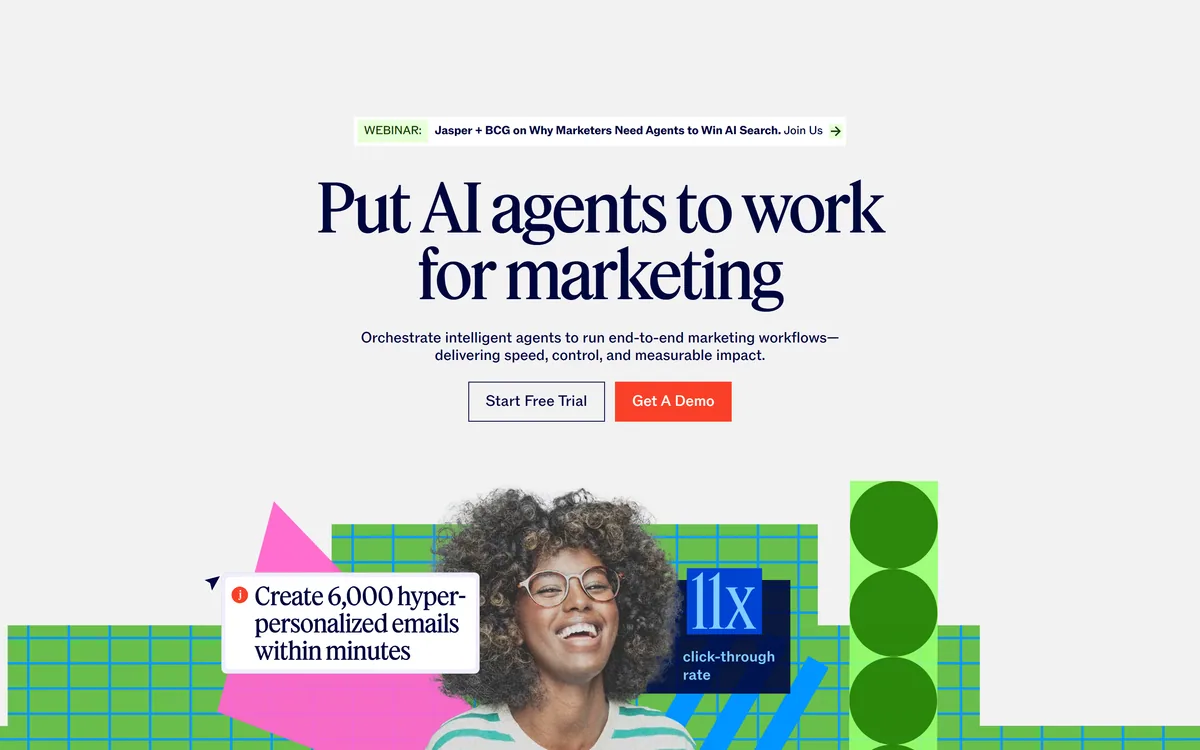
Jasper has moved from AI copywriting to orchestrating marketing agents, with 100+ specialised agents, Content Pipelines, the Jasper IQ context hub, Jasper Studio for custom agents, and brand governance across everything a marketing team produces.
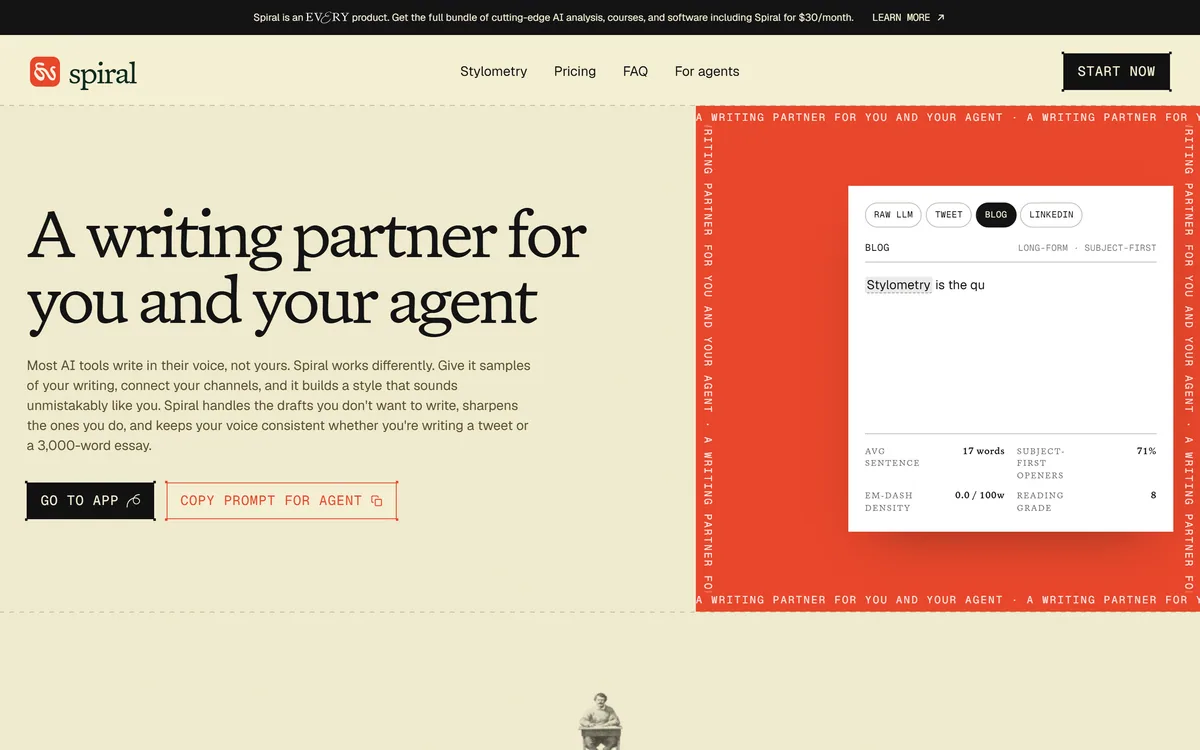
Spiral, a product from Every, uses stylometry to build a voice profile from your existing writing, then drafts tweets, blog posts, LinkedIn updates and newsletters in that voice. It adds shareable team styles, a knowledge base, and MCP and API access.
Copy.ai has become an AI-native go-to-market platform: workflows and agents that run prospecting, lead processing, deal coaching, ABM, and CRM enrichment across Salesforce, HubSpot, Gong, Outreach, and 2,000+ integrations.
Writesonic has become an AI search growth platform — tracking whether your brand appears across 10 AI platforms, running optimisation and citation work through an Action Center, and reporting results against traffic and revenue.
Typeface is an enterprise marketing AI platform built on four Arc products: a graph that grounds content in brand guidelines and audience context, agents that handle work across channels, spaces for review and approval workflow, and a forge for turning workflows into custom agents via MCP and APIs.