The reason most podcasts stop is not that people run out of things to say. It is the four hours after the recording.
Editing out the ums, trimming the twelve seconds where someone's dog barked, exporting, writing show notes, making cover art, uploading to three platforms, cutting clips for social — none of it is creative work and all of it has to happen every week.
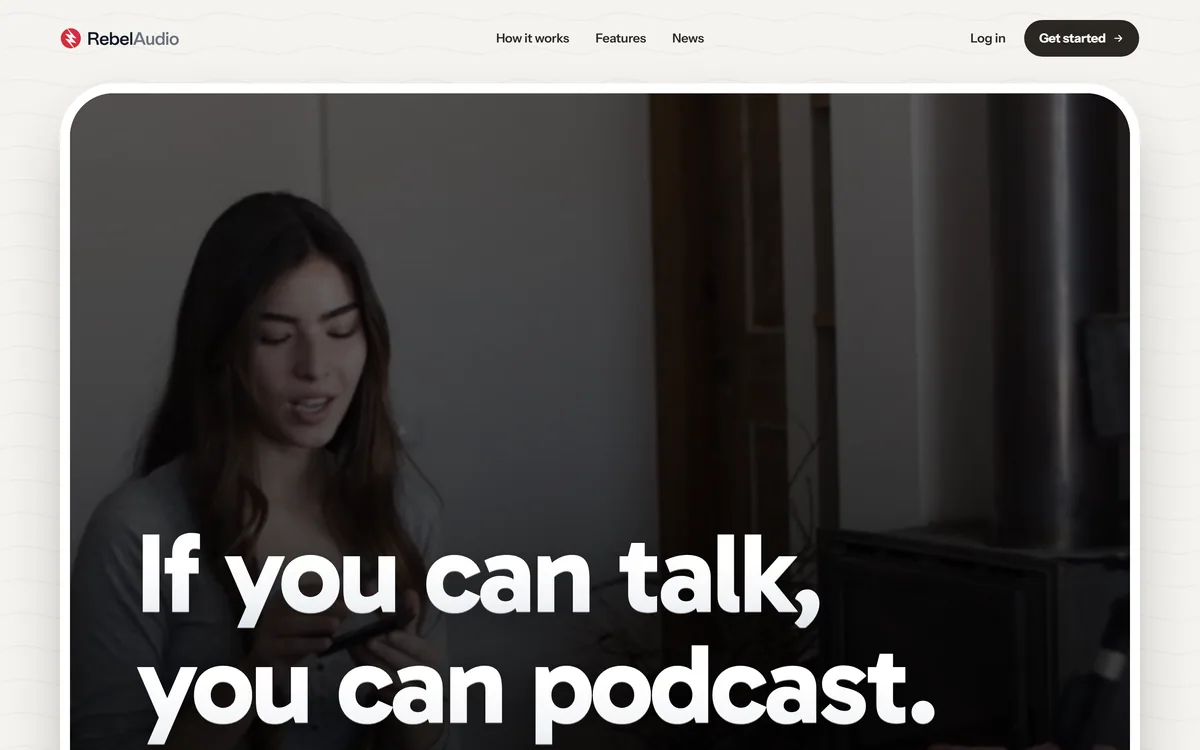
Rebel Audio's proposition is captured by its own line: if you can talk, you can podcast. It covers the whole distance from recording to published episode, and the ambition is what makes it interesting. This review covers what genuinely removes work, what the translation feature really implies, and the questions the site leaves unanswered.
Deleting A Word Deletes The Audio
- Word-level editing through the transcript — delete a sentence in the text and the audio goes with it, which is the correct interaction for speech.
- The tedious cleanup is automatic: filler words removed, silences trimmed, sound quality enhanced, captions generated.
- Translation into 47+ languages in the original voice, which is the most commercially interesting capability here.
- Distribution is one click to Spotify, Apple Podcasts, YouTube, iHeartRadio and RSS, with unified analytics across all of them.
- Video as well as audio — MP4 and MOV alongside MP3, WAV and M4A, with automatic clip extraction for social.
Reading Your Way Through An Edit
Transcript-based editing is the correct interaction for speech, and once you have used it a waveform feels like a strange thing to have been asked to work with.
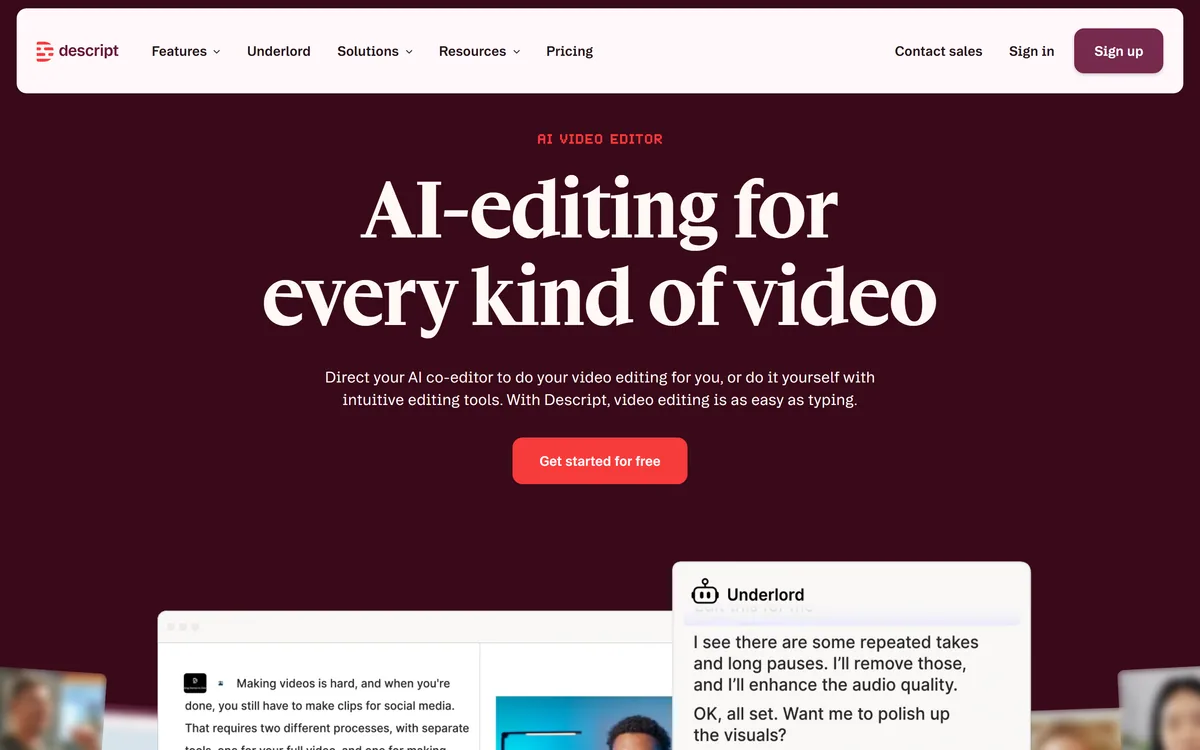
The old method meant finding a stumble by scrubbing through a visual representation of amplitude and listening repeatedly for the right moment, and Descript is the tool that first argued otherwise. The new one is reading a transcript, selecting the sentence, and deleting it. The audio follows.
It is faster, and it also changes what gets edited. Removing a rambling forty seconds is a paragraph selection rather than a fiddly waveform operation, which means it actually happens rather than being left in because fixing it was tedious.
The automatic cleanup — filler words, silences, sound enhancement — is the other half. These are the operations nobody enjoys and everyone does, and they are exactly the sort of mechanical work worth automating.
A caution on filler removal, though, because it is easy to overdo. Speech with every hesitation stripped out sounds subtly unnatural — real conversation has breath and pause in it, and removing all of them produces something that reads as processed even when a listener cannot say why. Use it at a moderate setting and listen to a full minute before applying it to an episode.
Editing speech by looking at a waveform was always a workaround. The transcript was the right interface all along.
Smart Clips And The Discovery Problem
Automatic extraction of social clips addresses the actual growth problem for podcasts, which is that discovery does not happen inside podcast apps.
People find shows through a clip on a social feed, and cutting those clips manually is a weekly task most independent podcasters skip — which is precisely why their shows do not grow.
Automated extraction makes the task cheap enough to happen at all, which is the whole premise of a dedicated tool such as OpusClip, and something posted weekly beats a perfect clip posted never.
The honest limitation is that a model selecting a clip is optimising for something detectable — a change in energy, a quotable phrase — rather than for what will actually resonate with your audience. Treat the suggestions as a shortlist and pick from them yourself. Reviewing five candidates takes two minutes and produces better results than either accepting the first or cutting from scratch.
Forty-Seven Languages In Your Own Voice
Voice translation into more than forty-seven languages, preserving the original voice, is the most commercially significant feature here and the one that deserves the most careful thought.
The opportunity is genuine. Podcast audiences are fragmented by language far more than by anything else, and a show that exists only in English is invisible to most of the world. Translation in your own voice keeps the thing that makes a show distinctive — a presenter's actual delivery — rather than replacing it with a synthetic reader.
Three practical cautions apply before you switch it on across a back catalogue.
First, translation quality varies sharply by language, and you will not be able to judge it in a language you do not speak. Get a native speaker to listen to a full episode before publishing a whole feed. A translation that is fluent and subtly wrong is worse than an obvious machine reading, because nobody catches it.
Second, humour, idiom and cultural reference translate badly. A show built on wordplay will lose more than it keeps.
Third, and most important: if your podcast has guests, their voices are being cloned too. That requires their explicit, informed consent — a voice is a person's likeness, protected in several jurisdictions independently of copyright, with new legislation arriving specifically for synthetic voices. Add it to your release form before you use the feature, not after.
- Have a native speaker review a full translated episode before publishing a whole catalogue.
- Get explicit written consent from every guest before cloning their voice into another language.
- Update your release form to cover synthetic voice reproduction and translation.
- Expect wordplay, idiom and cultural reference to degrade; shows built on them travel worst.
- Consider disclosing to listeners that an episode is an AI translation, which is both honest and increasingly expected.
Distribution Is The Unglamorous Half
One-click publishing to Spotify, Apple Podcasts, YouTube, iHeartRadio and RSS, with unified analytics across all of them, is the least exciting part of this product and possibly the most valuable.
Podcast distribution is genuinely tedious. Each platform has its own requirements, its own dashboard and its own upload flow, and doing it manually every week is where the enthusiasm for a new show goes to die.
Unified analytics matters more than it sounds too. Plays, downloads and average listen time scattered across four dashboards means nobody ever assembles the picture, so nobody learns whether the format change worked or where listeners drop off. One view makes that visible.
Average listen time is the number to watch. Downloads measure how well your title and cover art performed; listen time measures whether the episode was any good. Most podcasters watch the first and would learn far more from the second.
A practical note on RSS: whatever platform you use — including recording-first tools such as Riverside — make sure you retain control of your feed. Being able to move your show elsewhere without losing subscribers is the single most important structural protection a podcaster has, and it is worth confirming before you commit a catalogue.
Recording One Episode Through It
Podcast tools demo well on clean studio audio and reveal themselves on a real recording with a bad microphone and a barking dog. Test accordingly.
The bar is step four. Enhancement that cannot rescue your actual recording conditions is enhancement you cannot rely on.
- Upload an episode you have already edited yourself, so you have a known result to compare against.
- Edit it again through the transcript and time both. The difference is the actual saving, and it is usually large.
- Apply filler removal at a moderate setting, then listen to a full minute uninterrupted. Over-removal is the most common way this makes speech sound processed.
- Run enhancement on your worst-quality recording — a phone interview, a noisy room — rather than your best. That is where you learn its real limit.
- If you have guests, do not test translation until you have their written consent. Then have a native speaker review a full translated episode, not a clip.
- Publish one episode through the distribution flow and confirm you retain control of your RSS feed before moving a catalogue.
What The Site Leaves Open
Rebel Audio publishes terms and conditions and a privacy policy, and lists Mike Majlak as Chief Creator in Residence and Mark Burnett as an adviser — both recognisable names in creator and television production, which is real signalling about the audience it is chasing.
Several things a working podcaster needs are not addressed on the marketing pages, and they are worth establishing before committing a show.
Output ownership and rights over generated material — cover art, clips, translated audio — are not set out. For anyone monetising a podcast, that is the first question rather than a detail.
Voice cloning terms are the more consequential gap. A product that reproduces your voice, and your guests' voices, in other languages should state plainly how those voice models are stored, how long they persist, whether they can be deleted, and whether they could ever be used outside your own episodes. None of that appears on the pages we read.
Pricing is also absent from the marketing pages, with a start-for-free call to action but no published tiers.
None of this makes the product unsuitable. It means the terms of service are the document to read before a catalogue moves, and the voice questions are worth putting to support in writing.
Rebel Audio: What Is Stated
| Product type | End-to-end podcast production, editing and distribution |
|---|
| Audio formats in | MP3, WAV, M4A |
|---|
| Video formats in | MP4, MOV |
|---|
| Editing | Word-level editing through a document-style transcript interface |
|---|
| Automatic cleanup | Filler word removal, silence trimming, sound quality enhancement, caption generation |
|---|
| AI generation | Episode cover art, titles, descriptions, tags and episode ideas |
|---|
| Clips | Automatic extraction of social media clips from an episode |
|---|
| Translation | 47+ languages, preserving the original voice |
|---|
| Distribution | One-click to Spotify, Apple Podcasts, YouTube, iHeartRadio and RSS |
|---|
| Analytics | Unified across platforms — plays, downloads and average listen time |
|---|
| Notable people | Mike Majlak as Chief Creator in Residence; Mark Burnett as adviser |
|---|
| Published policies | Terms and Conditions, Privacy Policy |
|---|
| Pricing model | A start-for-free entry point; no tier structure published on the pages we read |
|---|