Lumen by Talkwalker: The Rename And What It Signals
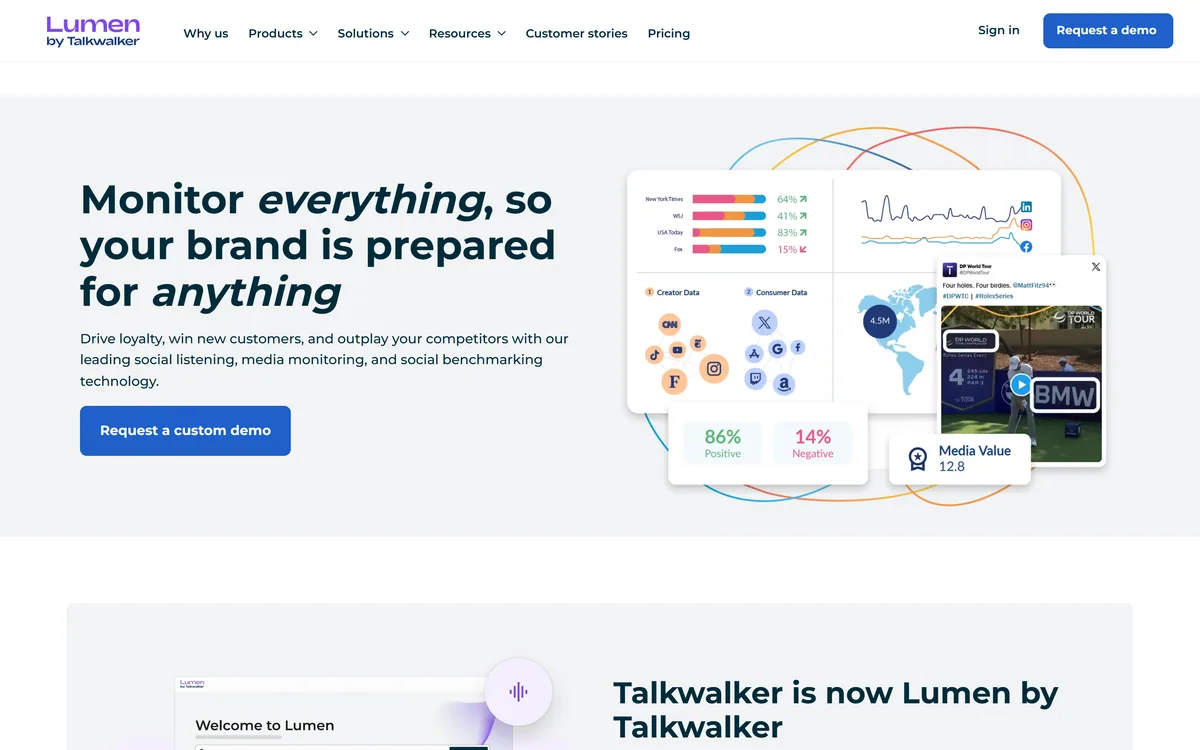
The site states it directly: Talkwalker is now Lumen by Talkwalker, reflecting a next chapter as Hootsuite and Talkwalker are brought closer together — the same platform, with same data, same reports, same workflows and integrations.
That reassurance is the correct thing to publish, and it answers the question every existing customer asks first.
Renames in enterprise software usually signal one of three things: a repositioning, a merger, or a product being folded into a larger suite. This one names the second and implies the third, since Hootsuite is a publishing and management platform and Talkwalker is a listening and intelligence one.
Those are genuinely complementary. The awkwardness in social tooling has always been that the team scheduling posts and the team analysing conversation used different systems and rarely compared notes.
For a buyer the practical questions are about roadmap rather than branding. Whether listening remains purchasable independently, how integration proceeds, and what happens to overlapping features are all reasonable things to ask during procurement rather than infer from a homepage.
Renames signal repositioning, merger, or absorption into a larger suite. This one names the second and implies the third — which makes roadmap the real question, not branding.
Sentiment Scores And How Far To Trust Them
One customer result on the page is stated as maintaining 93.7 percent positive sentiment across a multi-year rebrand, and that figure is worth using to explain what a sentiment score is.
Sentiment analysis classifies text as positive, negative or neutral. It works reasonably well on clear statements and badly on the things people actually post.
Sarcasm is the standard example and not the hardest one. A post reading *brilliant, another outage* is negative and lexically positive. Industry vocabulary inverts too — *sick*, *insane* and *ridiculous* are praise in some communities and complaints in others. Comparative posts mentioning two brands are routinely attributed to the wrong one.
Accuracy also varies sharply by language, and most tools are weakest exactly where a brand has least internal visibility.
None of that makes the measure useless, because errors partly cancel across large volumes and the trend line is usually meaningful even when individual classifications are not. The correct use is comparative — this week against last week, this campaign against the previous one — rather than absolute. A figure carried to one decimal place invites more confidence than the underlying method supports. Tools built specifically for open-text analysis, like Thematic, tend to be more explicit about that limitation.
What Does Listening Across AI Channels Mean?
The platform describes monitoring millions of conversations across social, digital and AI channels, spotting emerging trends and surfacing customer insights before competitors do.
The inclusion of AI channels is new and worth unpacking, because it is a different measurement problem from the rest.
Social listening has always worked by collecting posts — items that exist, persist and can be counted. What an assistant says about a brand is none of those things: it is generated on request, varies between askings, and leaves no public record anyone can crawl.
Monitoring it therefore means sampling — asking questions repeatedly and recording the answers — which produces an estimate rather than a census.
That distinction matters when the two sit in one dashboard, because a post count and an assistant-mention rate look similar and mean quite different things. The reason to track it anyway is straightforward: a growing share of people form an impression of a brand from a generated summary they will never attribute to any source, and a brand described wrongly there has no post to reply to.
- Read sentiment comparatively — week on week — not as an absolute score.
- Check language coverage for the markets you actually operate in.
- Treat AI-channel figures as samples, not counts.
- Set alert thresholds before a crisis, not during one.
- Ask what happens to listening as the Hootsuite integration proceeds.
Crisis Detection Before It Becomes A Story
The strongest of the published customer outcomes is also the most specific about mechanism: a business school stated to have maintained high positive sentiment across a multi-year rebrand by using the platform to flag misinformation before it became a media story.
That describes the genuine core value of listening, and it is worth separating from the dashboards.
Reputational damage is a timing problem. A complaint answered within an hour is customer service; the same complaint discovered three days later, after it has been shared and written up, is a crisis with a news cycle attached.
Nothing about the second version is harder to fix than the first — the organisation simply did not know.
What listening buys is the hours between something starting and someone noticing, and that window is worth more than any analysis produced afterwards. The other named results describe scale rather than speed: a telecom provider embedding social intelligence across 1,300 employees in 28 countries, and a beauty brand using trend detection to inform product development. All three are named organisations with described mechanisms, which is a better class of case study than an anonymous percentage. Publishing-side platforms such as Vista Social handle the response once you know, which is the other half of the same job.
Benchmarking Against Competitors
Social benchmarking is presented as a third pillar beside listening and media monitoring — comparing performance against competitors and industry standards.
Benchmarking is the feature that most often justifies the cost internally, for a reason that has little to do with analysis.
Your own numbers in isolation are close to uninterpretable. Engagement fell 12 percent this quarter: that is a disaster if the category grew, a good result if the category fell 30 percent, and noise if it was a seasonal effect that happens every year.
Without a comparison set, every social report is a story someone chose to tell about a number.
Benchmarking also changes the internal conversation from defending a metric to explaining a gap, which is a more productive place to be. The audience framing on the site — PR and communications, social marketing, consumer insights, and agencies — reflects that these are four different jobs sharing one data set. The stated 2,500-plus organisations and the Forrester evaluation referenced on the page place it among the established platforms rather than the challengers. Brandwatch is the closest direct comparison, and the two are usually evaluated together.
Setting Up Listening That Earns Its Cost
Listening platforms are bought for crises and then judged on dashboards nobody opens.
This order keeps the value where it actually is.
- Define what would constitute a crisis before configuring any alert.
- Set thresholds and route alerts to a person, not a shared inbox.
- Build the competitor set first — your own numbers mean little alone.
- Check language and market coverage against where you actually sell.
- Read sentiment as a trend, and never quote a decimal place.
- Review quarterly whether anyone acted on anything it surfaced.
Lumen by Talkwalker: What Is Being Monitored
- A rename, not a replacement — same data, reports, workflows and integrations, per the site.
- Three pillars: social listening, media monitoring and social benchmarking.
- AI channels included alongside social and digital conversation monitoring.
- 2,500-plus organisations stated, with named customer outcomes and a Forrester evaluation.
- Sentiment is an estimate, reliable in aggregate and unreliable on any single post.