
Fitia review on AInexfinder — freemium AI tool for Health & Lifestyle. Features, pricing notes, and alternatives.
Health & Lifestyle Review
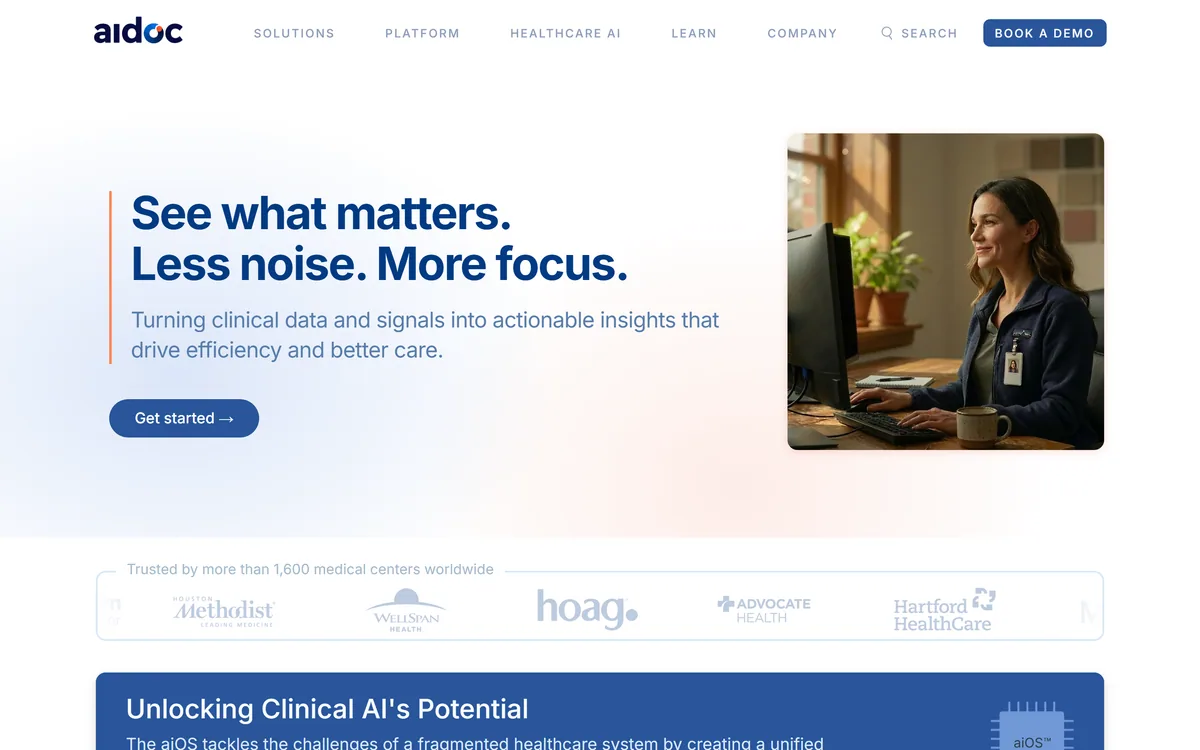
Aidoc is enterprise clinical AI for hospitals — the aiOS platform and CARE foundation model analyse imaging across radiology, cardiology, neurovascular, and vascular care to triage urgent findings, deployed in 1,600+ medical centres.
Excellent
Aidoc has an AInexfinder Editor Score of 4.5/5.
Best for: Health systems with high imaging volume where queue order matters; Hospitals prioritising stroke and pulmonary embolism pathways
The visit link goes to aidoc.com, the official site. Paid placements on AInexfinder are always labelled. How we make money
Aidoc is clinical AI for hospitals, and the problem it addresses is unglamorous but genuinely serious: a radiologist's worklist is usually ordered by when scans arrived, not by which patient is in the most danger.
Its software reads imaging as it comes in, identifies suspected urgent findings, and moves those cases forward in the queue. A suspected intracranial haemorrhage stops waiting behind a routine follow-up.
This review covers the platform, the clinical areas it covers, the outcome figures Aidoc publishes, and the questions a health system should ask before signing — because this is a procurement decision with patient-safety consequences, not a software trial.
| Company | Aidoc |
|---|---|
| Category | Enterprise clinical AI for medical imaging |
| Platform | aiOS enterprise platform |
| Foundation model | CARE |
| Radiology | Imaging analysis and worklist prioritisation |
| Cardiology | Coronary artery disease, echocardiography |
| Neurovascular | Stroke, brain aneurysm, spine, intracranial haemorrhage |
| Vascular | Venous thromboembolism, aortic disease, IVC filters |
| Beyond triage | Care coordination and patient management, including incidental findings capture |
| Stated scale | 1,600+ medical centres worldwide |
| Regulatory | Aidoc cites the largest portfolio of FDA-cleared radiology algorithms |
| Sold to | Hospitals and health systems |
Most discussion of medical AI focuses on diagnostic accuracy — can it match a radiologist. Aidoc's proposition is different and, in practice, more achievable: change the order in which humans look at things.
The radiologist still reads the scan and still makes the call. What changes is that the scan showing a probable pulmonary embolism reaches them sooner, because the software flagged it while it was sitting in a queue.
This framing matters for how the tool should be judged. A false positive costs a radiologist a few seconds of attention. A missed urgent finding costs considerably more, which is why triage tools are tuned toward sensitivity.
The clinical value is not in the software being right. It is in the right scan being looked at first.
Aidoc's architecture is worth understanding, because it is what distinguishes the company from vendors selling one algorithm for one condition.
aiOS is the enterprise platform that everything runs on. For a hospital, that matters more than any individual algorithm — integrating one AI tool into imaging workflow is a project, and integrating eight separately is an ordeal.
A single platform means one integration, one set of controls, and one place where clinical AI is governed.
CARE is Aidoc's foundation model, the layer beneath the individual clinical applications. The strategic bet is that a general model of medical imaging generalises better than a collection of narrow, separately trained detectors.
Whether that bet pays off is genuinely an open question in medical AI, and one worth asking the vendor about directly rather than accepting at face value.
Care coordination and patient management extend past the scan itself. Incidental findings capture is the clearest example — something noticed on a scan taken for another reason, which historically gets lost between departments.
That is a workflow failure rather than a diagnostic one, and it is a good fit for software.
Coverage is broader than most clinical AI vendors, spanning several specialties rather than concentrating on one.
Aidoc publishes specific operational figures: 31% faster time-to-notification for pulmonary embolism patients, a 34% reduction in door-to-puncture time for stroke patients, and 99% of eligible aortic aneurysm patients scheduled for follow-up.
These are the right kind of metrics — time-to-treatment in stroke and PE is directly linked to outcomes, so speeding it up is meaningful rather than cosmetic.
They are also vendor-reported, drawn from selected deployments, and we report them as such. A hospital evaluating Aidoc should ask which sites produced these numbers, what the baseline was, and whether the comparison was contemporaneous — the standard questions for any before-and-after clinical claim.
Buying clinical AI is unlike buying other software, and the evaluation should reflect that.
Aidoc states deployment across more than 1,600 medical centres, naming health systems including Mount Sinai, Yale New Haven Health, Houston Methodist, Ochsner, Sutter, Mercy, and UT Southwestern.
In healthcare, adoption at that scale carries real evidential weight. Academic medical centres do not put software into diagnostic pathways without clinical governance review, so each named deployment represents a passed institutional assessment.
It is still a vendor-stated list. But it is the kind of claim that is checkable and would be conspicuous if wrong.
Alert fatigue is the most serious practical risk. Triage tools are tuned for sensitivity, which means false positives, and clinicians who learn to dismiss flags reflexively have lost the benefit while keeping the interruption.
It does not reduce radiologist workload. Aidoc changes the order of reading, not the amount, so anyone hoping for staffing relief is measuring the wrong thing.
Performance varies by population. Models trained on one demographic mix can behave differently on another, and this is under-examined across the whole field, not just at Aidoc.
And it is an enterprise commitment. Integration, clinical governance, training, and change management are the real cost, and the software licence is often the smaller half of it.
Worklist prioritisation that surfaces suspected urgent findings first
aiOS enterprise platform for a single integration across specialties
CARE foundation model underlying the clinical applications
Neurovascular coverage including stroke, aneurysm, and intracranial haemorrhage
Vascular coverage including venous thromboembolism and aortic disease
Cardiology coverage including coronary artery disease and echocardiography
Incidental findings capture with follow-up tracking
Care coordination and patient management beyond the initial read
Clinical AI covers very different jobs, and these are not interchangeable.
| Tool | What it does | Who buys it | Regulatory footprint |
|---|---|---|---|
| Aidoc | Triages urgent findings in imaging | Hospitals and health systems | FDA-cleared algorithms for radiology |
| Nabla Copilot | Ambient clinical documentation | Clinicians and practices | Documentation, not diagnosis |
| Insilico Medicine | AI-driven drug discovery | Pharma and biotech | Research rather than clinical deployment |
| Neural Consult | Medical education and study support | Students and trainees | Educational, non-clinical |
| Claude | General assistant — not a medical device | Anyone | No clinical clearance |
These solve different problems in the same sector.
Last checked . Read from Aidoc's own site during this check, with the screenshot above captured at the same time.
Nothing here should be read as clinical guidance. Deployment decisions belong with a health system's own clinical governance process.
AInexfinder does not list plan prices or billing details. For current pricing, plans, and trials, visit the official Aidoc website.
Visit official website for pricingVendor pricing, credits, and billing policies change over time. Always confirm on the official site before you buy.
Aidoc earns an AInexfinder Editor Score of 4.5/5 (excellent). Best for: Health systems with high imaging volume where queue order matters; Hospitals prioritising stroke and pulmonary embolism pathways; Organisations losing incidental findings between departments.
Visit AidocLog in to write a review.
No reviews yet. Be the first to share your experience with Aidoc.
Assigned reviewer
Daniel ReedSenior AI Tools Reviewer
Daniel leads AInexfinder's tool reviews. He researches each tool from its own pricing, documentation and policies, checks its claims against independent sources, and writes up what it does well, where it falls short and who it genuinely suits.
Daniel and the AInexfinder editorial team research Aidoc from its own website, pricing, documentation and policies, checked against independent sources. This review is research-based: unless its method note says otherwise, we have not bought a plan or run hands-on tests. The Editor Score is our editorial judgement, and payment never changes it.
Similar Tools
Fitia review on AInexfinder — freemium AI tool for Health & Lifestyle. Features, pricing notes, and alternatives.

AI cycling coach that adapts plans to your readiness Category: Health & Lifestyle.
Humanity review on AInexfinder — freemium AI tool for Health & Lifestyle. Features, pricing notes, and alternatives.
Mealmind review on AInexfinder — paid AI tool for Health & Lifestyle. Features, pricing notes, and alternatives.

AI running coach for goal runners and Boston qualifiers Category: Health & Lifestyle.

AI companion for everyday emotional support and reflection Category: Health & Lifestyle.
Related Pages