Almost every company in AI drug discovery makes the same argument: our models find better targets and design better molecules, and one day that will produce a medicine. The argument is hard to check, because the gap between a promising molecule and a clinical result is a decade wide and most firms are still inside it.
Insilico Medicine is interesting because it is further along that road than the argument usually gets. Founded in 2014, it built the Pharma.ai software suite, used that suite to nominate a target and design a molecule against it, took the molecule into humans, and then published the Phase IIa results in a peer-reviewed journal.
This review separates what Insilico sells from what Insilico has proved. Those are different things, and the distinction matters whether you are a biotech evaluating the software or a reader trying to work out how much of the AI-drug story is real yet.
Rentosertib, Pharma.ai, And Why This One Is Different
- It is two businesses in one: Pharma.ai software licensed to other drug companies, and Insilico's own clinical pipeline run on that same software.
- The pipeline is the evidence. Most AI-drug-discovery firms sell a promise; Insilico put a molecule its own tools designed into patients and published what happened.
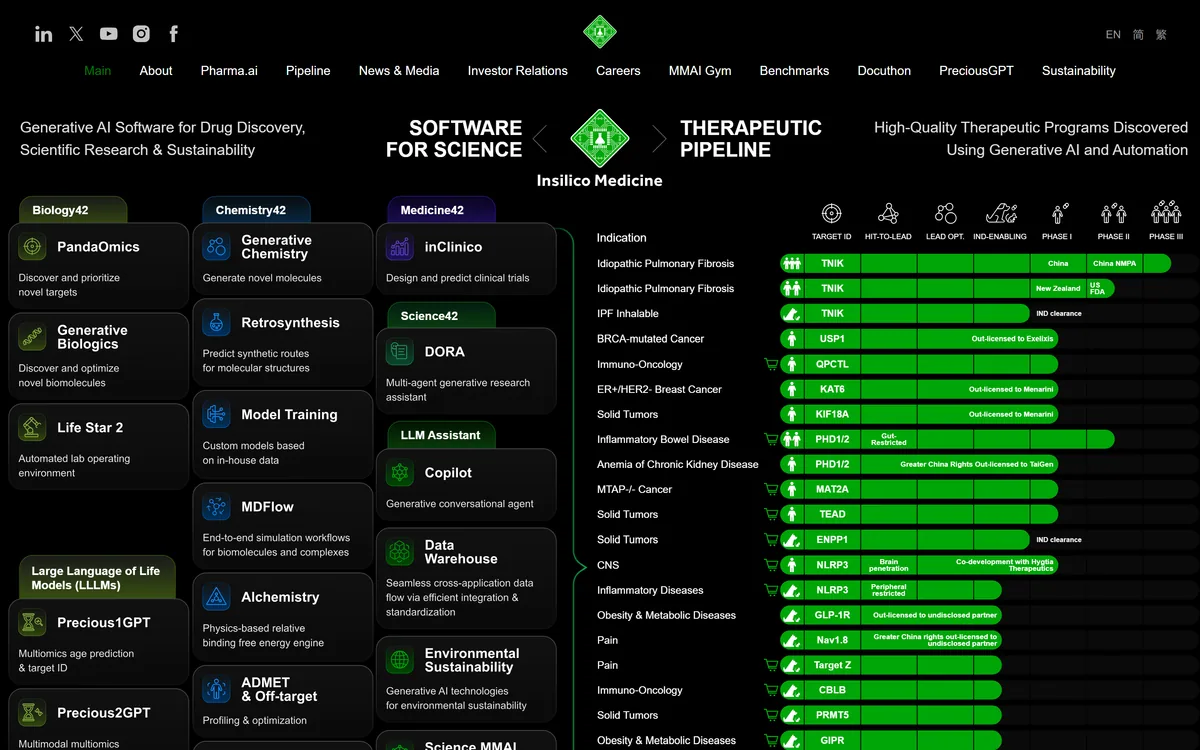
- Rentosertib (formerly ISM001-055) is a TNIK inhibitor for idiopathic pulmonary fibrosis with Phase IIa results in Nature Medicine.
- The Phase IIa was small — 71 patients, 12 weeks, conducted in China. Encouraging, not conclusive, and the company is preparing Phase III.
- Listed in Hong Kong at the end of 2025, which makes it one of the few AI-native drug companies with public financials to read.
Two Companies Wearing One Name
Understanding Insilico means noticing that it operates on both sides of a transaction it also runs itself.
On one side is Pharma.ai, a suite of software products licensed to pharmaceutical companies and research groups. On the other is Insilico's own therapeutic pipeline, a conventional biotech portfolio of programmes moving through preclinical and clinical stages.
The two are deliberately coupled. The pipeline is the demonstration that the software does something, and the software is the reason the pipeline can be run by a company of Insilico's size. A pure software vendor has to argue that its predictions would have worked; a company running its own trials can point at a result instead.
The pipeline is not a side project. It is the argument for the software, conducted in public and at the company's own expense.
What Sits Inside Pharma.ai
The suite is modular, and each module maps to a distinct stage of the discovery process rather than being one general-purpose model wearing several hats.
Target Discovery With PandaOmics
PandaOmics works on the question that comes before chemistry: which biological target is worth attacking for a given disease. It reads omics data, literature and clinical evidence to rank candidate targets.
This is the stage where AI plausibly adds the most value, because the search space is enormous, the evidence is scattered across decades of publications, and human researchers necessarily specialise narrowly. A PandaOmics Box deployment exists for organisations that need the tooling inside their own infrastructure.
Molecule Design With Chemistry42
Chemistry42 handles generative molecular design — proposing structures that should bind a chosen target while satisfying the many other constraints a drug has to meet — and includes retrosynthesis planning, which asks whether a proposed molecule can actually be made.
That second part is easy to overlook and genuinely important. A generative model unconstrained by synthesis will happily invent elegant molecules that no chemist can build.
Trial Design With inClinico
inClinico addresses clinical trial design and outcome prediction, which is where most drug capital is actually destroyed. Discovery is cheap relative to a failed Phase III.
Alongside these sit Generative Biologics for large-molecule work, Science42: DORA for research assistance, PreciousGPT as a life-sciences language model, Nach01, and MMAI Gym as a training environment.
Reading The Rentosertib Result Honestly
Rentosertib — previously ISM001-055, and written INS018_055 in some papers — is the molecule the whole story rests on. It is a TNIK inhibitor for idiopathic pulmonary fibrosis, a progressive lung disease with few good options. Both the target and the molecule came out of Insilico's own tools.
The Phase IIa was a double-blind, placebo-controlled 12-week study in 71 patients, conducted in China. At the 60 mg once-daily dose, mean forced vital capacity rose 98.4 mL from baseline over the 12 weeks, while the placebo group declined 20.3 mL. The drug was reported as safe and well tolerated across the doses tested, and the results were published in Nature Medicine.
That is a real, peer-reviewed, placebo-controlled result, and it deserves to be treated as one. It is also a 71-patient study over 12 weeks at a single geography — the size and duration at which respiratory trials routinely look encouraging and then fail to confirm. Lung function improving rather than merely declining more slowly is the striking part; whether it holds across a larger and more varied population is exactly what Phase III exists to find out.
- Design: double-blind, placebo-controlled, 12 weeks
- Population: 71 patients with idiopathic pulmonary fibrosis, conducted in China
- Headline signal: mean FVC +98.4 mL from baseline at 60 mg once daily, versus −20.3 mL on placebo
- Safety: reported safe and well tolerated at all doses studied
- Publication: Nature Medicine, which means the data survived external review
Where The Programme Goes Next
The company's stated direction extends rentosertib in three directions at once, which is a reasonable way to spend a positive Phase IIa.
- Prepare Phase III for the oral formulation in idiopathic pulmonary fibrosis — the study that decides whether the Phase IIa signal was real.
- Take the same molecule into kidney fibrosis, on the reasoning that TNIK biology is not lung-specific.
- Develop an inhaled formulation, which received IND clearance from China's CDE and would be the first AI-discovered candidate to enter a direct-to-lung clinical study.
- Keep advancing the wider pipeline — USP1, QPCTL, MAT2A, TEAD, ENPP1, KAT6, FGFR2/3 and PHD programmes across oncology, inflammation and fibrosis.
- Continue licensing Pharma.ai to external groups, so the software revenue is not dependent on any single clinical outcome.
The Part Nobody Should Overclaim
It is worth being precise about what has been shown, because this field attracts imprecision.
What has been demonstrated is that a target-and-molecule pair generated with AI assistance can reach Phase II and produce a credible efficacy signal. That is a meaningful first, and it is more than any competing claim in the category currently supports.
What has not been demonstrated is that AI-designed drugs succeed at a higher rate than conventionally discovered ones. Establishing that needs many programmes, many years, and Phase III outcomes rather than Phase II ones. Insilico is running the experiment, but the experiment is not finished.
It is also worth remembering that the AI shortened the earliest and cheapest part of the process. Chemistry and target selection are not where drug development mostly fails. Trials are, and a trial does not run faster because the molecule inside it was designed by a model.
Insilico At A Glance
| Founded | 2014 |
|---|
| Category | Generative AI drug discovery, plus an in-house clinical pipeline |
|---|
| Software suite | Pharma.ai |
|---|
| Named modules | PandaOmics, PandaOmics Box, Chemistry42, Generative Biologics, inClinico, Science42: DORA, PreciousGPT, Nach01, MMAI Gym |
|---|
| Lead candidate | Rentosertib (formerly ISM001-055 / INS018_055), a TNIK inhibitor |
|---|
| Lead indication | Idiopathic pulmonary fibrosis |
|---|
| Clinical stage | Phase IIa complete and published; Phase III in preparation |
|---|
| Peer review | Phase IIa results published in Nature Medicine |
|---|
| Listing | Hong Kong IPO completed at the end of 2025 |
|---|
| Offices | Cambridge MA, Hong Kong Science Park, Abu Dhabi, Shanghai |
|---|
| Advisory board | Includes Michael Levitt, 2013 Nobel laureate in Chemistry |
|---|
| Recognition | Fast Company most innovative biotechnology company, 2024 |
|---|
Terms You Need To Follow The Story
The rentosertib result is only readable if a handful of terms are clear.
- TNIK
- The protein rentosertib inhibits. Insilico's tools identified it as a fibrosis target, which is the part of the claim that belongs to PandaOmics rather than to chemistry.
- Idiopathic pulmonary fibrosis (IPF)
- A progressive scarring of lung tissue with no known cause and limited treatment options. Existing drugs slow decline rather than reverse it, which is why an increase in lung function draws attention.
- Forced vital capacity (FVC)
- The volume of air a patient can forcibly exhale. It is the standard efficacy endpoint in IPF trials, and it normally falls over time in untreated patients.
- Phase IIa
- An early efficacy study in a small patient group. It is designed to detect a signal and inform dosing, not to prove a drug works — that is Phase III's job.
- Retrosynthesis
- Working backwards from a target molecule to a route for making it. Chemistry42 includes this because a generated molecule nobody can synthesise is not a candidate.
- IND clearance
- Regulatory permission to begin human studies of a formulation. Insilico's inhaled rentosertib received this from China's CDE.