Modern protein engineering runs on a sprawl of brilliant but fiddly open tools, each with its own setup, dependencies and GPU demands. The hard part is rarely the science; it is getting the software to run at all. Tamarind Bio exists to erase that tax.
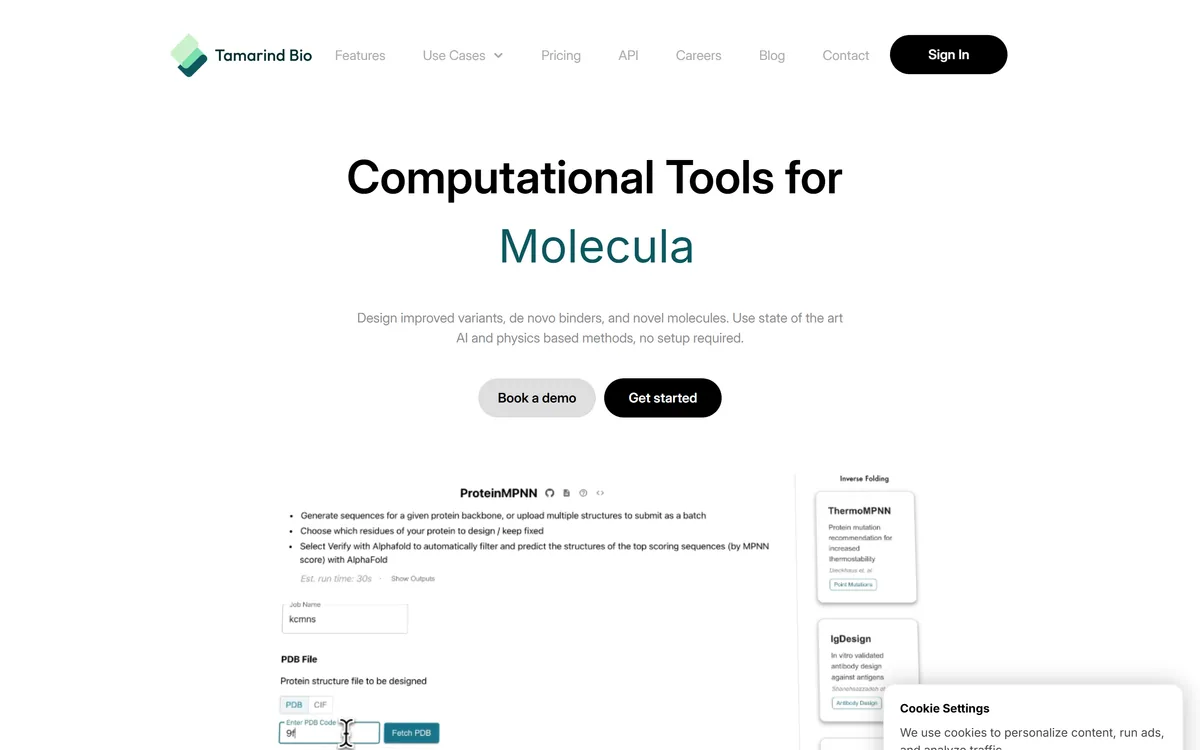
It is a cloud platform that puts the published state of the art, AlphaFold, RFdiffusion, ProteinMPNN, GROMACS and over a hundred more, behind a single interface and API, with the compute handled for you. It is to molecular design what a model-hosting service like Replicate is to AI models generally: the methods are public, the orchestration is the product.
This review covers what scientists can actually run on Tamarind Bio, who benefits from a no-setup platform, how access is structured, and where it is more than a lab needs.
Tamarind Bio, The Quick Read
- Tamarind Bio is AI infrastructure for biotech R&D: one interface onto the published state of the art in protein and molecule design.
- It hosts 100+ tools: AlphaFold, RFdiffusion, ProteinMPNN, GROMACS, Boltz, Chai-1 and more, with no deployment on your side.
- It scales the compute for you: GPU orchestration and parallelization across hundreds of thousands of inputs, via web UI, API or MCP.
- You keep your IP: it states you own your inputs and derivatives, on a SOC 2 cloud with isolated computations.
| What it is | A cloud platform for computational biology |
|---|
| Covers | Antibody, peptide, enzyme, small-molecule design |
|---|
| Tool catalogue | 100+ published methods in one interface |
|---|
| Named methods | AlphaFold, RFdiffusion, ProteinMPNN, GROMACS |
|---|
| Scale | GPU orchestration across huge input batches |
|---|
| Access | Web interface, programmatic API, MCP server |
|---|
| IP stance | You own your inputs and their derivatives |
|---|
| Security | SOC 2 compliant cloud, isolated computations |
|---|
One Interface For The State Of The Art In Protein Design
Tamarind Bio's pitch is that the cutting edge of protein engineering is already published, as AlphaFold, RFdiffusion, the MPNN family, GROMACS and dozens more, but almost none of it is easy to run. It gathers that catalogue into one place and handles the deployment, so a scientist can use a method without a literature review and a week of DevOps.
That reframing is genuinely valuable. The bottleneck in computational biology is often not ideas but access: the time between wanting to try a method and actually having it running. Collapsing that to a web interface or an API call changes what a small team can attempt.
It spans the real workflow, too, structure prediction, docking, de novo binder design and molecular-dynamics simulation, rather than a single trick, which is why it reads as infrastructure rather than a point tool.
The bottleneck in computational biology is often not ideas but access: the time between wanting to try a method and having it running. Tamarind collapses that to one interface.
What Can Scientists Actually Run On Tamarind Bio?
The platform organises its catalogue around the molecules you are working on, which keeps a huge tool list navigable.
Antibodies, Peptides, Enzymes And Small Molecules
There are dedicated tracks for antibodies and nanobodies, peptides, enzymes and small molecules. Within them you can design de novo binders, redesign and optimize CDRs for an antigen, predict antibody-antigen binding poses, and score developability properties like thermostability and solubility.
Underpinning those tracks is a catalogue of over a hundred named methods, the kind of breadth that a research-focused search tool like Exa helps you discover in the literature, except here each method is a click away rather than a paper to re-implement.
Compute, Scale And Your Own IP
Tamarind handles the high-performance compute, parallelization and GPU orchestration, so tools can run across hundreds of thousands of inputs without you managing a cluster. Access is through a web interface, a programmatic API, and an MCP server for agentic use.
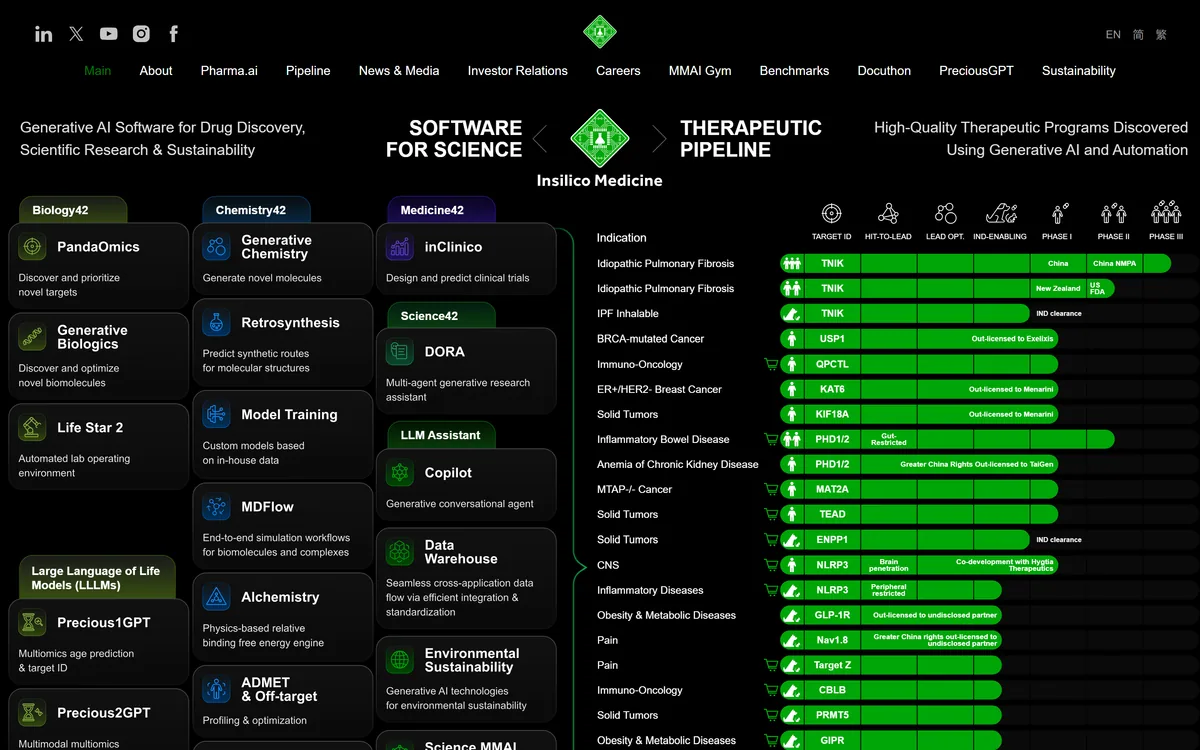
On the sensitive question of ownership, it states plainly that you own your inputs and their derivatives, on a SOC 2 cloud where each computation is isolated. For a peer in the drug-discovery space such as Insilico Medicine, that end-to-end stack is the whole company; Tamarind instead sells the tooling layer and leaves the IP with you.
The clearest win is for small and mid-size biotechs without a dedicated computational infrastructure team. They get access to methods that would otherwise require hiring and months of setup, at the speed of a web app.
It also helps bench scientists who are not ML engineers but want to use ML-driven design in their work, and larger groups that want to standardise on one interface rather than maintain a dozen bespoke deployments.
It is less necessary for organisations that already run their own mature pipelines and have the engineers to maintain them. For them the value is narrower, though even there the breadth of the catalogue and the scaling can be a useful overflow.
How Tamarind Bio Approaches Access And Pricing
Tamarind has a pricing page and a get-started path alongside a book-a-demo and book-a-call motion, which points to a self-serve entry with enterprise agreements for larger needs. We do not reproduce prices, which change; check the site.
Because the real cost of these methods is the compute they consume, the sensible way to weigh it is against what you would otherwise spend standing up and running the same tools yourself, in both cloud bills and engineer time.
For a team doing this occasionally, paying for managed access is almost always cheaper than building; for one running at constant high volume, the maths deserves a closer look, which is exactly what a pilot is for.
A Sensible Way To Pilot Tamarind Bio
Because it is infrastructure, judge it on a real task from your own pipeline rather than a demo molecule.
- Pick a method you already use or have wanted to try, and a real target from current work.
- Run it through the web interface first to gauge the setup time saved versus your own deployment.
- Check the outputs against a result you trust, so you are validating quality, not just convenience.
- If you build pipelines, call the same method through the API or MCP server to test fit.
- Scale one job up to a realistic batch size and watch how the orchestration and cost behave.
- Pass/fail: Tamarind is worth it if it saves meaningful engineer time without compromising the result.
- Confirm the IP and data-isolation terms in the Trust Center satisfy your organisation before committing.
Tamarind Bio Protein-Design Terms
- De novo binder
- A protein or peptide designed from scratch to bind a chosen target, rather than derived from a known one.
- CDR
- The complementarity-determining regions of an antibody, the loops that determine what antigen it binds; a key target for optimization.
- Developability
- How suitable a designed molecule is to make and use, covering properties like thermostability, solubility and aggregation.
- MCP server
- An interface that lets an AI agent call Tamarind's tools programmatically, not just a human through the web UI.