Running a machine-learning model in production usually means wrestling with GPUs, containers and scaling before you write a line of product code. Replicate's whole purpose is to make that someone else's problem.
It is a developer platform where thousands of models, image, video, speech, music and language, are callable with one line of code, where you can fine-tune them on your own data, and where you can deploy a custom model via its open-source Cog tool. The infrastructure is the product, much as model-observability tools like Helicone make the operational side of LLMs manageable.
This review covers how Replicate goes from a model to an API, where it saves builders real effort, how its compute billing works, and when self-hosting still wins.
Replicate, The Short Brief
- Replicate runs AI with an API: thousands of community and official models callable in a single line of code.
- It covers the full loop: run shared models, fine-tune them on your data, and deploy your own.
- Cog is the deploy mechanism: an open-source tool that packages a model and generates its API server.
- You pay for compute used: per-second billing that scales to zero when idle, with no charge when nothing is running.
| What it is | A platform to run AI models via API |
|---|
| Catalogue | Thousands of community and official models |
|---|
| Call it in | One line via Node, Python or HTTP |
|---|
| Fine-tuning | Train models on your own data |
|---|
| Custom deploy | Package your own model with Cog |
|---|
| Scaling | Automatic, including scale-to-zero |
|---|
| Billing | Pay per second of compute used |
|---|
| Open source | Cog is open-source model packaging |
|---|
Run Almost Any AI Model With One Line Of Code
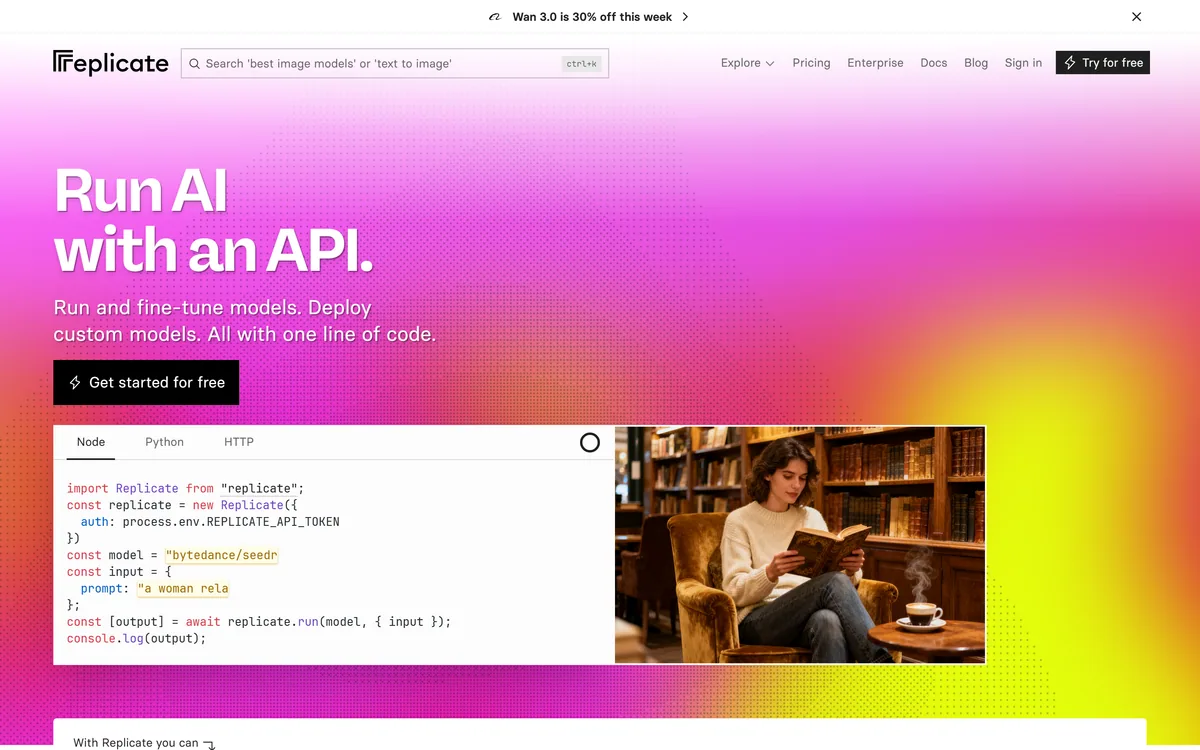
Replicate's defining feature is the one-line call. You point at a model by owner and name, pass inputs, and get outputs, without ever touching a GPU, a container or a scaling policy. That simplicity is what has made it a default building block for AI products.
The catalogue is the other half of the appeal: frontier models across images, video, speech, music and language sit behind the same interface, many carrying run counts in the millions that give a sense of what is production-proven.
Because the calling convention is identical whatever the model, swapping one generator for another is trivial, which matters in a field where the best model for a task changes every few months.
You point at a model by name, pass inputs, and get outputs, without ever touching a GPU, a container or a scaling policy. That simplicity is the whole product.
How Does Replicate Go From Model To API?
Replicate covers three jobs, and the third, deploying your own model, is where it goes beyond a model marketplace.
Running And Fine-Tuning Shared Models
You can call any public model through the client libraries or HTTP, and fine-tune supported ones on your own data to produce a private, specialised version, an image model trained on your style, for instance, then called the same one-line way.
That run-and-tune loop pairs naturally with the LLM-ops tooling teams add around it; an observability layer like Langfuse helps you trace and debug what your Replicate-hosted models are actually doing in production.
Packaging Your Own Model With Cog
For custom work, Replicate's open-source Cog tool packages your model, you define a config and a predict function, and it builds a container and generates an API server that Replicate deploys on an auto-scaling GPU cluster.
Cog being open source is a genuine trust and portability advantage: your packaging is not locked to one vendor. For the data side of an AI build, a retrieval API like Exa complements model hosting, feeding your models fresh, grounded context.
Where Replicate Saves Builders Real Effort
Replicate pays off most for developers and teams building AI features who do not want to become ML-infrastructure experts. It collapses weeks of GPU and deployment work into an API call, which is transformational for a small team or a prototype.
It also suits anyone who needs to experiment across many models quickly, since the uniform interface makes swapping and comparing cheap, and anyone whose load is spiky, because scale-to-zero means idle time costs nothing.
It saves less for an organisation running a single model at constant, heavy volume, where owning the infrastructure can be cheaper at scale, which is exactly the trade the comparison below lays out.
How Replicate Bills For Compute
Replicate is usage-based: you pay per second of compute by the hardware a model runs on, and because it scales to zero, you are not billed when nothing is running. There is a free tier to start, and enterprise plans for larger needs. We do not publish rates, which change; check the site.
That model is a near-perfect fit for the spiky, unpredictable load of most AI features, you pay for what you use and nothing when idle, and a poor fit only when a model runs flat-out around the clock.
The honest way to size the cost is to run your real workload for a short period and read the actual bill, rather than estimating from a per-second rate in isolation.
A Quick Way To Prove Out Replicate
Because the pitch is one-line simplicity, prove it on a real feature rather than a toy example.
- Pick a model that matches a feature you actually want to ship.
- Call it from your stack with the Node, Python or HTTP client and measure the integration time.
- If you need a specialised version, fine-tune a supported model on a sample of your data.
- If you have a custom model, package it with Cog and deploy it to test the full path.
- Run a realistic burst of traffic and watch how scaling and the bill behave.
- Pass/fail: Replicate is worth it if it ships the feature far faster than self-hosting would.
- Project the cost at your real steady-state volume before committing to it long term.
Replicate Model-Hosting Terms
- Cog
- Replicate's open-source tool that packages a model into a container and auto-generates an API server for it.
- Scale to zero
- Automatically shutting a model down when idle so you pay nothing when it is not running.
- Fine-tuning
- Training an existing model further on your own data to produce a specialised private version.
- Official model
- A model badged and maintained on Replicate, as opposed to a community-contributed one.
Should Replicate Run Your Models?
Builders Replicate Fits Neatly
- Developers adding AI features without ML-infra expertise
- Teams that need to experiment across many models fast
- Products with spiky or unpredictable load
- Anyone deploying a custom model without building a cluster
- Prototypes that need to ship quickly
When Replicate Is Not The Right Home
- One model running flat-out around the clock
- Teams with mature ML infrastructure already
- Workloads with strict on-prem-only data rules
- Anyone needing the lowest possible cost at huge scale
- Use cases that never change model and never scale down