Biomechanical testing has always been a resource problem rather than a knowledge problem. The science of how an athlete accelerates has been settled for decades; getting a number for your athlete meant a lab, a day, and a budget almost nobody has.
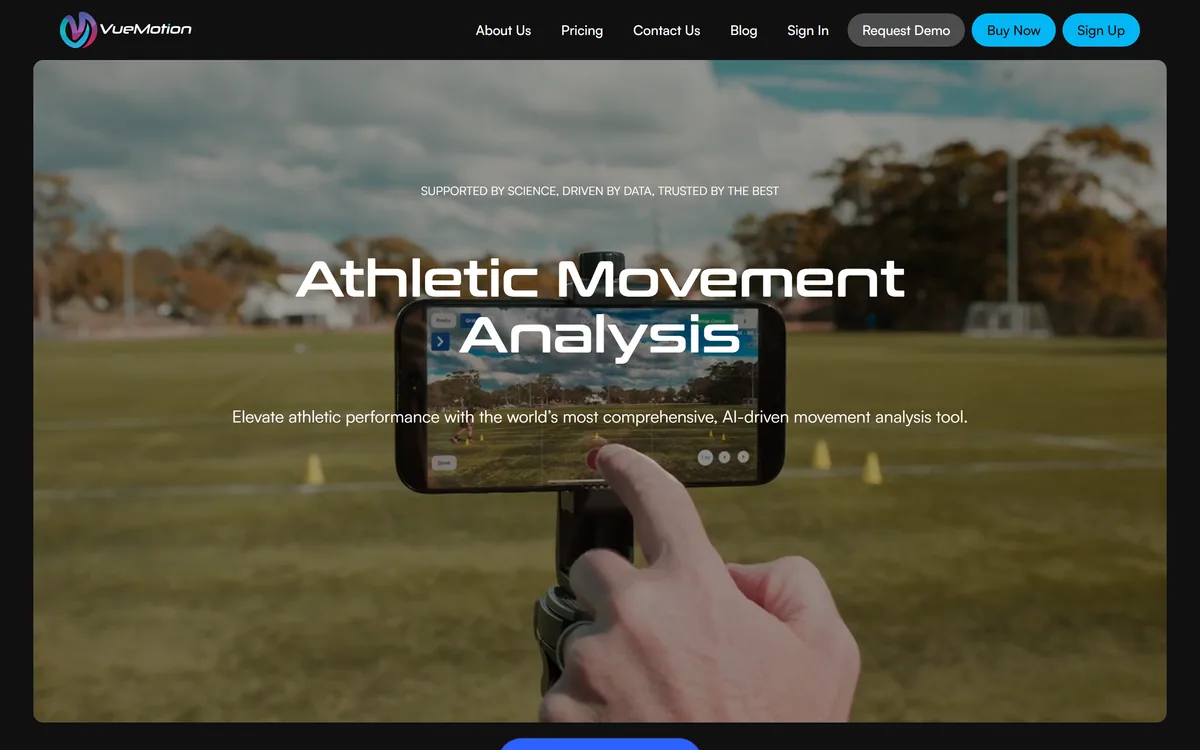
VueMotion's proposition is that a phone on a tripod and five cones on any surface produces the same class of measurement.
That claim is either a significant democratisation or an overreach, and the useful thing about this product is that it gives you enough information to judge which.
VueMotion: Biomechanics From A Phone Camera
- A phone, a tripod and five cones — no sensors, markers or lab hardware required.
- Five test types: acceleration, upright running, deceleration, change of direction and jumping.
- Every metric published: split times, step length, step frequency, ground contact time, flight time and thigh angular velocity.
- Independent validation named — studies against motion capture through a partnership with the Australian Catholic University.
- 11 sports supported, with the domain now on vuemotion.com after moving from the .ai address.
What Can Computer Vision See In A Sprint?
The platform lists exactly what it outputs per analysis: split times and average and maximum speeds, total time, step length, step frequency in hertz, ground contact time, flight time, thigh angular velocity and kinograms, delivered as augmented reality video plus individual and team reports.
Publishing that list is the most important thing on the site, because it converts a vague capability claim into a set of specific, testable measurements.
Most of these are things a coach with a stopwatch cannot get at all. Split times, yes, with practice. Ground contact time measured in milliseconds, no — that requires frame-level analysis, and at 4K 60fps you have the temporal resolution to do it.
Thigh angular velocity is the most interesting inclusion, because it is a mechanism variable rather than an outcome one. Two athletes can run the same time with entirely different limb mechanics, and only one of them is close to their ceiling.
The honest limit is that video sees positions over time and infers everything else. Force, which is what actually accelerates a body, is not measured — it is derived. That derivation can be good, and it is not the same as a force plate.
A stopwatch gives you the outcome. Ground contact time and thigh angular velocity give you the mechanism, and only one of those tells you what to change.
Reading The Validation Claim Properly
The site states patent-pending, scientifically validated algorithms, and elsewhere states that it has partnered with several universities including the Australian Catholic University, which has carried out several independent validation studies against the gold standard of motion capture.
That second statement is meaningfully stronger than the first, and the difference matters.
Scientifically validated is a phrase anyone can print. Naming a specific university that ran comparisons against marker-based motion capture is a checkable claim, and it invites the question any buyer should ask: validated for which measures, at what error margin, under what conditions.
Those details decide usability. A system agreeing with motion capture within two percent on split times and fifteen percent on ground contact time is useful for one purpose and misleading for another, and only the published study says which.
The site points to a validation page and invites contact for further information, which is the right posture. Anyone spending real money on this should read the studies rather than the summary — including whether they cover the specific tests and sports they intend to use.
Eleven Sports And What Movement Profiles Show
The supported list is specific: athletics, Australian rules football, baseball, basketball, cricket, ice hockey, netball, NFL, rugby league, rugby union and soccer.
A named list rather than a claim of universal applicability is a good sign, and the composition tells you what the underlying analysis is built around.
Every sport there involves sprinting, decelerating and changing direction under time pressure. What is absent is equally informative — no swimming, no cycling, no gymnastics, no combat sports, because those movements are not what this measures.
The output is described as an athlete movement profile with precise measurements, so interventions and performance can be tracked objectively over time. That framing is the correct one, because a single test is nearly worthless.
Biomechanical measurement earns its value through repetition. A ground contact time on one Tuesday is a number; the same measurement across a season, either side of a training block or a return from injury, is evidence — which is the same logic that makes daily readiness tracking in Vici useful and one-off measurement mostly not.
- Confirm your sport is on the list of eleven before committing.
- Read the validation studies for the specific tests you will use.
- Standardise surface, footwear and camera position across sessions.
- Test the same athletes repeatedly rather than everyone once.
- Treat derived force estimates as estimates, not plate data.
Patent-Pending And Scientifically Validated
Both phrases appear together on the site, and they pull in opposite directions in a way worth understanding.
Patent-pending means an application has been filed. It says nothing about whether a patent will be granted, and pending status is not evidence of anything except that a filing exists.
It is also, for a buyer, close to irrelevant. Whether the vendor can stop a competitor copying its method has no bearing on whether the measurements are accurate for your athletes.
Scientifically validated is the claim that matters, and it is the one with substance behind it here — a named institution, comparisons against motion capture, and an invitation to request further detail.
The general lesson is worth stating because this category is full of it: in sports technology, patent language is marketing and independent validation is evidence. MacroFactor is a useful comparison, because it publishes its method rather than a filing status. When a vendor offers both, read the second and ignore the first.
What The Setup Actually Requires
The stated equipment is a smartphone, a tripod and five cones, with capture at 4K 60fps through an iPhone app carrying indoor and outdoor modes to reduce motion blur, and the ability to control up to six iPhone cameras simultaneously from one device.
The multi-camera control is the feature that turns this from a demo into something a team can run.
Testing a squad one athlete at a time with one phone consumes an afternoon. Six synchronised cameras with remote start and stop means a whole team in a few minutes, which is the difference between testing once a season and testing regularly.
The motion blur point is more technical than it sounds and genuinely matters. Standard phone video at typical shutter speeds smears a fast-moving limb across frames, and any measurement of contact time depends on knowing precisely when the foot landed.
The remaining constraints are practical. Six iPhones is a real hardware requirement, camera position and surface need to be consistent between sessions for comparisons to mean anything, and the app is iOS with a web platform alongside it. Using a phone camera as a measuring instrument is a pattern worth watching, and Derm AI applies it to a very different problem.
Testing Athletes Without A Motion Lab
The failure mode with accessible testing is testing everyone once, producing a spreadsheet nobody revisits and no decision anybody makes.
This sequence sets up measurement you can actually compare against itself later.
- Read the validation studies for the tests you intend to run.
- Fix a protocol — surface, footwear, cone distances, camera position, time of day.
- Record that protocol in writing so a colleague can repeat it exactly.
- Test a small squad and establish each athlete's own baseline.
- Re-test after a training block, not after a single session.
- Compare each athlete against themselves before comparing across the squad.
VueMotion: Sports And Partners
| Domain | vuemotion.com; the .ai address redirects here |
|---|
| Positioning | AI-driven athletic movement analysis, accessible from a phone or the web |
|---|
| Sports supported | Athletics, AFL, baseball, basketball, cricket, ice hockey, netball, NFL, rugby league, rugby union and soccer |
|---|
| Test types | Acceleration, upright running, deceleration, change of direction and jumping |
|---|
| Equipment needed | A smartphone, a tripod and five cones — no sensors or markers |
|---|
| Capture | 4K at 60fps, with indoor and outdoor modes to limit motion blur |
|---|
| Multi-camera | Up to six iPhone cameras controlled from one device |
|---|
| Outputs per credit | AR video plus individual and team reports |
|---|
| Measures | Split times, average and maximum speed, total time, step length, step frequency, ground contact time, flight time, thigh angular velocity and kinograms |
|---|
| Validation | Independent studies against motion capture via the Australian Catholic University, per the site |
|---|
| Partner product | PSR credits from Speedworks, a UK coach education company — Projection, Switching and Reactivity |
|---|
| Displayed scale | 100k athletes, 80 elite teams, 11 sports, 50 countries and 10M frames analysed |
|---|
Is VueMotion Right For Your Programme?
Test athletes when
- Your sport is one of the eleven on the list.
- You want objective evidence either side of a training intervention.
- Return-to-play decisions currently rest on subjective assessment.
- A lab is out of reach on budget, distance or scheduling.
- You can standardise a protocol and repeat it across a season.
Book a lab when
- You need force plate data rather than derived estimates.
- The movement is swimming, cycling, gymnastics or combat sport.
- A clinical or medico-legal decision depends on the numbers.
- Nobody will own re-testing, so you would measure once and stop.
- Your squad has no consistent surface or setup to test on.