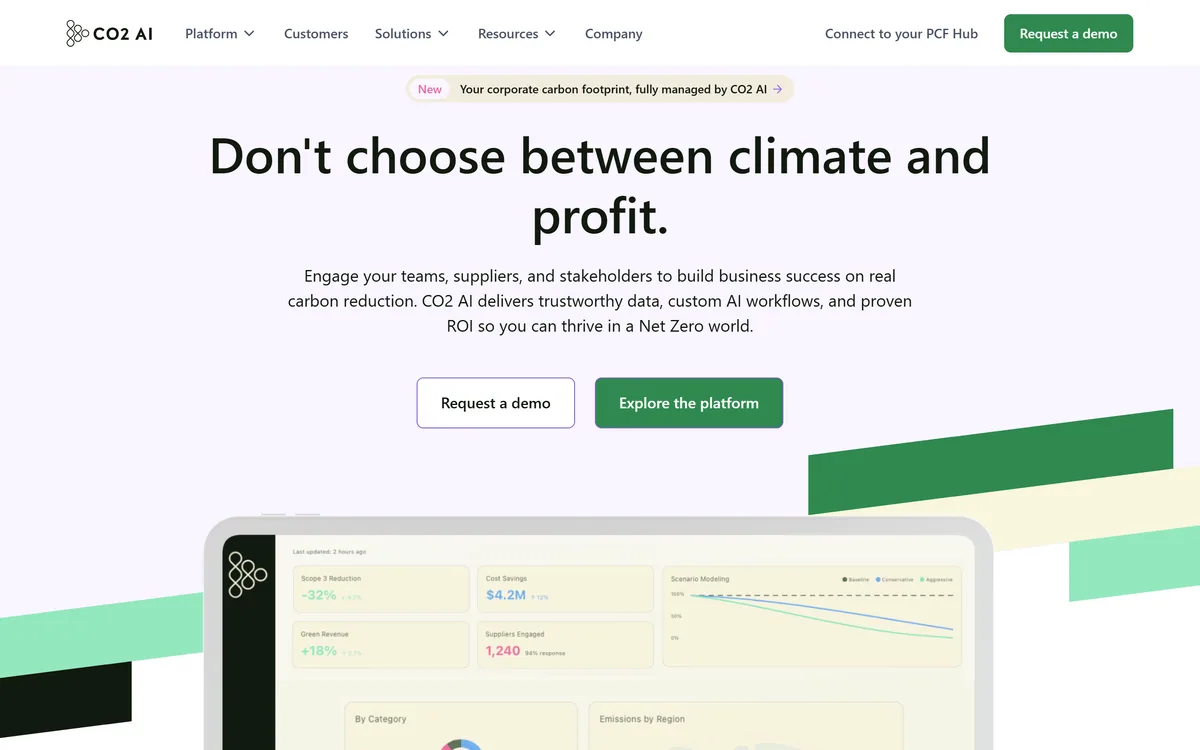
Corporate carbon accounting has become a reporting obligation, not a nice-to-have, and for a large multinational it is a genuinely hard data problem spanning operations, products and thousands of suppliers. CO2 AI is built for that scale.
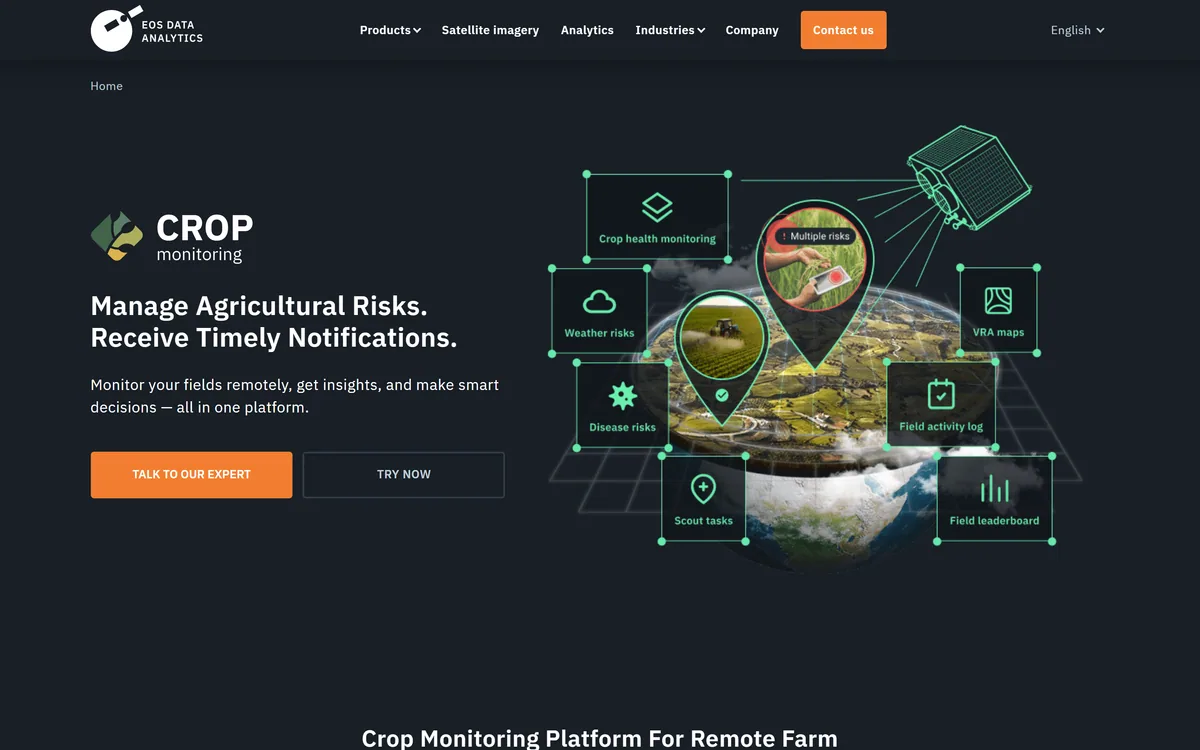
It is an enterprise sustainability platform that measures, reduces and reports emissions by connecting corporate, product and supplier data in one system, using AI to match emission factors, flag data gaps and prioritise where to cut. It sits in the same deep-tech-for-enterprise world as climate-data tools like EOSDA Crop Monitoring, but aimed at the carbon ledger rather than the field.
This review covers how CO2 AI turns data into decarbonization, how to read its impressive-sounding numbers with a clear head, how it is sold, and which organisations it actually fits.
CO2 AI, The Core Facts
- CO2 AI is an enterprise carbon platform: measure, reduce and report emissions across corporate, product and supply-chain data in one place.
- It is built for scale and complexity: Scopes 1-3, thousands of product footprints, and a hub for collecting supplier data.
- AI does the heavy lifting: emission-factor matching, anomaly detection and data-gap flagging, with abatement-cost curves to prioritise.
- It is enterprise, demo-led: its strong recognition and ROI figures are vendor claims to verify against your own case.
Carbon Accounting Built For Big, Messy Enterprises
CO2 AI's core claim is that it unifies three things most tools keep separate: the corporate footprint, individual product footprints, and supplier data. For a complex global business, that separation is exactly the problem, so bringing them into one system is a meaningful design choice.
The target user is a lean sustainability team at a large enterprise, people responsible for a reporting and reduction mandate far bigger than their headcount. The pitch is that AI closes that gap by automating the grind of matching activity data to emission factors and spotting anomalies.
It is firmly an enterprise product, not something a small company would adopt, and it reads that way: the language is about audit trails, regulatory frameworks and booking decarbonization the way a finance team books cost savings. Its closest comparison is Persefoni, which leans more toward disclosure and finance; the two are the obvious shortlist for a large enterprise carbon programme.
The pitch is that AI closes the gap between a reporting mandate and a lean team, by automating the grind of matching activity data to emission factors and spotting the anomalies.
How Does CO2 AI Turn Data Into Decarbonization?
The platform moves from measurement to action in stages, which is what separates an accounting tool from a reduction one.
It builds a corporate footprint across Scopes 1, 2 and 3 as a single source of truth, and generates product carbon footprints at scale from bill-of-materials data. The AI-driven emission-factor matching, anomaly detection and data-gap flagging are what make that tractable for thousands of SKUs.
That data-matching work is the unglamorous heart of carbon accounting, and automating it is where the time savings the vendor advertises would come from, savings worth validating on your own data rather than taking on faith.
Abatement Curves And The Supplier Hub
On the action side, CO2 AI builds marginal abatement cost (MAC) curves to rank which decarbonization levers give the most reduction per unit cost, and runs a Supplier Hub to collect primary data from suppliers and benchmark them.
The supplier piece is where most Scope 3 emissions live and where the data is hardest to get. A satellite-based monitoring tool like Taranis solves a different climate-data problem, but the shared lesson is the same: primary data is the hard part, and a structured way to collect it is a real feature.
Reading CO2 AI's Numbers With A Clear Head
CO2 AI's site is dense with strong figures, large ROI percentages, big accuracy and speed multiples, major-analyst recognition and blue-chip customer names. These are vendor-stated, and this review treats them as claims, not established facts.
That is not a knock; the recognition from well-known analyst firms and the named enterprise customers are real signals of maturity. But a headline like a particular ROI multiple or a time-saving percentage describes the vendor's framing of selected deployments, and your mileage depends entirely on your data and processes.
The same applies to compliance language. CO2 AI aligns to the recognised standards and regulations, but 'aligned to' and 'audit-ready' are about enabling your reporting, not a guarantee your disclosures will pass; your auditors and advisers decide that.
How CO2 AI Is Sold And Priced
CO2 AI is an enterprise, demo-led product: there is no self-serve pricing, and engagement runs through a request-a-demo and connect-your-data motion. We do not publish prices, which are negotiated; the site is the place to start that conversation.
For the buyer, the value question is whether the platform's automation meaningfully reduces the cost of compliance, the people-hours, the consultant fees, the risk of a bad disclosure, relative to a serious annual commitment.
For a large, complex business facing CSRD-style obligations, that case can be strong; for a smaller organisation, this is almost certainly more platform than the mandate requires, and a lighter tool will serve better.
A Grounded Way To Evaluate CO2 AI
Because the marketing is confident, run the evaluation on your own data and your own reporting obligation.
- Name your actual obligation, the frameworks and deadlines you must report against, before the demo.
- Bring a real slice of your data and have CO2 AI build a footprint from it, not a sample.
- Check the AI's emission-factor matches against ones your team already trusts.
- Test the Supplier Hub with a handful of real suppliers to see how collection works in practice.
- Ask your sustainability advisers or auditors whether the output fits their assurance process.
- Pass/fail: CO2 AI is worth it if it cuts the real cost and risk of your reporting, on your numbers.
- Treat every ROI, accuracy and speed figure as a claim to verify, not a result to assume.
| What it is | An enterprise sustainability and carbon platform |
|---|
| Measures | Corporate footprints across Scopes 1, 2 and 3 |
|---|
| Products | Product carbon footprints at SKU scale |
|---|
| AI role | Factor matching, anomaly and gap detection |
|---|
| Prioritising | Marginal abatement cost (MAC) curves |
|---|
| Suppliers | A Supplier Hub for primary data collection |
|---|
| Standards | Aligned to GHG Protocol, SBTi, CSRD and more |
|---|
| Model | Enterprise, demo-led, no self-serve pricing |
|---|
CO2 AI Carbon-Accounting Terms
- Scope 1, 2, 3
- The three categories of emissions: direct (1), purchased energy (2), and everything across the value chain (3), which is usually the largest and hardest.
- Product carbon footprint
- The emissions associated with a single product across its lifecycle, often built from bill-of-materials data.
- Emission factor
- A coefficient that converts an activity or spend into an emissions estimate; matching data to the right factor is core to carbon accounting.
- MAC curve
- A marginal abatement cost curve, ranking decarbonization levers by how much reduction each delivers per unit of cost.
Is CO2 AI Matched To Your Reporting?
Organisations CO2 AI Can Help
- Large enterprises with a serious disclosure obligation
- Lean sustainability teams stretched across a big mandate
- Businesses needing product footprints at SKU scale
- Companies where Scope 3 and suppliers dominate emissions
- Teams that want to prioritise cuts by cost-effectiveness
When CO2 AI Is The Wrong Scale
- Small or mid-size companies with a light footprint
- Anyone wanting self-serve, low-cost accounting
- Teams who will take ROI and accuracy claims on faith
- Organisations without the data to feed a platform like this
- Those needing only a simple annual estimate