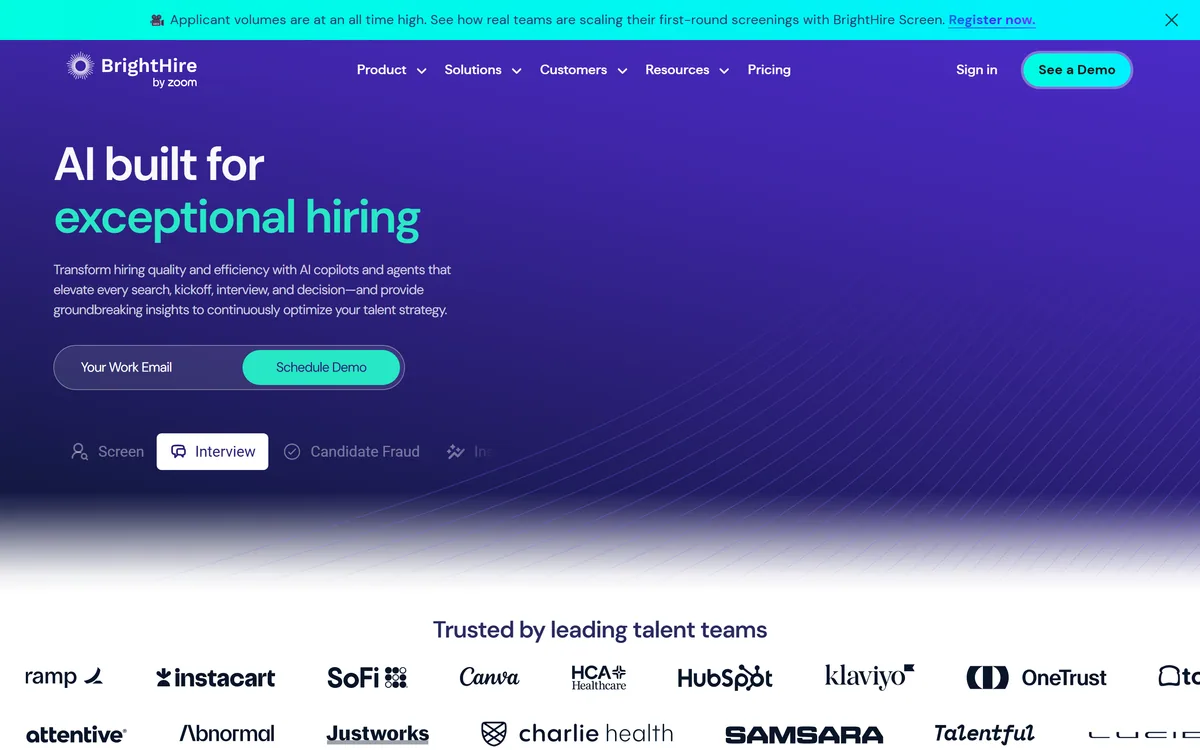
Hiring interviews are inconsistent, under-documented and prone to bias, and getting them right is high-stakes for candidates and companies alike. BrightHire's pitch is to bring intelligence to them: record, analyse and improve interviews.
It plans interviews, records and takes AI notes, offers an optional AI interviewer for first rounds, detects impersonation and deepfakes, and coaches interviewers, integrating with your ATS. It sits among hiring tools like HeyMilo, at the interview-intelligence end.
This review covers how BrightHire supports interviews, which teams it suits, how it's sold, and the bias, consent and data duties, which are central, to weigh first.
BrightHire Interview-Intelligence Facts
| What it is | An AI interview-intelligence platform for hiring |
|---|
| Company | BrightHire, Inc. |
|---|
| Core | Records and analyses interviews; planning, AI notes, insights |
|---|
| AI interviewer | Optional automated first-round screens (BrightHire Screen) |
|---|
| Also | Candidate-authenticity/deepfake detection; interviewer coaching |
|---|
| Integrations | ATS, video-conferencing, Slack/Teams/email |
|---|
| Access | Sales-led/demo (no public price or free tier shown) |
|---|
| Sensitive | Hiring bias/fairness; recording consent; candidate data |
|---|
AI Interview Intelligence For Hiring Teams
BrightHire's core job is to make interviews better: more consistent, more documented and fairer. It helps plan interviews, records and transcribes them, generates AI notes and highlights, and turns the result into insights and interviewer coaching, so hiring decisions rest on evidence rather than fuzzy memory.
It adds more: an optional 'always-on AI interviewer' (BrightHire Screen) for automated first-round interviews, candidate-authenticity detection (signals of AI-generated answers, proxies or deepfakes), and analytics across your hiring, integrated with your ATS and meeting tools.
The pitch is explicitly fairness-oriented, equitable, structured, bias-reduced hiring, with the AI positioned to inform interviewers, not to make the call for them.
The honest framing is that BrightHire targets a genuinely important problem well, and better-documented, more structured interviews can reduce bias and improve decisions, which is good for candidates and companies. But the duties are heavy and central. It records and analyses candidate interviews, so recording consent is essential (laws vary; BrightHire markets 'consent-first design' and SOC 2, GDPR, CCPA, which you must still implement and confirm). Critically, AI must inform, not decide: hiring decisions carry legal and ethical weight (anti-discrimination law included), so the AI's notes, scores and any automated screen should support human judgement, never replace accountable human decision-making, and bias-reduction is a goal to verify, not assume. It handles sensitive candidate data, and its impersonation/deepfake detection on candidates is itself a candidate-privacy consideration. Its metrics and claims are vendor-stated.
BrightHire can make hiring fairer and better-documented; it records candidates (consent-first, your duty), must inform rather than decide hiring, and handles sensitive candidate data.
How Does BrightHire Support Interviews?
BrightHire pairs interview recording and analysis with coaching and screening.
Planning, Recording And Notes
It plans, records and takes AI notes on interviews, turning them into insight and interviewer coaching.
A tool like Jobright AI helps candidates find and apply to jobs; BrightHire's angle is the employer's interview process, analysing and improving it, the other side of hiring.
AI Interviews, Fairness And Consent
An optional AI interviewer runs first rounds, and impersonation/deepfake detection flags candidate-authenticity signals.
A tool like Avoma records and analyses sales meetings; BrightHire is purpose-built for hiring, where the fairness, consent and anti-discrimination duties are especially serious.
Which Hiring Teams BrightHire Suits
BrightHire suits talent-acquisition and recruiting teams, and enterprises, that run many interviews and want them more consistent, documented, fair and coachable.
It suits organisations that will implement recording consent properly, treat the AI as decision support (not the decision), and handle candidate data and anti-discrimination duties responsibly.
It suits less well teams that can't manage recording consent, anyone who'd let an AI screen or score decide hiring outcomes, and organisations that can't meet the compliance and fairness obligations hiring carries.
A fair way to place it: if you hire at volume and will use BrightHire to inform fairer, better-documented decisions, with consent handled and humans deciding, it's a strong, well-aimed platform; if you'd let it decide, skip consent, or treat bias-reduction as automatic, weigh it very carefully, because hiring is legally and ethically high-stakes and the accountability stays with you. In practice the teams that get the most from it treat it as a system of record and a coach, better notes, fairer structure, interviewer feedback, rather than a verdict machine, and that framing is also what keeps it on the right side of fairness and the law.
How BrightHire Prices Interviews
BrightHire is sold to companies, sales-led via a demo, with no public price or free tier shown. We do not publish prices, which vary; confirm the plan, the consent/compliance terms and data handling with the vendor.
The value question is better, fairer hiring versus cost and responsibility: for a team hiring at scale, more consistent, documented interviews and coaching can improve decisions and reduce risk, but the consent and fairness duties are part of the cost.
The sensible approach is to scope a demo against your real hiring process, confirm how recording consent is captured and how candidate data is handled, insist the AI informs rather than decides, pilot it with fairness in view, and roll out only once the duties are met.
Evaluating BrightHire On Real Interviews
Because hiring is high-stakes, pilot BrightHire with consent handled and humans deciding.
- Scope a demo against your real interview and hiring process.
- Confirm how recording consent is captured (laws vary) before recording.
- Keep hiring decisions human, use AI notes/scores/screens as support only.
- Confirm candidate-data handling and anti-discrimination compliance.
- Treat bias-reduction as a goal to verify, not assume.
- Pass/fail: BrightHire is worth it if it makes hiring fairer with humans deciding.
- Treat its metrics and study claims as vendor-stated.
BrightHire, The Interview-Intelligence Brief
- BrightHire analyses interviews: records, notes and insight for hiring teams.
- It aims at fair hiring: consistency, coaching and bias reduction.
- It has an AI interviewer: optional automated first-round screens.
- Mind the duties: records candidates (consent-first), informs not decides, handles sensitive data.