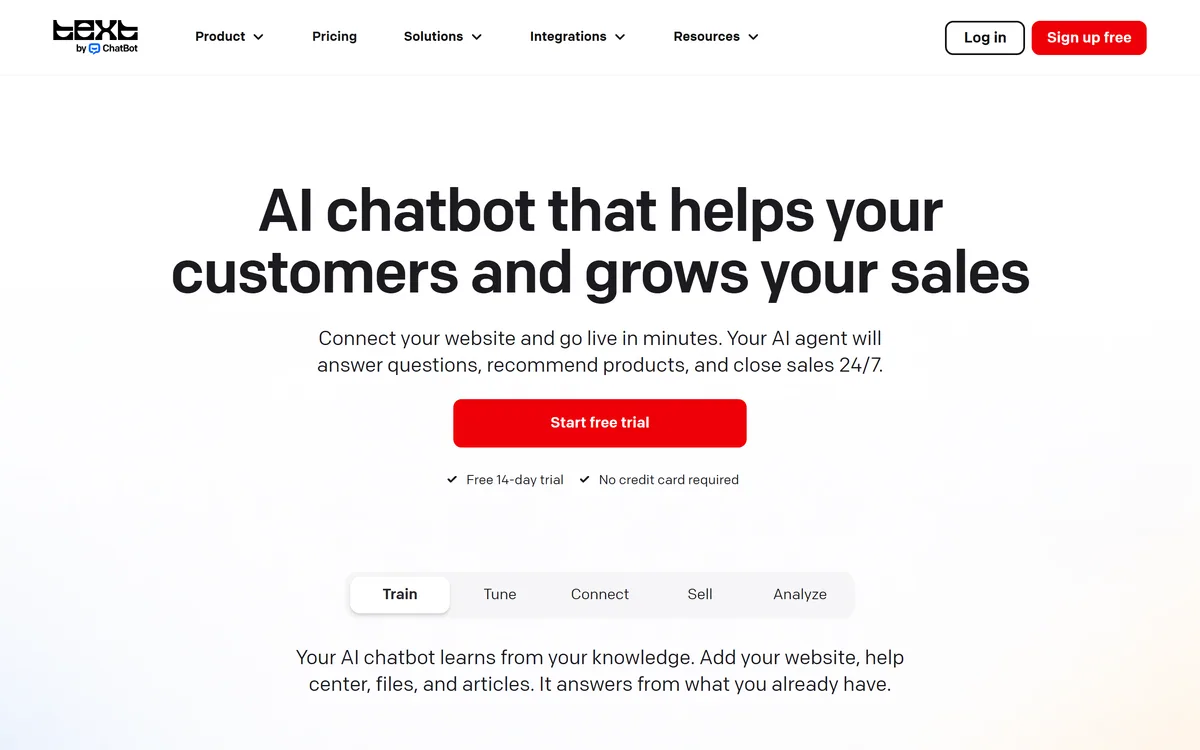
Website visitors want instant answers, and a chatbot trained on your own content can deflect a lot of repetitive questions. ChatBot.com, from the LiveChat group, is built for that: a no-code AI chatbot for your site.
You train it on your content, deploy a widget, and hand off to humans when needed, with integration into LiveChat and messaging. It competes with support bots like Botsonic, backed by an established support suite.
This review covers how ChatBot answers your visitors, which businesses it suits, how it's priced, and the accuracy and data caveats to weigh first.
ChatBot Website-Bot Facts
| What it is | A no-code website AI chatbot platform |
|---|
| Company | ChatBot.com (by Text, Inc., the LiveChat group) |
|---|
| Core | Build a chatbot trained on your content |
|---|
| Deploy | Website widget and messaging channels |
|---|
| Handoff | Escalation to human agents (LiveChat) |
|---|
| Integrations | LiveChat, Messenger, Slack and more |
|---|
| Audience | SMB and mid-market support and sales |
|---|
| Access | Subscription with a trial |
|---|
A No-Code AI Chatbot For Your Website
ChatBot's core job is to answer website visitors automatically. You train it on your content, help docs, pages, FAQs, and it builds a no-code AI chatbot that responds to common questions, deflecting repetitive support and capturing leads around the clock.
Its pedigree is a selling point. It's made by Text, Inc., the company behind LiveChat, so it slots into an established support ecosystem with mature human-handoff and agent tooling, rather than being a standalone newcomer.
It deploys as a website widget and across messaging channels, with escalation to human agents when the bot reaches its limit, so visitors aren't stuck with a bot that can't help.
The honest framing is that ChatBot is a solid, no-code support bot backed by a serious support suite. The caveats are the category's: RAG-style answers can still miss or be wrong, so human handoff and monitoring matter; answer quality depends on your content; it handles customer conversation data, a privacy consideration; and its claims are vendor-stated. It's a paid tool, with the deeper value tied to the LiveChat ecosystem.
ChatBot is a solid no-code support bot backed by LiveChat; answers can miss, so keep handoff, and weigh data handling.
How Does ChatBot Answer Your Visitors?
ChatBot pairs a content-trained bot with an established support ecosystem.
Training On Your Content
You train it on your content and deploy a widget, and it answers common questions, deflecting support and capturing leads 24/7.
A no-code bot like Wonderchat takes a similar content-trained approach; ChatBot's angle is the LiveChat ecosystem behind it, with mature human handoff and agent tooling.
Channels, Handoff And Integrations
It hands off to human agents (via LiveChat) when the bot reaches its limit, and integrates with messaging and other tools.
A support agent like LiveChatAI is a close comparison; ChatBot's integration with the full LiveChat suite is its distinctive strength, so match it to whether you want a standalone bot or an ecosystem.
Which Websites ChatBot Suits
ChatBot suits SMB and mid-market businesses, especially support and sales teams, that want a no-code website chatbot to deflect repetitive questions and capture leads, and particularly those already in or open to the LiveChat ecosystem.
It suits teams that value mature human-handoff and an established support suite over a bare bot, and that have decent content to train on.
It suits less well teams with thin or outdated content (answers reflect it), anyone needing a free tool, and those in high-stakes contexts intolerant of an occasional wrong answer without tight guardrails.
A fair way to place it: if you want a dependable no-code support bot with strong human handoff, especially alongside LiveChat, ChatBot is a solid choice; if your content is thin or you need a free tool, weigh it accordingly, and always keep the human handoff and monitor the bot's answers.
It helps to be realistic about where a no-code support bot earns its keep. ChatBot answers the repetitive, well-documented questions, hours, returns, how-to, that otherwise eat your team's time, and it does that only as well as the content you give it, so a thin or outdated knowledge base produces a thin, outdated bot. The strong human handoff is what makes it safe to deploy, because the bot can confidently take the easy questions while anything it can't answer reaches a person quickly, rather than leaving the customer stuck in a loop, which is the single fastest way to turn a support bot into a complaint.
How ChatBot Prices Its Bots
ChatBot is a subscription with a trial, scaled by usage and features, with deeper value for those using the wider LiveChat suite. We do not publish prices, which change; check the site and confirm the limits and data terms.
The value question is deflection versus cost: if the bot reliably resolves a meaningful share of questions, it pays for itself in support time; if it frustrates visitors into asking for a human anyway, it adds a step.
The sensible approach is to use the trial to build the bot on real content, measure resolution and satisfaction on genuine questions, confirm the data handling, and judge whether the LiveChat ecosystem adds value for you.
Trialling ChatBot On Your Site
Because bot answers can miss, trial ChatBot on your real content with handoff on.
- Train it on real help content and ask the questions your visitors actually ask.
- Check the answers, including edge cases, for accuracy.
- Confirm the human handoff triggers sensibly on hard questions.
- Measure resolution and satisfaction on genuine visitor questions.
- Confirm how conversation data is handled.
- Pass/fail: ChatBot is worth it if it resolves real questions without frustrating visitors.
- Treat resolution and usage claims as vendor-stated.
ChatBot, The Website-Agent Brief
- ChatBot builds website bots: a no-code AI chatbot trained on your content.
- It's part of a support suite: by Text, the LiveChat group, with handoff to humans.
- It deploys where you need it: website widget and messaging channels.
- Mind the caveats: bot answers can miss, so keep human handoff, and weigh data handling.