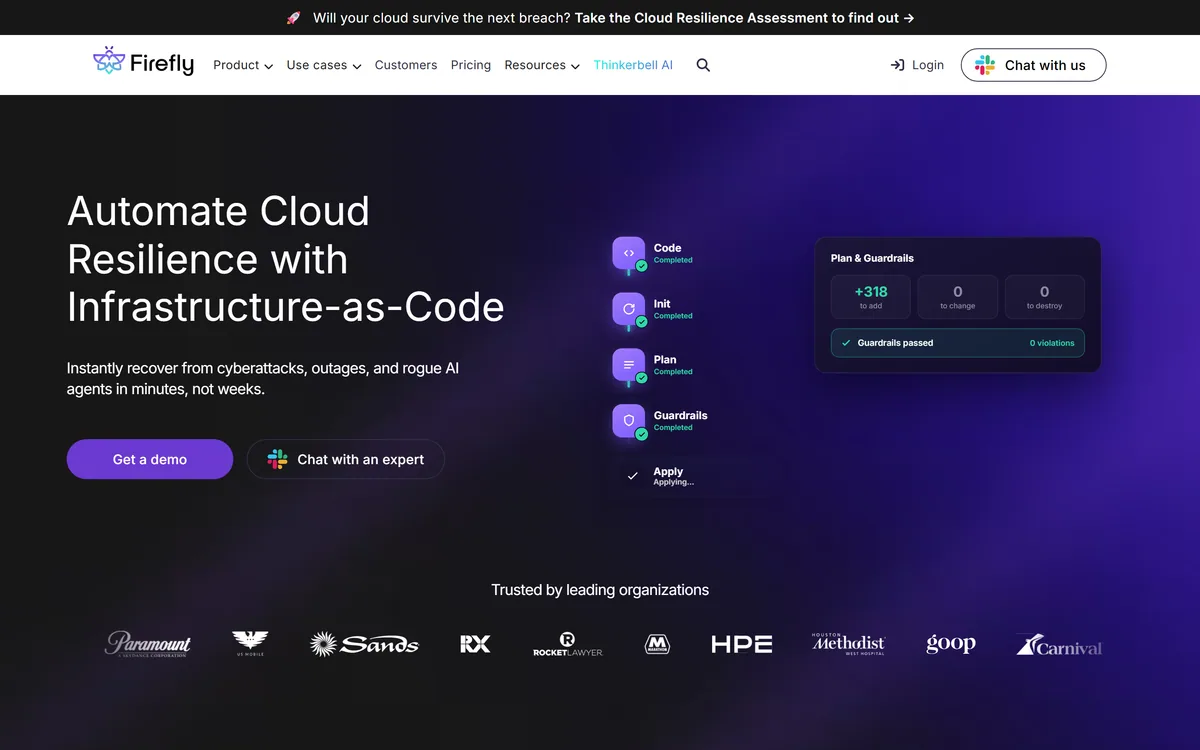
Not Adobe Firefly This review is of Firefly at firefly.ai, a cloud resilience and infrastructure-as-code platform for enterprise IT. It is unrelated to Adobe Firefly, the generative image product, and does not generate images, video or other media.
The name is a trap: this Firefly, at firefly.ai, has nothing to do with Adobe's image generator. It is a cloud resilience and infrastructure-as-code (IaC) platform for enterprise IT teams.
It converts cloud resources into reusable IaC, detects and remediates configuration drift, recovers whole environments after outages or cyberattacks, and generates audit-ready compliance evidence. It sits among cloud-ops and reliability tools; for incident response specifically, a platform like Rootly solves a neighbouring problem.
This review covers how Firefly protects cloud infrastructure, which cloud teams it suits, how it reaches enterprises, and where it fits in a modern cloud-operations stack.
Firefly, The Cloud-Resilience Brief
- Firefly is a cloud resilience platform: infrastructure-as-code automation, disaster recovery and compliance, for enterprises.
- It is not Adobe Firefly: this firefly.ai is a cloud-ops tool, not a generative image or creative product.
- It targets the hard parts: codifying resources, catching drift, and recovering environments after outages or attacks.
- AI here is analysis, not media: the AI automates and analyses infrastructure rather than generating content.
Infrastructure-As-Code Automation And Disaster Recovery
Firefly's job is to make cloud infrastructure recoverable and governable. It reads your live cloud resources and turns them into infrastructure-as-code, so your environment is described in reusable, version-controlled files rather than clicked together by hand.
From that foundation it watches for drift, the gap that opens when live resources diverge from their defined state, and helps remediate it, and it can recover a full environment to a last-known-good state across regions after an outage or a cyberattack.
It layers governance on top: guardrails, and audit-ready compliance evidence mapped to frameworks like DORA, NIS2, SOC 2 and ISO, which matters to regulated enterprises. It also references open-source tooling and an AI assistant for infrastructure work.
The honest framing is twofold. First, the identity: this is a cloud-ops tool where AI means automation and analysis, not generated media, so do not confuse it with Adobe Firefly. Second, like any resilience platform, its value depends on how thoroughly it is set up, and its headline recovery and reliability figures are vendor claims to test against your own environment.
This Firefly is a cloud resilience tool, not Adobe's image generator, and its recovery claims are worth testing against your own environment.
How Does Firefly Protect Cloud Infrastructure?
Firefly combines IaC automation with drift remediation, recovery and compliance.
Codifying Resources And Catching Drift
It converts existing cloud resources into infrastructure-as-code, detects configuration drift and misconfigurations, and helps remediate them, so the live environment stays aligned with its defined state.
Where a code-scanning tool like Semgrep focuses on finding issues in source code, Firefly operates at the cloud-infrastructure layer, on the resources themselves rather than the application code.
Recovery, Compliance And Guardrails
For resilience, it can recover a full environment to a last-known-good state across regions after an outage or attack, and it produces audit-ready compliance evidence against major frameworks.
A security-remediation tool such as Corgea addresses code vulnerabilities; Firefly's angle is recovering and governing the infrastructure estate, with human review before changes hit production.
Which Cloud Teams Firefly Suits
Firefly suits CloudOps, platform-engineering, security and governance teams at enterprises that run significant cloud estates and need resilience, drift control and audit-ready compliance.
It suits organisations in regulated sectors facing frameworks like DORA and NIS2, and those that want infrastructure described as code so it can be reviewed, recovered and governed.
It fits less well small teams with simple infrastructure, where the platform's depth and enterprise focus outweigh the benefit, and anyone looking for a generative or creative AI tool, which this is not.
A good way to weigh it is by estate size and risk. An enterprise with a complex cloud footprint and real recovery and compliance obligations stands to gain; a small shop with a handful of resources will find it more than it needs.
How Firefly Reaches Enterprises
Firefly is enterprise software sold through a demo, with a pricing page but no public self-serve amounts in our read, so cost depends on estate size and scope. We do not publish prices, which change; contact the vendor.
The cost question is risk reduction and engineering time saved, fewer manual runbooks, faster recovery, easier audits, against the platform cost and the setup effort to codify your estate.
The sensible approach is a scoped pilot on one cloud account: codify it, test drift detection and a recovery scenario, and measure how much manual work and risk it actually removes before expanding.
Piloting Firefly On One Cloud Account
Because resilience is only proven under test, pilot Firefly on one cloud account first.
- Connect one cloud account and convert its resources to infrastructure-as-code.
- Turn on drift detection and review what it flags.
- Run a controlled recovery scenario to a last-known-good state.
- Generate compliance evidence and check it maps to your frameworks.
- Keep human review before any remediation hits production.
- Pass/fail: expand only if it measurably cuts manual work and proves recovery works.
- Treat recovery-time and reliability percentages as vendor claims.
Firefly Cloud-Resilience Facts
| What it is | A cloud resilience and IaC automation platform |
|---|
| Not | Not Adobe Firefly; not image generation |
|---|
| IaC | Converts cloud resources to reusable code |
|---|
| Drift | Detects and remediates configuration drift |
|---|
| Recovery | Full-environment recovery after outages/attacks |
|---|
| Compliance | Audit-ready evidence (DORA, NIS2, SOC 2, ISO) |
|---|
| AI role | Automation and analysis, not generative media |
|---|
| Access | Enterprise, sold via demo |
|---|
Firefly Cloud-Resilience Terms
- Infrastructure-as-code (IaC)
- Describing cloud infrastructure in reusable, version-controlled files rather than configuring it by hand; Firefly converts live resources into it.
- Drift
- When live cloud resources diverge from their defined state; Firefly detects and helps remediate it.
- Disaster recovery (DR)
- Restoring systems after an outage or attack; Firefly can recover environments to a last-known-good state.
- RTO
- Recovery time objective, the target time to restore a system after disruption, which resilience tools aim to shorten.
- Compliance evidence
- Audit-ready proof that controls are met, which Firefly generates against frameworks like DORA, NIS2, SOC 2 and ISO.
Is Firefly Right For Your Cloud Estate?
CloudOps Teams Firefly Serves
- Enterprise CloudOps and platform teams
- Security and governance functions
- Regulated sectors (DORA, NIS2)
- Teams wanting infrastructure as code
- Organisations needing fast recovery
When Firefly Outsizes Your Cloud
- Small teams with simple infrastructure
- Anyone seeking a generative or creative AI tool
- Those expecting Adobe Firefly
- Teams without a real recovery need
- Shops wanting public self-serve pricing