
AI companion for everyday emotional support and reflection Category: Health & Lifestyle.
Health & Lifestyle Review
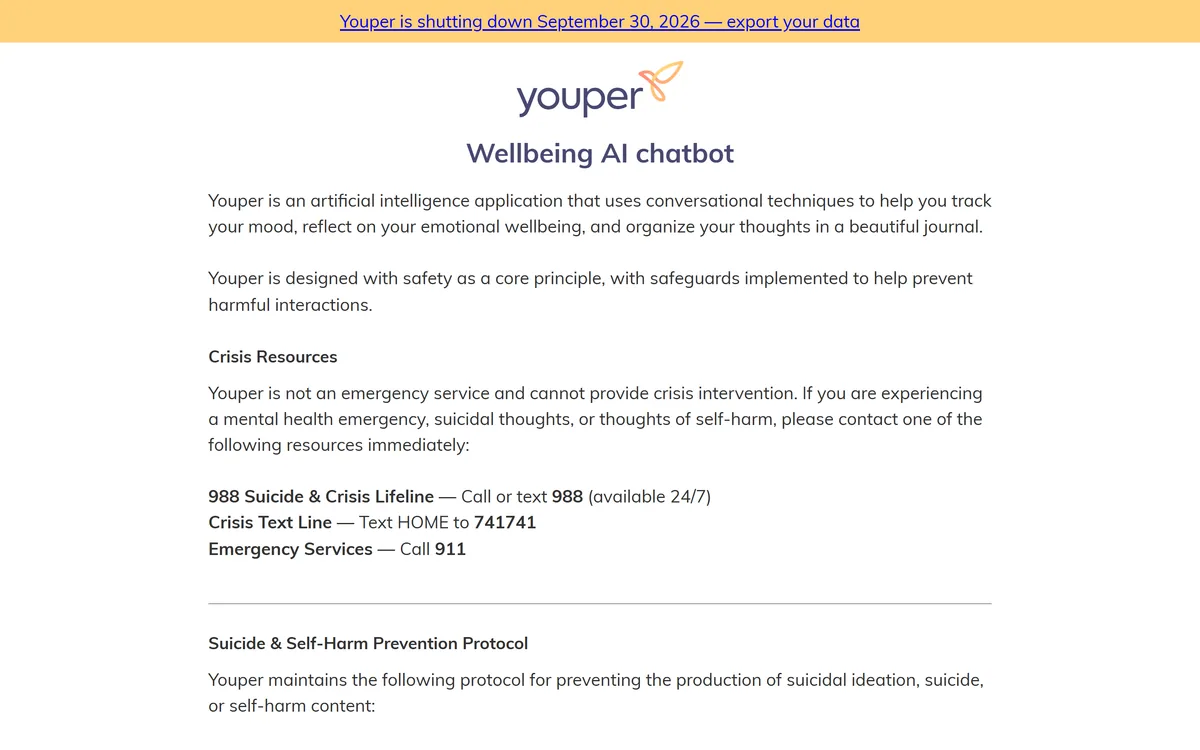
Youper is an AI emotional-health assistant built around conversational check-ins, mood tracking and journaling. The company has announced it is shutting down on 30 September 2026, after which accounts, chat history and personal data are permanently deleted.
Fair
Youper has an AInexfinder Editor Score of 3.2/5.
Best for: Existing users who need to export their journal before 30 September 2026; Anyone cancelling a Youper subscription and looking for a replacement
The visit link goes to youper.ai, the official site. Paid placements on AInexfinder are always labelled. How we make money
If you arrived here to decide whether to try Youper, the decision has been made for you. The company has announced that the service closes on 30 September 2026, the apps have already been pulled from the App Store and Google Play, and new subscriptions are switched off.
If you are an existing user, this page is about one thing: getting your data out before it is deleted. From 1 October 2026 the company says accounts, chat histories and personal data are permanently removed from its servers and backups. For someone who has been checking in daily since 2019, that is a meaningful archive about to disappear.
Below: exactly what to do before the deadline, an honest account of what Youper was, and where people are moving instead.
Last checked . Checked directly against Youper's own site and its published notices, alongside independent coverage of the shutdown. The screenshot above was captured during this check.
Dates and export routes can change during a wind-down. Confirm on Youper's own site before relying on anything here, and do not treat this page as medical advice. If you are in crisis, contact 988 in the US or your local emergency service rather than any app.
Do this first and read the rest afterwards. The export request is quick, but it is not instant, and leaving it to the final week is how people lose years of entries.
The export takes ten minutes. Recovering it after 1 October takes nothing, because there will be nothing to recover.
Youper launched in 2016, built by a team including a psychiatrist, and grew to more than three million users. The product was a conversational assistant for emotional health rather than a therapy service.
In practice that meant short guided conversations, mood tracking over time, and a journal that filled itself from those conversations. The technique borrowed from cognitive behavioural approaches — notice the thought, name the feeling, examine the reasoning — delivered as chat rather than as exercises.
It was adults-only by design, stated as 18 and over. And the company was consistently clear about the boundary: Youper was not a medical device, had not been cleared or approved by the US Food and Drug Administration, and did not provide medical advice, diagnosis or treatment.
Youper published a suicide and self-harm prevention protocol with three parts: detection of distress in what a user writes, referral to crisis services including 988 and the Crisis Text Line, and content safeguards intended to stop the model producing harmful responses.
This is worth recording because it is the part of the category that matters most and is easiest to skip. Any replacement you consider should be judged on whether it has something equivalent, and whether it says so plainly.
A conversational app that tracks mood and prompts reflection is a support tool. It is genuinely useful for noticing patterns, building a check-in habit, and putting words to a feeling before it becomes a spiral.
It is not treatment, and Youper never claimed otherwise. Anyone whose reason for using it was clinical — active depression, anxiety that interferes with living, crisis risk — needed a clinician alongside it, and needs one now more than ever.
Youper is not the first AI mental-health app to close, and the pattern behind these exits is worth understanding before you pick a replacement.
Consumer wellbeing apps sit in an awkward position. Regulated medical products can bill through healthcare systems but must clear evidence and approval bars. Unregulated wellbeing tools avoid those bars but must survive on consumer subscriptions in a market where retention is brutal and the sceptical questions about AI and mental health have got louder.
The practical lesson for a user is unglamorous: assume any app holding a personal archive might close, and export periodically rather than at the end. Data portability is a feature you only notice the absence of once, and by then it is too late.
Replacing Youper properly means being honest about which of its jobs you actually used.
If it was journalling and mood patterns, the reflective-journal tools cover that well and generally export cleanly. If it was the check-in habit, several conversational apps do the same thing. If it was calming down in the moment, a guided meditation tool is a closer fit than a chat interface.
And if any part of your use was clinical rather than supportive, this closure is a prompt to talk to a professional. An app closing should not be the thing that interrupts real care — which is precisely why real care should not depend on an app in the first place.
| Status | Shutting down |
|---|---|
| Service ends | 30 September 2026 |
| Data deleted from | 1 October 2026, including backups |
| Export route | Settings → Request My Data, or the company's export page |
| App availability | Delisted from the App Store and Google Play |
| New subscriptions | Disabled |
| Launched | 2016 |
| Reported users | More than three million |
| Company | Youper, Inc., San Francisco, California |
| Age policy | 18 and over; explicitly not intended for minors |
| Regulatory status | Not a medical device; not cleared or approved by the FDA |
| Crisis features | Distress detection, referral to 988 and Crisis Text Line, content safeguards |
Conversational check-ins that guide reflection rather than deliver exercises
Mood tracking recorded over time
A journal populated from the conversations themselves
Techniques drawn from cognitive behavioural approaches
A published suicide and self-harm prevention protocol
Distress detection with referral to 988 and the Crisis Text Line
Content safeguards intended to prevent harmful model responses
A self-service data export, available until the shutdown date
These do different parts of what Youper did. Match the replacement to the job you actually used it for.
| Tool | Closest to Youper's | Still operating | Best for |
|---|---|---|---|
| Youper | Conversational check-ins, mood tracking, auto-filled journal | No — closes 30 September 2026 | Nobody new; existing users should export |
| Rosebud | Reflective journalling with AI prompts | Yes | People whose main use was writing and noticing patterns |
| Earkick | Mood tracking and in-the-moment check-ins | Yes | People who valued the daily habit more than the conversation |
| StillMind | Calming down in the moment, guided rather than chatted | Yes | People using Youper mainly to settle anxiety or sleep |
| Mindsera | Structured journalling with analytical feedback | Yes | People who want the reflection to go deeper than a check-in |
Different approaches to the same underlying job — noticing how you are, and doing something about it.
AInexfinder does not list plan prices or billing details. For current pricing, plans, and trials, visit the official Youper website.
Visit official website for pricingVendor pricing, credits, and billing policies change over time. Always confirm on the official site before you buy.
Youper earns an AInexfinder Editor Score of 3.2/5 (fair). Best for: Existing users who need to export their journal before 30 September 2026; Anyone cancelling a Youper subscription and looking for a replacement; People choosing a new AI wellbeing app who want to learn from this closure.
Visit YouperLog in to write a review.
No reviews yet. Be the first to share your experience with Youper.
Assigned reviewer
Daniel ReedSenior AI Tools Reviewer
Daniel leads AInexfinder's tool reviews. He researches each tool from its own pricing, documentation and policies, checks its claims against independent sources, and writes up what it does well, where it falls short and who it genuinely suits.
Daniel and the AInexfinder editorial team research Youper from its own website, pricing, documentation and policies, checked against independent sources. This review is research-based: unless its method note says otherwise, we have not bought a plan or run hands-on tests. The Editor Score is our editorial judgement, and payment never changes it.
Similar Tools
AI companion for everyday emotional support and reflection Category: Health & Lifestyle.

Ash review on AInexfinder — freemium AI tool for Health & Lifestyle. Features, pricing notes, and alternatives.
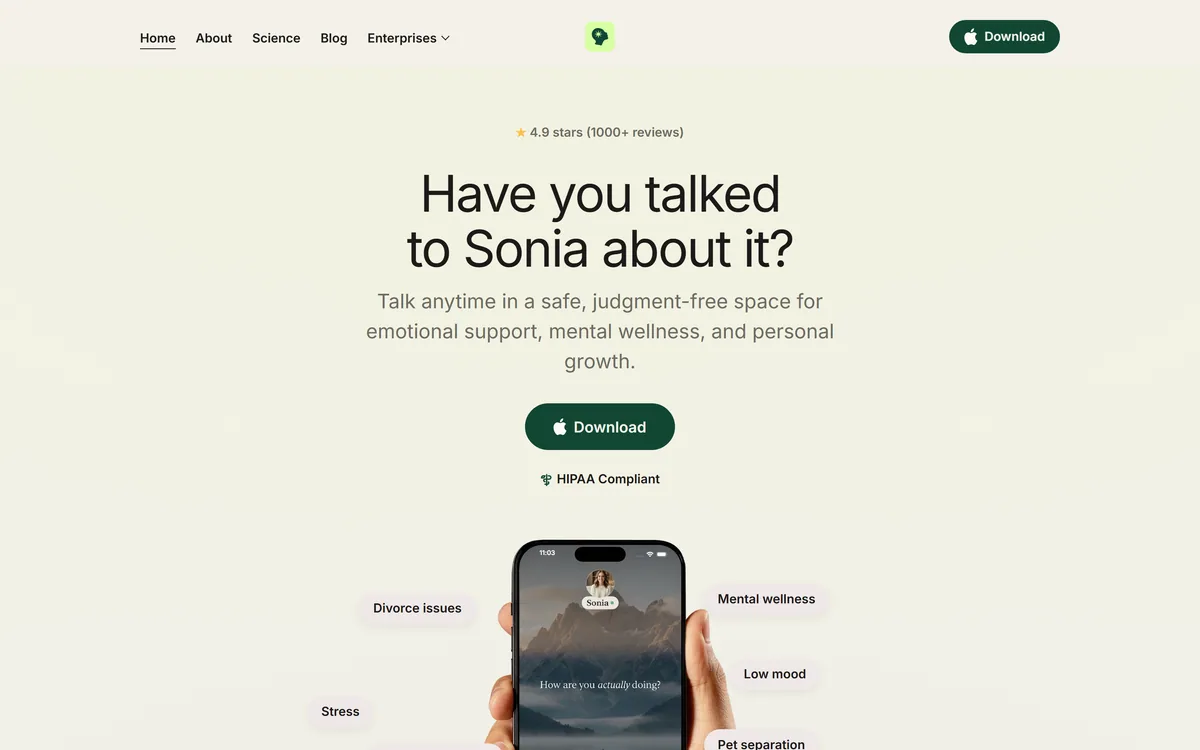
Sonia is an AI emotional-support app grounded in CBT principles, offering a private, 24/7 space to talk through everyday stress, mood and life transitions. It is HIPAA-compliant and built with mental-health professionals, but it is not a replacement for therapy or crisis care.
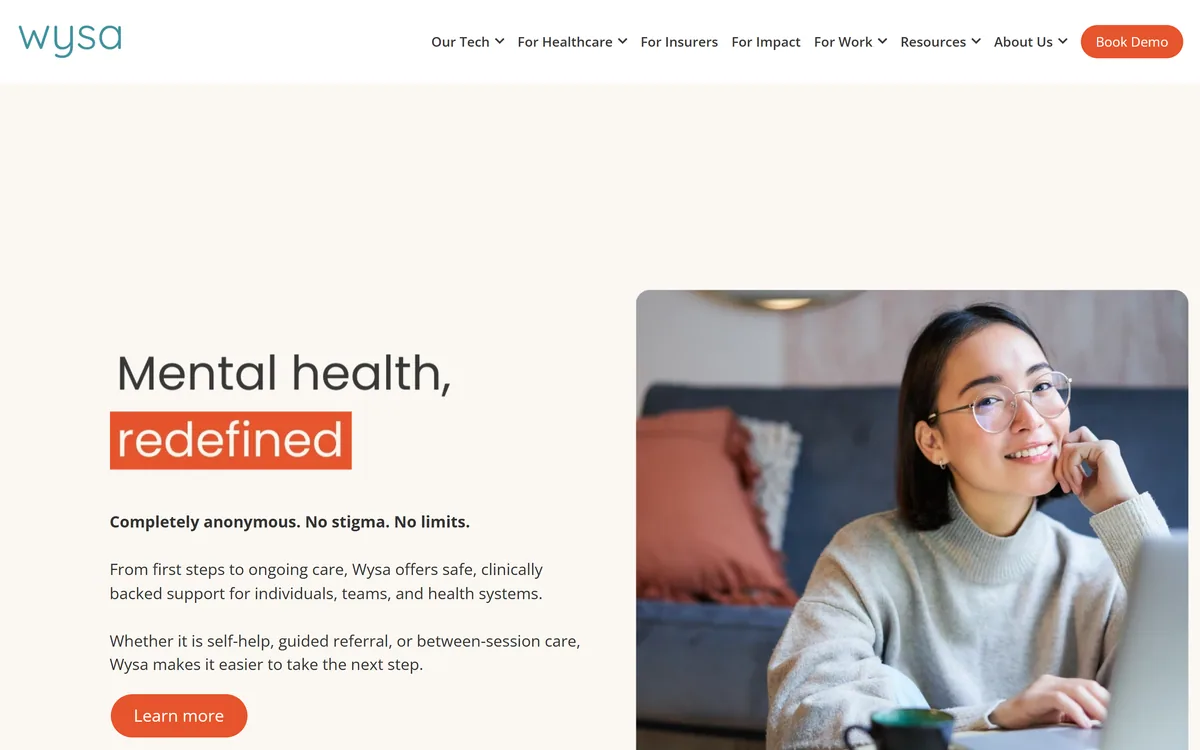
Wysa is an anonymous, CBT-based AI mental-health support tool designed as a safer alternative to general AI, with human-in-the-loop clinical oversight, backed by peer-reviewed research, and sold to health systems, employers and insurers, not a substitute for professional care.
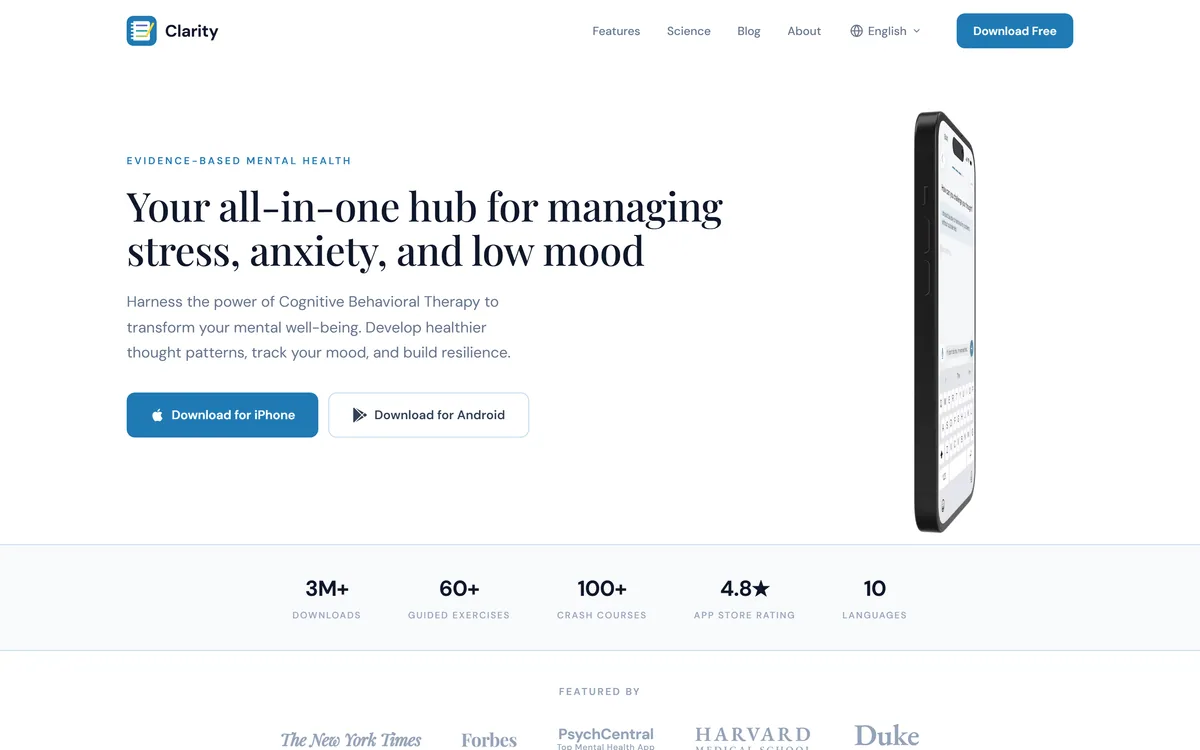
Clarity is a mental health app built on cognitive behavioural therapy, with 60+ guided exercises, AI journalling, chatbots trained in CBT, DBT and ACT, mood and emotion tracking, standardised screening tests, and a library of crash courses, meditation and breathwork.
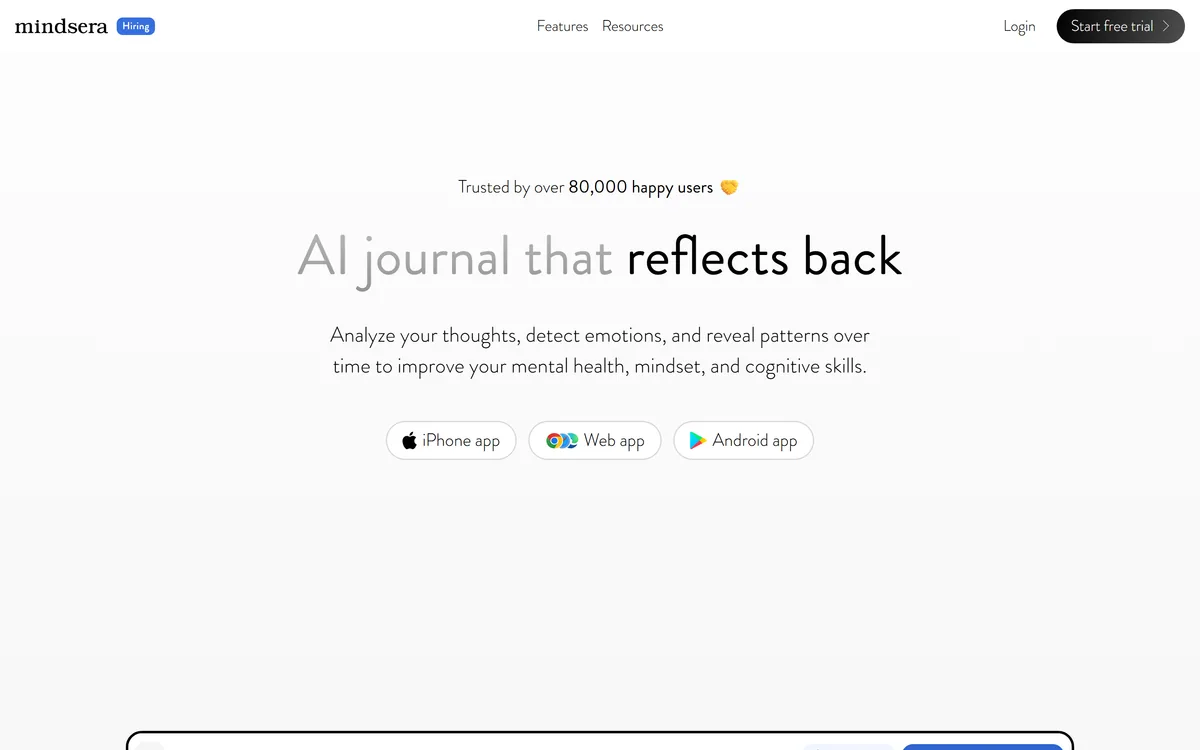
Mindsera is an AI journalling app that analyses entries as you write, surfaces patterns and emotions over time, and offers more than fifty mental models as structured prompts. It accepts typed, spoken and photographed handwritten entries, and runs on iOS, Android and the web.
Related Pages