How to Choose AI Tools for SEO and AI Search in 2026
A practical editor’s guide to picking AI tools that help classic SEO and answer-engine visibility — with free options, comparison tips, and how AInexfinder structures listings for discoverability.

On this page11 sections
Why AI Tool Choice Matters for SEO and AI Search
Search is no longer only ten blue links.
People still use Google and Bing, but they also ask ChatGPT, Perplexity, Claude, and Gemini for “best free writing AI” or “Notion AI alternatives.”
If you pick tools poorly, you waste budget.
If you list or recommend tools poorly, search engines and answer engines both struggle to trust your pages.
This guide shows how to evaluate AI tools for classic SEO, answer engines (AEO), and AI citations (GEO) — and how a structured directory like AInexfinder helps you shortlist faster.
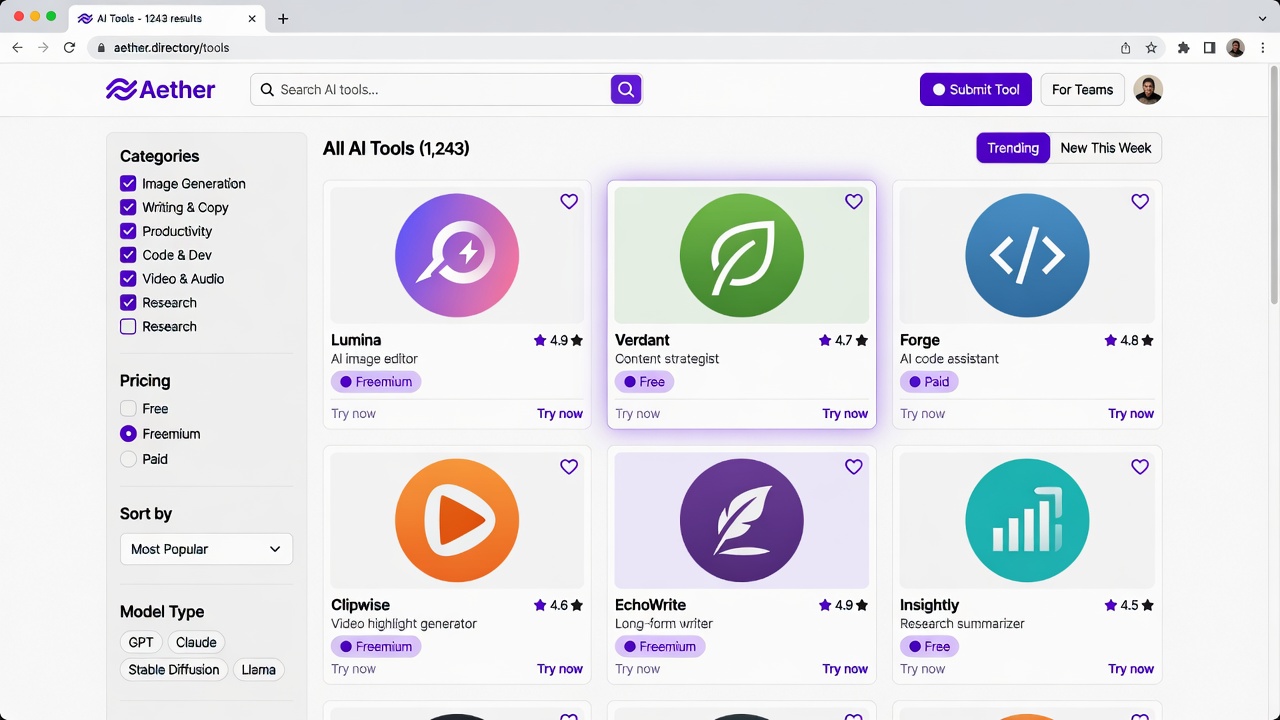
Example: a clean tools directory layout — cards, pricing cues, and filters make comparison scannable for humans and machines.
What “AI SEO” Means in Plain Language
| Layer | Who it serves | What good tool content needs |
|---|---|---|
| SEO | Google, Bing | Clear titles, depth, internal links, indexable pages |
| AEO | Answer boxes / AI Overviews | Short direct answers + FAQ in natural language |
| GEO | ChatGPT, Perplexity, Claude, Gemini | Factual, structured, citable pages with sources |
You do not need a different product for each layer. You need tools (and listings) that produce accurate, structured, linkable content.
Step 1 — Start From the Job, Not the Hype
Before you open another “top 50 AI tools” list, write one sentence:
“I need AI to help me ___ so I can ___ without ___.”
Examples:
- Draft blog outlines so I can publish weekly without blank-page time
- Create image variants so social posts ship same-day
- Summarize research so I can write FAQs that match real questions
Then browse by use case on AInexfinder:
- All AI tools
- Browse all categories
- Writing & Content tools
- Image & Design tools
- Coding & Development tools
- Free AI tools
- AI tools by profession
Step 2 — Prefer Free or Freemium When You Are Learning
For SEO teams testing prompts, outlines, or image ideas, a free tier reduces risk.
Filter for free/freemium first on the free AI tools page, then upgrade only if the tool clearly saves hours.
Checklist for free tiers
- Can you export or copy results without a paywall?
- Are rate limits documented?
- Is commercial use allowed on the free plan?
- Will unpaid data train a public model? (read the privacy policy)
Step 3 — Compare Before You Subscribe
Never judge a tool from a homepage alone. Use side-by-side structure:
- Compare AI tools
- AI tool alternatives hub (then open a specific tool’s alternatives page)
- Best AI tools by category
- Example deep links: Best writing tools, Best coding tools, ChatGPT alternatives
When you compare, score each option on:
- Output quality on your real task (one prompt, same inputs)
- Pricing honesty (free limits, seat cost, annual traps)
- Workflow fit (docs, API, integrations)
- Risk (data retention, admin controls)
Step 4 — Demand Content That Answer Engines Can Use
Whether you use AI tools or list them, pages that win in AI search share patterns:
Direct Answer Near the Top
Open with what the tool is and who it is for in 2–3 sentences — not a hero slogan.
Structured Sections
What it is · Who it is for · Features · Pricing · Pros/cons · FAQ · Related links.
Visible FAQ That Matches Real Questions
“Is it free?”, “What are alternatives?”, “Who is it for?” — written as humans ask.
Internal Links
Connect category hubs, free tools, methodology, and comparisons so crawlers (and readers) can move.
AInexfinder tool pages follow this pattern; our review methodology explains how listings are checked for working product and pricing accuracy.
Step 5 — Avoid Thin “AI-generated” Spam
Mass-produced tool blurbs without facts hurt SEO and AI trust. Good practice:
- Only claim features you can verify
- Keep pricing language honest (“freemium” vs “free forever”)
- Link out to the official site for live prices
- Update pages when plans change
Thin pages may stay out of the index on purpose — quality gates protect readers and rankings.
Recommended Shortlist Stack (by Job)
| Job | Start with | Then compare |
|---|---|---|
| Writing / SEO drafts | Free AI tools | Writing & Content · Best writing tools · SEO writing |
| Images for posts | Image & Design | Best image tools · Image generation |
| Research / chat | All AI tools | Compare hub · ChatGPT alternatives |
| Coding assistants | Coding & Development | Best coding tools · AI tools for developers |
Exact “best” tools change monthly — always re-check pricing and free limits on the vendor site.
How AInexfinder Helps This Workflow
- Directory search — find tools by keyword and category
- Free filter — reduce paid risk early
- Alternatives & compare — avoid single-vendor lock-in
- Structured listings — review-style sections, FAQ, related links for SEO/AEO
- Methodology — transparent review approach
Submit a product via Submit a tool if you build something that meets those standards.
FAQ
What Is the Best AI Tool for SEO in 2026?
There is no single best tool.
Pair a writing assistant for drafts, a research tool for SERP questions, and an image tool for assets — then measure time saved on your site. Start in Writing & Content and SEO writing.
Are Free AI Tools Good Enough for SEO Content?
Often for outlines, FAQs, and first drafts. Always edit for accuracy, brand voice, and links.
Free tiers may limit volume. Browse free AI tools first.
How Do AI Search Engines Pick Sources?
They prefer clear, factual, well-structured pages with consistent entities and useful answers. Thin or contradictory pages are weak candidates for citation.
Should I Block AI Crawlers?
If you want citations in AI answers, allow major AI crawlers on public content and keep private areas (admin, APIs) blocked. Pair that with a clear site map for humans and machines.
Bottom Line
Choose AI tools from job → free trial → compare → verify facts, not from hype rankings.
For discovery, start at AInexfinder, narrow with Writing & Content or all categories, and free AI tools, then only pay when the tool survives a real-task test.
Last updated for 2026. Pricing and free tiers change — always confirm on official vendor sites.
About
Ethan Carter
AI Guides & Tutorials Lead
Ethan writes hands-on, step-by-step guides that turn complex AI workflows into something anyone can follow. He focuses on practical setups, prompts, and getting real results from everyday tools.
View profile

