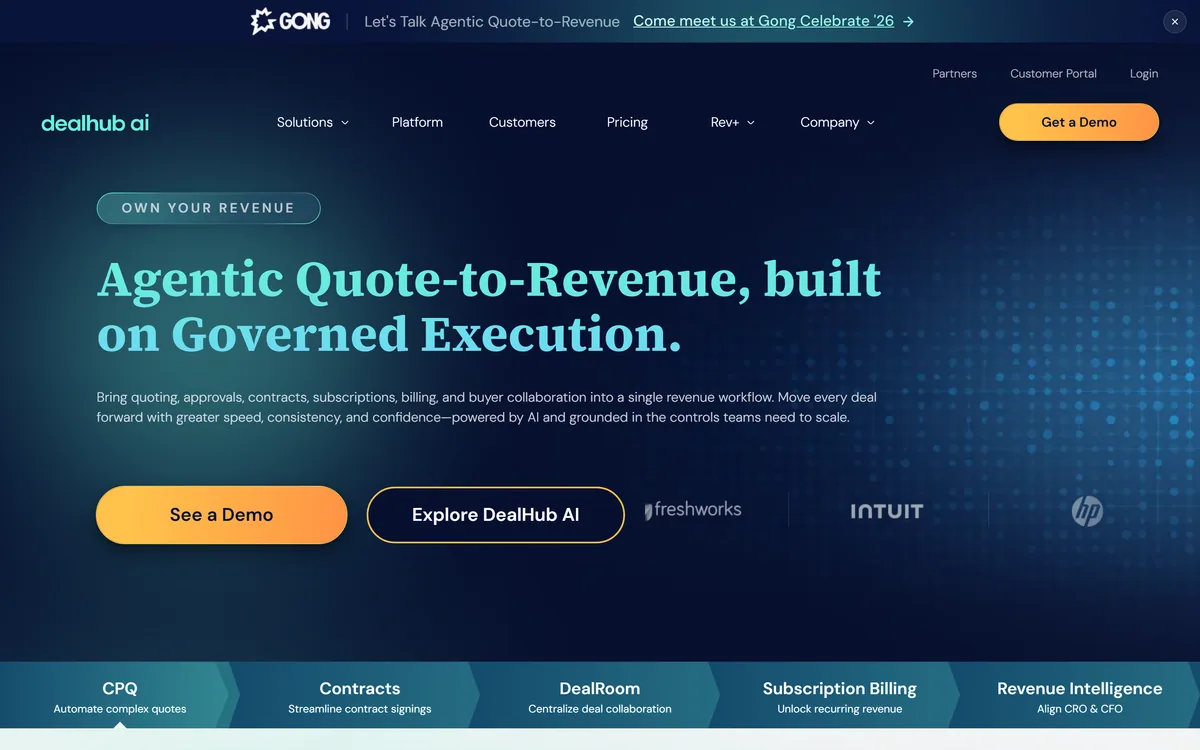
The stretch between a verbal yes and recognised revenue is where enterprise deals quietly go to die: quotes take days, approvals sit in inboxes, contracts bounce around, and billing is a separate system entirely. DealHub exists to make that whole stretch one connected, governed workflow.
It brings configure-price-quote, approvals, contract management, subscription billing and buyer collaboration into a single flow, now with an agentic layer on top and a focus on what it calls governed execution, moving every deal forward with speed and consistency but within the controls a large organisation needs.
This review covers what the agentic layer adds to CPQ, how the DealRoom and revenue intelligence pieces fit, the enterprise compliance case, how it is priced, and who it suits against other CPQ and revenue tools.
DealHub In Four Points On Revenue
- DealHub is an agentic quote-to-revenue platform that unifies quoting, approvals, contracts, subscriptions, billing and buyer collaboration.
- Its heart is CPQ: configure pricing, automate approvals and generate accurate quotes fast, for every sales motion.
- It adds DealRooms and revenue intelligence, so buyers collaborate in one place and leaders get a real-time view of deals.
- It is built on governed execution, enterprise controls and deep compliance, aimed at sales teams that need consistency at scale.
DealHub Quote-To-Revenue Facts
| What it is | Agentic quote-to-revenue platform |
|---|
| Core | CPQ: configure, price and quote |
|---|
| Covers | Quoting, approvals, contracts, subscriptions, billing |
|---|
| Buyer side | DealRoom for buyer collaboration |
|---|
| Intelligence | Revenue intelligence aligning CRO and CFO |
|---|
| Integrations | Salesforce, HubSpot, Dynamics 365, NetSuite, Slack, Gong, DocuSign |
|---|
| Compliance | ISO 27001, 27701, 22301, 42001; SOC 1 and 2 Type II; GDPR, CCPA |
|---|
| Positioning | An alternative to Salesforce CPQ |
|---|
| Company | DealHub Ltd |
|---|
Quoting, Contracts And Billing In One Workflow
DealHub's core argument is unification. Instead of a CPQ tool here, a contract tool there, and billing somewhere else, it runs quoting, approvals, contracts, subscriptions and billing as one workflow, so a deal moves forward without falling between systems.
The pains it targets are specific and familiar: IT changes to pricing logic taking months, slow and error-prone sales processes, a CPQ implementation that is never done. Bringing the pieces together is how it attacks each, keeping reps efficient with consistent, guided quoting.
It sits in the orbit of broader go-to-market tools. A CRM with AI like HubSpot AI runs the pipeline; DealHub owns the quote-to-revenue mechanics that sit on top of it, which is why it integrates with rather than replaces the CRM.
The stretch between a verbal yes and recognised revenue is where enterprise deals quietly die. That whole stretch is what DealHub tries to make one workflow.
What Does DealHub's Agentic Layer Add To CPQ?
CPQ is mature technology; the newer question is what agentic AI and collaboration add on top of a solid quoting engine.
Guided Selling And Automated Approvals
DealHub's conditional logic customises the flow for every deal, guiding reps through complex sales processes so quoting is consistent and approvals are automated rather than chased by email. The cited outcomes, approval cycles cut from days to hours, fewer manual quoting steps, are the operational wins that matter day to day.
Conversation-intelligence tools like Gong analyse the calls that lead to a deal; DealHub automates the mechanics once the deal is in motion, so the two address different stages of the same revenue process.
DealRooms And Revenue Intelligence
The DealRoom gives buyers and sellers one place to collaborate, where reps and buyers can see exactly where approvals sit, which reduces the friction and back-and-forth that slows deals. Revenue intelligence then aligns the CRO and CFO with a shared view of what is happening.
That buyer-facing collaboration is a genuine differentiator over a pure internal CPQ, and it connects to the post-sale world where a platform like Gainsight owns retention, so the revenue picture joins up across the lifecycle.
Governed Execution And The Enterprise Compliance Case
DealHub leans on the phrase governed execution, and it is more than branding: the point is to move deals fast while staying inside the controls a large or regulated organisation requires. Speed without governance is how enterprises end up with inconsistent pricing and compliance gaps.
The compliance credentials are unusually deep: ISO 27001, 27701, 22301 and 42001, SOC 1 and SOC 2 Type II attestations, and GDPR and CCPA compliance. For a system handling pricing, contracts and billing, that breadth is exactly what a procurement and security review looks for.
It also integrates across the enterprise stack, Salesforce, HubSpot, Dynamics 365, NetSuite, Slack, Gong and DocuSign, and can be adjusted without coding, which matters given that never-ending-implementation pain it explicitly targets.
How DealHub Approaches Its Pricing
DealHub is an enterprise platform sold through a demo and sales process rather than a public price list, positioned as an alternative to Salesforce CPQ and similar revenue tools.
AInexfinder does not publish plan prices, and enterprise quote-to-revenue platforms are quoted against your needs in any case. What drives cost is which solutions you license, CPQ, contracts, DealRoom, billing, revenue intelligence, your seat count and your integrations, so budget for it as a platform with implementation behind it.
The value equation is deal velocity and consistency: DealHub pays off when faster, more accurate, more governed quoting and billing are worth more than the platform and rollout, which is true for organisations with complex deals far more than for simple ones.
Evaluating DealHub Against Your Sales Motion
Because DealHub is a platform tied to how you sell, evaluate it against your real sales motion and systems, not a generic demo.
- Map your actual quote-to-revenue process and where it currently breaks or slows.
- In a demo, have DealHub configure a quote for one of your genuinely complex deals.
- Check how its approval automation and conditional logic fit your real rules.
- Test the integration with your CRM and billing or ERP systems, since that connectivity is central.
- Try a DealRoom for a mock deal and judge whether buyer collaboration is smoother than your email today.
- Pass/fail: DealHub is worth it only if it measurably speeds and tightens quoting and billing for deals like yours.
- Confirm which solutions and compliance certifications are in the package you are quoted.
Teams DealHub Is Built For
- Enterprise and mid-market teams with complex, configurable deals
- Sales orgs whose quoting and approvals are slow or inconsistent
- Teams that want quoting, contracts and billing in one workflow
- Organisations needing deep compliance certifications
- Companies wanting buyer collaboration through a DealRoom
When DealHub Is Overkill
- Small teams with simple, flat-price products
- Businesses that do not need CPQ at all
- Anyone wanting a self-serve tool with public pricing
- Teams unwilling to invest in implementation
- Organisations whose CRM already covers their simple quoting