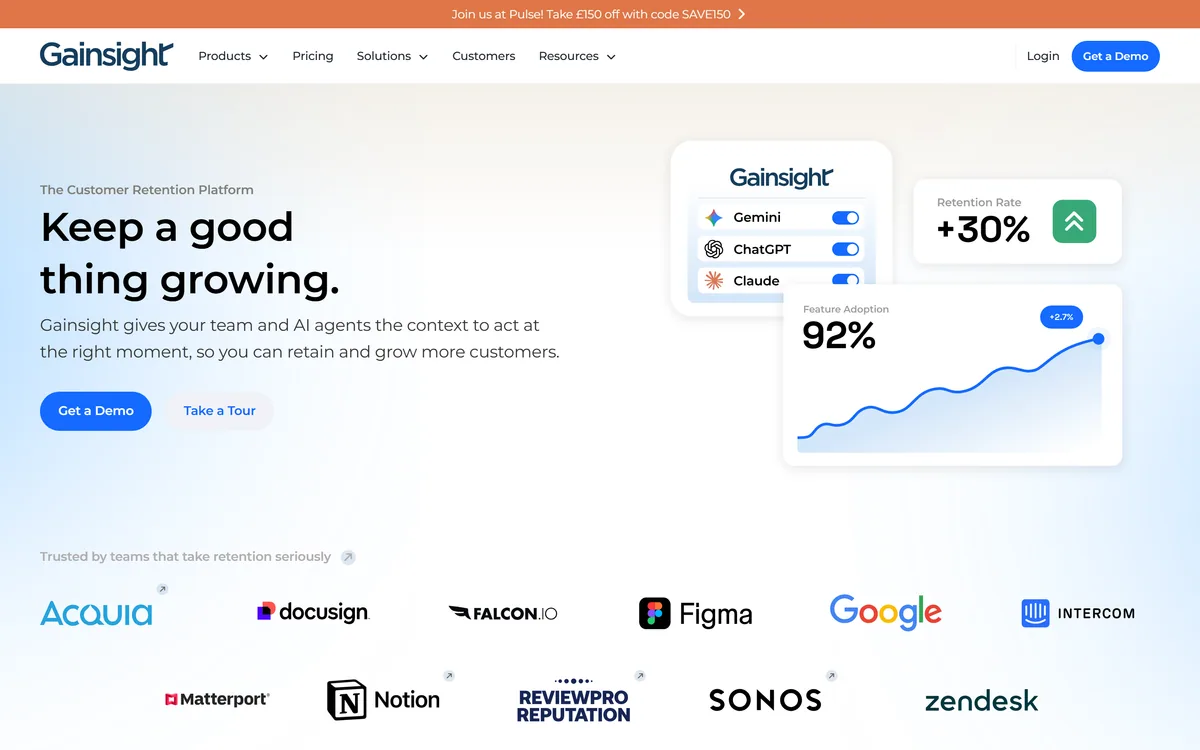
Winning a customer is expensive; keeping and growing one is where the economics of a subscription business actually live. The discipline of customer success exists to make retention deliberate rather than accidental, and Gainsight is the platform most associated with it.
It pulls product usage, engagement and support signals together, turns them into scored risk and clear actions, and now gives both human teams and AI agents the context to act at the right moment. Around that sit products for product-led adoption, community and customer education, so the whole post-sale journey lives in one place.
This review covers how the signal-to-action model works, what Gainsight's products actually cover, the buy-build-hire approach to its agentic AI, how it is priced, and the teams it fits against other customer-success platforms.
Gainsight In Four Points On Retention
- Gainsight is a customer success and retention platform that turns customer signals into scored risk and the right next action.
- It spans the whole journey: customer success, product experience, community and customer education, under one platform.
- Agentic AI runs through it, with Staircase AI for signals and Atlas agents you can buy, build, or hand the work to.
- It is an enterprise platform, aimed at teams that take retention and expansion seriously rather than at small or casual use.
Gainsight Customer-Retention Facts
| What it is | Customer success and retention platform |
|---|
| Core idea | Turn customer signals into scored risk and action |
|---|
| Products | Gainsight CS, PX, CC (community), Skilljar education |
|---|
| Signals | Staircase AI for risk scoring from engagement data |
|---|
| AI model | Atlas AI agents, via buy, build or hire |
|---|
| Journey covered | Onboarding, adoption, engagement, learning, renewal, expansion |
|---|
| Customers cited | Handshake, Rockwell Automation, DocuSign |
|---|
| Segment | Enterprise and mid-market |
|---|
| Company | Gainsight, San Francisco |
|---|
The job Gainsight is built for is spotting the warning signs before renewal day, and the growth hiding inside an existing account, early enough to act. It does that by turning scattered signals, product usage, engagement, support, into a scored view of risk and a recommended action.
That is the difference between customer success as a job title and customer success as a system. Without a platform, a team reacts to churn after it is visible; with one, it is nudged toward the account that is quietly drifting while there is still time. The value is entirely in acting early on the right account.
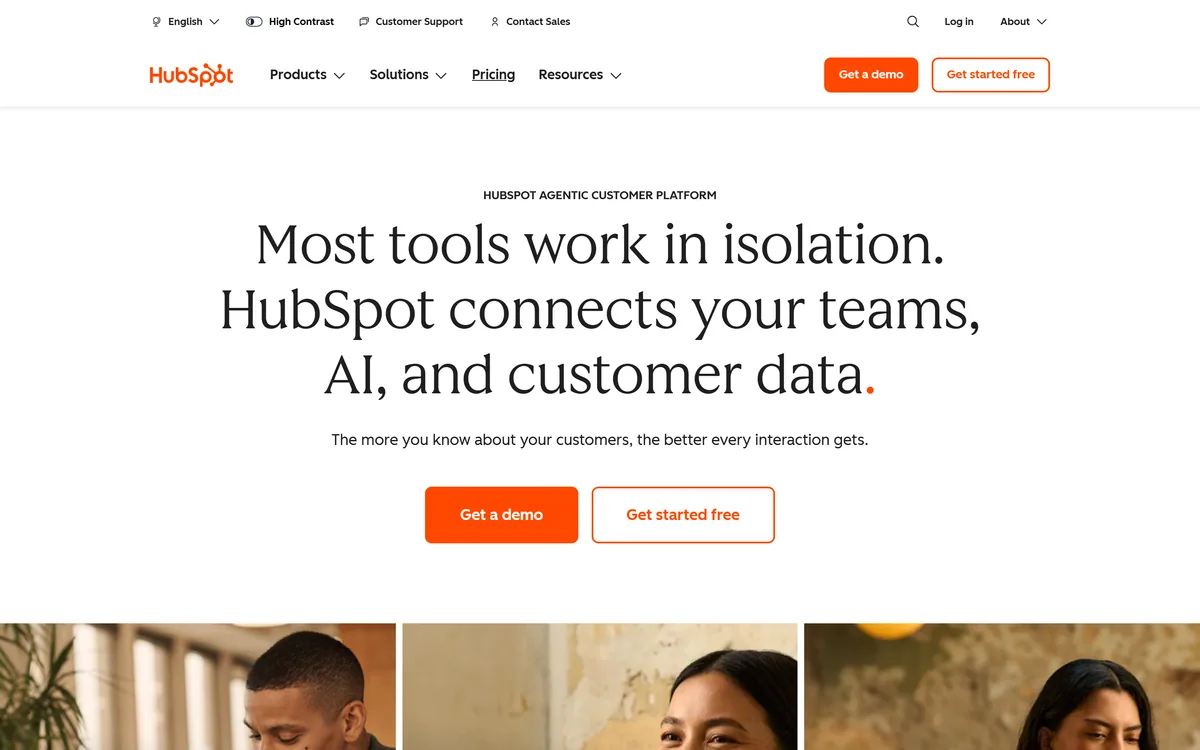
It is a different category from a sales CRM with AI like HubSpot AI, which leads up to the deal; Gainsight owns what happens after the contract is signed, where retention and expansion are won or lost.
Customer success as a job title reacts to churn once it is visible. Customer success as a system is nudged toward the account drifting while there is still time.
What Do Gainsight's Products Actually Cover?
Gainsight is a suite rather than a single app, and the pieces map to stages of the post-sale journey.
CS, PX, Community And Customer Education
Gainsight CS drives retention and expansion for customer success teams; Gainsight PX drives adoption with in-app guidance that meets users where they get stuck; Gainsight CC is a community where customers ask, answer and learn; and Skilljar turns new customers into product experts with scalable academies.
Running these together is the pitch: onboarding feels like a continuation, adoption is watched rather than assumed, and learning closes the gap between what shipped and what customers understand. Signal analysis tools like Gong cover the conversation side of revenue, while Gainsight covers the product-and-engagement side.
Staircase AI And The Atlas Agents
Staircase AI is the layer that turns every signal into scored risk and the right action, and the Atlas AI agents are how that work gets automated. A team can ask a general assistant like Perplexity AI a question, but it cannot see your customer base; Gainsight's agents act on your own account context.
The honest caveat is that an agentic layer is only as good as the data and processes feeding it. Gainsight is powerful precisely because it is wired into your customer data, which also means it rewards teams with clean, well-instrumented data and underwhelms those without it.
The Buy, Build, Hire Model For Agentic AI
Gainsight frames its agentic AI around three choices. Buy gets you apps and agents ready to work without starting from scratch. Build lets you create your own agents and workflows with your customer context already wired in. Hire hands the work to Gainsight experts and agents to run a motion like renewals at scale.
That framing is genuinely useful because it maps to how different organisations actually adopt AI: some want it out of the box, some want to customise, and some want the outcome without staffing the motion. It also sets honest expectations, since the deepest value comes from the build path, which assumes real investment.
For a buyer, the question is which path you are actually resourced for. Buying agents you never configure, or committing to build without the team to do it, are the two ways this kind of platform disappoints.
How Gainsight Approaches Enterprise Pricing
Gainsight is sold as an enterprise platform, with pricing quoted through sales rather than listed, and a demo as the entry point. It is not a self-serve tool you sign up for on a card.
AInexfinder does not publish plan prices, and enterprise pricing is bespoke in any case. What drives it is the usual enterprise mix: which products you license, how many customers and users you manage, and how much of the agentic layer you adopt. Budget for it as a platform investment with implementation behind it.
The value equation is retention: Gainsight pays for itself when keeping and growing customers at scale is worth more than the platform and the team to run it, which is true for established subscription businesses far more than for small ones.
Evaluating Gainsight Against Your Retention Goals
Because Gainsight is a platform rather than a feature, evaluate it against a real retention goal and your actual data, not a demo dashboard.
- Name the retention or expansion outcome you actually want to move, and the signals that would predict it.
- In a demo, check whether Gainsight can ingest your real signals and turn them into a risk score you would trust.
- Decide honestly which of buy, build or hire your team is resourced to pursue.
- Map one product, such as CS or PX, to a concrete workflow your team runs today and see whether it fits.
- Ask how the Atlas agents would act on your data, and what data hygiene they assume.
- Pass/fail: Gainsight is worth it only if it would measurably improve a retention outcome that justifies the platform and implementation cost.
- Confirm which products and AI capabilities are in the package you are quoted before committing.