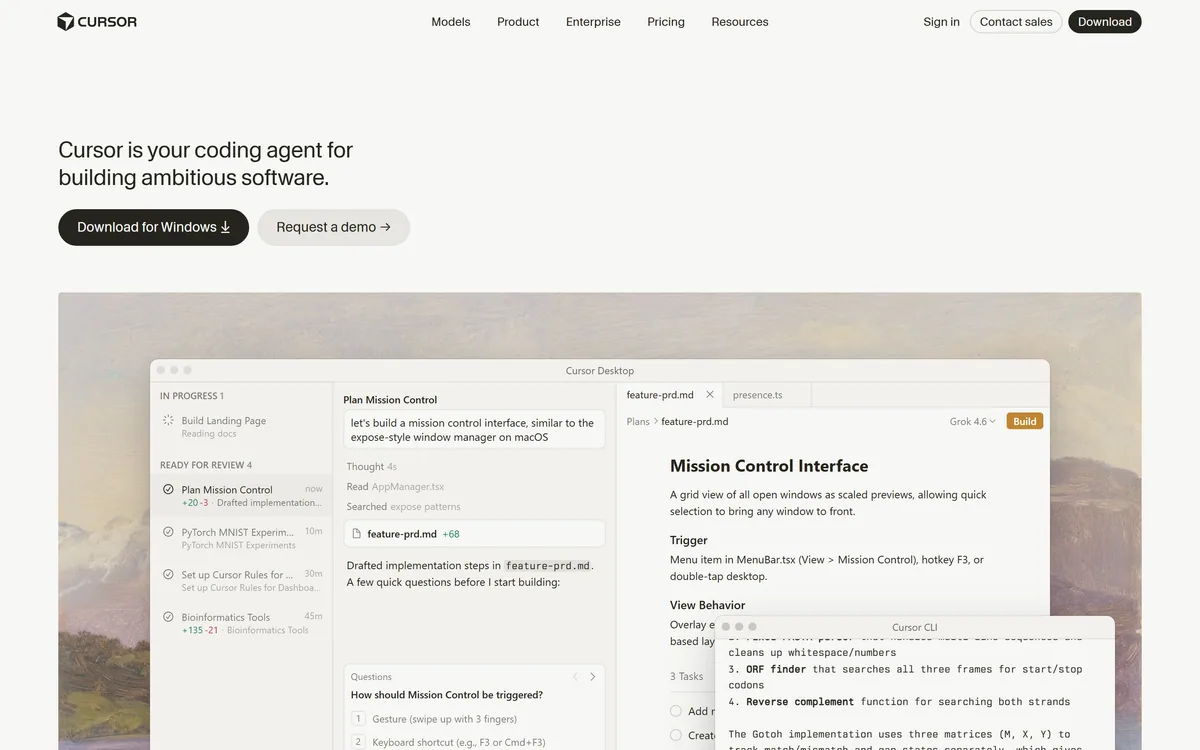

Cursor is an AI-first code editor and agent platform from Anysphere — now a SpaceX subsidiary — that plans, writes, tests, and reviews code across your repository from the desktop editor, a CLI, the web, and Slack.
Coding & Development Review
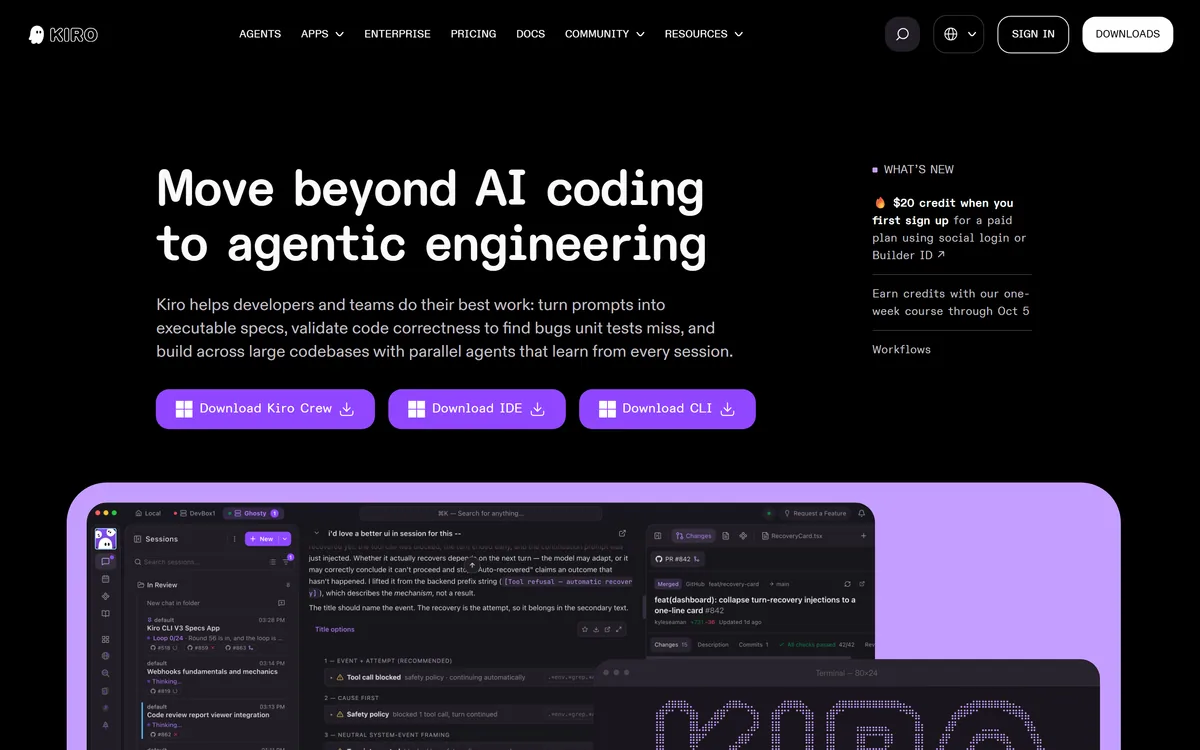
Kiro is an agentic software-engineering toolset, an IDE, a CLI and cloud sessions, that turns prompts into executable specs, validates code correctness, and works across large codebases with parallel agents, positioned as a step beyond basic AI code completion.
Very good
Kiro earns 4.1 for a genuinely sharper idea than autocomplete: spec-driven agentic engineering, where prompts become reviewable executable specs, backed by correctness checks, parallel agents and a configurable trust model across IDE, CLI and cloud. The honest limit is that its public page is sparse, so the evidence is thin and claims stay modest; the concept suits spec-first teams who will judge it on real code and watch the credit burn. AInexfinder Editor Score: 4.1/5.
Best for: Spec-first developers; Teams wanting a trust model
The visit link goes to kiro.dev, the official site. Paid placements on AInexfinder are always labelled. How we make money
AI coding has mostly meant autocomplete, helpful, but it still leaves the engineer holding the intent and the correctness. Kiro's pitch is to move up a level, to "agentic engineering" built around specs rather than loose prompts.
It is a toolset spanning an IDE, a CLI and cloud sessions that turns prompts into executable specs, validates code correctness, and works across a codebase with parallel agents. It sits among coding agents like OpenCode and IDE-native assistants such as JetBrains Junie, distinguished by its spec-first approach.
This review covers how Kiro builds across a codebase, who agentic engineering suits, how its credits work, and the honest caveat that its public page is light on detail. We weigh it on what is verifiable.
| What it is | An agentic software-engineering toolset |
|---|---|
| Surfaces | IDE, CLI and cloud sessions |
| Core idea | Spec-driven development from prompts |
| Correctness | Validation to catch bugs tests miss |
| Scale | Parallel agents across large codebases |
| Config | Specs, steering files, hooks, trust model |
| Connection | Linked to Amazon tools / Builder ID |
| Pricing | Freemium with credits |
Kiro's organising concept is the spec. Rather than reacting to a one-off prompt, it turns your intent into an executable spec, a defined description of what to build, and then has agents work against that, which is a more disciplined pattern than freeform chat-to-code.
The appeal is that a spec is reviewable and reusable: you can see what the agent understood before it acts, and correct the intent rather than untangle the output afterward. For non-trivial work, that front-loaded clarity is where agentic coding either earns trust or loses it.
A fair caveat up front: Kiro's public page leans heavily on terminal visuals and is sparse on hard detail, and it connects to Amazon tools via a Builder ID. We describe what is verifiable and keep the claims modest where the evidence is thin.
A spec is reviewable: you can see what the agent understood before it acts, and correct the intent rather than untangle the output afterward.
Two capabilities define the workflow beyond the spec itself.
From a spec, Kiro scaffolds and edits a project and runs code-correctness validation intended to catch bugs that unit tests miss, with steering files and hooks to shape how it behaves and a trust model governing what it may do.
Correctness-checking beyond tests is the ambitious part, and the right way to judge it is on your own code. A coding agent like Cosine approaches deep codebase understanding from a different angle, so comparing them on a real task is more useful than comparing feature lists.
Kiro can run parallel agents across a large codebase and offers resumable local and cloud sessions, with a cloud workspace you populate with your own agents, MCP servers and hooks rather than one that is pre-filled.
That explicit, you-configure-it cloud model is a sensible trust choice for engineering teams wary of an agent with unbounded access. It is a more deliberate posture than a one-click assistant, and it suits teams that want to see and control what the agent can reach.
Kiro suits developers and teams ready to work in a spec-first way, those building non-trivial features where defining intent up front pays off, rather than people wanting a quick inline suggestion.
It also appeals to teams that value an explicit trust model and configurable cloud sessions over a black-box agent, and to anyone already in the Amazon developer ecosystem given the Builder ID connection.
It suits less well a developer who just wants autocomplete in their editor, or anyone who needs a mature, heavily documented tool today, given how sparse the public information currently is. The concept is strong; the evidence base, from the site alone, is still thin.
Kiro is freemium with paid plans and sign-up credits, plus bonus credit for social login or a Builder ID and promotional credit-earning. We do not publish prices, which change; check the site.
A credit model is normal for agentic coding, since agent runs consume real compute, so the practical question is how far your typical workflow draws down credits, which only real use reveals.
Because there is a free entry, the low-risk move is to run Kiro on a real task and watch both the quality of its spec-driven output and the credit burn before committing to a plan.
Because the public detail is limited, judge Kiro on a real feature in a real repo rather than on the marketing.
Spec-driven development from prompts
Executable specs you review before building
Code-correctness validation
Parallel agents across a codebase
IDE, CLI and cloud sessions
Steering files, hooks and trust model
Resumable local and cloud workspaces
Amazon Builder ID connection
The useful comparison is with other coding agents and IDE assistants.
| Tool | Tool | Approach | Best for |
|---|---|---|---|
| Kiro | Spec-driven agentic engineering | Defined intent, correctness checks | Spec-first teams |
| OpenCode | Open-source coding agent | Transparent, flexible agent | Open-source-minded devs |
| JetBrains Junie | IDE-native agent | In-editor agentic help | JetBrains users |
| Cosine | Codebase-understanding agent | Deep code comprehension | Large-codebase work |
Last checked . Read from kiro.dev during this check, with the screenshot above captured at the same time.
Kiro's public page is sparse (heavy on terminal visuals), so our evidence is limited; we describe what is verifiable and keep claims modest where detail is thin.
An open-source agent, an IDE-native agent and a codebase-understanding agent to weigh alongside Kiro.
AInexfinder does not list plan prices or billing details. For current pricing, plans, and trials, visit the official Kiro website.
Visit official website for pricingVendor pricing, credits, and billing policies change over time. Always confirm on the official site before you buy.
Kiro earns an AInexfinder Editor Score of 4.1/5 (very good). Best for: Spec-first developers; Teams wanting a trust model; Non-trivial feature work.
Visit KiroLog in to write a review.
No reviews yet. Be the first to share your experience with Kiro.
Assigned reviewer
Daniel ReedSenior AI Tools Reviewer
Daniel leads AInexfinder's tool reviews. He researches each tool from its own pricing, documentation and policies, checks its claims against independent sources, and writes up what it does well, where it falls short and who it genuinely suits.
Daniel and the AInexfinder editorial team research Kiro from its own website, pricing, documentation and policies, checked against independent sources. This review is research-based: unless its method note says otherwise, we have not bought a plan or run hands-on tests. The Editor Score is our editorial judgement, and payment never changes it.
Similar Tools
Cursor is an AI-first code editor and agent platform from Anysphere — now a SpaceX subsidiary — that plans, writes, tests, and reviews code across your repository from the desktop editor, a CLI, the web, and Slack.
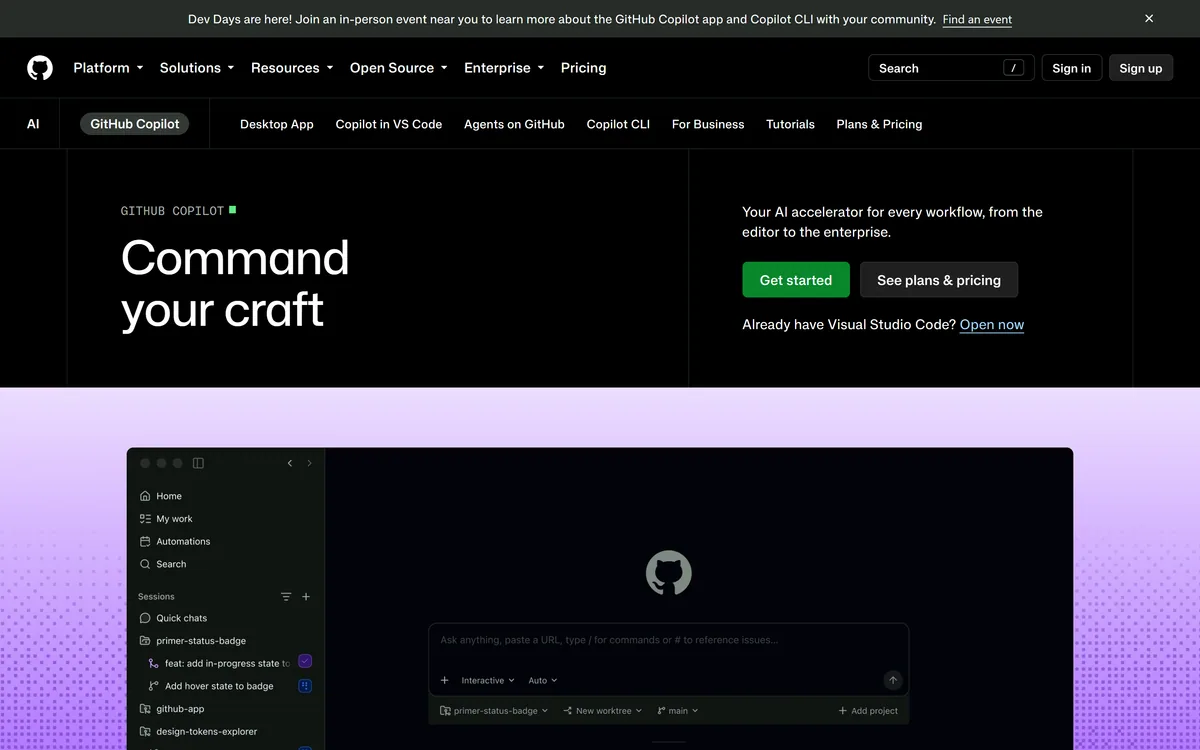

GitHub Copilot is an AI coding assistant that spans completion, chat, agent mode, automated code review, and a cloud agent that opens pull requests, working across VS Code, Visual Studio, JetBrains, Xcode, Neovim, Eclipse, the CLI, and github.com.
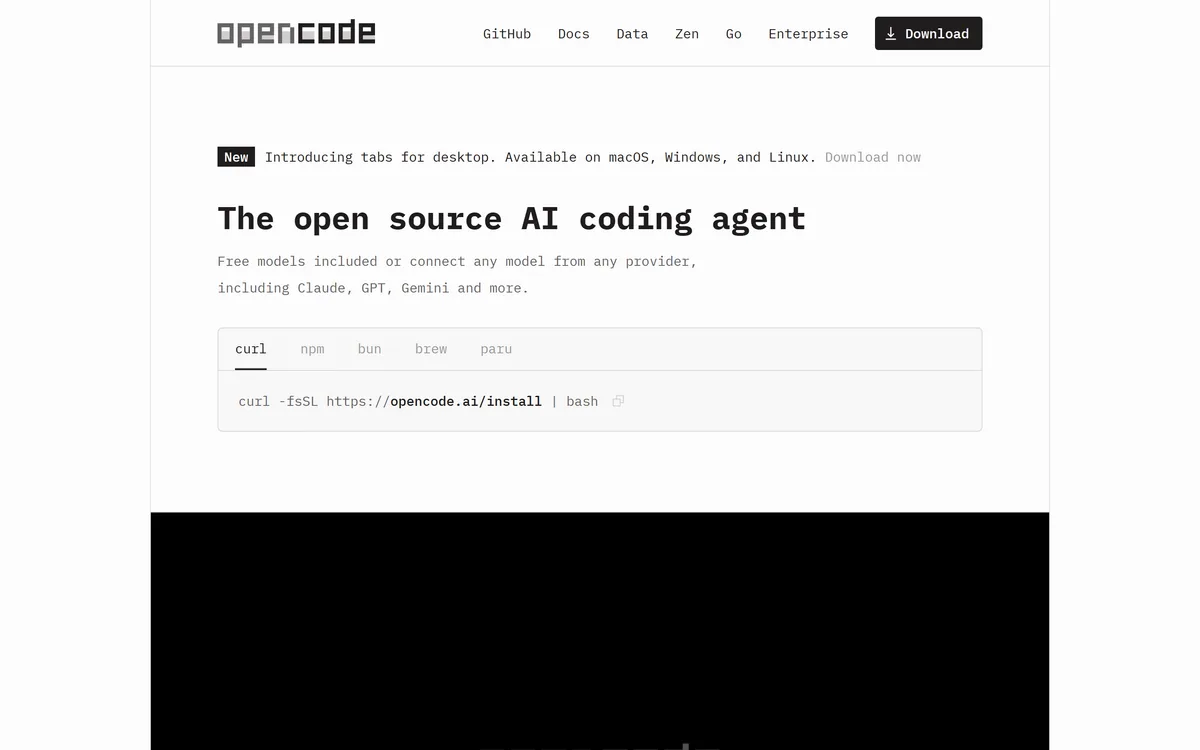
OpenCode is an open source AI coding agent built for the terminal, with desktop and IDE clients alongside. It connects to 75+ model providers, configures language servers automatically, runs parallel agent sessions, keeps conversations locally in SQLite, and is built by the team behind SST.
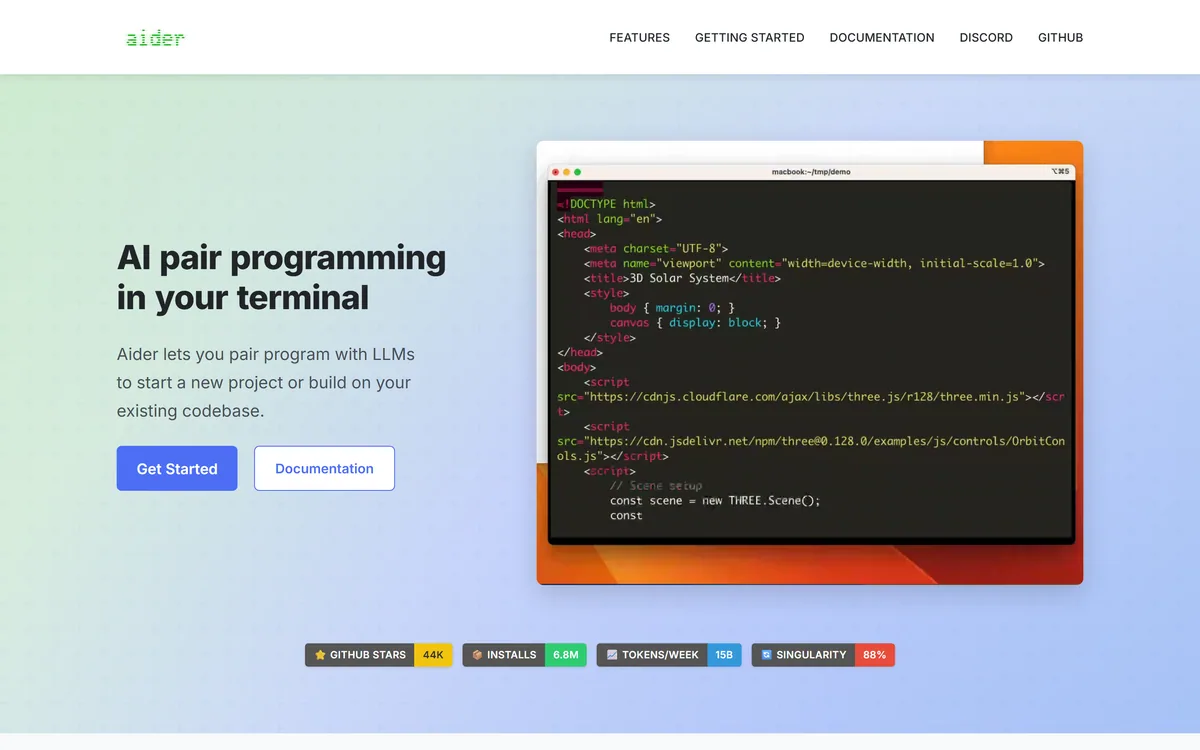
Aider is an open-source AI pair programming tool that runs in your terminal, builds a map of your whole repository for context, works with almost any LLM including local models, and commits each change to git with a written message so every edit can be diffed and undone.
Traycer review on AInexfinder — freemium AI tool for Coding & Development. Features, pricing notes, and alternatives.
Generate native iOS, Android and web apps from prompts Category: Coding & Development.
Related Pages