Ask a general assistant to plan a week in Portugal and you get something that reads beautifully and cannot be booked. The hotel closed in 2023, the museum is shut on Mondays, and the train does not run that route.
Layla's answer is to plan against live prices and availability rather than from memory, which is the difference between an itinerary and a piece of travel writing.
The second half is more unusual: human travel experts who can take the plan, book it, and manage changes — which puts a travel agency behind the software.
Layla: AI Itineraries Checked By Humans
- Live pricing and availability for flights, hotels, trains and activities, rather than plans invented from training data.
- Human travel experts who can plan, book and manage a whole trip, or step in at any stage.
- 2,361,902 itineraries displayed as built, with examples showing duration and party composition.
- Multi-city and road trips named as a specialism, with route optimisation between destinations.
- Layla AI GmbH, Berlin, with free planning tools and an annual premium subscription.
Why Do AI Trip Plans Usually Disappoint?
Layla states that it builds a day-by-day plan using live pricing and availability, comparing flights, hotels, trains and activities.
That is the fix for the specific failure that makes most AI travel planning worthless, and it is worth being precise about what goes wrong.
A language model asked to plan a trip produces the most plausible itinerary, which is not the same as a real one. It will confidently name a restaurant that closed, a museum with the wrong opening hours, and a journey time that assumes a road that does not exist.
Worse, it is wrong in a way that looks right. Nothing in the output signals which details were retrieved and which were generated, so you discover the difference while standing outside a locked door.
Querying live inventory changes the nature of the output. A hotel that appears is a hotel with rooms at a price; a train that appears runs. That constraint makes the plan less imaginative and considerably more useful — the same reason cited answers matter more than fluent ones in tools like Liner.
A generated itinerary is wrong in a way that looks right. You find out while standing outside a locked door.
Where A Travel Expert Adds Value
Layla's FAQ is explicit that human experts can understand your needs, create an itinerary, find and recommend options, make bookings and update plans as things change.
That is a travel agency, and it is worth understanding what an agent actually provides beyond the booking.
Almost none of it is finding the flight. The value is in what happens when something breaks — a cancelled connection at midnight, a hotel that has lost your reservation, a strike that closes an airport. Someone who can rebook you is worth considerably more than someone who found you a good price.
Agents also carry knowledge that is not written down anywhere a model could read: which resort is next to a building site, which transfer is a two-hour ordeal, which neighbourhood is unpleasant after dark.
The combination is the genuinely interesting proposition here. Let the AI do the tedious comparison work at speed, and bring in a person for judgement and for the moment something goes wrong — which is close to the correct division of labour between the two.
Two Million Itineraries And What They Show
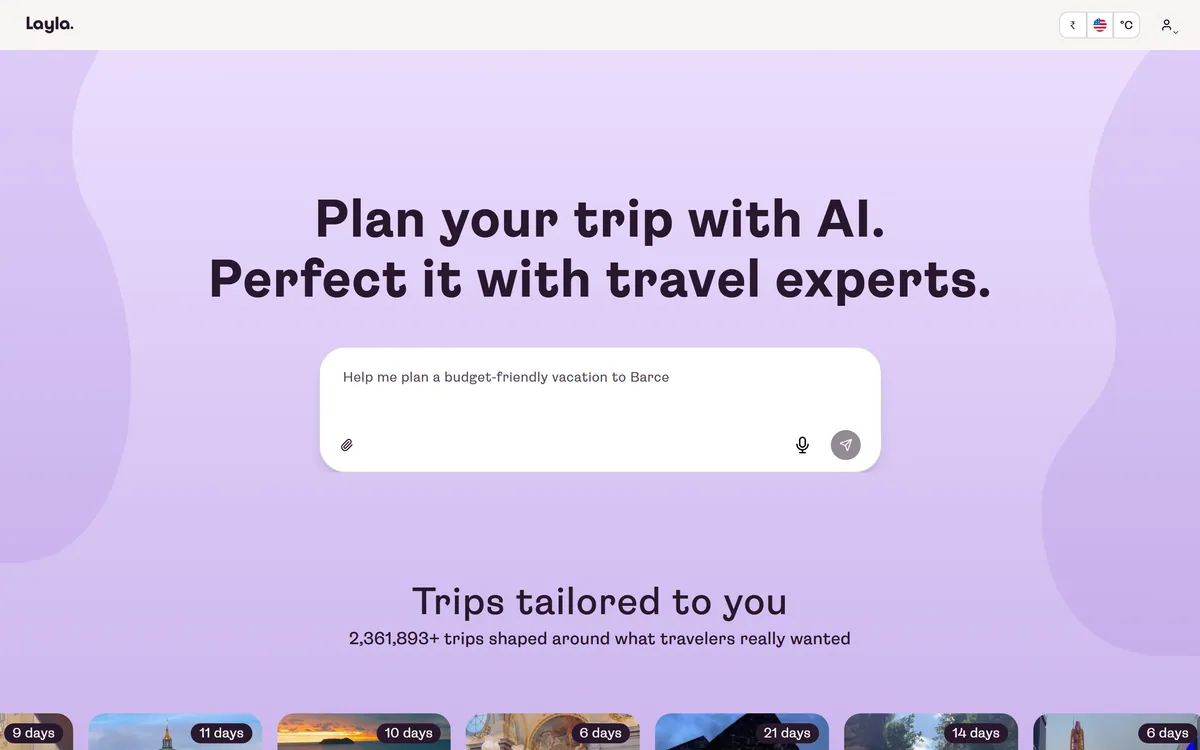
The homepage displays a precise figure — 2,361,902 trips shaped around what travellers really wanted — alongside dozens of example itineraries with durations, destinations and party descriptions.
The examples are more informative than the number, and worth reading as data rather than decoration.
What they reveal is the shape of demand. Trips run from two days to twenty-nine, and party composition varies constantly — solo, couples, families, groups of friends, honeymoons. Destinations spread across Europe, Asia, Australia and India rather than clustering on a handful of stock cities.
That variety is the argument for planning software rather than templates. A two-day Chicago weekend and a twenty-two-day Kuala Lumpur and Bali honeymoon share nothing structurally, and neither fits a pre-built itinerary.
The title's separate claim of being trusted by millions describes a different quantity from trips built, and the site does not reconcile them. Read the trip count, which is specific, rather than the user claim, which is not.
- Ask what financial protection a booking through the experts carries.
- Give real constraints — budget, pace, mobility — not just a destination.
- Use the human expert for the complicated leg, not the whole trip.
- Check opening days and seasonal closures yourself before committing.
- Confirm prices at the point of booking, not from the plan.
Multi-City Routing And Where It Helps Most
The FAQ names multi-city itineraries and road trips as a specialism, describing route optimisation between destinations across flights, trains and car rental, with places to visit along the way.
This is where software genuinely beats a person working alone, and the reason is combinatorial.
A single-destination trip has few decisions. A five-city trip has an ordering problem, and the number of possible sequences grows fast enough that no traveller evaluates them all — most people pick an order that seems sensible and accept whatever inefficiency follows.
Getting it wrong is expensive in the currency that matters on holiday. A badly ordered route costs a full day of travel and several hundred in unnecessary fares, and the mistake is invisible until you are on the wrong train.
Road trips add a different constraint — driving time between overnight stops — which is exactly the kind of tedious arithmetic worth handing over. The judgement about whether four hours of driving is acceptable on day three remains yours, and that is the part to check rather than accept. General AI search such as Komo will answer questions about a destination and book nothing, while a personal assistant like Khoj works over your own notes instead.
What To Settle Before Money Changes Hands
Layla offers free planning tools with an annual premium subscription, and its experts can make bookings on your behalf. The combination raises questions that a planning tool alone does not.
The first is financial protection. Travel bookings in most jurisdictions carry consumer protections that depend on who sold you what — package travel regulations, airline bonding schemes, card chargeback rights — and those differ sharply between booking direct, booking through an agent, and booking through a platform.
The site does not address this on the pages we read, and it is the single most important thing to establish before letting anyone book a trip for you.
The second is who holds the booking. If a flight changes, whether you or the agent can alter it determines how a disrupted trip goes, and it is worth knowing which name is on the reservation.
None of this is a criticism of the service. It is ordinary due diligence that applies to every travel intermediary, and a company with a German entity and a published imprint is a reasonable place to ask the question rather than a reason to avoid it.
Planning A Trip You Will Actually Take
The failure mode with AI trip planning is accepting a beautiful itinerary that assumes you walk fourteen kilometres a day and enjoy museums.
This sequence produces a plan that survives contact with the actual holiday.
- State your real pace and constraints, not your aspirational ones.
- Give a genuine budget — it changes every recommendation.
- Have it optimise the route order before you choose any hotels.
- Verify opening days and seasonal closures for anything you care about.
- Bring in a human expert for the leg that worries you most.
- Confirm what protection your booking carries before paying.
Layla: Scale And Approach
| Company | Layla AI GmbH, described as made in Berlin |
|---|
| Positioning | An AI travel agent and trip planner with human expert support |
|---|
| Planning inputs | Dates, destinations, budget and travel style |
|---|
| Data | Live pricing and availability for flights, hotels, trains and activities |
|---|
| Human service | Experts can plan, book and manage a trip end to end |
|---|
| Displayed trips | 2,361,902 itineraries built |
|---|
| Trip types named | Multi-city, road trips, family, solo, couples and honeymoons |
|---|
| Route planning | Optimisation between destinations across flights, trains and car rental |
|---|
| Suggested lengths | Three to five days for city breaks, seven to ten for multi-city |
|---|
| Free tier | Free planning tools with optional upgrades |
|---|
| Premium | An annual subscription for unlimited premium planning features |
|---|
| Sibling product | Roam Around, listed in the footer |
|---|