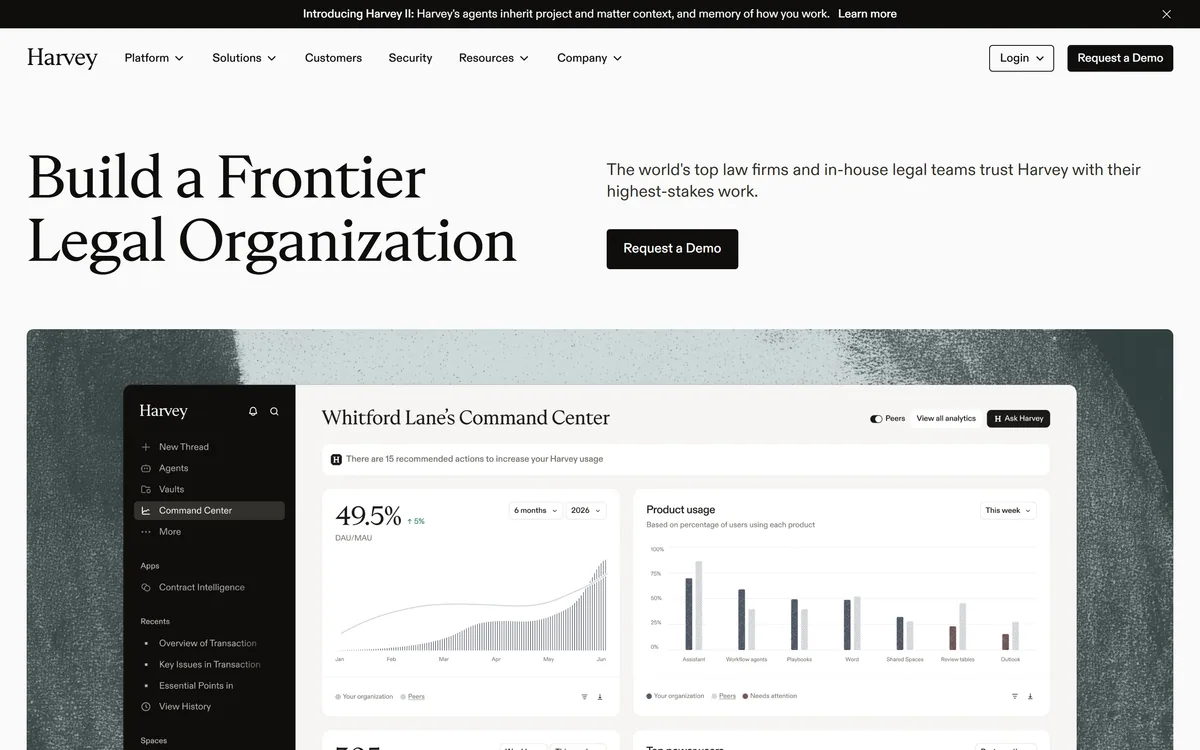

Harvey is an AI platform for legal and professional services — agents, a Vault for documents, Knowledge, Spaces, and Contract Intelligence — used by firms including A&O Shearman, Latham & Watkins, and Norton Rose Fulbright.
Emerging & Specialized Review
Luminance is a contract platform from Luminance Technologies Ltd. spanning Draft, Negotiate, Analyze, Comply, Investigate and Collaborate. It describes a mixture-of-experts architecture using probabilistic consensus across multiple models, with over 1,000 customers named on the site.
Very good
Luminance is a serious enterprise platform and its customer list is the most persuasive thing about it — AMD, Tesco, KPMG, Clifford Chance and Slaughter and May do not buy legal software casually, and law firms are the hardest audience for legal AI because the software claims to assist their own expertise. The six-module spread from drafting to investigation is genuinely broad, and the multi-model architecture is a defensible answer to single-model brittleness. What holds it below the top is the marketing: 90% time savings and 98% cost reduction are unaudited vendor figures, and a platform this large is a project rather than a purchase. AInexfinder Editor Score: 4.2/5.
Best for: Enterprises with contract estates too large to know by memory; Legal operations answering board-level questions about exposure
The visit link goes to luminance.com, the official site. Paid placements on AInexfinder are always labelled. How we make money
Contracts are the connective tissue of a business, and almost nobody knows what is in the ones they already signed.
That gap is what separates contract platforms from contract assistants. An assistant helps with the agreement in front of you; a platform is bought because someone needs to answer a question about ten thousand agreements nobody has read since signature.
Luminance is firmly the second kind, and its six modules make the ambition explicit: drafting at one end, investigation of an existing estate at the other, and negotiation, analysis and compliance in between.
Luminance describes a unique AI architecture powered by multiple models, using a mixture-of-experts approach with probabilistic consensus to reach what it calls Legal-Grade accuracy.
The underlying idea is genuinely sensible, whatever you make of the branding. A single model has a characteristic set of failure modes, and if you route every question through it, you inherit all of them uniformly.
Several models scored against each other change the failure profile. Where they agree, confidence is higher; where they disagree, you have identified exactly the passages a human should look at — which is more useful than a uniform confidence score across everything.
For contract review specifically this matters, because the cost of errors is asymmetric. Missing an unusual indemnity is expensive; flagging a standard one unnecessarily costs a minute. An architecture that surfaces disagreement rather than smoothing it over is aligned with that asymmetry.
What the site does not tell you is which models, how many, or how the consensus is weighted, and none of that is verifiable from outside. Treat it as a plausible design decision rather than a proven accuracy claim — the customer list is stronger evidence than the architecture description.
Compare that with LegalOn, which grounds its review in attorney-written playbooks instead. Both are answers to the same worry — that a model's judgement is unexplainable — reached from opposite directions.
Where several models disagree, you have found exactly the passages a human should read. That is more useful than one confident score across everything.
Draft, Negotiate, Analyze, Comply, Investigate and Collaborate is unusually wide coverage, and no organisation uses all six equally.
Draft and Negotiate serve the flow of new agreements, which is where most legal software lives and where the competition is thickest. If that is your only problem, a narrower tool will do it for less.
Analyze and Investigate are the modules that justify a platform. They operate on the estate you already have — finding every contract with a particular clause, answering what your exposure is if a supplier fails, discovering which agreements auto-renew next quarter. That question is unanswerable without a system, and it is the one that reaches a board.
Comply is the module that gets bought after a regulatory change, when someone asks which of ten thousand agreements need amending and the honest answer is that nobody knows.
The practical read is that a platform this size is bought for the estate, not the pipeline. If your pain is reviewing incoming NDAs faster, this is an expensive way to solve it.
The site states 90% time savings on contract review, a 98% reduction in contract management costs, and 500+ hours saved on contract generation. These deserve reading carefully rather than dismissing.
The first problem is the baseline. Ninety per cent faster than what — a junior lawyer reading every word, or a process that was already partially automated? The saving is defined by the starting point, and the starting point is never stated.
The second is selection. Figures like these come from customers willing to be quoted, which is a self-selecting group of successful deployments. Nobody publishes the average across all customers including the ones that struggled.
The third is definitional. A 98% reduction in contract management costs requires a definition of contract management cost that includes or excludes salaries, systems and outside counsel, and the answer moves the number by an order of magnitude.
None of this means the platform does not save time — the customer list suggests it plainly does. It means the percentages are marketing and the named customers are evidence, and you should weight them accordingly.
The same caution applies to every vendor in this category, Ironclad included: the customer logos are checkable and the percentages are not.
The customer list answers this better than any positioning statement. AMD, Danone, Ralph Lauren, Tesco, Campbell Soup, NTT DATA, E.ON, Staples, BBC Studios, AB InBev, Hitachi, KPMG, Clifford Chance and Slaughter and May are not a random cross-section.
Two patterns stand out. The first is scale: these are organisations with contract estates large enough that nobody can hold them in their head, which is precisely the condition that makes Analyze and Investigate valuable rather than interesting.
The second is the law firms. Clifford Chance and Slaughter and May are among the most demanding possible buyers of legal AI, because the software's claims overlap with their own core expertise and their professional risk tolerance is extremely low. Their presence is meaningful evidence.
What the list also tells you is who this is not for. There is no small firm on it, and that is not an oversight — a platform with six modules, an implementation project and enterprise procurement behind it is not economic below a certain size.
The honest framing for a smaller organisation is that Luminance is a good platform you are unlikely to be able to justify, and that the right comparison set is narrower tools solving the specific stage that hurts.
For a firm below that scale, a Word-native reviewer such as Ivo or a drafting assistant like Spellbook delivers most of the day-to-day benefit without the implementation project.
Enterprise legal software is bought on demos and regretted on rollouts, and the difference is almost always whether the pilot tested anything real.
A pilot on curated sample contracts proves the vendor can curate. A pilot on your worst agreements proves something useful.
Draft, Negotiate, Analyze, Comply, Investigate and Collaborate as distinct modules
A multi-model architecture rather than a single underlying model
Probabilistic consensus intended to surface disagreement between models
Analysis across an existing contract estate, not only new agreements
Compliance review for finding agreements affected by a regulatory change
Investigation tooling for questions about historic contracts
ISO 27001 and SOC 2 certification for enterprise procurement
Contract tools separate by whether they serve the incoming pipeline or the estate you already signed.
| Tool | Centre of gravity | Scale it suits | Best for |
|---|---|---|---|
| Luminance | Analysis and investigation of a large estate | Enterprise | Answering questions about contracts nobody has read |
| Ironclad | Workflow across the contract lifecycle | Mid-market to enterprise | Running a process across departments |
| LegalOn | Review against attorney-authored playbooks | In-house teams of most sizes | Consistent, defensible review standards |
| Ivo | Redlining in Word against your own playbook | Small to mid-size legal teams | Adoption without a platform migration |
| Spellbook | Drafting assistance in Word | Small firms | Help writing rather than a system to run |
| Operating company | Luminance Technologies Ltd. |
|---|---|
| Positioning | Legal-Grade AI for contract activity across the business |
| Modules | Draft, Negotiate, Analyze, Comply, Investigate, Collaborate |
| Architecture | Multiple models in a mixture-of-experts approach with probabilistic consensus |
| Customers | Over 1,000 |
| Named customers | AMD, Danone, Ralph Lauren, Tesco, Campbell Soup, NTT DATA, E.ON, Panda Express, Staples, BBC Studios, AB InBev, Hitachi, KPMG, Clifford Chance, Slaughter and May, Automation Anywhere |
| Certifications | ISO 27001, SOC 2, plus a Gartner rating |
| Stated results | 90% time savings on review, 98% reduction in contract management costs, 500+ hours saved on generation |
| Footer | Privacy Policy, Cookie Policy, Terms & Conditions, Anti-Slavery Statement |
Last checked . Read from luminance.com and its footer, with the screenshot above captured in the same session.
What we could not confirm: which underlying models the architecture uses, how many, or how consensus is weighted; the baseline behind any of the percentage claims, or how they were measured; headquarters, company size or funding; pricing and module packaging; supported languages; whether named customers use all six modules or one; typical implementation timelines; and independent verification of the certifications. The homepage loads its body content on scroll, so the capture above shows the header only. We did not use the platform, so nothing here reflects tested accuracy.
Different points on the contract lifecycle are served by very differently sized products.
AInexfinder does not list plan prices or billing details. For current pricing, plans, and trials, visit the official Luminance website.
Visit official website for pricingVendor pricing, credits, and billing policies change over time. Always confirm on the official site before you buy.
Luminance earns an AInexfinder Editor Score of 4.2/5 (very good). Best for: Enterprises with contract estates too large to know by memory; Legal operations answering board-level questions about exposure; Compliance teams finding agreements affected by a regulatory change.
Visit LuminanceLog in to write a review.
No reviews yet. Be the first to share your experience with Luminance.
Assigned reviewer
Daniel ReedSenior AI Tools Reviewer
Daniel leads AInexfinder's tool reviews. He researches each tool from its own pricing, documentation and policies, checks its claims against independent sources, and writes up what it does well, where it falls short and who it genuinely suits.
Daniel and the AInexfinder editorial team research Luminance from its own website, pricing, documentation and policies, checked against independent sources. This review is research-based: unless its method note says otherwise, we have not bought a plan or run hands-on tests. The Editor Score is our editorial judgement, and payment never changes it.
Similar Tools
Harvey is an AI platform for legal and professional services — agents, a Vault for documents, Knowledge, Spaces, and Contract Intelligence — used by firms including A&O Shearman, Latham & Watkins, and Norton Rose Fulbright.
AI contract review and lifecycle management for legal teams Category: Emerging & Specialized.
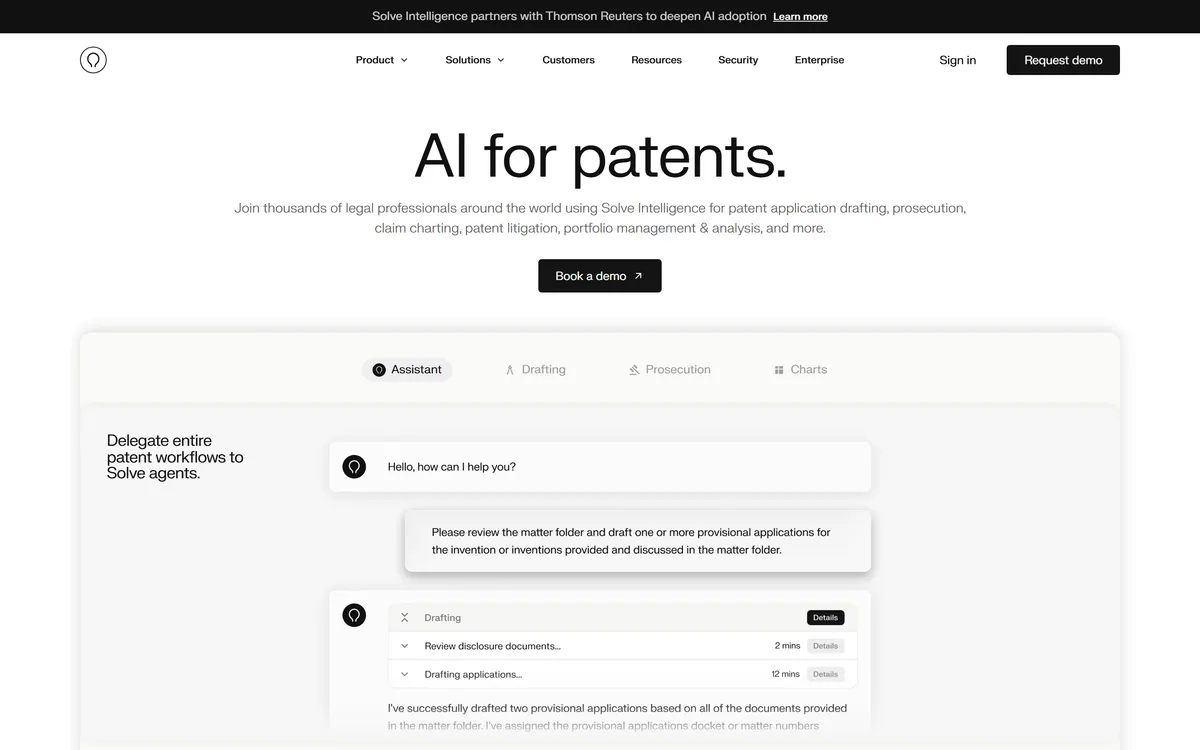
Solve Intelligence is an AI platform for patent work, covering application drafting, office action responses, invalidity and claim-mapping charts, freedom-to-operate reviews and portfolio analysis. It is used by over 700 in-house IP teams and law firms, with SOC 2 Type II and ISO 27001 certification and no training on customer data.
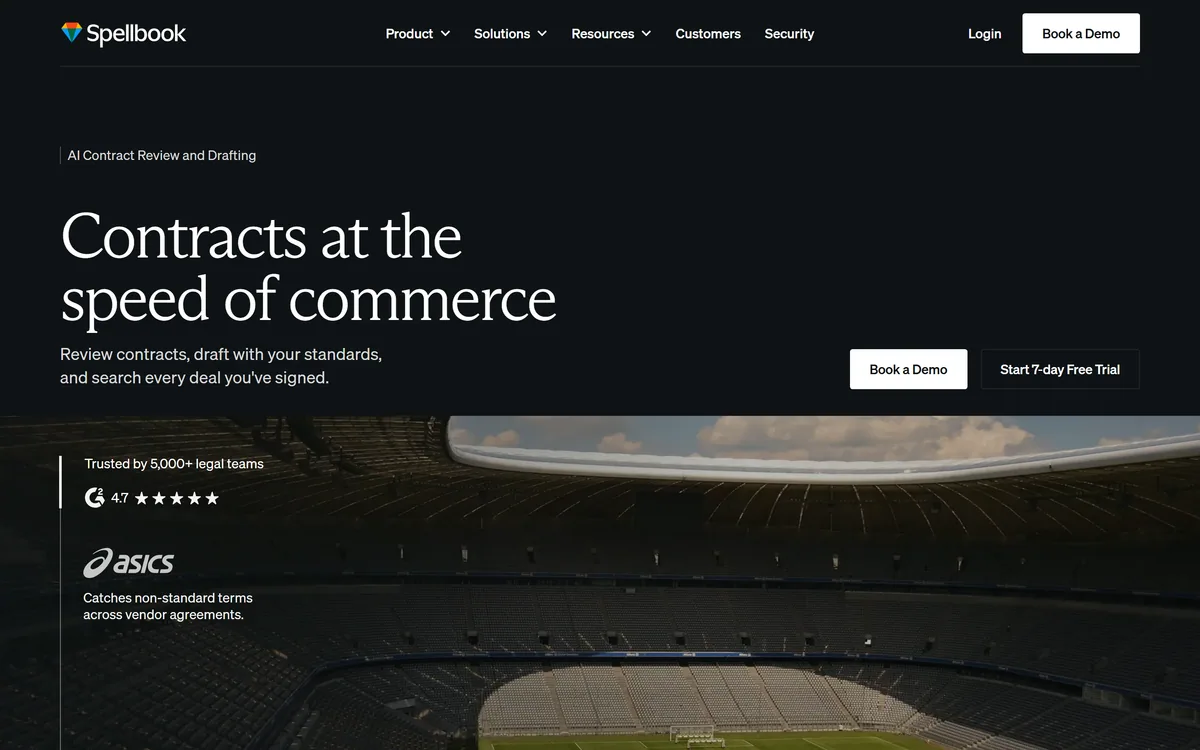
Spellbook reviews and drafts contracts inside Word and Google Docs, redlining against a firm's own playbooks, comparing terms to thousands of similar agreements, and indexing signed contracts for search — used by a stated 5,000-plus legal teams in 80-plus countries.
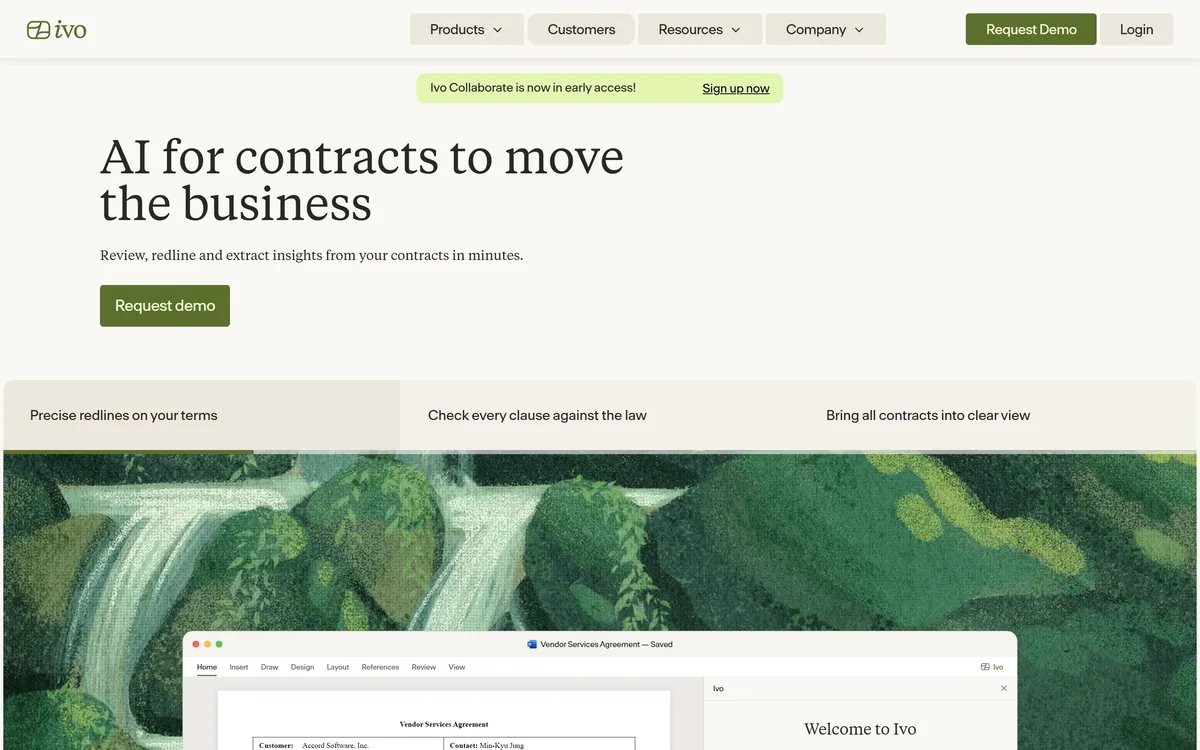
Ivo is AI contract review for in-house legal teams. It applies redlines directly in Microsoft Word or Google Docs, evaluates agreements against your playbooks and historical contracts, benchmarks clauses by governing law and industry, and queries executed contracts in plain language.

LegalOn is a contract lifecycle platform from LegalOn Technologies, Inc. covering intake, review, redlining, storage and analysis, built on more than 135 attorney-authored playbooks across industries and countries, with a Microsoft Word integration and agentic workflows.
Related Pages