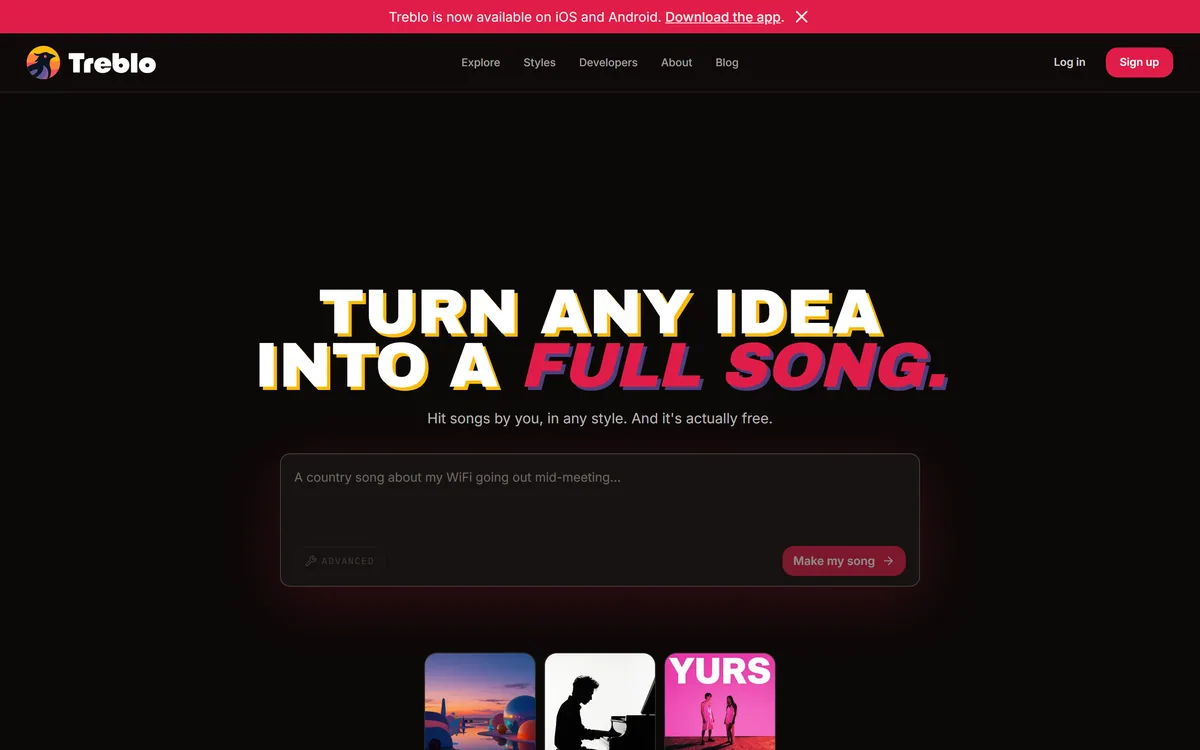
Treblo turns a sentence into a song. Not a loop or a backing track — a complete piece with structure and vocals, generated from a plain description of what you want.
Its own example prompt tells you a lot about the intended audience: "A country song about my WiFi going out mid-meeting." This is built for the personal and the playful as much as for anything professional.
This review covers what the generation actually produces, where AI music is genuinely good and genuinely weak, the rights question that hangs over the whole category, and who should use it.
Treblo In A Nutshell
- What it does: generates a complete song — music, structure, and vocals — from a one-sentence description, in any style you name.
- It is free, and says so prominently: "Hit songs by you, in any style. And it's actually free."
- Beyond the web app: iOS and Android apps, a browsable Styles library, an Explore feed, and a Developers section.
- The obvious use is personal: birthday songs, in-jokes, and one-off novelty tracks that would never justify hiring anyone.
- The unresolved question is rights. Before using generated music commercially, read the terms rather than assuming.
From Sentence To Song
The interaction is deliberately minimal. You describe the song — subject, style, mood — press a button, and a finished track comes back. There is an Advanced option for more control, but the default path assumes you want to type one line and hear something.
That simplicity is the product. Music generation tools that expose stems, tempo maps, and arrangement controls serve musicians; this serves people who cannot play anything and want a song anyway.
A Styles library sits alongside the prompt box, which matters because naming a genre precisely is the single biggest lever on output quality.
The interesting thing about AI music is not that it replaces musicians. It is that it creates songs that would otherwise never have existed at all.
What AI Music Is Genuinely Good At
It is worth separating the uses where generated music is excellent from those where it disappoints, because the gap is wide.
Personal And Occasional
A song for someone's birthday, a running joke set to music, a track about a specific shared experience — these are things nobody would ever commission, and generated music makes them trivial.
The bar here is not artistic quality. It is whether the person it was made for smiles, and on that measure these tools succeed constantly.
Background And Filler
Music beneath a video, a podcast intro, a hold loop, or a game prototype needs to be appropriate rather than remarkable, and generated tracks clear that bar comfortably.
The saving is real: licensing stock music is a recurring cost and a recurring search.
Sketching An Idea
For musicians, generated output can be a fast way to hear whether a concept works before investing hours in producing it properly — a rough draft rather than a finished piece.
Where It Still Falls Short
Lyrics are the consistent weak point across every tool in this category. They scan, they rhyme, and they rarely say anything a person would have chosen to say. Specificity is what makes a lyric land, and generation reaches for the general.
Vocals are the second tell. They have improved enormously, but sustained notes, unusual phrasing, and emotional delivery still betray the source on close listening.
Structural repetition is the third. Generated songs tend toward safe, conventional arrangements, because that is what the training data rewards. Nothing surprises you.
None of this matters for a birthday song. All of it matters if you were hoping to release something.
Getting Better Results From It
Prompt quality drives output quality more here than in almost any other generative category.
- Name the genre precisely — "1970s soul ballad" produces something far more coherent than "a nice song".
- Browse the Styles library before writing your own prompt, to learn what vocabulary the model responds to.
- Specify mood and tempo separately from subject; they are different instructions and get treated as such.
- Keep the subject concrete. A song about one specific incident beats a song about a general feeling every time.
- Generate several versions of the same prompt rather than refining endlessly — variation between runs is large.
- Use Advanced mode once you know what you want, not on your first attempt.
The Rights Question
This is the part that deserves care, and it applies to every AI music tool rather than to Treblo specifically.
Before using a generated track anywhere commercial — a monetised video, an advertisement, a client project — read the actual terms of service on what you may do with the output. Free tools in particular vary enormously on this.
There is a second layer of uncertainty across the whole category: the legal position on models trained on copyrighted music is unsettled, and that uncertainty sits with users of the output as well as with the vendors.
For personal use none of this matters. For anything commercial, five minutes reading the terms is cheap insurance.
The Developer Angle
Treblo publishes a Developers section, which suggests generation is available programmatically rather than only through the interface.
That opens uses the web app does not: generating music inside a game, a video tool, or an app that needs a soundtrack per user rather than a shared one.
It also means the free positioning may work differently for programmatic access than for the consumer product, so check that separately if you are building on it.
Treblo Product Snapshot
| Category | AI music and song generator |
|---|
| Input | A plain-text description of the song you want |
|---|
| Output | A complete track, including vocals and structure |
|---|
| Style control | A browsable Styles library, plus an Advanced mode on the prompt |
|---|
| Discovery | Explore feed of tracks made by other users |
|---|
| Apps | iOS and Android, alongside the web app |
|---|
| Developer access | A Developers section is published on the site |
|---|
| Cost to start | Free, stated prominently on the homepage |
|---|
| Example prompt | "A country song about my WiFi going out mid-meeting" |
|---|