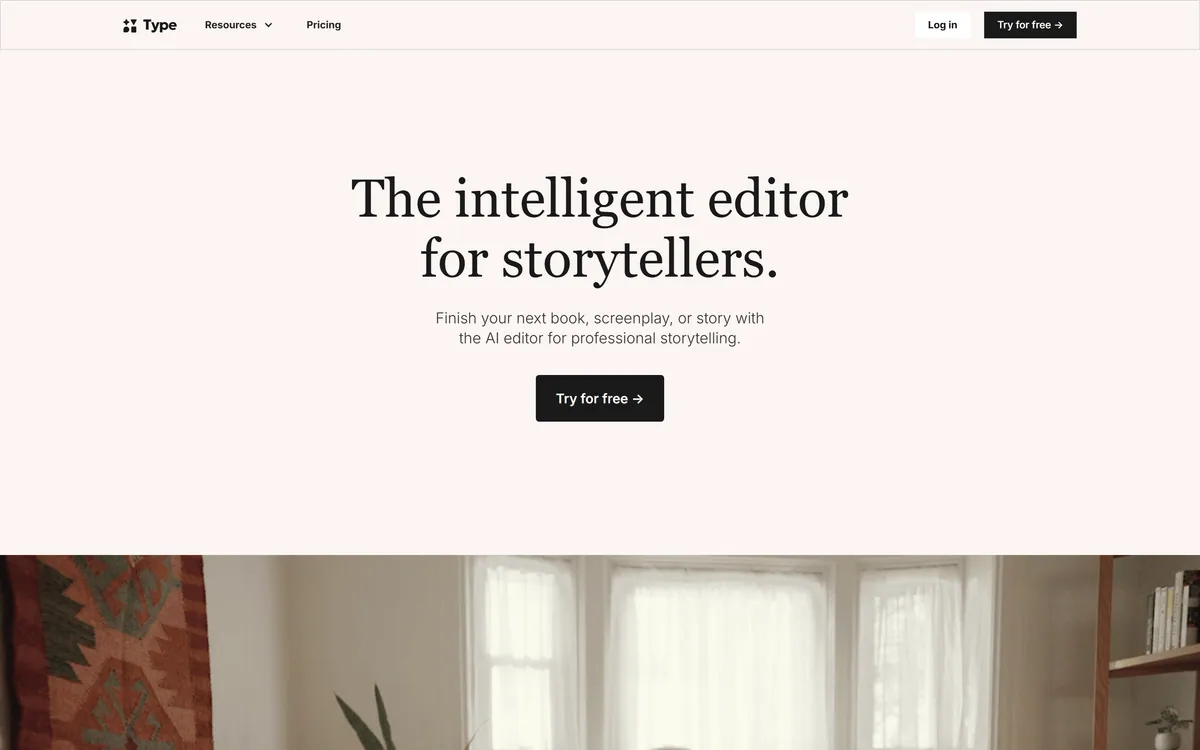
General chatbots are everywhere, and they are genuinely useful for a paragraph. But writing a book in one is miserable: you lose your place, the model forgets your characters, and you spend half your time copy-pasting between a chat window and a document. Type.ai is built for the opposite experience.
It is a proper editor for long-form creative writing, with the AI assistant embedded in the draft rather than bolted on in a side panel. It remembers rich details about your story, lets you define custom rules so suggestions sound like you, and wraps it in a real word processor with offline mode, version history and export options.
This review covers how the integrated editor works, how Type.ai keeps track of your story, the word-processor fundamentals it gets right, how it is priced, and who it suits against other writing tools.
Type.ai In Four Points For Storytellers
- Type.ai is an AI editor for long-form creative writing — books, novels, screenplays and stories that need careful crafting.
- Draft and assistant live together: no copy-pasting between a chatbot and a document, with the AI embedded in the editor.
- It remembers your story: notes for characters, settings and scenes, plus custom rules so it writes in your style.
- It is a real word processor too, with offline mode, version history, rich formatting and export to DOCX, PDF or narrated audio.
An Editor Where Your Draft And The AI Live Together
The central design choice is integration. In Type.ai, your draft and the AI assistant occupy the same workspace, so generating, revising and reviewing happen in place rather than in a separate chat you copy out of.
That sounds minor until you have written at length the other way. Every copy-paste between a chatbot and a document is a small tax on attention and a chance to lose formatting or context; removing it keeps you in the writing. For long-form work specifically, staying in one deep workflow is the difference between a tool you tolerate and one you live in.
It positions itself explicitly as an alternative to writing in Jasper AI or a general chatbot for long-form tasks, trading breadth for a document-first editing experience built around the manuscript.
Writing a book in a chat window is miserable: you lose your place and the model forgets your characters. Type.ai is built for the opposite.
How Does Type.ai Keep Track Of Your Story?
The feature that separates a long-form tool from a clever autocomplete is memory, and Type.ai's is explicit and editable.
Notes For Characters, Settings And Scenes
Type.ai's Notes feature stores rich details about your characters, world and scenes, and takes all of them into account when you ask for writing help, so suggestions are specific to your story rather than generic. You can edit any note by hand or ask the assistant to update it.
This is the same problem fiction-focused tools like Sudowrite and NovelCrafter tackle in their own ways; the useful comparison is how each manages story context and how naturally it fits your writing process.
Custom Rules To Write In Your Style
You can create custom writing rules that amplify the quirks that make your prose yours, so the AI's suggestions bend toward your voice instead of flattening it into generic competence, the most common complaint about AI-assisted fiction.
Combined with the story Notes, this is what lets Type.ai function as a genuine collaborator on a manuscript: it knows your world and your voice, and keeps both in mind across a document as long as 150,000 words.
A Real Word Processor, Offline And Private
Underneath the AI, Type.ai is a complete writing tool, which many AI-first writing apps forget to be. It has full offline capability, so you can write without a connection, plus version history, keyboard shortcuts and rich formatting including images, tables and code.
On privacy, it states plainly that no AI models are trained on your data and your documents remain private to you, which matters for writers protecting unpublished work.
Export is equally practical: a finished draft goes out as DOCX, PDF, a view-only URL, or a narrated audio track, so the manuscript leaves the tool in whatever form the next step needs. These fundamentals are unglamorous and exactly what a serious writer needs.
How Type.ai Prices Its Writing Workflow
Type.ai keeps free access to your drafts forever, with premium plans unlocking the full feature set and access to premium models from Anthropic, OpenAI and Google. There is a money-back guarantee and an annual saving.
AInexfinder does not publish plan prices, which change and are best read on the site. The sensible way to weigh it is against how much long-form writing you actually do: for someone finishing a book or screenplay, a focused editor can be worth far more than a cheaper general chatbot; for occasional paragraphs, it is overkill.
The free tier keeps your drafts accessible, so you can start a project and judge the workflow before paying for the premium models and features.
A Short Test Of Type.ai On A Chapter
Because its value is the long-form workflow, test Type.ai on a real chapter rather than a one-off paragraph.
- Import or start a real chapter, and set up Notes for a couple of your characters and settings.
- Create a custom style rule that captures something specific about your voice.
- Ask the AI for help revising a passage and judge whether it respects your Notes and your style.
- Work offline for a stretch to confirm the editor genuinely functions without a connection.
- Export the draft to DOCX or PDF and check the formatting survives cleanly.
- Pass/fail: Type.ai earns a premium plan only if writing in it is genuinely better than your current long-form setup.
- If you narrate, generate an audio export and judge whether the voice is usable for your purpose.
| What it is | AI editor for long-form creative writing |
|---|
| Best for | Books, novels, screenplays and stories |
|---|
| Integration | Draft and AI assistant in one place |
|---|
| Memory | Notes for characters, settings and scenes |
|---|
| Style | Custom writing rules to match your voice |
|---|
| Document length | Works on documents up to around 150,000 words |
|---|
| Fundamentals | Offline mode, version history, keyboard shortcuts |
|---|
| Export | DOCX, PDF, view-only URL, or narrated audio |
|---|
| Privacy | No AI models trained on your data |
|---|