Interactive fiction is one of the oldest ideas in computing and one of the hardest to make well. The reason is arithmetic: every meaningful choice multiplies the writing, and a story with real branching demands ten times the words a linear one does for the same reading time.
That arithmetic is exactly what generative models change. Talefy, published by AIcberg Labs, builds on it — a platform where you create characters, worlds and branching narratives, and where readers make choices that shape how the story develops.
This review covers what the format genuinely offers, why generation solves interactive fiction's structural problem while creating a different one, what the creation tools actually give you, and who will and will not enjoy this.
Talefy Explained In Five Points
- It is a play-it format, not a write-it tool. Stories branch on reader choices rather than running to a single fixed ending.
- Two audiences share one platform — people creating stories and people playing them — which is what gives it a chance of having anything to read.
- Creation covers characters, worlds and genre, including backstories, goals, relationships and dialogue patterns.
- Everything runs in a browser, with no install and nothing to export — the story lives on the platform.
- Published by AIcberg Labs, with a Discord community that in this category tends to matter more than any feature.
Why Generation Suits Branching Fiction
A traditional choose-your-own-adventure author faces an impossible trade. Offer genuine choices and the branch count explodes beyond what anyone can write; keep the writing manageable and the choices become cosmetic — different words leading to the same next page.
Most published interactive fiction quietly chooses the second, which is why the form has a reputation for choices that do not matter.
Generation removes that constraint. A branch that nobody has written yet can be written when a reader takes it, which means choices can genuinely diverge rather than converging back for authorial convenience.
That is a real structural advantage and it deserves to be stated clearly, because it is the strongest argument for this whole category.
Interactive fiction's oldest problem is that real choices cost more words than anyone can write. Generation is the first thing to actually change that arithmetic.
And What Generation Costs In Return
The trade is craft. A human-authored branching story has a shape — foreshadowing that pays off, a reveal timed to land, an ending that recontextualises what came before. Those things exist because an author knew where the story was going.
A story generated as you walk through it does not know where it is going, and it shows in a specific way: everything remains locally coherent while never quite building. Scenes follow sensibly from scenes. Nothing accumulates.
The second cost is consistency over length. A detail established in the first ten minutes may quietly stop being true by the fortieth, and in a branching story there is no single canonical thread to check it against.
The honest summary is that this is a genuinely different pleasure from reading a novel, and readers who arrive expecting the novel will be disappointed. Readers who arrive wanting to poke at a world and see what it does are in the right place.
What The Creation Side Gives You
Talefy's creation tools separate into three layers, and each one meaningfully constrains what the generation does with your story.
Characters As Constraints
Character creation covers backstory, goals, relationships and dialogue patterns rather than just a name and a description.
The dialogue patterns field is the one that does the heavy lifting. A character defined only by their history will speak in the model's default register; a character defined by how they talk stays recognisably themselves across a long session, which is the main thing that makes generated fiction feel authored.
Worlds As Rules
World-building covers settings from the ordinary to the fantastical, and the useful frame is that a world is a set of rules the generation must respect.
The most common creator mistake here is describing scenery instead of constraints. What magic costs, who holds power, what is forbidden and what happens if you break it — these produce better stories than three paragraphs about the architecture, because they are things a plot can collide with.
Genre As Expectation
Genres span fantasy, sci-fi, romance, horror and comedy, and can be blended.
Genre is doing real work in a generated story: it sets the reader's expectations about pacing and stakes, and it tells the model what kind of scene ought to come next. Horror in particular depends almost entirely on withholding, which is the thing generative models are worst at and the reason horror is the genre to test before committing to a long story.
Getting A Story Worth Playing
Creators who treat this like prompting get generic output. Creators who treat it like game design get something people finish.
- Define three or four characters properly before writing any plot — including how each one speaks, not just who they are.
- Write your world as rules and constraints rather than description. Anything a plot can break is worth more than anything a reader can only look at.
- Set one clear dramatic question the whole story hangs on, so branches vary the route rather than the destination.
- Play through your own story twice, taking opposite choices, and notice where the two paths quietly converge — that is where the choices are not real.
- Check whether details established early survive to the end, because that is where generated fiction most reliably drifts.
- Publish and read the feedback in the community rather than relying on your own reading — you cannot experience your own branches as a stranger would.
- Keep sessions self-contained enough that a reader who stops for a week can return without having lost the thread.
Two Practical Things To Know
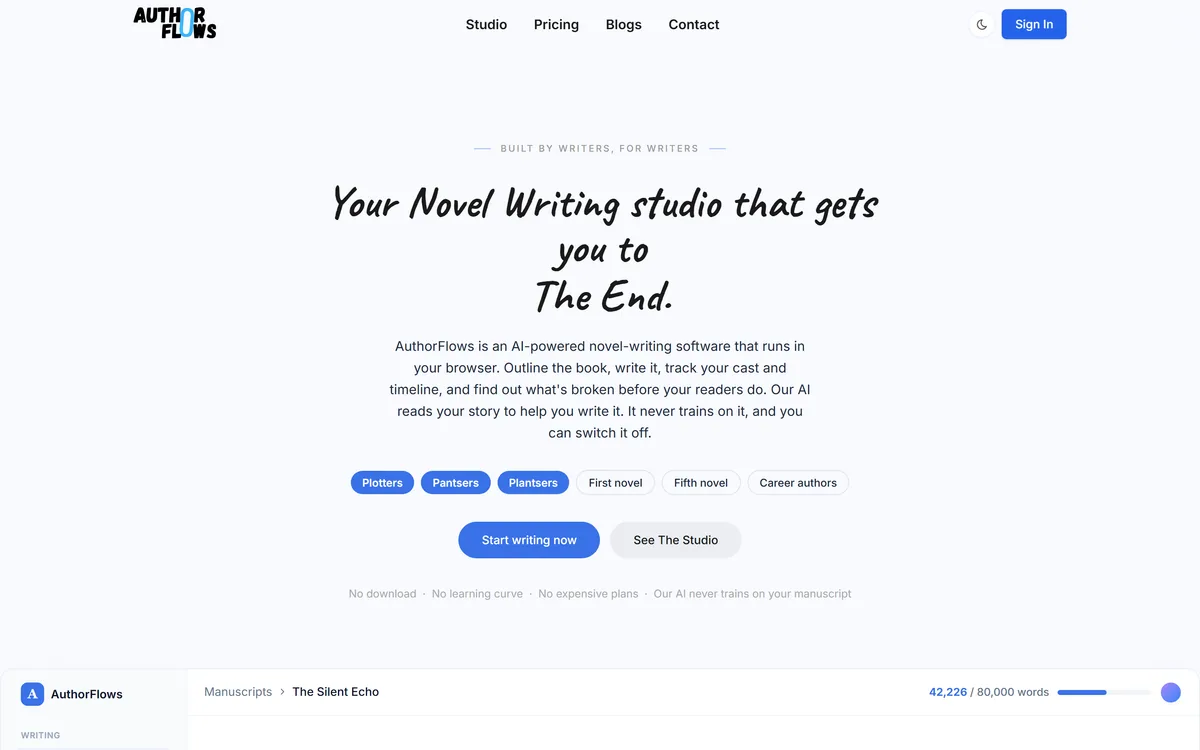
Everything runs in the browser and stories live on the platform. That makes playing effortless and means what you build is not portable in the way a manuscript in a writing tool is. If your goal is a novel you own and publish elsewhere, this is the wrong tool — a dedicated novel-writing studio is what you want.
The second is that the platform's value is almost entirely a function of who else is on it. A story platform with a hundred good stories and an active community is a completely different product from the same software with none, and no feature list captures that difference. The Discord and the published catalogue tell you more about whether Talefy is worth your time than anything on the marketing page.
Content is also worth checking against your own expectations. A platform spanning romance and horror with user-generated worlds will contain a wide range of material, and anyone considering it for a younger reader should look at what is actually published rather than assume.
Will You Enjoy Talefy?
Worth Trying If
- You like interactive fiction and text adventures as a form
- You enjoy world-building more than finishing a manuscript
- You want to see what a story does when you push it in an unexpected direction
- You are happy for the story to live on a platform rather than in a file you own
- You would use a community as part of the fun rather than working alone
Not Built For You If
- You want to write a novel you will publish somewhere else
- Careful prose craft is what you read for
- You need your work exportable and portable
- You want authored payoff and structure more than exploration
- You are choosing for a young reader without checking what is published