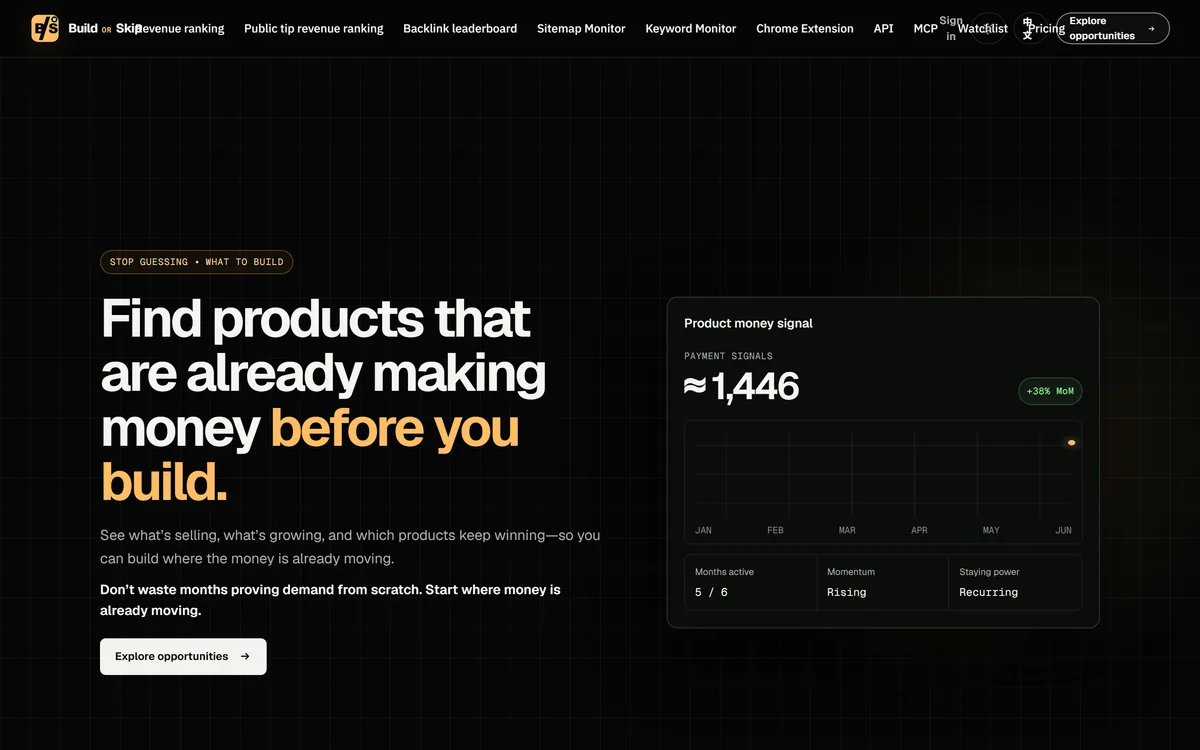
Build or Skip is a product-opportunity research tool that surfaces payment signals, rankings, momentum and backlink libraries, with an API and MCP access, so you can see what is already making money before you build, treating the data as research signals, not proof.
Most people start a product from a hunch and find out whether anyone would pay only after they have built it. Build or Skip is designed to flip that order: look for evidence of demand first.
It is a research tool that surfaces signals a product is already making money, payment indicators, rankings, momentum and backlink libraries, and exposes them through a dashboard, an API and MCP access for AI agents. The honest framing, which it uses itself, is signals rather than proof: evidence to reduce guesswork, not a promise. For a factual question you would still reach for a tool like Perplexity AI; Build or Skip is narrower, aimed at the build-or-skip decision.
This review covers what signals it tracks, why they should be read as research and not certainty, how its access is priced, and whether it earns a place in a builder's toolkit.
Build or Skip surfaces signals that a product is already making money before you build.
Build or Skip, In One Line
Build or Skip is opportunity research: it surfaces signals that a product is already making money, so you build with evidence.
It tracks several signals: payment indicators, rankings, momentum and backlink libraries, not a single metric.
It has an API and MCP: so the data can feed your own tools and AI agents, not just a dashboard.
Signals, not proof: the data reduces guesswork, but it is research to validate, never a guarantee a product will work.
Find Products Already Making Money Before You Build
The premise is sound and a little contrarian: instead of inventing something new and hoping, look at what is already earning and decide whether to compete, differentiate, or skip. Build or Skip is built around that question.
It gathers signals that point to real demand, products with payment activity, rising rankings, momentum, so you are reasoning from evidence rather than enthusiasm. That is a genuinely useful reframing for anyone who has shipped into silence before.
It is not a directory you list on, nor a validator that answers yes or no. It is a lens on the market, and like any lens, its usefulness depends on reading what it shows you carefully rather than literally.
Instead of inventing something new and hoping, look at what is already earning, then decide whether to compete, differentiate, or skip. That reframing is the whole point.
What Signals Does Build or Skip Actually Track?
The value is in the breadth of signals and how you can access them, not a single magic number.
Payment Signals, Rankings And Momentum
The headline signals are payment indicators, that a product has real paying activity, alongside rankings and momentum, so you can tell a steady earner from a fading one.
Reading several signals together is the point. A curated listing channel like StackLedge tells you a tool exists; Build or Skip is trying to tell you whether products in a space are actually making money and trending up.
Backlink Libraries, API And MCP
Beyond the live signals, it offers backlink libraries for researched products and, importantly, programmatic access through an API and MCP, so the data can feed your own tools or an AI agent rather than living only in a dashboard.
That MCP access is the most forward-looking part, letting an agent query opportunity signals directly. It is a different shape from a launch channel like Nick Launches; Build or Skip is a data source you build research on, not a place to be seen.
Read These Signals As Research, Not Proof
This is the caveat that decides whether you use the tool well. Signals that a product makes money are evidence that a market exists; they are not evidence that your version will succeed, and the tool is honest about that distinction.
Payment activity can be inflated, momentum can reverse, and a crowded, profitable niche can be the hardest to enter, not the easiest. The data reduces guesswork; it does not remove judgement, execution or timing from the equation.
Used as research, one input among several before you commit, it is valuable. Used as a verdict, a green light because the number looked good, it will mislead. The honest framing is the correct one: signals, not proof.
How Build or Skip Prices Its Access
Build or Skip is a subscription product, with access to its signals, libraries and the API or MCP gated behind a paid plan, the normal model for a research data tool.
AInexfinder does not publish prices, which change and are best read on the site. The value question is whether the research it saves, hours of manually piecing together whether a niche earns, justifies a recurring cost for how often you actually evaluate new ideas.
For someone weighing opportunities regularly, that can pay for itself quickly; for a one-off idea, a short, focused subscription or a careful trial is the sensible way to test it.
A Short Way To Test Build or Skip
Because its risk is over-trusting a signal, test it with a decision you can check and a healthy scepticism.
Pick a niche you are genuinely considering, not a random one, so the test is real.
Pull the payment, ranking and momentum signals for the leading products in it.
Cross-check one finding against a second source so you are not trusting a single number.
If you build tools or agents, try the API or MCP to see if the data fits your workflow.
Ask the harder question the data cannot answer: could you actually enter and differentiate here?
Pass/fail: Build or Skip is worth it if it changed a build-or-skip decision you would otherwise have guessed.
Treat every signal as research to validate with judgement and real-world testing, never as a guarantee.
Build or Skip Research Facts
What it is
A product-opportunity research tool
Core idea
Find products already making money before you build
Signals
Payment indicators, rankings, momentum
Libraries
Backlink data for researched products
Access
A dashboard, an API and MCP
For AI agents
MCP so agents can query the signals
Positioning
Research signals, not proof of success
Pricing
A subscription for access
Build or Skip Signal Terms
Payment signal
An indicator that a product has real paying activity, used as evidence that demand exists.
Momentum
Whether a product's traction is rising or fading, so a steady earner can be told from a declining one.
Backlink library
Collected backlink data for a researched product, useful for gauging reach and SEO footprint.
MCP access
A protocol that lets an AI agent query Build or Skip's signals programmatically, not just through a dashboard.
Does Build or Skip Earn Its Place?
Builders Build or Skip Helps
Indie makers who want evidence of demand before building
Founders validating a niche against real money signals
Builders who will feed the data into tools via API or MCP
People who evaluate new product ideas regularly
Anyone who treats the signals as research, not a verdict
When Build or Skip Does Not Help
Anyone wanting a yes-or-no guarantee a product will work
People who would skip the judgement the data cannot replace
Builders committed to an idea regardless of the signals
Those evaluating a single one-off idea, where a trial suffices
Anyone expecting a listing channel rather than research
Key features of Build or Skip
Payment signals for real paying activity
Rankings to gauge a product's standing
Momentum to tell steady from fading
Backlink libraries for researched products
A dashboard for exploring opportunities
An API for programmatic access
MCP access for AI agents
A research-first, signals-not-proof framing
Pros & cons
Pros
5
Reframes building around evidence of demand
Reads several signals together, not one metric
API and MCP let the data feed your own tools
Honest that it offers signals, not proof
Saves hours of manual market research
Cons
5
Signals can mislead if read as a verdict
A profitable niche can be the hardest to enter
Does not replace judgement, timing or execution
A recurring cost for occasional evaluators
Not useful for those committed regardless of data
Best For
Indie makers validating demand
Founders weighing a niche
Builders using API or MCP
Frequent idea evaluators
People who treat data as research
How Build or Skip Compares For Research
The useful comparison is with other ways to research a market, not with listing channels.
Last checked . Read from buildorskip.dev during this check, with the screenshot above captured at the same time.
A product-opportunity research tool for the build-or-skip decision
Payment signals indicating real paying activity
Rankings and momentum to gauge trajectory
Programmatic access via an API
MCP access so AI agents can query the signals
Explicit framing of the data as signals, not proof
A subscription model for access
No plan prices reproduced here, in line with this site's pricing policy
Build or Skip presents its data as research signals, not proof; the signals reduce guesswork but do not guarantee a product will succeed, and still require judgement and real-world validation.
Other Research And Directory Tools
A research assistant, a directory and a launch channel to pair with opportunity signals.
Perplexity AI — sourced answers for the background research
StackLedge — a curated directory for discovering tools
Nick Launches — a launch channel once you decide to build
Editor's Verdict
3.6/5
Build or Skip earns 3.6 for a genuinely useful reframing, build from evidence of demand rather than a hunch, backed by payment, ranking and momentum signals and real API and MCP access that let the data feed your own tools and agents; it is capped by the hard truth it states honestly, that signals are not proof, so the tool informs a build-or-skip decision but never replaces judgement. AInexfinder Editor Score: 3.6/5.
Build or Skip pricing
AInexfinder does not list plan prices or billing details. For current pricing, plans, and trials, visit the official Build or Skip website.
Vendor pricing, credits, and billing policies change over time. Always confirm on the official site before you buy.
Frequently asked questions
What is Build or Skip?
Build or Skip is a product-opportunity research tool. It surfaces signals that a product is already making money, payment indicators, rankings, momentum and backlink libraries, through a dashboard, an API and MCP, so you can see what sells before you build rather than guessing.
What signals does Build or Skip track?
Payment signals that point to real paying activity, rankings and momentum to gauge whether a product is steady or fading, and backlink libraries for researched products. The point is to read several signals together rather than trusting any single number.
Does Build or Skip guarantee a product will succeed?
No, and it is honest about that. It provides signals, not proof: evidence that a market exists, not that your version will work. Payment activity can be inflated and momentum can reverse, so the data reduces guesswork but does not replace judgement, execution or timing.
What are the API and MCP for?
They give programmatic access to the signals so the data can feed your own tools or an AI agent, rather than living only in a dashboard. The MCP access is especially forward-looking, letting an agent query opportunity signals directly as part of a larger workflow.
Who is Build or Skip for?
Indie makers and founders who want evidence of demand before committing, especially those who evaluate new ideas regularly or will feed the signals into their own tools via API or MCP. It suits people who treat the data as research, not a yes-or-no verdict.
How much does Build or Skip cost?
It is a subscription, with its signals, libraries and the API or MCP behind a paid plan. We do not publish prices, which change; check the site. Weigh the recurring cost against how often you actually evaluate new product ideas and the research it saves.
Why read the signals as research, not proof?
Because a profitable niche can be the hardest to enter, not the easiest, and signals describe the market, not your ability to compete in it. Used as one input before you commit, the data is valuable; used as a green light on its own, it will mislead.
How is Build or Skip different from a directory?
A directory like StackLedge tells you a tool exists and lets you list or find it. Build or Skip is a data source: it tries to tell you whether products in a space are making money and trending up, so you can decide whether to build, differentiate or skip.
How should I test Build or Skip?
Pick a niche you are genuinely considering, pull its payment, ranking and momentum signals, and cross-check one finding against a second source. If you build tools, try the API or MCP. It is worth it if it changed a decision you would otherwise have guessed.
Can an AI agent use Build or Skip?
Yes. Its MCP access is designed so an AI agent can query the opportunity signals programmatically, making the data part of an automated research workflow rather than something you only read in a dashboard. That is one of its more distinctive, forward-looking features.
Daniel reviews AI tools the slow way — by actually using them on real projects. His reviews cover what works, what breaks, and who each tool is genuinely a good fit for.
Daniel and the AInexfinder editorial team research Build or Skip using public product information, listing evidence, and (when available) hands-on checks. Scores reflect listing completeness and transparency — not paid placement.
Listings may include affiliate or sponsored placements, which are labeled when present. Editorial scores and cons are not sold. See our affiliate disclosure and review methodology.
Listomize is an Etsy SEO platform that generates titles, tags, and descriptions within Etsy's own limits, scores listings, optimises 100+ listings from a CSV, tracks competitors and trends, and auto-generates Pinterest pins.
Lahjty (لهجتي) is an Arabic-first marketing platform for MENA campaigns. From one brief it produces dialect-aware ad copy, headlines, campaign images with Arabic text rendered in, dialect-aware voice, and SEO articles grounded in your own brand sources — with a Partner API and an MCP server for teams that want it inside their own workflow.
MaxAEO is an answer engine optimisation platform from HIII PTE. LTD. It tracks how ChatGPT, Gemini, Claude, Perplexity, Copilot, Grok and Google's AI surfaces mention a brand, with sentiment, competitor benchmarking and citation tracing.
Mailjet is a Sinch-owned email platform handling both marketing campaigns and transactional sending from one account. It offers a collaborative drag-and-drop editor, an email API with SMTP relay, AI generation and segmentation, and EU-based data centres.
Outranking is an AI SEO content platform that writes briefs and first drafts and optimises them with real-time scoring, grounding content in live SERP data through its Concepts feature, with keyword clustering, internal linking and content workflows.
PitchBud is a press outreach tool that drafts a release with Claude Sonnet, publishes it to a newsroom URL with NewsArticle schema and RSS, matches relevant journalists by their recent work, and drafts personal pitches you review and send yourself.