Self-maintaining AI knowledge base for teams Category: Productivity & Automation.
Productivity & Automation Review
Document360 is knowledge base and documentation software built around Eddy AI, combining conversational search that cites its sources, an AI chatbot over scattered documents and tickets, a writing agent inside the editor, and an MCP server that exposes the knowledge base to ChatGPT, Claude and Copilot.
Very good
Most documentation platforms bolted a chatbot onto an existing product. Document360's framing is sharper — that tools built before AI agents, MCP and connected workflows are now the wrong shape — and its answer includes an MCP server as a first-class feature rather than a roadmap item. Search that cites the article it drew from is the detail that makes AI documentation usable rather than merely impressive. It is enterprise software with the certifications to match, and the migration story from Confluence and Zendesk is doing a lot of the selling. AInexfinder Editor Score: 4.2/5.
Best for: Support organisations answering the same questions repeatedly; Product teams publishing customer-facing documentation
The visit link goes to document360.com, the official site. Paid placements on AInexfinder are always labelled. How we make money
| Positioning | Intelligent knowledge base software where humans and AI work together |
|---|---|
| AI brand | Eddy AI |
| AI features | AI search with citations, AI chatbot, AI writing agent, contextual assistance |
| Agent access | An MCP server connecting the knowledge base to ChatGPT, Claude and Copilot |
| Feature count | 100+ across authoring, search, security and self-service |
| Outputs supported | Knowledge base, documentation, AI chatbot, user manuals, SOPs and API documentation |
| Migration sources | Confluence, Zendesk, Microsoft Word, SharePoint and Google Docs |
| Integrations | 60+ out-of-the-box connectors including Slack, Intercom, Zendesk, Salesforce and GitHub |
| Enterprise features | SSO, SCIM, role-based access, audit logs, IP restriction, workspaces and localisation |
| Certifications | SOC 2 and ISO 27001:2022, per the site |
| Reach | Stated as used by thousands of businesses across 150+ countries |
| Displayed rating | 4.7 out of 5 on G2, cited with 1,400+ verified reviews and, in the footer, 3,000+ |
Document360 lists an MCP server among its core AI features, described as connecting your knowledge base to ChatGPT, Claude and Copilot.
That is a more consequential decision than it appears, and it turns on where people now go for answers.
A knowledge base has always assumed the reader comes to it. They open the help site, search, and read an article. That assumption held for twenty years and is quietly breaking, because people increasingly ask an assistant instead — and the assistant answers from whatever it can reach.
If your documentation is not reachable, the assistant answers anyway, from training data that may be years old or from a competitor's page. You do not get a blank; you get a confidently wrong answer with your product's name on it.
An MCP server closes that gap by making the knowledge base a source an agent can query directly. It is the same structural move that makes personal document assistants like Khoj useful, applied to a company's public documentation rather than an individual's files.
A knowledge base assumes the reader comes to it. People now ask an assistant instead, and the assistant answers whether or not it can reach you.
Document360 describes its AI search as conversational search grounded in your articles that cites every source.
The citation is the whole feature, and skipping it is what makes most documentation chatbots unusable in practice.
An uncited answer in a support context creates a specific problem: the reader cannot tell whether it came from current documentation, an outdated article nobody archived, or the model filling a gap. All three read identically, and only one is safe to act on.
That matters more here than in general search because documentation answers get acted on. Someone follows the steps, changes a setting, and finds out later whether the answer was real.
Citations also change the maintenance loop in a useful direction. When an answer is wrong, the citation tells you which article to fix — so the AI layer becomes a way of finding stale documentation rather than a way of hiding it.
The migration pitch is direct: most documentation tools were built for a world before AI agents, MCP and connected workflows, and named import paths exist from Confluence, Zendesk, Microsoft Word, SharePoint and Google Docs.
Listing those five is a precise piece of positioning, because between them they hold most of the world's existing internal documentation.
The argument is honest about the real obstacle, too. Nobody stays on a documentation platform because they love it; they stay because moving several thousand articles is a project nobody wants to sponsor.
Naming the import paths reduces that objection from a project to a task, which is the only way this category's incumbents ever get displaced.
The caution is the one every migration carries: articles move, but structure, redirects, permissions and internal links often do not. A knowledge base's URLs are load-bearing — they sit in support macros, in product tooltips and in search results — and the question to ask a vendor is what happens to every existing link on the day you switch.
Among the 100-plus features sits a support ticket deflector, alongside pro analytics, duplicate content detection and a feedback manager.
Deflection is the metric this entire category is bought on, and it deserves a careful reading.
The theory is clean: a customer who finds the answer in documentation does not open a ticket, so tickets avoided is documentation value delivered. One of the platform's published case studies quotes a 15 percent reduction in support tickets after localising a knowledge base.
The complication is that not opening a ticket is not the same as being helped. A customer who searches, fails, and gives up also does not open a ticket, and looks identical in the deflection number.
Which is why the feedback manager and duplicate content detection matter more than they sound. Deflection tells you tickets went down; article-level feedback and search-with-no-result data tell you whether that happened because people were helped or because they left. Reading what customers actually said across every channel is a further step again, and where Thematic operates.
Document360 displays 4.7 out of 5 on G2 and describes itself as a G2 leader in knowledge base software for three consecutive years. The review count is given as 1,400-plus in one place and 3,000-plus in the footer.
Two different counts on one page usually means two different scopes — one platform versus several, or verified versus total — and neither is labelled, so read the score rather than the volume.
The case studies are more useful because each names a company, a person and a specific outcome: 10,000-plus page views on individual articles, a 30 percent traffic increase after analytics-led content changes, a 15 percent ticket reduction after localisation.
Attributed outcomes with named people are checkable in a way an aggregate rating is not, and the localisation result in particular describes a mechanism you can reason about.
Three years of category leadership is the more durable signal. Any product can have a strong quarter; sustaining a position across a rolling review base is harder to arrange. For knowledge that stays internal rather than customer-facing, TextCortex is closer to the right shape.
Documentation projects fail in the same way twice: everything is migrated and nothing is maintained, or everything is rewritten and nothing ships.
This sequence puts the decisions that are expensive to reverse first.
AI search with source citations
AI chatbot across docs, tickets and files
AI writing agent inside the editor
MCP server for ChatGPT, Claude and Copilot
Migration from Confluence, Zendesk, SharePoint and Google Docs
Workflow builder, decision trees and scheduled publishing
SSO, SCIM, audit logs, IP restriction and role-based access
Localisation, workspaces and custom domains
Knowledge tools differ by who the audience is and how AI reaches the content.
| Tool | Audience | AI access | Best for |
|---|---|---|---|
| Document360 | Customers and support teams | AI search, chatbot and MCP server | Public and internal knowledge bases |
| Khoj | One person's own documents | Chat over your files | Personal rather than organisational |
| TextCortex | Employees across a company | Agents plus knowledge search | Governing AI use organisation-wide |
| Thematic | Insights and CX teams | Theme analysis | Understanding what customers ask |
| Fillout | Anyone completing a form | None | Collecting data rather than publishing it |
Other tools around knowledge, support and the AI that reads them.
Last checked . Read from document360.com in a browser session on the date above, including the full footer. The screenshot was captured at the same time.
What we could not confirm: why the G2 review count differs between the page body and the footer, or what each figure counts; how AI search behaves when the correct answer is not in the knowledge base; what happens to existing URLs, redirects and permissions during a migration; how the support ticket deflector distinguishes a customer who was helped from one who gave up; and pricing, which sits on a separate page we did not reproduce. We did not import content or run a trial.
AInexfinder does not list plan prices or billing details. For current pricing, plans, and trials, visit the official Document360 website.
Visit official website for pricingVendor pricing, credits, and billing policies change over time. Always confirm on the official site before you buy.
Document360 earns an AInexfinder Editor Score of 4.2/5 (very good). Best for: Support organisations answering the same questions repeatedly; Product teams publishing customer-facing documentation; Companies migrating off Confluence, Zendesk or SharePoint.
Visit Document360Log in to write a review.
No reviews yet. Be the first to share your experience with Document360.
Assigned reviewer
Daniel ReedSenior AI Tools Reviewer
Daniel leads AInexfinder's tool reviews. He researches each tool from its own pricing, documentation and policies, checks its claims against independent sources, and writes up what it does well, where it falls short and who it genuinely suits.
Daniel and the AInexfinder editorial team research Document360 from its own website, pricing, documentation and policies, checked against independent sources. This review is research-based: unless its method note says otherwise, we have not bought a plan or run hands-on tests. The Editor Score is our editorial judgement, and payment never changes it.
Similar Tools
Self-maintaining AI knowledge base for teams Category: Productivity & Automation.
AI data workspace with memory and agent teams Category: Productivity & Automation.

Enterprise AI assistant for work search and agents Category: Productivity & Automation.
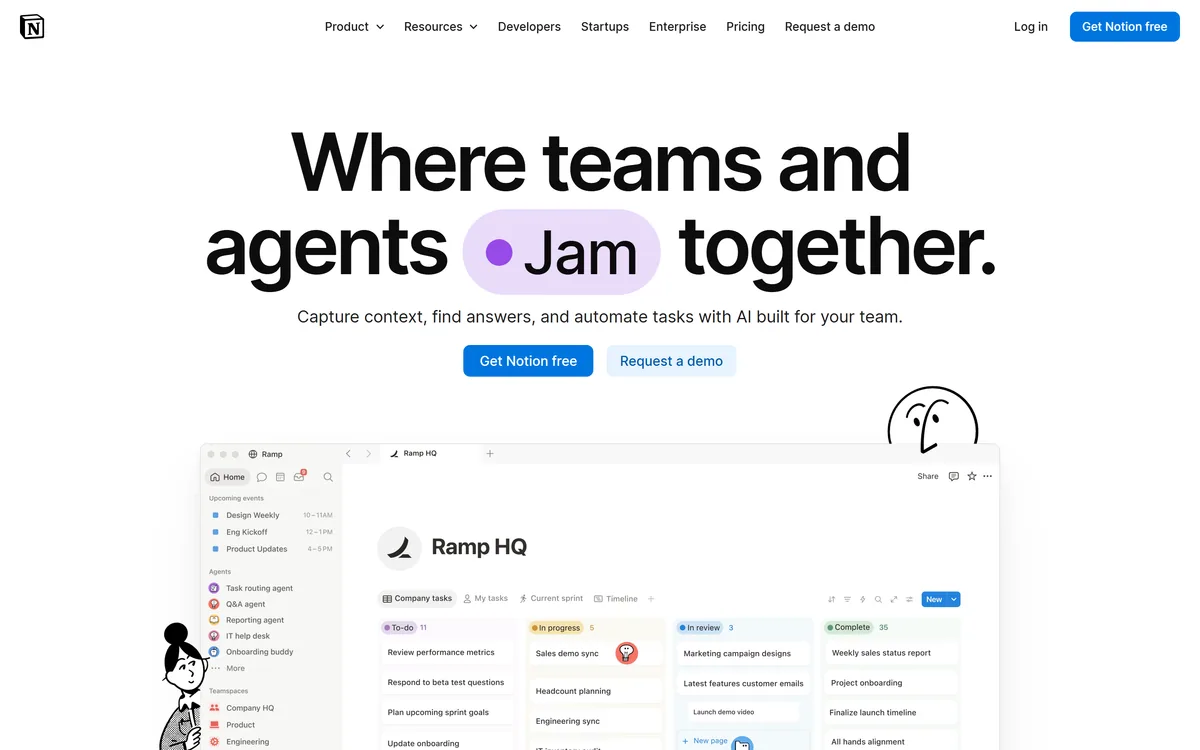

Notion AI is the assistant built into Notion — writing and editing in docs, agents that run recurring work like triage and reporting, AI Meeting Notes, and Enterprise Search across connected tools such as Slack, GitHub, Gmail, and Google Drive.
AI spreadsheet that analyzes data in plain language Category: Productivity & Automation.

Sourcetable review on AInexfinder — freemium AI tool for Productivity & Automation. Features, pricing notes, and alternatives.
Related Pages