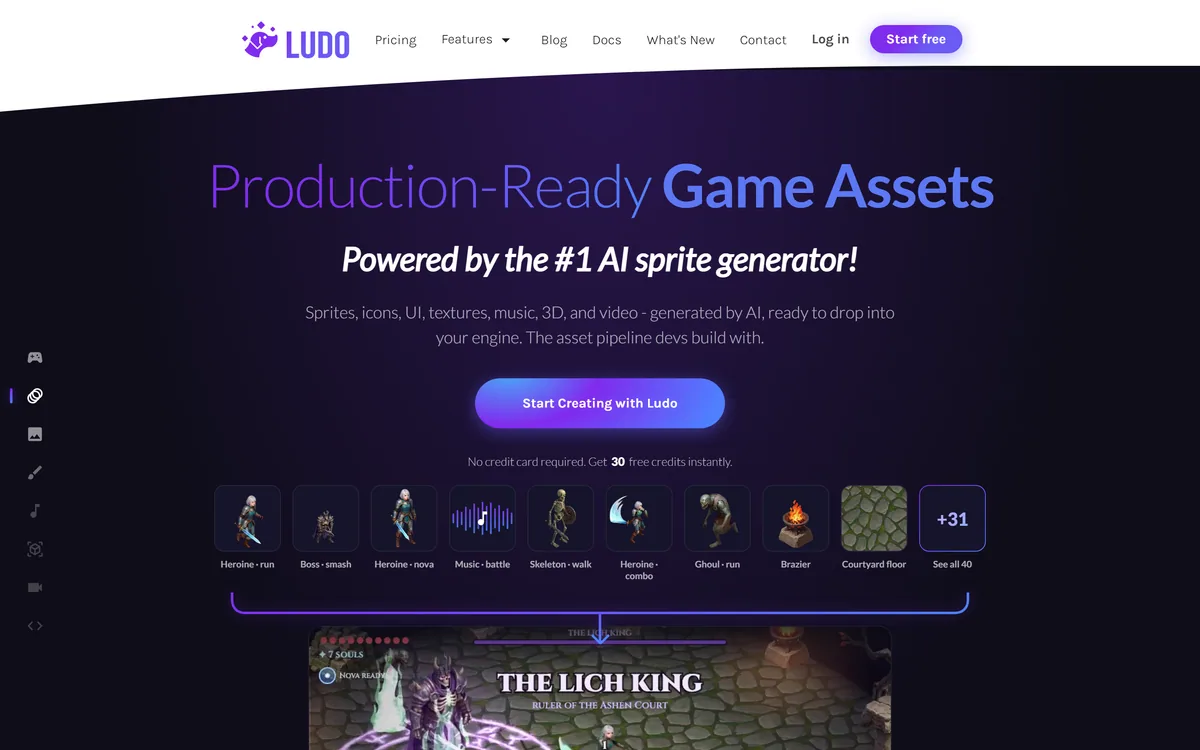
Game development stalls on assets, a solo dev or small studio can design mechanics but not always draw sprites, model 3D or compose audio. Ludo.ai's pitch is to fill those gaps: an AI generator for the whole range of game assets.
It makes sprites and animated spritesheets, UI, textures, icons, 3D models, music, SFX and voice, in many styles. It sits among generative creative tools like Krea, but aimed squarely at game assets.
This review covers how Ludo.ai makes assets, which developers it suits, how its credits work, and the rework and rights caveats to weigh first.
Ludo.ai Game-Asset Facts
| What it is | An AI game-asset generator |
|---|
| Company | Not stated in the captured page |
|---|
| Core | Sprites, spritesheets, UI, textures, icons, 3D, audio and voice |
|---|
| 2D | Character, UI, VFX, texture, tileset, icon and concept art in 30+ styles |
|---|
| 3D | PBR models, GLTF, retopology, auto-rig, for Unity/Unreal/Godot |
|---|
| Audio | Music, SFX, voice design and voice cloning |
|---|
| Access | Freemium, credit-based (free start, no card) |
|---|
| Sensitive | Generative IP + voice cloning + synthetic music; confirm terms |
|---|
Ludo.ai, The Game-Asset Brief
- Ludo.ai makes game assets: sprites, 3D models, textures, icons, music, SFX and voice.
- It's built for game devs: drop-in assets for prototypes and production.
- It covers 2D, 3D and audio: spritesheets, rigging, PBR 3D and voice design.
- Mind the realities: AI assets often need rework, and rights and commercial terms need confirming.
Generating Sprites, 3D And Audio For Games
Ludo.ai's core job is to generate the assets a game needs, across the whole range. It makes 2D art, character sprites, animated spritesheets, UI, VFX, textures, tilesets, icons and concept art in many styles, plus 3D models (PBR, GLTF, with retopology and auto-rigging) ready to drop into Unity, Unreal or Godot, and audio (music, SFX and voice).
For 2D it leans into game-specific needs, spritesheets with hundreds of motion presets, directional sprites rigged from 3D into multi-direction sheets, and an image editor that iterates on a prompt while keeping a character's identity, which is exactly the consistency games require.
On the audio side it generates music and SFX and offers voice design and voice cloning, rounding out a one-stop asset pipeline so a small team isn't blocked waiting on an artist, modeller and composer.
The honest framing is that Ludo.ai is an ambitious, genuinely useful asset generator for prototyping and filling gaps, but the caveats matter if you plan to ship. AI-generated assets vary in quality and often need rework, cleanup, retopology, re-rigging or an artist's pass, before they're production-grade, so treat it as a fast first draft, not a finished pipeline. As generative media it raises IP and style questions; its voice cloning raises likeness and consent issues; and its music raises rights questions. Crucially, we could not confirm asset ownership or commercial-use terms from the captured page, so confirm those with the vendor before shipping anything generated. Its claims are vendor-stated.
Ludo.ai is a genuinely useful asset generator for prototyping; assets often need rework, and you must confirm the ownership, voice and music rights before shipping.
How Does Ludo.ai Make Game Assets?
Ludo.ai pairs broad 2D/3D/audio generation with game-specific consistency features.
Sprites, Spritesheets And 3D
It generates sprites, spritesheets, 3D models and audio, with directional sprites and identity-preserving edits that suit game pipelines.
A creative suite like GoEnhance AI covers broad effects; Ludo.ai's angle is game assets specifically, sprites, rigging and engine-ready 3D, which is a narrower, better-fitted job for developers.
Audio, Voice And A Rights Caveat
On audio it adds music, SFX and voice design with cloning, so one tool covers art, models and sound.
A music generator like Suno focuses on songs; Ludo.ai's audio is one part of a wider asset pipeline, so match it to whether you need a whole game-asset toolkit or one medium.
Which Game Makers Ludo.ai Suits
Ludo.ai suits indie and solo game developers who need to fill asset gaps, art, 3D, audio, they can't produce themselves, and small studios wanting to prototype faster.
It suits teams that treat generated assets as a fast starting point to refine, and that work in Unity, Unreal or Godot where the engine-ready 3D and spritesheets fit.
It suits less well studios needing guaranteed production-grade, original assets without rework, anyone who can't confirm the ownership and commercial-use terms, and teams uneasy about voice cloning or AI-generated style.
A fair way to place it: if you're a solo dev or small studio using it to prototype and fill gaps, and you'll refine the output and confirm the rights, Ludo.ai can genuinely unblock your project; if you need finished, rights-cleared production assets or can't verify the commercial terms, weigh it carefully, because 'drop-in' assets still need a rework pass and clear rights before they ship.
How Ludo.ai's Credits Work
Ludo.ai is freemium and credit-based: you can start free (it states no credit card and a batch of free credits), then pay for more credits and capacity. We do not publish prices, which change; check the site and confirm how credits are consumed per asset.
The value question is assets produced versus credit cost and rework: if it unblocks art, 3D or audio you couldn't otherwise make, the credits can be well spent, but heavy generation and iteration burns them, and rework time is a real cost on top.
The sensible approach is to use the free credits to generate the asset types you actually need, judge their quality and how much rework they require, confirm the ownership and commercial-use terms, and only pay once it clearly speeds your project.
Generating One Game Asset With Ludo.ai
Because assets need rework and rights need confirming, generate one real asset first.
- Generate the asset types you actually need (sprite, 3D model or audio).
- Judge the quality and how much rework it needs for production.
- Confirm the asset ownership and commercial-use terms before shipping.
- Use voice cloning only with the rights and consent to that voice.
- Watch how quickly credits are consumed at your target quality.
- Pass/fail: Ludo.ai is worth it if it unblocks assets and saves real time.
- Treat quality and 'production-ready' claims as vendor-stated.