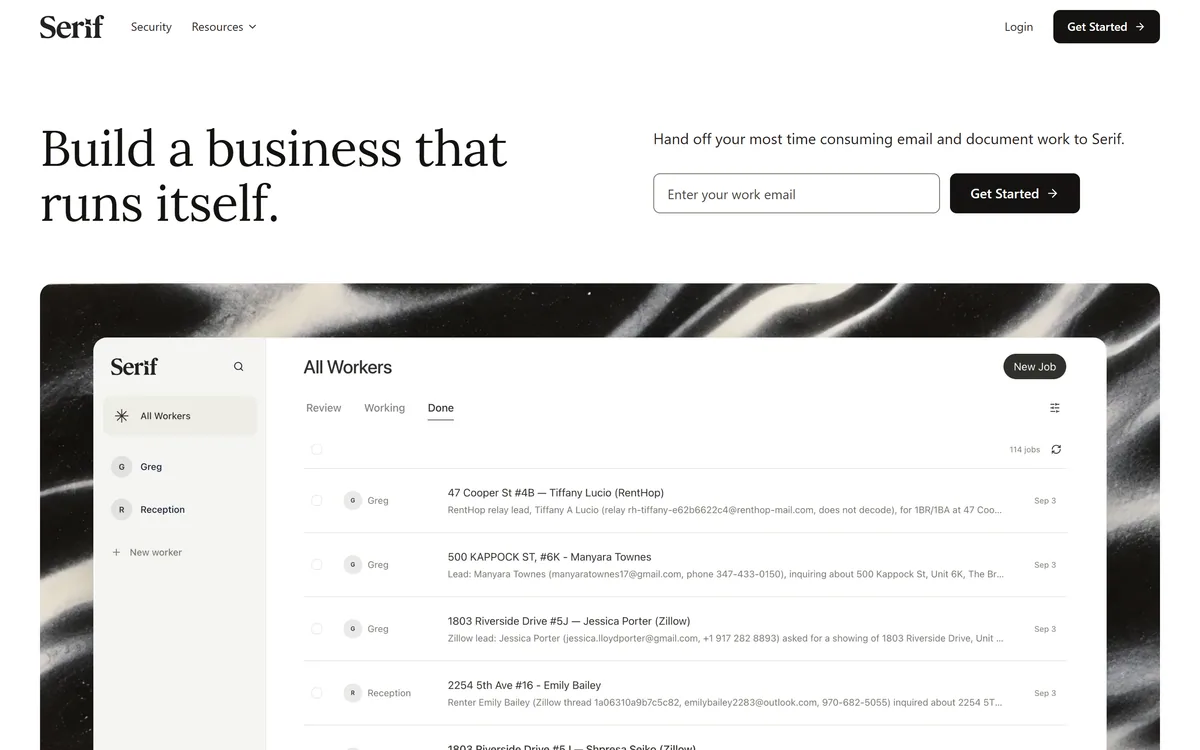
In many businesses the real bottleneck is the inbox: chasing documents, answering repeat questions, checking files against rules and sending quotes. Serif is built to hand that grunt work to AI agents while keeping people in charge of judgement.
Its agents read email threads, pull and process attachments, run lookups, apply your policies and write replies around the clock, and route anything uncertain to the right person. It sits among workplace agents like Cassidy, but it is focused tightly on email- and document-heavy operational work.
This review covers how Serif takes work off your plate, who it is for, how it prices, and how to delegate to it carefully.
Serif Email-Agent Facts
| What it is | AI agents for email and document workflows |
|---|
| Does | Reads threads, pulls attachments, runs lookups, writes replies |
|---|
| Policy | Applies your rules and keeps a record |
|---|
| Escalation | Routes uncertain cases to the right person |
|---|
| Workflows | Document collection, compliance, intake and quoting, support |
|---|
| Verticals | Real estate, mortgage, healthcare, insurance and more |
|---|
| Security | Says email is not used to train models (vendor-stated) |
|---|
| Access | Get-started sign-up; pricing via the site |
|---|
AI Agents That Handle Email And Document Grunt Work
Serif's promise is to take the most time-consuming email and document work off a team: answering repeat questions, chasing invoices and missing paperwork, collecting and checking documents, and drafting replies, all running around the clock.
What makes it more than an auto-responder is policy. Serif agents are trained on how you work, apply your rules to each thread, keep a record of what they did and escalate edge cases rather than guessing, which is exactly what operational and compliance work needs.
Its examples are telling: transaction compliance for real-estate brokerages, disclosure tracking for mortgage teams, prior-authorisation review in healthcare and errors-and-omissions file review in insurance. These are document-heavy, rules-heavy jobs where consistent handling matters.
The honest framing is that Serif is a strong fit for repetitive, policy-driven inbox work, but it is still AI acting on your behalf. In regulated workflows, review, audit trails and clear escalation are not optional extras; they are the reason to trust it at all.
Serif applies your rules, keeps a record and escalates edge cases instead of guessing, which is what operational and compliance work needs.
How Does Serif Take Work Off Your Plate?
The platform pairs autonomous handling with human judgement and enterprise security claims.
Reads Threads, Applies Policy, Writes Replies
Serif agents read incoming threads, pull attachments, run lookups, apply your policy and write replies, around the clock. Setup follows a diagnose, train and run pattern: find the workflows worth automating, train agents on how your team works, then put the work on autopilot, without needing technical expertise.
For broader workflow automation across apps, a tool like Bardeen automates tasks between tools; Serif is specialised in the inbox and document side, where most of this work arrives.
Human-In-The-Loop And Enterprise Security
When an agent is unsure how to proceed, Serif routes the job to the right person for review, so your team supplies judgement on the hard cases. Serif also says your email is never used to train models, is not stored on its servers, and that what it learns is encrypted at rest, claims worth confirming in its security documentation.
For an individual's inbox triage rather than team workflows, an assistant like Cora is a lighter fit; Serif is built for business processes that run through shared inboxes.
Who Serif Is For Among Businesses
Serif is for businesses whose operations run through email and documents: brokerages, mortgage and insurance teams, healthcare administration, agencies and service firms that handle intake, quoting, document collection and compliance checks.
It suits small and mid-sized teams where owners or operators are buried in repetitive email, and larger teams that want consistent, policy-based handling with a record of every action.
It fits less well businesses with little repetitive inbox work, teams unwilling to define clear policies for agents to follow, and regulated organisations that cannot yet satisfy themselves about data handling, review and audit. Its volume figures and customer results are vendor-stated.
A simple test of fit is to look at last month's sent folder and count how many replies were near-identical answers, document requests or status updates. The higher that share, the more of the week Serif can realistically take back, and the clearer the business case becomes.
How Serif Is Priced For Businesses
Serif is sold through a get-started flow aimed at businesses; the homepage did not list prices at the time of checking. We do not publish prices, which change; check the site.
The value question is hours saved against cost, on one well-defined workflow first. Serif's own case studies cite large time savings, but your result depends on how repetitive and rule-based your inbox work really is.
The sensible approach is to automate one narrow workflow, such as document chasing or repeat questions, measure hours saved and error rates, and expand only once the agent is reliable.
A Careful First Delegation To Serif
Because Serif acts on your behalf, start with one narrow workflow and keep humans reviewing until it earns trust.
- Identify one repetitive, rule-based email workflow, such as document chasing.
- Write down the policy you want the agent to follow, including edge cases.
- Train the agent and review its draft replies before they go out.
- Confirm data-handling, security and retention terms for your industry.
- Check that uncertain cases are actually escalated to the right person.
- Pass/fail: Serif is worth it if it saves real hours without increasing errors.
- Treat customer results and volume figures as vendor-stated.
Serif, The Inbox Brief
- Serif automates email and document work: agents read threads, pull attachments, look things up and reply.
- It follows your policy: agents apply your rules, keep a record and escalate edge cases instead of guessing.
- It targets back-office workflows: document collection, compliance, intake and quoting, and complex support.
- Humans stay in the loop: the design is AI does the work, your team provides judgement, which matters in regulated work.