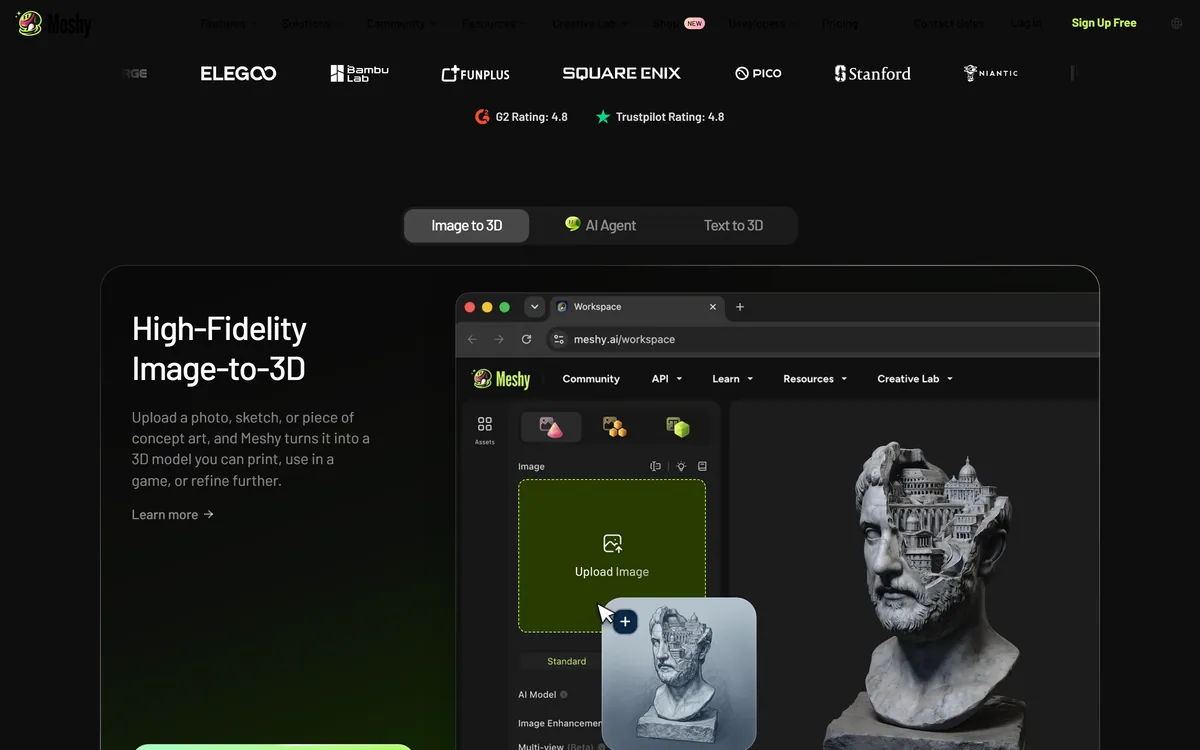
Meshy is an AI 3D model generator that turns text or images into 3D models in under a minute, with printability checks, auto-repair and direct export to slicers like Bambu Studio and OrcaSlicer, plus assets for games and media.
Emerging & Specialized Review
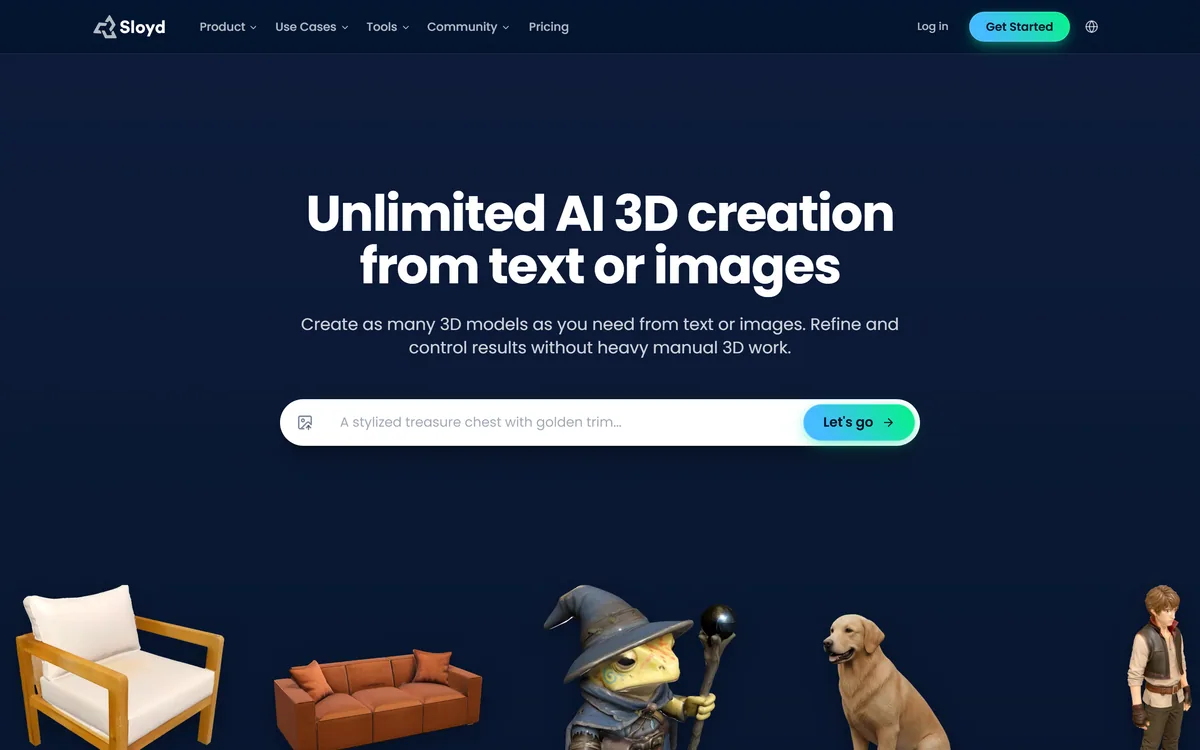
Sloyd is a generative-3D platform that creates 3D models from text or images, with topology control, auto-rigging and animation, print-ready export and engine plugins, priced for unlimited (non-credit) generation, aimed at game devs, makers and 3D creators.
Very good
Sloyd earns 4.0 for making generative 3D actually usable: text- or image-to-model with topology control, rigging, print-ready checks and engine plugins, priced for unlimited generation that rewards iteration rather than punishing it. It is not for bespoke hero models or a single one-off, and generating from photos of people or Roblox avatars carries likeness and platform-rules caveats, but for asset-heavy pipelines it is a strong, practical pick. AInexfinder Editor Score: 4.0/5.
Best for: Indie game asset pipelines; 3D-printing makers
The visit link goes to sloyd.ai, the official site. Paid placements on AInexfinder are always labelled. How we make money
3D asset creation is a bottleneck for game devs, makers and designers, slow to model by hand and awkward to outsource. Sloyd's pitch is to generate an editable, export-ready model from a text prompt or an image in seconds.
It covers the whole path from generation to a usable asset: topology control, auto-rigging and animation, print-ready export, and plugins for the engines people actually ship in. It sits among asset-generation tools like Layer AI, with unlimited, non-credit generation as its distinctive commercial choice.
This review covers what you can build and export with Sloyd, who it suits across 3D work, how its unlimited pricing works, and the likeness caveat to keep in mind.
| What it is | A generative-3D model platform |
|---|---|
| Inputs | Text or image to 3D |
| Control | Topology, polycount, texture resolution |
| Pipeline | Auto-rigging, animation, part-splitting |
| Watertight checks, STL/OBJ export | |
| Engines | Unity, Unreal and Blender plugins; API |
| Pricing | Unlimited generation, not credit-based |
| Caveat | Likeness/IP on photos of people and avatars |
Sloyd's core is text- and image-to-3D: describe an object or upload a reference, and it generates a textured 3D model in seconds. For anyone who cannot model by hand, or does not want to for routine assets, that removes a real bottleneck.
What raises it above a novelty generator is that the output is meant to be used, not just admired. You can control topology, polycount and texture resolution, which is exactly what a game or print pipeline needs and what most generative-3D tools skip.
It pairs AI generation with parametric templates, so you are not always at the mercy of a prompt; for predictable assets you can steer with parameters, and for novel ones you can generate. That combination is a sensible middle path.
What raises Sloyd above a novelty generator is that the output is meant to be used: you control topology, polycount and texture resolution, exactly what a real pipeline needs.
The value is in the whole path from a generated shape to an asset you can ship or print.
After generation you can refine topology and style, auto-rig and AI-animate, split a model into parts, and, for printing, run watertight and manifold checks before exporting STL or OBJ. That end-to-end coverage is what makes it practical.
For game art specifically, a tool like SpriteFlow handles the 2D sprite side, while Sloyd's niche is 3D assets you drop straight into a scene. The print-prep checks also make it genuinely useful to the 3D-printing and maker crowd, not just game devs.
Sloyd exports into Unity, Unreal and Blender via plugins and offers a 3D-generation API with job-status polling for production use, so it fits an existing workflow rather than being a walled garden. For broader image needs around a project, a generator like GenApe covers the 2D side.
The caveat to state plainly: generating 3D from a photo of a person or pet, and the one-click Roblox avatar feature, raise likeness and platform-rules questions. Use your own or properly licensed references, and follow each platform's rules for avatars and user-generated content.
Sloyd suits indie game developers and studios needing a steady supply of props and assets, 3D-printing makers who value print-ready geometry, and designers, previs artists and e-commerce teams who need 3D without a modelling specialist.
The unlimited, non-credit generation is especially valuable for iterative work, where you generate many variations to find the right one and a per-credit tool would punish exploration. For asset-heavy pipelines, that pricing is the headline reason to look.
It suits less well anyone needing bespoke, hero-quality hand-crafted models, where a skilled 3D artist still wins, or a one-off single model, where the subscription is hard to justify. It is a volume-and-iteration tool.
Sloyd is a subscription with explicitly unlimited (not credit-based) generation, a commercial licence included, and separate API access. We do not publish prices, which change; check the site.
The unlimited model is the commercial differentiator: for anyone who generates a lot, removing per-generation metering changes how freely you can iterate, which is most of the creative value in generative tools.
The honest value test is your volume: if you generate assets regularly, unlimited generation quickly justifies a subscription; if you need a single model occasionally, it will not.
Because output must be usable in a real pipeline, trial Sloyd on an asset you would actually ship or print.
Text- and image-to-3D generation
Topology and polycount control
Auto-rigging and AI animation
AI part-splitting
Print-prep and STL/OBJ export
Unity, Unreal and Blender plugins
3D generation API
Roblox avatar creator
The useful comparison is with other asset-generation tools across 3D and 2D.
| Tool | Tool | Strength | Best for |
|---|---|---|---|
| Sloyd | Text/image to usable 3D | Topology, rigging, print, plugins | Game and print asset pipelines |
| Layer AI | Game-asset generation | Styled game art | Game studios |
| SpriteFlow | 2D sprite generation | Sprites and 2D assets | 2D game art |
| GenApe | General image generation | 2D imagery around a project | Mixed image needs |
Last checked . Read from sloyd.ai during this check, with the screenshot above captured at the same time.
Generating 3D from photos of real people or pets, and Roblox avatars, raises likeness and platform-rules questions; use licensed references and follow each platform's rules. The creator count is vendor-stated.
A game-asset generator, a sprite tool and a general image generator to weigh alongside Sloyd.
AInexfinder does not list plan prices or billing details. For current pricing, plans, and trials, visit the official Sloyd website.
Visit official website for pricingVendor pricing, credits, and billing policies change over time. Always confirm on the official site before you buy.
Sloyd earns an AInexfinder Editor Score of 4.0/5 (very good). Best for: Indie game asset pipelines; 3D-printing makers; Designers without a modeller.
Visit SloydLog in to write a review.
No reviews yet. Be the first to share your experience with Sloyd.
Assigned reviewer
Daniel ReedSenior AI Tools Reviewer
Daniel leads AInexfinder's tool reviews. He researches each tool from its own pricing, documentation and policies, checks its claims against independent sources, and writes up what it does well, where it falls short and who it genuinely suits.
Daniel and the AInexfinder editorial team research Sloyd from its own website, pricing, documentation and policies, checked against independent sources. This review is research-based: unless its method note says otherwise, we have not bought a plan or run hands-on tests. The Editor Score is our editorial judgement, and payment never changes it.
Similar Tools
Meshy is an AI 3D model generator that turns text or images into 3D models in under a minute, with printability checks, auto-repair and direct export to slicers like Bambu Studio and OrcaSlicer, plus assets for games and media.
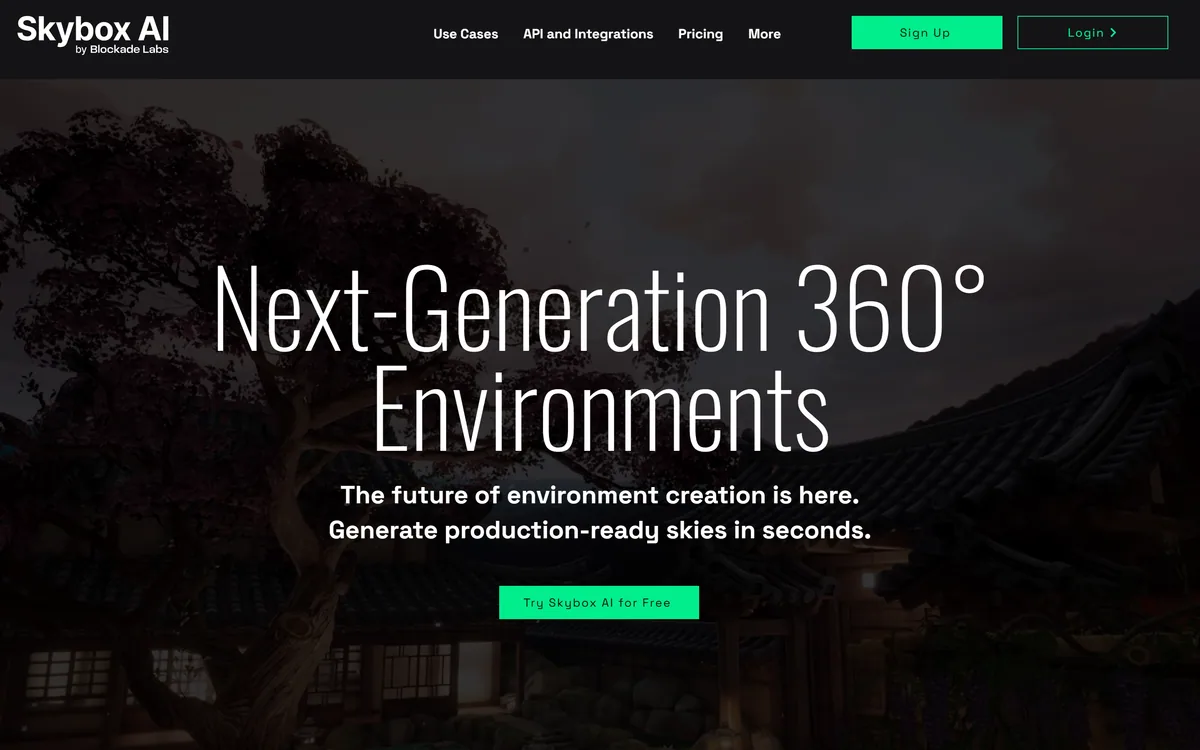
Skybox AI by Blockade Labs generates 360-degree equirectangular panoramas and skyboxes with stated generation times as fast as 15 seconds, 32-bit HDRI export for scene lighting, a Unity plugin, MCP support and direct export to Blender and Unreal.
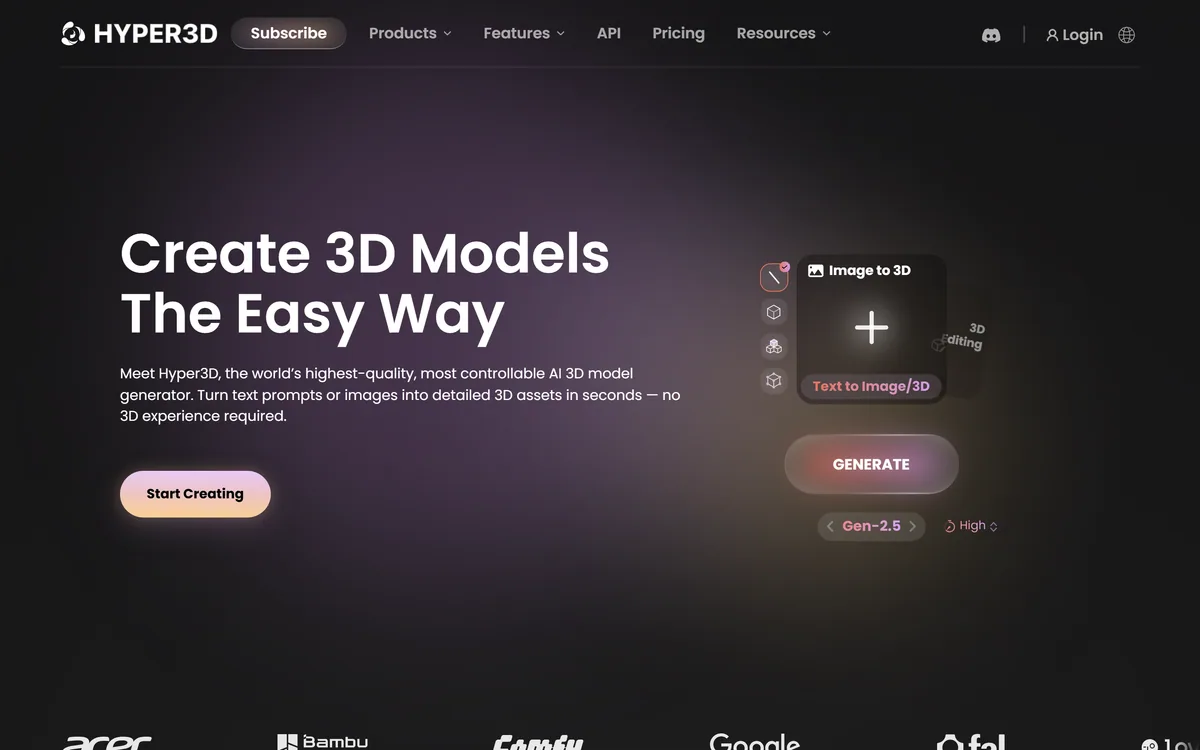
Rodin (Hyper3D) is an AI 3D model generator that turns text prompts or a single image into detailed 3D assets, with 21 styles, generation controls, plugins for Blender, Unity and Unreal, an API and MCP, aimed at game, print, product and avatar creators.

Conversational AI characters and NPCs for games Category: Emerging & Specialized.
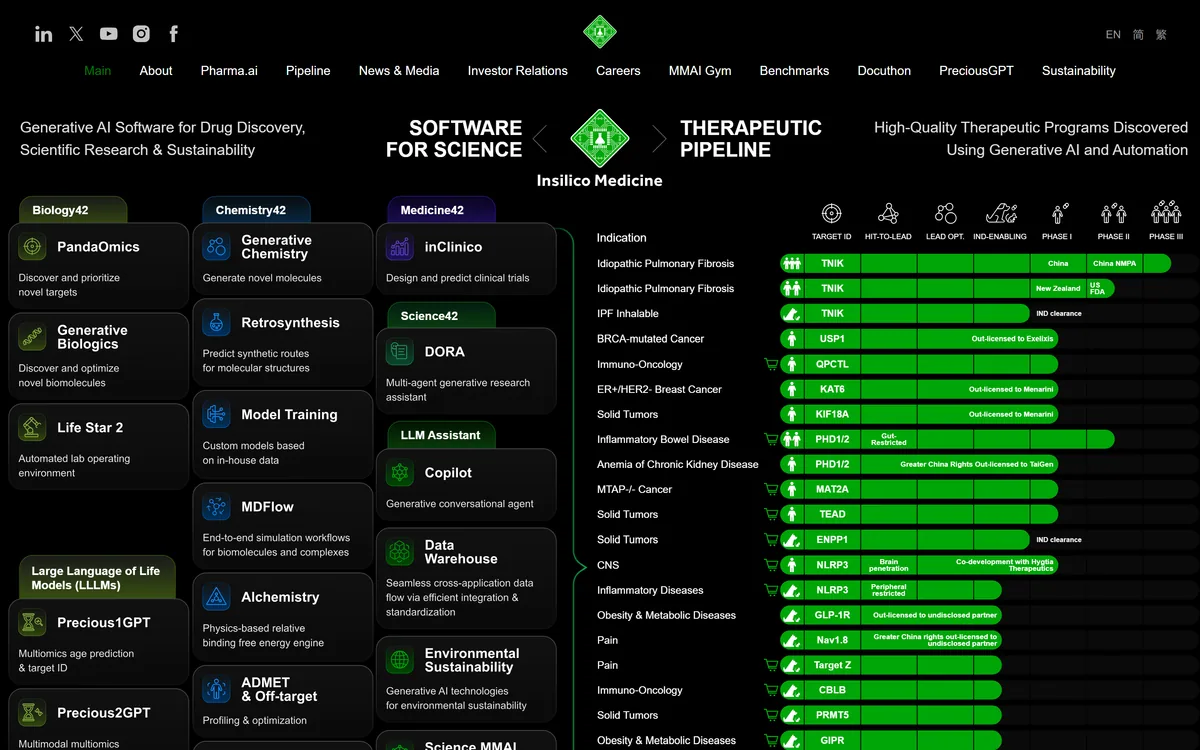
Insilico Medicine pairs the Pharma.ai software suite — PandaOmics, Chemistry42, inClinico and more — with its own clinical pipeline. Its lead candidate rentosertib, a TNIK inhibitor for idiopathic pulmonary fibrosis, has Phase IIa results published in Nature Medicine.

AI-powered stock scanning and trade idea generation platform Category: Emerging & Specialized.
Related Pages