Football analysis has had a hard economic floor for twenty years, and it has nothing to do with the software. It is that somebody has to watch the match and mark what happened.
A trained analyst tagging passes, duels, positions and phases takes several hours per ninety minutes. Elite clubs employ people to do exactly that. Everybody else — academies, semi-professional sides, national federations with forty age-group teams — simply does not have the analysis, because the labour was never available.
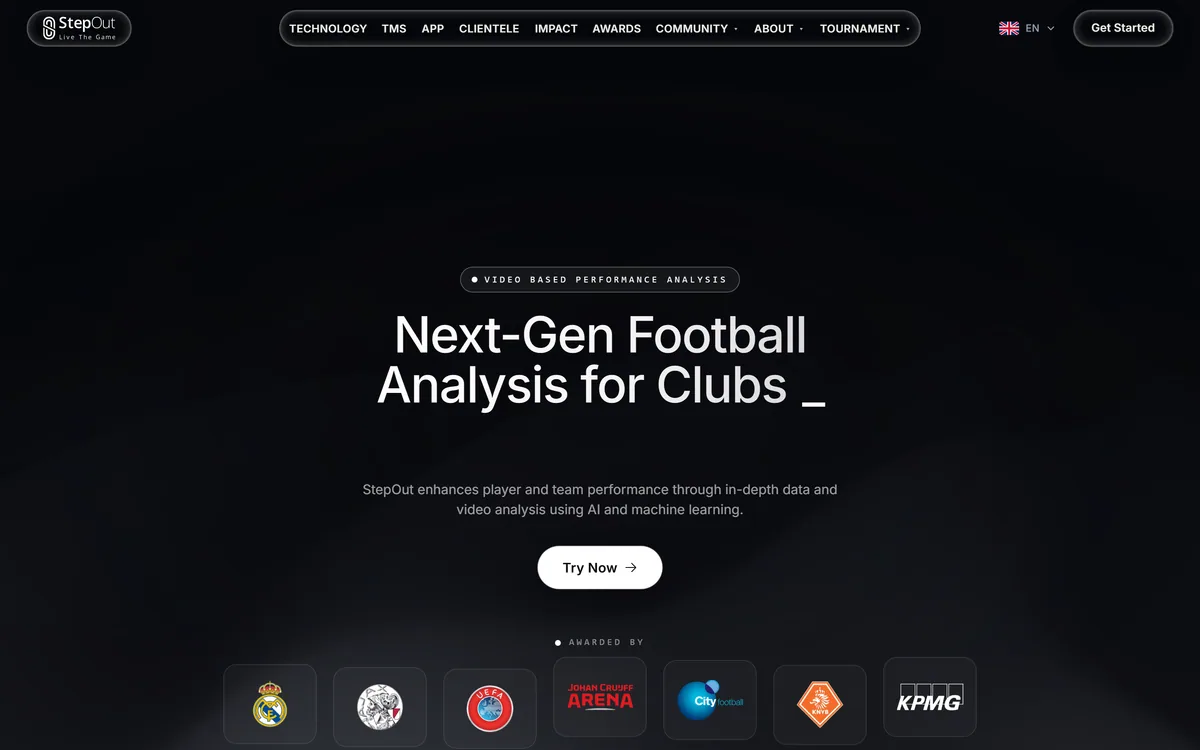
StepOut's proposition is that computer vision removes the tagger. This review covers what automated tagging can genuinely extract, what your footage has to look like for any of it to work, why the management system matters as much as the analysis, and where a human analyst is still irreplaceable.
Automated Match Analysis, Briefly
- StepOut is a computer vision platform that turns raw football match footage into tagged performance and tactical data, identifying players by shirt number and generating statistics without anyone tagging events by hand.
- Removing manual tagging is the entire proposition. Tagging a single match traditionally takes an analyst hours, which is why the practice never reached below the professional level.
- It is three products, not one: the video analysis, a Team Management System described as a digital command centre, and a player-facing mobile app.
- The named users are unusually strong for a young company — Real Madrid CF, AFC Ajax, Rayo Vallecano, Bengaluru FC, the All India Football Federation and Australian state federations.
- What it needs from you is specific: footage where shirt numbers are legible, plus lineups mapping numbers to players. Get that wrong and nothing downstream works.
The Tagging Bottleneck, And Why Removing It Changes Who Gets Analysis
It is worth being precise about the constraint, because it explains the whole category rather than just this product.
Automated highlight products like WSC Sports solved a different half of this for broadcasters. Analysis software has existed for decades and it was never the limiting factor. The limit was that data entry is human. Someone watches the footage and marks every event — this was a pass, from this player, in this zone, under this pressure, at this minute.
That labour scales linearly with matches, which produces a hard divide. A Premier League club employs analysts and gets every match analysed. A youth academy running fourteen teams across age groups cannot, because it would need a department.
Automating identification and event extraction does not make the analysis better than a good human analyst's. It makes it available to organisations that previously had none, which is a much larger change than an incremental quality improvement.
This is why the customer list reads the way it does. Real Madrid and Ajax do not need this to know what happened in a first-team match — they have people. They are interested in scale: academy matches, youth age groups, opposition footage, the tail of games nobody had capacity to review.
For a national federation like the AIFF, or a state body running competitions, the value is different again — consistent data across hundreds of matches nobody would otherwise have watched analytically.
Analysis software was never the bottleneck. Somebody watching the match with a keyboard was, and that is what decides which clubs have data and which do not.
The requirements are stated plainly on the site and they deserve emphasis, because they are where most disappointment in this category originates.
The system identifies players by shirt number, and it needs lineups mapping those numbers to names. Both conditions are hard requirements rather than preferences.
That has consequences you should think through before buying. Numbers must be legible from the camera position, which means a wide fixed camera at height is workable and a phone at pitch level frequently is not. Rain, mud and low winter light all degrade legibility exactly when grassroots football is played. Kits with poor number contrast — white on yellow, dark on dark — cause problems that no model solves.
Two players in similar kit at distance, a goalkeeper in a different shirt, a substitute wearing a number that already appeared: all of these are edge cases worth testing rather than assuming.
None of this is a criticism. Every automated system in this space has the same dependency, and the vendor is more upfront about it than most. But it does mean the honest evaluation question is not whether the software works — it is whether your footage is good enough to feed it.
The practical implication for a club: fixing your filming setup may be a prerequisite investment, and it is usually cheaper than the software.
- Take a match you already had analysed manually, so you have ground truth to compare against.
- Check the footage first — can you read every shirt number yourself at full screen?
- Run it through and compare the automated output against your analyst's tagging, event by event.
- Test a deliberately awkward match: bad light, rain, or a kit clash.
- Only then decide whether the gap is in the software or in your camera position.
The Management System Is Half The Product
The Team Management System is easy to skim past as bundled admin software, and for the actual buyer it is frequently the deciding half.
The reason is that analysis on its own does not change anything. A folder of statistics that a coach never opens has no effect on a player's development. The value only appears when data reaches the person who acts on it, in a form they will use, at a time it matters.
That is what an integrated system attempts. Squad records, session planning, availability, and performance data sitting in the same place as the video — so a coach preparing a session sees the analysis rather than having to go and find it.
Clip tools such as OpusClip handle the content side, not the coaching side. The player app matters for the same reason from the other direction. Players who see their own data engage with development differently from players who are told about it, and in youth academies that engagement is much of the point.
The trade-off is the usual one for integrated systems: if you already run a management platform you are happy with, you are buying overlap. Ask specifically what exports and integrations exist, because a closed system that will not talk to your existing tools creates work rather than removing it.
How Clubs Pay For It
This site does not publish plan prices, and StepOut does not either — the site refers to subscription plans without setting out tiers.
The structure is subscription-based, and in this category the meters are almost always the same three: how many matches or hours of footage you process, how many teams or squads you manage, and how many staff seats you need.
That shape has a specific consequence for the buyer this product is aimed at. An academy running fourteen teams cares far more about the per-team and per-match dimensions than about seats, and those are exactly the numbers that determine whether the economics work at youth level.
Two questions worth putting directly to them before a trial. First, whether processing is metered by match or by video minute, since extra-time, warm-ups and multi-angle footage change that arithmetic substantially. Second, whether footage storage is included or separate, because video volume at federation scale becomes its own cost.
The comparison that actually matters is not against other software. It is against the cost of the analyst hours you are currently not spending — for most organisations below the professional tier, the honest baseline is zero analysis at all, which makes the calculation about capability rather than savings.
What The Camera Cannot See
Being clear about this is more useful than a list of statistics, and it applies to every automated analysis system rather than to this one specifically.
Events are not understanding. A system can tell you a midfielder made 62 passes at 89% accuracy. It cannot tell you that 40 of them were sideways under no pressure because the player was hiding, which is the thing a coach actually needs to know.
Audio analysis needs a separate layer again, of the kind Speechmatics provides. Off-ball movement is where football is decided and where footage is weakest. Broadcast and single-camera angles follow the ball, so the run that created the space — the most valuable action in many goals — is frequently outside the frame entirely.
Context does not survive extraction. A poor performance against a stronger side in bad conditions on a heavy pitch produces the same numbers as a poor performance without excuses. Comparing players across contexts using raw counts is how youth assessment goes wrong.
Youth data carries a specific hazard. Physical maturation dominates performance metrics in adolescent football to a degree that swamps ability, and relative age effects are well documented in the sport. Data-led selection at academy level reliably rewards early developers unless someone actively corrects for it.
Used properly this is a tool that gives a coach far more to look at. Used carelessly it gives a false precision to decisions about teenagers' careers.
- Counts events, not intentions — volume is not the same as contribution
- Off-ball movement is often outside a single camera's frame entirely
- Opposition quality, conditions and pitch are stripped out of raw statistics
- Physical maturity dominates youth metrics and is easily mistaken for ability
- Tactical instruction explains much of what the numbers show, and is invisible to the camera
Capability, Users And Requirements
| Category | AI football video analysis and team management |
|---|
| Core function | Automated analysis of match footage into tactical and performance data |
|---|
| Identification method | Players identified by shirt number |
|---|
| Tagging | Automatic event and action tagging, with no manual tagging required |
|---|
| Products | Video analysis, Team Management System, and a player-facing mobile app |
|---|
| Stated processing | Vendor states the AI scans every frame in minutes |
|---|
| Input requirements | Match video with legible numbered shirts, plus team lineups mapping numbers to players |
|---|
| Target users | Professional clubs, youth academies, national federations, tournament organisers, coaches, analysts, players and scouts |
|---|
| Named clubs and bodies | Real Madrid CF, AFC Ajax, Rayo Vallecano, Bengaluru FC, the All India Football Federation, Football NSW, Football Queensland |
|---|
| Recognition | Real Madrid Next accelerator (2025) and AFC Ajax Reimagine Football Challenge (2022), with recognition cited from KPMG, UEFA and City Football Group |
|---|
| Platform | Web-based, with a mobile app for players |
|---|
| Charging model | Subscription plans, with tiers not published; no prices published here |
|---|