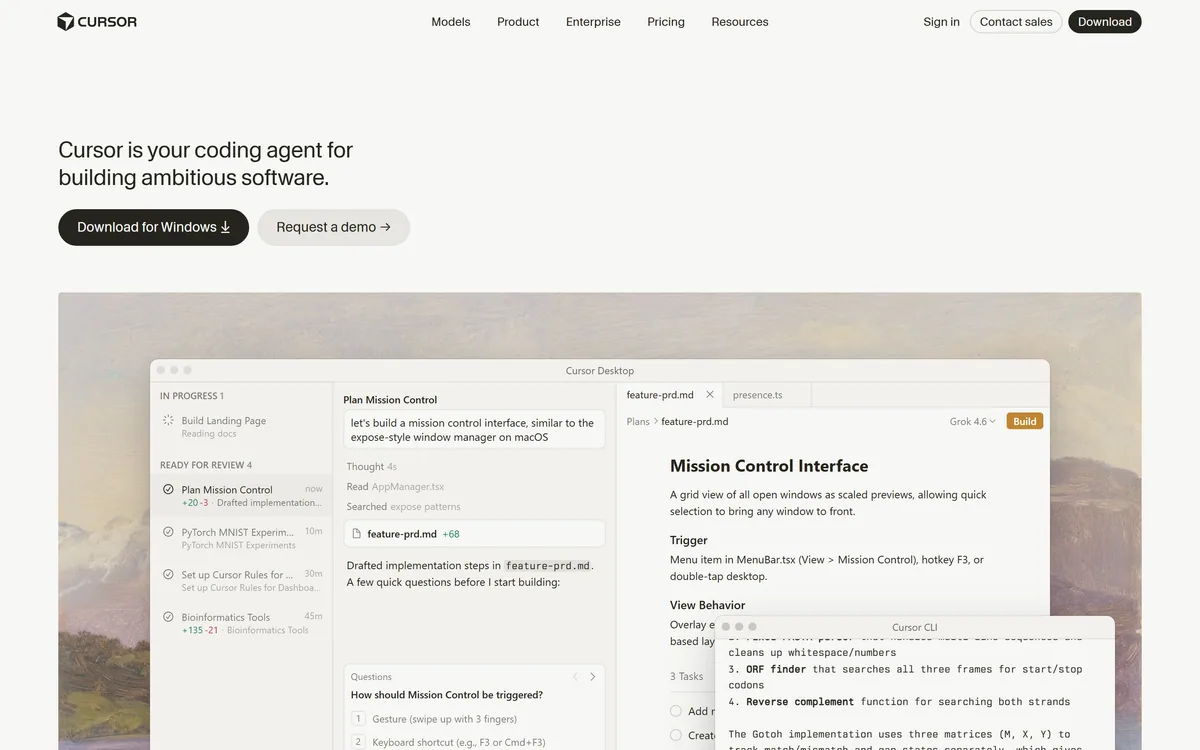

Cursor is an AI-first code editor and agent platform from Anysphere — now a SpaceX subsidiary — that plans, writes, tests, and reviews code across your repository from the desktop editor, a CLI, the web, and Slack.
Coding & Development Review
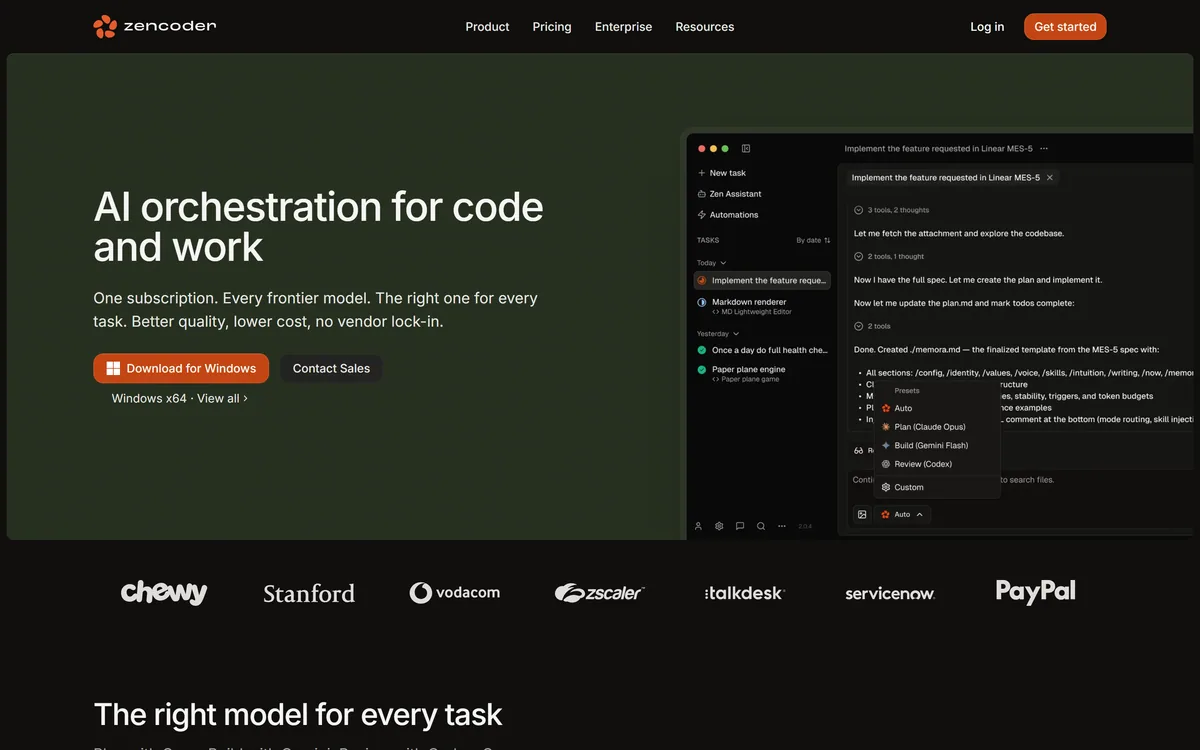
Zencoder is an AI orchestration platform for engineering work: agents plan with one model, build with another and review with a third, across multi-repo indexing and full dependency mapping, inside VS Code and JetBrains. It adds scheduled automation and a work layer spanning Jira, Slack and Notion.
Very good
Zencoder scores well because it acts on something most coding tools ignore: planning, building and reviewing are different cognitive tasks, and the best model for each is not the same model. Routing them separately under one subscription is a sounder architecture than picking a favourite. The enterprise posture is unusually complete — SOC 2 Type II, ISO 27001, ISO 42001, zero code storage, no training on your data, and on-premise or hybrid deployment — which clears procurement in places most rivals cannot. It loses ground because the surface is broad enough to be diffuse, spanning IDE agents, workflows, scheduled automation and a work layer, and because nothing about real-world quality is published. AInexfinder Editor Score: 4.2/5.
Best for: Engineering teams working across multiple repositories; Organisations whose security policy has blocked cloud AI coding tools
The visit link goes to zencoder.ai, the official site. Paid placements on AInexfinder are always labelled. How we make money
There is a quiet assumption inside most AI coding tools that deserves questioning: that one model should do the whole job.
It does not match how the work actually divides, and single-model tools such as Cursor inherit that assumption. Planning a change is a reasoning task — understanding a system, weighing approaches, deciding what to touch. Writing the code is a generation task. Reviewing it is an adversarial task, where the useful skill is finding what is wrong rather than producing something plausible. Models have measurably different strengths across those three.
Zencoder's argument is that you should therefore use three, and route each stage to whichever is best at it. That is a more interesting proposition than another assistant, and the enterprise posture underneath it is stronger than most of the category can offer.
The site is specific about the division: Claude Opus for planning, Google Gemini for building, OpenAI Codex for review. Naming which model does what is more transparency than most orchestration products offer, and it makes the claim checkable.
The reasoning holds up. A planning model benefits from long-context reasoning over an existing system. A building model benefits from throughput and code fluency. A review model benefits most from a different perspective than the one that wrote the code — which is the oldest principle in software review and applies to models for the same reason it applies to people.
That last point is the strongest part of the design. A model reviewing its own output tends to confirm it, because the reasoning that produced the code is the reasoning being applied to check it. A different model with different training brings genuinely independent judgement, and it catches things self-review does not.
The practical benefit of bundling this is commercial rather than technical. Buying frontier access to three providers separately is expensive and administratively tiresome; one subscription that routes between them removes both problems.
The corresponding risk is the aggregator risk that applies across this whole category: Zencoder does not control the models it routes to, so upstream capability, pricing and availability changes pass through to you.
A model reviewing its own code applies the same reasoning that produced it. Independent review needs a genuinely different reviewer — that has always been true of people, and it is true of models.
Zencoder states multi-repo indexing, architectural awareness and full dependency mapping. For anyone working in a small codebase this sounds like a detail; for anyone working in a real organisation it is the whole question.
Serious systems are not one repository, which is where single-repo agents such as Aider reach their limit. They are a service, its client libraries, a shared schema, an infrastructure repo and three internal packages — and the changes that actually take time are the ones that cross those boundaries. Changing an API contract means finding every caller, which is precisely the work a single-repo tool cannot help with because it cannot see them.
Dependency mapping is the substantive part of the claim. Knowing that a change to one module affects four consumers is the difference between a complete change and a broken deployment discovered on Thursday.
The question to press in evaluation is scale rather than existence. Indexing works differently at five repositories and five hundred, and index freshness matters as much as index coverage — a map that is a week stale will confidently point an agent at code that has moved.
Alongside the interactive agents, Zencoder offers scheduled automation for things like daily bug triage, pull request reviews and dependency updates.
This is a more significant shift than it appears. An interactive agent waits to be asked, which means it only ever helps with work you already decided to do. A scheduled agent works on the things nobody gets round to — and in most engineering organisations that backlog is where the real cost sits.
Dependency updates are the clearest case, and the kind of maintenance GitHub Copilot was never designed to initiate. Everyone knows they should happen, almost nobody prioritises them, and the consequence is a codebase that eventually cannot be upgraded without a project. Something that opens those pull requests every week, with tests run, changes that from a project into a routine.
Bug triage is similar: unglamorous, valuable, and the first thing dropped when a team is busy.
The governance question this raises is real and worth settling before switching it on. An agent that opens pull requests unattended needs a defined review path, permissions narrow enough that it cannot merge unreviewed, and someone accountable for what it produces. The technology is ready for this; most teams' process is not, and that gap is where trouble arrives.
Zencoder states SOC 2 Type II, ISO 27001 and ISO 42001, zero code storage, no model training on your data, and deployment as cloud, on-premise or hybrid. That is a materially stronger set than most AI coding tools publish.
ISO 42001 is the one worth noticing, because it is the AI management systems standard rather than a general security certification. Holding it says something specific about how the company governs AI systems, which is exactly the question a regulated buyer now asks and which SOC 2 does not answer.
Zero code storage is the claim that unblocks the most conversations. The reason many organisations forbid AI coding tools is not model quality; it is that source code is the asset, and sending it to a third party who retains it is a governance problem no engineering argument overcomes. A tool that processes without retaining changes that discussion.
On-premise and hybrid deployment closes the remaining gap for defence, finance and healthcare, where data residency is a hard requirement rather than a preference.
The diligence to do is the same as with any vendor: ask for the reports rather than the badges, confirm what zero code storage means in practice for prompts and telemetry as well as source, and get the subprocessor list — because a router that calls three model providers has at least three subprocessors seeing your code.
Multi-model orchestration is impossible to judge from a demo, because the demo repository has none of the properties that make your codebase hard.
The bar is step three. If the cross-repo change misses a caller, the dependency map is not doing the thing you are buying it for.
Zencoder spans a lot: IDE agents, Zenflow Code workflows, Zenflow Work automations across Jira, Slack, Notion, Gmail and Calendar, scheduled automation, and a marketplace.
Breadth is a genuine benefit when the pieces reinforce each other, and a genuine risk when they do not. A tool that indexes your repositories and also reads your Jira tickets can connect a requirement to the code that implements it, which no single-purpose tool can. That is a real advantage.
The risk is that a platform doing seven things rarely does all seven as well as the best single-purpose tool does one, and evaluating breadth is hard because a demo can only show you the good parts.
The way through is to pick the one capability you would buy this for and evaluate that alone. If multi-repo agentic coding is the reason, judge it on that and treat the work layer as a bonus you may never use. If the cross-tool automation is the reason, judge that.
Buying a platform for its second-best feature is how teams end up paying for surface area they never touch — and with a subscription rather than credits, unused surface area is pure cost.
Task-specific model routing across Claude Opus, Google Gemini and OpenAI Codex
Agents that draft a specification before implementing
Multi-repo indexing with architectural awareness and full dependency mapping
Automatic tests, linting and code review on every change
Zenflow Code workflows for features, bugs and refactors
Zenflow Work automations across Jira, Slack, Notion, Gmail, Calendar and 100+ tools
Scheduled automation for bug triage, PR reviews and dependency updates
Cloud, on-premise or hybrid deployment with zero code storage
The differences that matter here are how many models a tool uses, how much of your codebase it can see, and whether it can be deployed where your policy requires.
| Tool | Model approach | Codebase scope | Deployment |
|---|---|---|---|
| Zencoder | Routes across three named frontier models by task | Multi-repo with dependency mapping | Cloud, on-premise or hybrid |
| Cursor | Bundled frontier models in its own editor | Single repository, deep editor context | Cloud |
| GitHub Copilot | Bundled | Repository-aware within your editor | Cloud, with enterprise controls |
| Aider | Any model, including local | Single repository via a repo map | Runs entirely on your machine |
| Sentry Seer | Its own agent | Starts from production errors rather than the repository | Cloud |
| Product type | AI orchestration platform for coding and engineering work |
|---|---|
| Model routing | Claude Opus for planning, Google Gemini for building, OpenAI Codex for review |
| IDE support | VS Code and JetBrains |
| Codebase context | Multi-repo indexing, architectural awareness, full dependency mapping |
| Verification | Tests, linting and code review run on every change |
| Products | Zenflow Code, Zenflow Work, IDE Agents, Marketplace |
| Work integrations | Jira, Slack, Notion, Gmail, Calendar and 100+ tools |
| Automation | Scheduled runs for bug triage, PR reviews and dependency updates |
| Certifications | SOC 2 Type II, ISO 27001, ISO 42001 |
| Data handling | Zero code storage; no model training on your data |
| Deployment | Cloud, on-premise or hybrid |
| Legal entity | For Good AI Inc. |
| Pricing model | Subscription; amounts not published on the pages we read |
Compare on codebase scope and deployment before features — those two decide whether a tool is usable in your organisation at all.
Last checked . Read from zencoder.ai, including the footer, with the screenshot above captured in the same session.
What we could not confirm: no pricing is published on the pages we read; no benchmark, accuracy or acceptance-rate figures are given for the agents; the certification reports themselves are not public, so scope and any exceptions are unknown; what zero code storage covers for prompts and telemetry as distinct from source is not spelled out; the subprocessor list is not published, which matters because routing to three model providers implies at least three; and we did not use the product.
AInexfinder does not list plan prices or billing details. For current pricing, plans, and trials, visit the official Zencoder website.
Visit official website for pricingVendor pricing, credits, and billing policies change over time. Always confirm on the official site before you buy.
Zencoder earns an AInexfinder Editor Score of 4.2/5 (very good). Best for: Engineering teams working across multiple repositories; Organisations whose security policy has blocked cloud AI coding tools; Teams that want independent model review rather than self-review.
Visit ZencoderLog in to write a review.
No reviews yet. Be the first to share your experience with Zencoder.
Assigned reviewer
Daniel ReedSenior AI Tools Reviewer
Daniel leads AInexfinder's tool reviews. He researches each tool from its own pricing, documentation and policies, checks its claims against independent sources, and writes up what it does well, where it falls short and who it genuinely suits.
Daniel and the AInexfinder editorial team research Zencoder from its own website, pricing, documentation and policies, checked against independent sources. This review is research-based: unless its method note says otherwise, we have not bought a plan or run hands-on tests. The Editor Score is our editorial judgement, and payment never changes it.
Similar Tools
Cursor is an AI-first code editor and agent platform from Anysphere — now a SpaceX subsidiary — that plans, writes, tests, and reviews code across your repository from the desktop editor, a CLI, the web, and Slack.
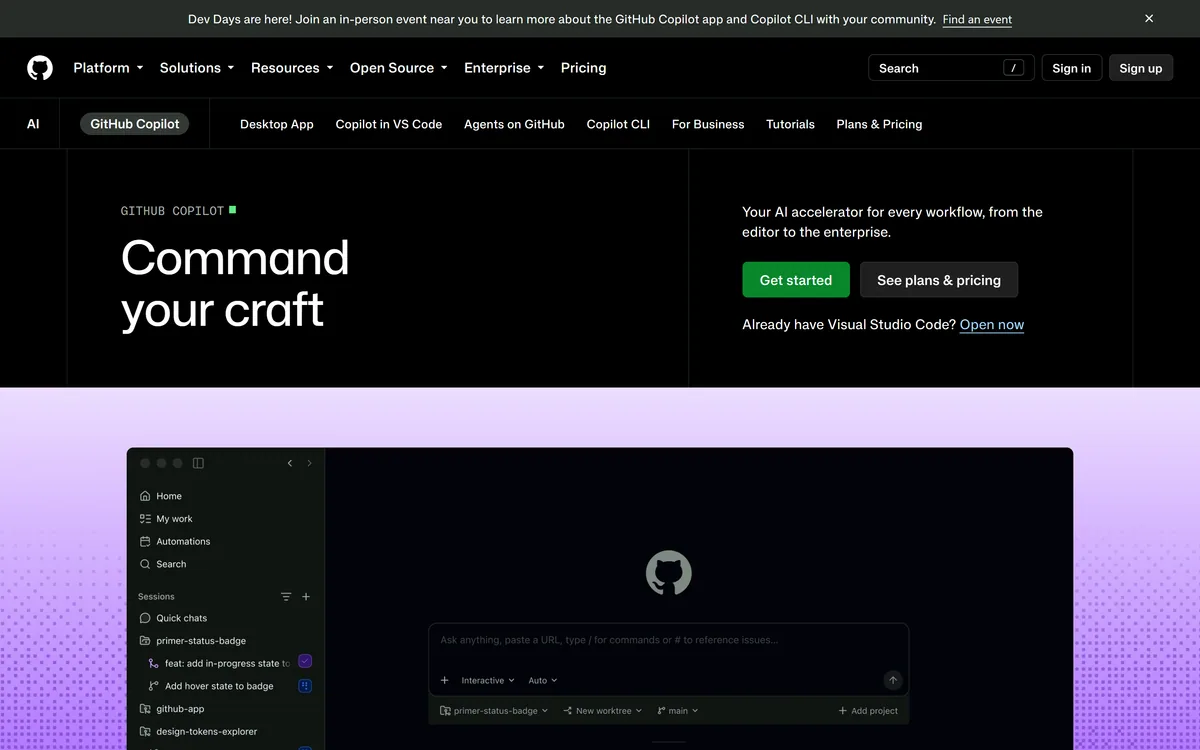

GitHub Copilot is an AI coding assistant that spans completion, chat, agent mode, automated code review, and a cloud agent that opens pull requests, working across VS Code, Visual Studio, JetBrains, Xcode, Neovim, Eclipse, the CLI, and github.com.
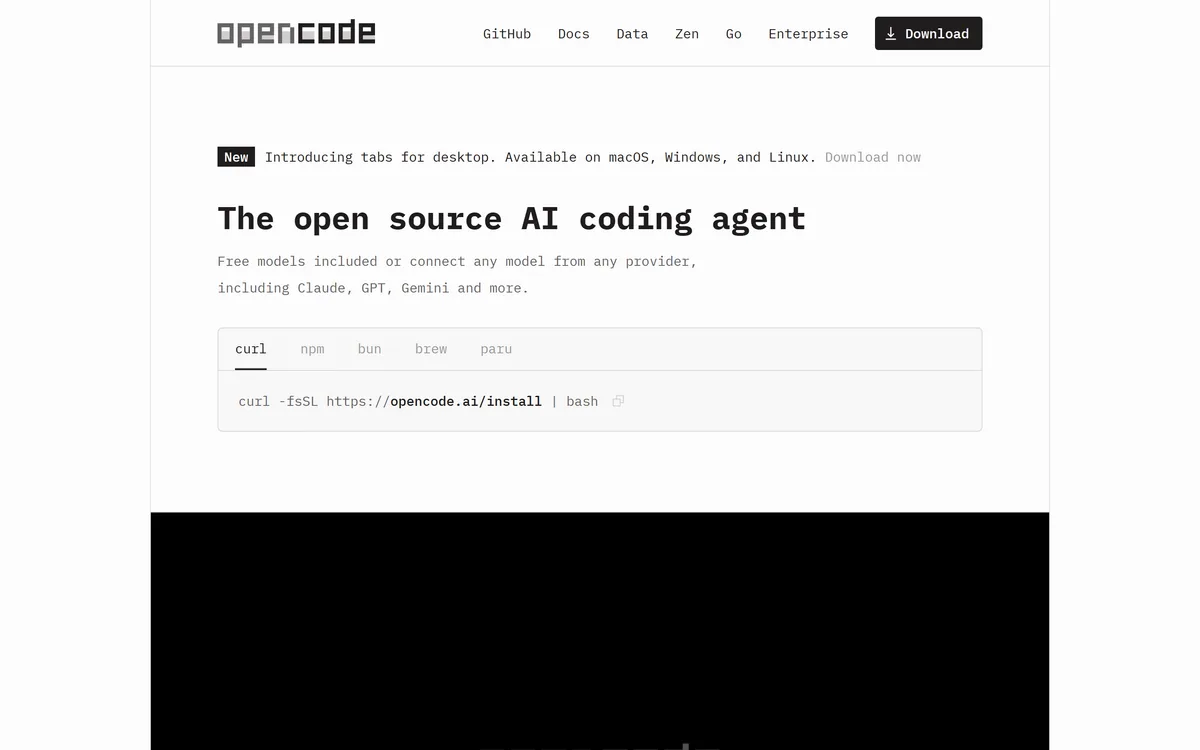
OpenCode is an open source AI coding agent built for the terminal, with desktop and IDE clients alongside. It connects to 75+ model providers, configures language servers automatically, runs parallel agent sessions, keeps conversations locally in SQLite, and is built by the team behind SST.
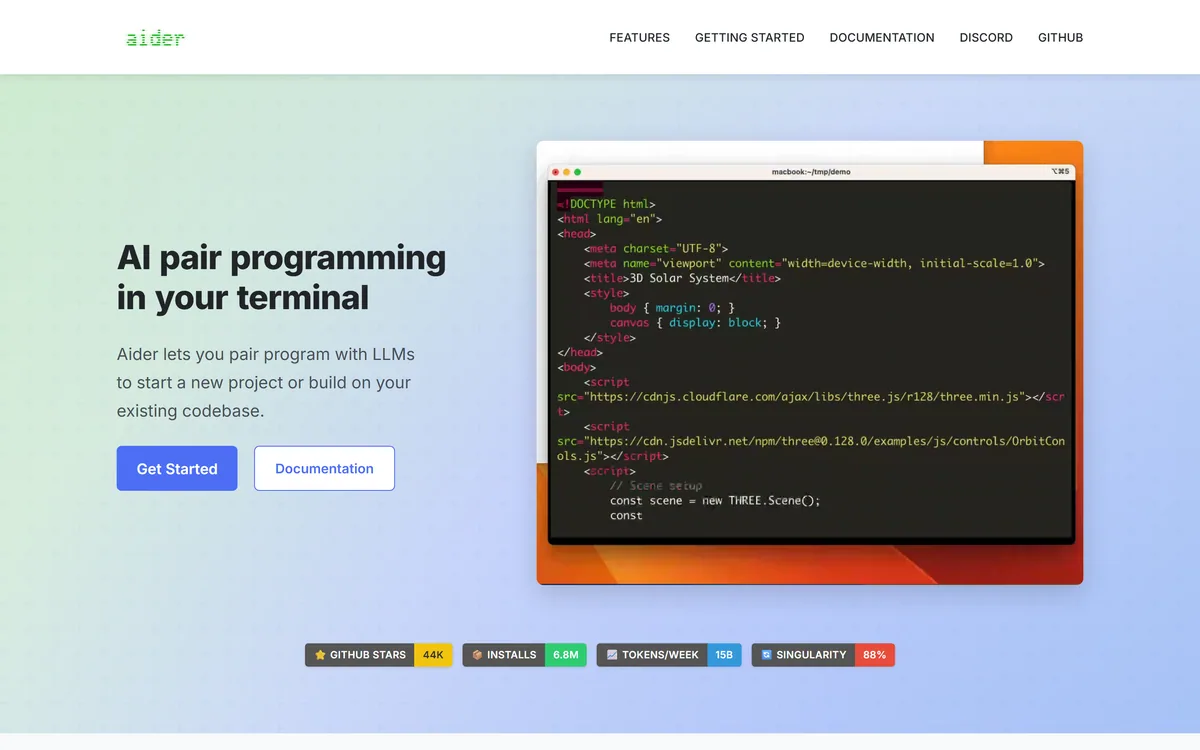
Aider is an open-source AI pair programming tool that runs in your terminal, builds a map of your whole repository for context, works with almost any LLM including local models, and commits each change to git with a written message so every edit can be diffed and undone.
Generate native iOS, Android and web apps from prompts Category: Coding & Development.
Traycer review on AInexfinder — freemium AI tool for Coding & Development. Features, pricing notes, and alternatives.
Related Pages