Baz is an AI code review platform whose agents review plans, pull requests, security issues and merge readiness with context from your entire codebase, explaining their reasoning, suggesting fixes and learning from your team's feedback.
As more code is written with AI assistance, the bottleneck shifts to review: someone has to check that all that code is correct, secure and fits the system. Baz positions itself as an AI verification layer for exactly that moment.
Its agents review plans, pull requests, security issues and merge readiness with context from your entire codebase, explain their reasoning, suggest fixes and improve with your team's feedback. It sits alongside review tools like Korbit AI, with an emphasis on reviewing across the whole lifecycle of a change.
This review covers how Baz reviews a pull request, where it fits a review process, how it is offered to teams, and when it should not be the final reviewer.
Baz reviews plans, pull requests and merge readiness with whole-codebase context.
AI Code Review From Plan To Production
Baz starts from a simple observation: AI coding has made writing code faster, but review has not kept pace, so bugs, security issues and architectural regressions slip through more easily. Its answer is a set of AI review agents that act as an extra, always-available reviewer.
What distinguishes it from simple diff linters is context. Baz's reviewers draw on the whole codebase, so they can spot problems that only make sense in light of how other code works, such as a helper that mutates shared state and breaks retries elsewhere.
It also reviews beyond the pull request itself, with plan reviews before code is written, security reviews, merge-readiness checks and production feedback, aiming to catch issues at whichever stage is cheapest to fix.
Its findings come with reasoning and severity, which matters because reviewers drown when every comment looks equally urgent. Customer quotes on the site credit the severity indicator and shorter, more concise comments with saving review time.
The honest framing is that Baz can raise the floor of code review and save human reviewers time, but AI reviewers miss things and occasionally flag non-issues. It works best as a verification layer that frees people to focus on design and risk, not as an automatic approver.
Baz can raise the floor of code review, but it works best as a verification layer that frees people for design and risk, not as an automatic approver.
How Does Baz Review A Pull Request?
Baz combines codebase-aware review with checks at several stages of a change.
Whole-Codebase Context And Explained Findings
Baz's reviewers catch bugs, security issues, architectural regressions and style violations in pull requests, explain their reasoning and suggest fixes, which developers can commit directly. Customer quotes on the site cite faster time to merge and fewer bugs, which are vendor-presented results.
For broader AI help writing the code in the first place, an assistant like Tabnine works in the editor; Baz focuses on reviewing what gets written.
Where Baz Fits A Review Process
Baz fits engineering teams that ship frequently, especially those using AI coding tools heavily, where the volume of code to review has grown faster than reviewer capacity.
It fits teams with large or complex codebases, where context-aware review catches issues a diff-only tool would miss, and teams that want consistent review quality across many repositories.
It also fits platform and security-minded teams that want a consistent first pass on every pull request before a human looks, so human attention goes to the changes that genuinely need it.
It fits less well very small teams with light review loads, where a human reviewer can keep up comfortably, and organisations that cannot share code with a third-party service without a security review.
In regulated or safety-critical code, Baz can help, but approvals should remain with qualified people and established processes; AI review is an extra safety net, not a replacement for accountability.
How Baz Is Offered To Teams
Baz offers a free trial and demos, with paid plans for teams and organisations. We do not publish prices, which change; check the site.
The value question is reviewer time and defect rates: if Baz shortens time to merge and catches real bugs before production, it can pay for itself quickly on an active team.
Track signal quality too. If developers start ignoring Baz's comments because too many are noise, the value drops, so measure the share of findings that lead to real changes.
The sensible approach is to run Baz alongside your existing human review for a few weeks and compare what it catches, how often it is wrong and how much time it saves.
Running Baz On Real Pull Requests
Because review quality is measurable, pilot Baz alongside human reviewers on real pull requests.
Review Baz's data-handling and security terms before connecting repositories.
Enable it on one active repository alongside your normal human review.
Track which Baz findings lead to real fixes versus being dismissed.
Check whether its severity ratings match your team's judgement.
Measure time to merge and escaped bugs before and after.
Pass/fail: Baz is worth it if it catches real issues with little noise.
Keep human approval on risky and security-sensitive changes.
Baz, The Review-Agent Brief
Baz is an AI code review platform: agents review pull requests with context from your whole codebase.
It reviews more than diffs: plans, security, merge readiness and production behaviour are part of the pitch.
It explains itself: reviewers give reasoning, severity and suggested fixes, and learn from team feedback.
It is a verification layer, not the final word: humans should still own approvals on risky changes.
Key features of Baz
AI pull-request review
Whole-codebase context
Plan review
Security review
Merge readiness review
Severity indicators
Suggested fixes
Learning from feedback
Pros & cons
Pros
5
Context-aware, not diff-only
Reviews across a change's lifecycle
Explained findings with severity
Suggested fixes save time
Free trial to test
Cons
5
Can miss issues or add noise
Requires sharing code with a vendor
Less value for small teams
Not a substitute for human approval
Results figures are vendor-presented
Best For
High-volume code review
AI-assisted codebases
Large repositories
Security checks
Merge readiness
Baz Against Other Code Reviewers
The useful comparison is with other ways teams review and verify code.
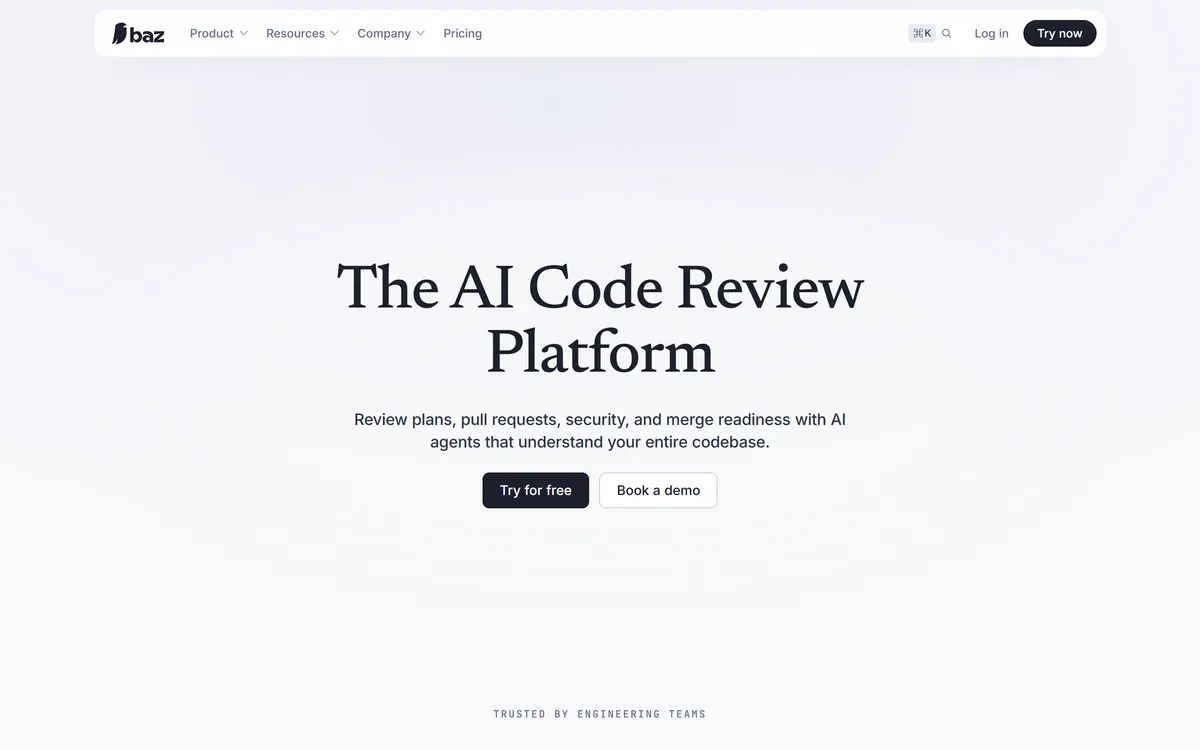
Last checked . Read from baz.co during this check, with the screenshot above captured at the same time.
An AI code review platform
Reviewers with context from the entire codebase
Plan, pull-request, security, merge and production reviews
Findings with reasoning, severity and suggested fixes
Learning from team feedback
Customer quotes on time to merge and bug reduction (vendor-presented)
A free trial and demos
No prices reproduced here, in line with this site's pricing policy
AI reviewers can miss issues or raise false alarms; keep human approval on risky changes. Customer results are vendor-presented. Review data handling before connecting private code.
Code-Quality Tools To Weigh Beside Baz
A PR review tool, an AI-SRE tool and an enterprise coding assistant to weigh alongside Baz.
Baz earns 4.0 as a thoughtful AI code review platform for the age of AI-written code: reviewers with whole-codebase context check plans, pull requests, security and merge readiness, explain their reasoning with severity and suggest fixes, and learn from your team. It suits teams whose review load has outgrown their reviewers. AI review still misses things and can add noise, and approvals on risky changes should stay human, so pilot it alongside your current process and measure signal quality. AInexfinder Editor Score: 4.0/5.
Baz pricing
AInexfinder does not list plan prices or billing details. For current pricing, plans, and trials, visit the official Baz website.
Vendor pricing, credits, and billing policies change over time. Always confirm on the official site before you buy.
Frequently asked questions
What is Baz?
Baz is an AI code review platform whose agents review plans, pull requests, security issues and merge readiness with context from your entire codebase, explaining findings and suggesting fixes.
How is Baz different from a linter?
Linters check rules within changed lines. Baz uses whole-codebase context, so it can catch bugs, regressions and security issues that only make sense in light of other code.
Can Baz approve pull requests automatically?
It is best used as a verification layer that supports reviewers. Keep human approval on risky, security-sensitive or production-critical changes.
Does Baz review more than pull requests?
Yes. It offers plan review before implementation, security review, merge review and production review, sharing engineering context across stages.
Does Baz learn from my team?
Baz says its reviewers continuously improve with your team's feedback, which should reduce noise over time as it learns your conventions.
Is it safe to give Baz access to my code?
Review its security and data-handling terms with your security team before connecting private repositories, as with any third-party code service.
How much does Baz cost?
Baz offers a free trial and demos, with paid team and organisation plans. We do not publish prices, which change; check the site.
Who is Baz best for?
Engineering teams shipping frequently, especially with heavy AI coding use, large codebases or many repositories, where review capacity is the bottleneck.
Will Baz slow down my developers?
If tuned well, it should speed reviews by catching issues early. If findings are noisy, developers may ignore them, so measure how many comments lead to real fixes.
Are Baz's customer results typical?
Quoted improvements in time to merge and bug counts are vendor-presented. Measure your own before-and-after metrics during a pilot.
Daniel reviews AI tools the slow way — by actually using them on real projects. His reviews cover what works, what breaks, and who each tool is genuinely a good fit for.
Daniel and the AInexfinder editorial team research Baz using public product information, listing evidence, and (when available) hands-on checks. Scores reflect listing completeness and transparency — not paid placement.
Listings may include affiliate or sponsored placements, which are labeled when present. Editorial scores and cons are not sold. See our affiliate disclosure and review methodology.
CodeScene measures code with CodeHealth, a validated metric predicting defects and delivery performance. It states the average enterprise codebase scores 5.15 out of 10 while AI needs 9.5 to work reliably, and offers an MCP server, automated reviews and IDE feedback. Operated by CodeScene AB.
cubic reviews pull requests in GitHub and your IDE, enforces rules written in plain English, and learns from senior engineers' PR comment history. It runs thousands of agents nightly to scan an entire codebase for bugs, pulls context from Linear, JIRA, Notion and Confluence, and is free for public repositories.
Sourcery is an AI code-review tool that reviews every pull request in minutes, catching bugs, edge cases and security issues with one-click fixes, plus codebase security scanning, with a strong stance on keeping your code private.
Snyk Code is a static application security testing tool built for developers, using DeepCode AI to find vulnerabilities in the IDE in real time and Snyk Agent Fix to propose pre-validated fixes, including coverage for AI-generated code.
Korbit AI is an automated code-review tool that reviews pull requests inside GitHub, GitLab and Bitbucket, flagging bugs, security and design issues with fix explanations, writing PR descriptions and summaries, and generating team insights, without training on your code.
Codacy combines static analysis, SAST, SCA, secret scanning, IaC checks and test coverage in one platform, and has repositioned around AI-assisted engineering — detecting AI policy violations and unapproved model calls, with Codacy Guardrails embedding checks inside agentic workflows.