

HubSpot AI is branded Breeze — an assistant plus a set of agents for prospecting, content, customer service, campaigns, nurture, and revenue, all running on live CRM data, with an Agent Builder for custom ones.
FreemiumBusiness & Marketing
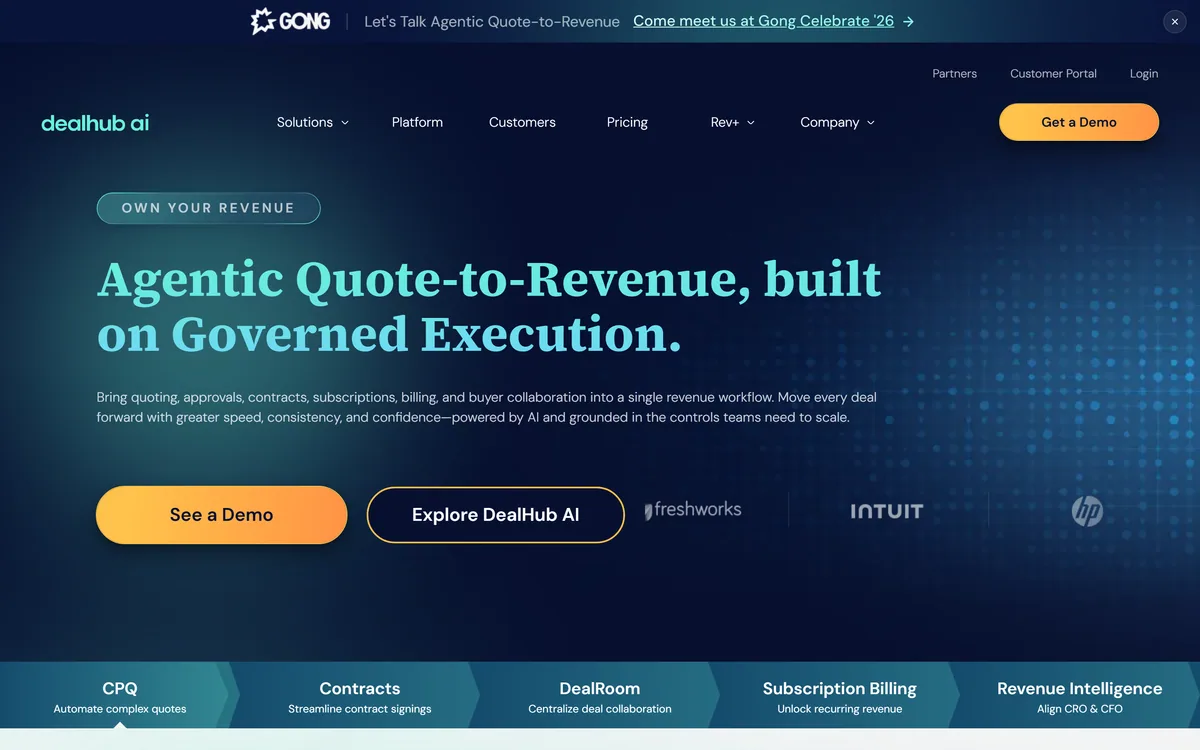
DealHub is an agentic quote-to-revenue platform that brings CPQ, approvals, contracts, subscriptions, billing and buyer collaboration into one governed workflow, with guided selling and revenue intelligence, built for enterprise sales teams.
The stretch between a verbal yes and recognised revenue is where enterprise deals quietly go to die: quotes take days, approvals sit in inboxes, contracts bounce around, and billing is a separate system entirely. DealHub exists to make that whole stretch one connected, governed workflow.
It brings configure-price-quote, approvals, contract management, subscription billing and buyer collaboration into a single flow, now with an agentic layer on top and a focus on what it calls governed execution, moving every deal forward with speed and consistency but within the controls a large organisation needs.
This review covers what the agentic layer adds to CPQ, how the DealRoom and revenue intelligence pieces fit, the enterprise compliance case, how it is priced, and who it suits against other CPQ and revenue tools.
| What it is | Agentic quote-to-revenue platform |
|---|---|
| Core | CPQ: configure, price and quote |
| Covers | Quoting, approvals, contracts, subscriptions, billing |
| Buyer side | DealRoom for buyer collaboration |
| Intelligence | Revenue intelligence aligning CRO and CFO |
| Integrations | Salesforce, HubSpot, Dynamics 365, NetSuite, Slack, Gong, DocuSign |
| Compliance | ISO 27001, 27701, 22301, 42001; SOC 1 and 2 Type II; GDPR, CCPA |
| Positioning | An alternative to Salesforce CPQ |
| Company | DealHub Ltd |
DealHub's core argument is unification. Instead of a CPQ tool here, a contract tool there, and billing somewhere else, it runs quoting, approvals, contracts, subscriptions and billing as one workflow, so a deal moves forward without falling between systems.
The pains it targets are specific and familiar: IT changes to pricing logic taking months, slow and error-prone sales processes, a CPQ implementation that is never done. Bringing the pieces together is how it attacks each, keeping reps efficient with consistent, guided quoting.
It sits in the orbit of broader go-to-market tools. A CRM with AI like HubSpot AI runs the pipeline; DealHub owns the quote-to-revenue mechanics that sit on top of it, which is why it integrates with rather than replaces the CRM.
The stretch between a verbal yes and recognised revenue is where enterprise deals quietly die. That whole stretch is what DealHub tries to make one workflow.
CPQ is mature technology; the newer question is what agentic AI and collaboration add on top of a solid quoting engine.
DealHub's conditional logic customises the flow for every deal, guiding reps through complex sales processes so quoting is consistent and approvals are automated rather than chased by email. The cited outcomes, approval cycles cut from days to hours, fewer manual quoting steps, are the operational wins that matter day to day.
Conversation-intelligence tools like Gong analyse the calls that lead to a deal; DealHub automates the mechanics once the deal is in motion, so the two address different stages of the same revenue process.
The DealRoom gives buyers and sellers one place to collaborate, where reps and buyers can see exactly where approvals sit, which reduces the friction and back-and-forth that slows deals. Revenue intelligence then aligns the CRO and CFO with a shared view of what is happening.
That buyer-facing collaboration is a genuine differentiator over a pure internal CPQ, and it connects to the post-sale world where a platform like Gainsight owns retention, so the revenue picture joins up across the lifecycle.
DealHub leans on the phrase governed execution, and it is more than branding: the point is to move deals fast while staying inside the controls a large or regulated organisation requires. Speed without governance is how enterprises end up with inconsistent pricing and compliance gaps.
The compliance credentials are unusually deep: ISO 27001, 27701, 22301 and 42001, SOC 1 and SOC 2 Type II attestations, and GDPR and CCPA compliance. For a system handling pricing, contracts and billing, that breadth is exactly what a procurement and security review looks for.
It also integrates across the enterprise stack, Salesforce, HubSpot, Dynamics 365, NetSuite, Slack, Gong and DocuSign, and can be adjusted without coding, which matters given that never-ending-implementation pain it explicitly targets.
DealHub is an enterprise platform sold through a demo and sales process rather than a public price list, positioned as an alternative to Salesforce CPQ and similar revenue tools.
AInexfinder does not publish plan prices, and enterprise quote-to-revenue platforms are quoted against your needs in any case. What drives cost is which solutions you license, CPQ, contracts, DealRoom, billing, revenue intelligence, your seat count and your integrations, so budget for it as a platform with implementation behind it.
The value equation is deal velocity and consistency: DealHub pays off when faster, more accurate, more governed quoting and billing are worth more than the platform and rollout, which is true for organisations with complex deals far more than for simple ones.
Because DealHub is a platform tied to how you sell, evaluate it against your real sales motion and systems, not a generic demo.
CPQ for configurable, rule-based quoting
Automated approval workflows
Contract management and e-signature integration
Subscription billing
DealRoom for buyer collaboration
Revenue intelligence for leaders
Guided selling with conditional logic
Deep enterprise compliance certifications
The comparison is about which part of the revenue process a tool owns and how it fits your stack.
| Tool | Owns | Strength | Note |
|---|---|---|---|
| DealHub | Quote-to-revenue end to end | Unified CPQ, contracts, billing, DealRoom | Enterprise platform, implementation needed |
| HubSpot AI | CRM and go-to-market | All-in-one pipeline and marketing | Lighter on deep CPQ and billing |
| Gong | Revenue conversations | Call and deal intelligence | Analyses calls, not quoting mechanics |
| Gainsight | Post-sale customer success | Retention and expansion | After the deal, not the quote |
Last checked . Read from dealhub.io during this check, with the screenshot above captured at the same time.
Outcome figures such as approval-cycle reductions are the vendor's own case-study claims; value depends on deal complexity and implementation.
A go-to-market CRM, a conversation-intelligence tool, and a post-sale success platform.
DealHub earns 4.0 for genuinely unifying the quote-to-revenue process, CPQ, approvals, contracts, billing and a buyer-facing DealRoom, with guided selling, revenue intelligence and unusually deep compliance; it is capped because it is an enterprise platform whose value depends on complex deals and real implementation, and is overkill for simple, flat-price products. AInexfinder Editor Score: 4.0/5.
AInexfinder does not list plan prices or billing details. For current pricing, plans, and trials, visit the official DealHub website.
Visit official website for pricingVendor pricing, credits, and billing policies change over time. Always confirm on the official site before you buy.
Log in to write a review.
No reviews yet. Be the first to share your experience with DealHub.
Assigned reviewer
Daniel ReedSenior AI Tools Reviewer
Daniel reviews AI tools the slow way — by actually using them on real projects. His reviews cover what works, what breaks, and who each tool is genuinely a good fit for.
Daniel and the AInexfinder editorial team research DealHub using public product information, listing evidence, and (when available) hands-on checks. Scores reflect listing completeness and transparency — not paid placement.
HubSpot AI is branded Breeze — an assistant plus a set of agents for prospecting, content, customer service, campaigns, nurture, and revenue, all running on live CRM data, with an Agent Builder for custom ones.
Clay is go-to-market data infrastructure built around waterfall enrichment: instead of one provider, it queries a marketplace of more than 200 in sequence until a field is filled. Claygent AI agents research companies and people, and the results push into a CRM, ad platforms or a native sequencer.
Trellus is an AI dialer that works inside Salesloft, Outreach and HubSpot, offering parallel dialling of up to five lines, real-time call guidance, conversational analytics, voice agents for practice and inbound, and a LinkedIn tool, aimed at multiplying sales conversations.
AutogenAI is an enterprise platform for writing proposals, bids and grant applications. It covers the workflow from qualifying an opportunity through drafting, research, review and compliance, using custom language engines built on each customer's own tone of voice and content library.
Aviso is an agentic revenue intelligence platform for go-to-market teams. It covers forecasting, pipeline inspection, conversation and relationship intelligence, coaching, sales engagement and customer success, with more than 30 prebuilt agentic workflows and a no-code studio for building new agents.
Ironclad is an AI contract lifecycle management platform covering create, review, sign, store, analyze and fulfill. Jurist is its agentic AI contract partner for legal review, Ironclad AI runs behind every workflow stage, and 20+ integrations connect it to Salesforce, Word, Slack, DocuSign and SAP.