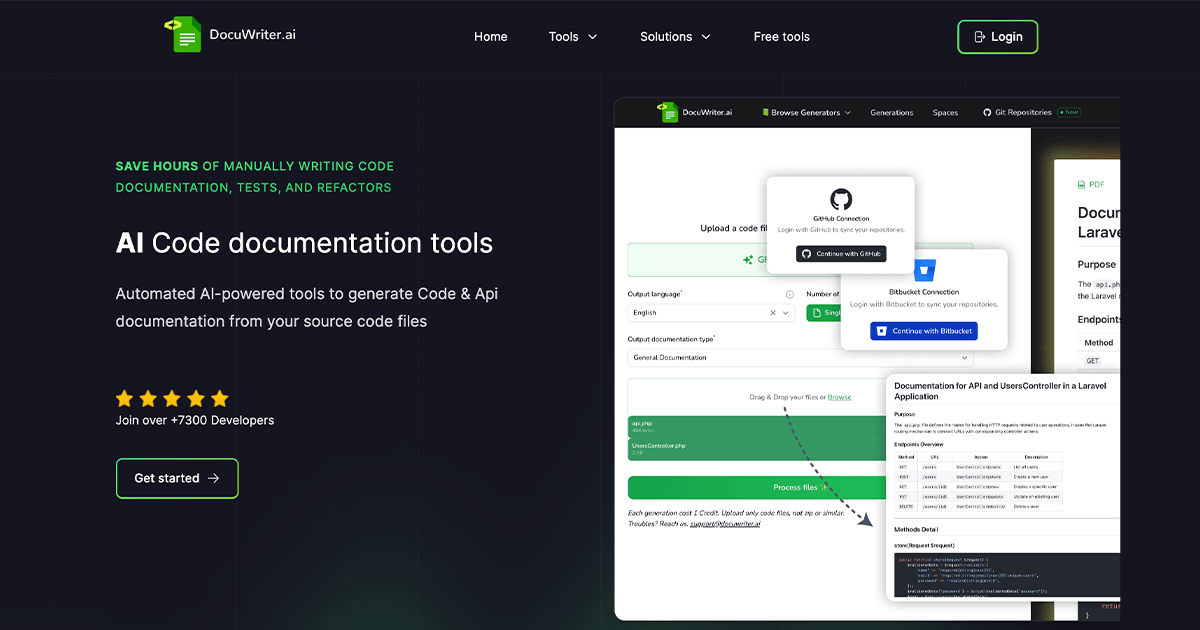
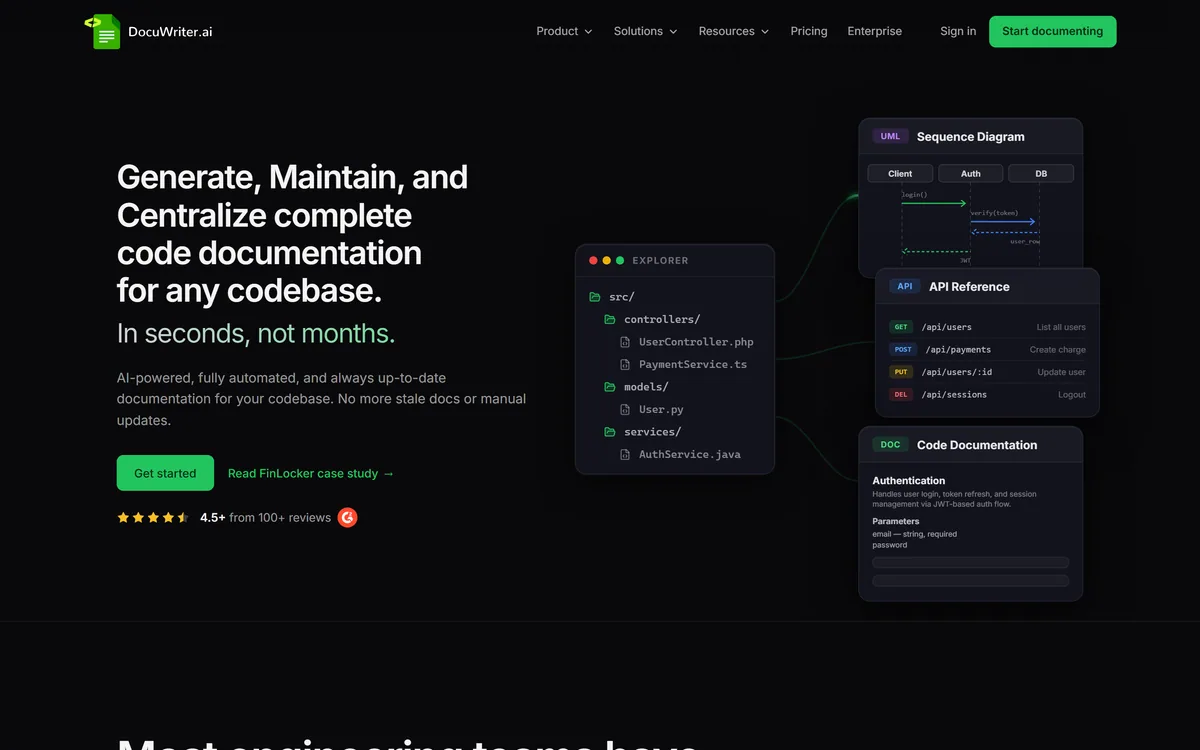
DocuWriter.ai connects to your repositories, analyses code with AST parsing and a code-aware retrieval pipeline, and generates a hierarchical documentation tree with UML, API references and module docs, then keeps it current by proposing reviewable updates when the code changes.
docuwriter.ai7 viewsAdded November 7, 20251K visitors
Most engineering teams either have no documentation or documentation nobody trusts because it fell out of date years ago. DocuWriter.ai is built to attack both problems by generating docs directly from the source and keeping them current as the code evolves.
You connect a repository, it analyses the code and produces a documentation tree with module docs, UML and sequence diagrams and API references, and an autopilot opens reviewable update suggestions when code changes. It sits beside documentation platforms like Theneo, with a stronger focus on generating docs from whole codebases.
This review covers how DocuWriter.ai documents a repository, which codebases it helps most, how it prices documentation, and where its generated docs still need an engineer.
DocuWriter.ai generates documentation from source code and keeps it current.
DocuWriter.ai documents codebases automatically: connect a repository and get a full, hierarchical documentation tree.
It reads the code, not just prose: AST parsing and code-aware retrieval ground the docs in your actual source.
It keeps docs fresh: an autopilot proposes reviewable updates whenever the code changes.
Generated docs still need review: they explain what code does, not always why it was built that way.
Code Documentation Generated From The Source Itself
DocuWriter.ai's purpose is to produce complete, structured documentation for a codebase without a documentation team. Rather than asking engineers to write docs by hand, it reads the repository and generates a hierarchical tree that mirrors how the code is organised.
Its method is worth noting. The vendor says it analyses code with AST parsing and a code-aware retrieval pipeline rather than letting a language model freely rewrite prose, which is designed to keep the output grounded in what the source actually contains.
The second half of the pitch is freshness. Documentation rots because nobody updates it when code changes; DocuWriter.ai's autopilot watches the repository and proposes reviewable updates, so docs can stay aligned with the code instead of drifting.
The honest framing is that generated documentation is an excellent baseline but not the whole story. It can describe what a module does and how APIs are shaped, but design rationale, trade-offs and business context still come from people, and generated text should be reviewed before teams rely on it.
Generated documentation is an excellent baseline, but design rationale and trade-offs still come from people.
How Does DocuWriter.ai Document A Repository?
The workflow runs from connecting a repository to publishing and maintaining the docs.
Repo Connection, AST Parsing And A Docs Tree
You connect GitHub, GitLab (including self-hosted), Bitbucket or Azure DevOps with OAuth or a personal access token, and DocuWriter.ai analyses the codebase to build a documentation tree grounded in the source, covering modules, functions and their relationships.
Access to source code is the first thing security teams will ask about, so review its data-handling and retention terms before connecting private repositories, as you would for any code-analysis service. Teams that also want AI help writing code in the same repositories often pair documentation with a governed assistant such as Tabnine.
UML, API References And Autopilot Updates
Beyond prose, it generates UML and sequence diagrams and API references, and its autopilot opens update suggestions when code changes. You can edit docs in its editor, publish to a private team space or a public site, and export to Markdown, Word, PDF, Confluence or Git.
For API-first documentation and developer portals, a platform like Theneo focuses on that experience, while a knowledge-base platform like Document360 suits broader product and help documentation.
Which Codebases DocuWriter.ai Helps Most
DocuWriter.ai helps most with inherited or undocumented codebases, such as code that arrived through an acquisition, a long-departed team or years of growth without docs, where generating a baseline is far faster than writing one by hand.
It suits teams fighting documentation rot, engineering leaders who need architecture and API documentation for audits or compliance reviews, and organisations handing a codebase to a partner, acquirer or new team.
It also helps onboarding: new engineers can explore a generated documentation tree and ask questions of the codebase instead of interrupting colleagues, which the vendor supports with team spaces and AI Q&A.
It helps less with small, well-documented projects, and it cannot supply the 'why' behind decisions. Teams should treat generated docs as a living baseline that engineers correct and enrich, and keep a review step on autopilot updates.
How DocuWriter.ai Prices Documentation
DocuWriter.ai offers paid plans with options for teams and enterprises; the homepage directs to a pricing page and a start-documenting flow. We do not publish prices, which change; check the site.
The value question is engineering time: documenting a large codebase by hand can take weeks or months, so even partial automation can be worthwhile if the output is accurate enough to trust after review.
The sensible approach is to document one real repository first, have engineers who know that code check the output for accuracy, and judge whether the time saved outweighs the review effort before rolling it out widely.
It is also worth checking how pricing scales with repository size, number of users and update frequency, since documentation tools are often priced by seats, repositories or usage rather than a flat fee.
Documenting One Real Repository First
Because accuracy is everything in documentation, pilot DocuWriter.ai on code your team already understands well.
Review DocuWriter.ai's security and data terms before connecting private code.
Connect one repository your team knows well.
Generate the documentation tree, diagrams and API reference.
Ask engineers who own that code to check accuracy and gaps.
Make a code change and review the autopilot's update suggestion.
Pass/fail: DocuWriter.ai is worth it if reviewed docs are accurate and save real time.
Treat ratings and case studies as vendor-presented.
Key features of DocuWriter.ai
Repository connections
AST-based code analysis
Hierarchical docs tree
UML and sequence diagrams
API reference generation
Autopilot doc updates
Docs editor and publishing
Multi-format export
Pros & cons
Pros
5
Fast baseline docs for whole codebases
Grounded in actual source code
Keeps docs current as code changes
Useful for audits and handoffs
Many export options
Cons
5
Needs engineer review for accuracy
Cannot capture design rationale
Requires sharing source code
Less value for small projects
Ratings are vendor-stated
Best For
Undocumented codebases
Documentation rot
Compliance documentation
Engineering onboarding
Codebase handoffs
DocuWriter.ai Compared With Hand-Written Docs
The useful comparison is with the other ways teams produce documentation.
When DocuWriter.ai's Generated Docs Need An Engineer
Small, already well-documented projects
Teams expecting docs to explain design rationale
Orgs unable to share source with a third party
Anyone skipping review of generated docs
Those reading ratings as proof of accuracy
What DocuWriter.ai's Site Describes
Last checked . Read from docuwriter.ai during this check, with the screenshot above captured at the same time.
An AI tool that generates code documentation
Repository connections for GitHub, GitLab, Bitbucket and Azure DevOps
AST parsing and code-aware retrieval described
A hierarchical documentation tree
UML and sequence diagrams and API references
An autopilot proposing reviewable updates on code changes
Publishing to team spaces or public sites, and exports to several formats
Use cases including audits, onboarding and handoffs
A vendor-stated 4.5+ rating from 100+ reviews
No prices reproduced here, in line with this site's pricing policy
Generated documentation should be reviewed by engineers who know the code; it explains what code does more reliably than why. Review data-handling terms before connecting private repositories.
Documentation Tools To Weigh Beside DocuWriter.ai
An API documentation platform, a knowledge base and an enterprise coding assistant to weigh alongside DocuWriter.ai.
DocuWriter.ai earns 4.0 as a strong answer to a near-universal engineering problem: missing or stale documentation. It connects to your repositories, analyses code with AST parsing and code-aware retrieval, and generates a documentation tree with diagrams and API references, then keeps it fresh with reviewable autopilot updates. It shines on inherited codebases, audits and onboarding. Generated docs still need engineers to check accuracy and add the 'why', and connecting private code needs a security review first. AInexfinder Editor Score: 4.0/5.
DocuWriter.ai pricing
AInexfinder does not list plan prices or billing details. For current pricing, plans, and trials, visit the official DocuWriter.ai website.
Vendor pricing, credits, and billing policies change over time. Always confirm on the official site before you buy.
Frequently asked questions
What is DocuWriter.ai?
DocuWriter.ai is an AI tool that generates and maintains documentation for software codebases. It connects to your repositories, analyses the code and produces a documentation tree with module docs, UML and sequence diagrams and API references.
Which repositories does DocuWriter.ai support?
It connects to GitHub, GitLab including self-hosted instances, Bitbucket and Azure DevOps, using OAuth or a personal access token.
How does DocuWriter.ai keep docs up to date?
Its autopilot watches your repository and opens reviewable update suggestions whenever the code changes, so documentation can stay aligned rather than drifting out of date.
Is DocuWriter.ai's documentation accurate?
It is designed to be grounded in the source through AST parsing and code-aware retrieval, but generated docs should still be checked by engineers who know the code, especially before audits or handoffs.
Can DocuWriter.ai explain why code was written a certain way?
Not reliably. It can describe what code does and how it is structured, but design rationale, trade-offs and business context still need to come from the people who made those decisions.
Is it safe to connect private code?
Connecting private repositories means sharing source with a third-party service, so review DocuWriter.ai's security, retention and data-handling terms with your security team first.
What formats can DocuWriter.ai export?
It exports to Markdown, Word, PDF, Confluence and Git, and can publish to private team spaces or a public documentation site.
How much does DocuWriter.ai cost?
It offers paid plans for teams and enterprises. We do not publish prices, which change; check the site and pilot it on one repository first.
Who is DocuWriter.ai best for?
Teams with inherited or undocumented codebases, organisations whose docs have rotted, and engineering leaders preparing documentation for audits, onboarding or handoffs.
How is DocuWriter.ai different from an API docs platform?
API docs platforms focus on presenting and maintaining API references for developers. DocuWriter.ai generates documentation across an entire codebase, including modules and architecture, from the source itself.
Daniel reviews AI tools the slow way — by actually using them on real projects. His reviews cover what works, what breaks, and who each tool is genuinely a good fit for.
Daniel and the AInexfinder editorial team research DocuWriter.ai using public product information, listing evidence, and (when available) hands-on checks. Scores reflect listing completeness and transparency — not paid placement.
Listings may include affiliate or sponsored placements, which are labeled when present. Editorial scores and cons are not sold. See our affiliate disclosure and review methodology.
Dosu captures knowledge automatically from coding agent sessions, keeps documentation updated when source code changes, and connects GitHub, Confluence, Notion and Slack into one source of context. It states 50% fewer tokens burned, 2x faster agent performance and 200k+ engineers using it.
Theneo is an AI-powered API documentation and developer-portal platform where engineers, writers, PMs and AI agents co-edit API references, guides and changelogs in real time, with generation from any spec, MCP and llms.txt for agents, and private per-customer portals.
GitBook is a documentation platform that syncs with your repository for docs-as-code workflows, proactively flags content that no longer matches your product, answers user questions through an AI assistant, and connects to Claude, ChatGPT and Cursor through MCP so agents can read your docs directly.
Stainless generates idiomatic client libraries in seven languages, documentation that tracks the API, and MCP servers, all derived from an OpenAPI specification. Its homepage announces that the company is joining Anthropic.
GitHub Copilot is an AI coding assistant that spans completion, chat, agent mode, automated code review, and a cloud agent that opens pull requests, working across VS Code, Visual Studio, JetBrains, Xcode, Neovim, Eclipse, the CLI, and github.com.