Logome review on AInexfinder — freemium AI tool for Image & Design. Features, pricing notes, and alternatives.
FreemiumImage & Design
Logomakerr.ai generates logos from a few inputs and pairs them with a Brand Kit of 200+ branded templates for business cards, presentations, flyers and social posts, plus optional designer assistance for refining a mark.
A logo is the first thing a new business is told it needs and the last thing it should spend money on before it has customers.
That tension is why logo generators exist, and it is a genuine gap rather than an invented one. The alternative for most founders is not a designer; it is a wordmark typed in a default font, or nothing at all.
Logomakerr.ai sits in that space, and the more interesting half of the product is not the logo. It is the Brand Kit, because a mark on its own does very little until it appears consistently on the things people actually see.
The honest answer is yes for some businesses and no for others, and the line is about what the mark has to do.
A logo has two jobs: identify you, and be distinguishable from everyone else in your category. Generated logos are reliably good at the first and structurally weak at the second, because they are assembled from the same libraries of symbols, typefaces and layout conventions everyone else is drawing on.
For a local service business, a side project, or a company whose customers arrive by recommendation, that is usually fine. Nobody chooses a plumber on the sophistication of the logotype, and a clean, professional mark beats an amateurish one comfortably.
It becomes a real problem when the mark has to carry differentiation — a consumer product on a shelf, a brand competing on identity, anything where the logo is doing marketing work rather than identification work. There, looking like the category is the failure.
The other consideration is longevity. A generated mark is cheap enough to replace, which is a genuine advantage early on. Rebranding gets expensive once the mark is on packaging, signage and a thousand documents, so the right question is not whether it is perfect but whether you can afford to change it later.
The same trade-off runs through the whole category. Looka and Brandmark draw on comparable libraries, so the choice between them is about what comes with the mark rather than about distinctiveness.
A logo has two jobs: identify you, and look unlike everyone else. Generators are reliably good at the first and structurally weak at the second.
The site lists customisation across fonts, colours, symbols and layouts, but does not state which file formats you receive — and that is the single most practical thing to establish before paying.
The distinction is between raster and vector. A raster file, such as a PNG, is a fixed grid of pixels and degrades when enlarged. A vector file, such as an SVG or EPS, is a set of mathematical curves that stays sharp at any size.
This is not a preference. A vector file is what a sign-maker, a printer, an embroiderer or a vehicle-wrap shop will ask for, and if you cannot supply one, the answer is either a poor result or paying someone to redraw the mark from a picture of it.
The second question is whether you receive an editable source file at all, because at some point you will need a version in one colour, a version that works on a dark background, and a version cropped to a square for an app icon.
Ask both questions before purchase rather than after. A cheap logo you cannot supply to a printer is not cheap, and this is the most common way people are disappointed by generated marks.
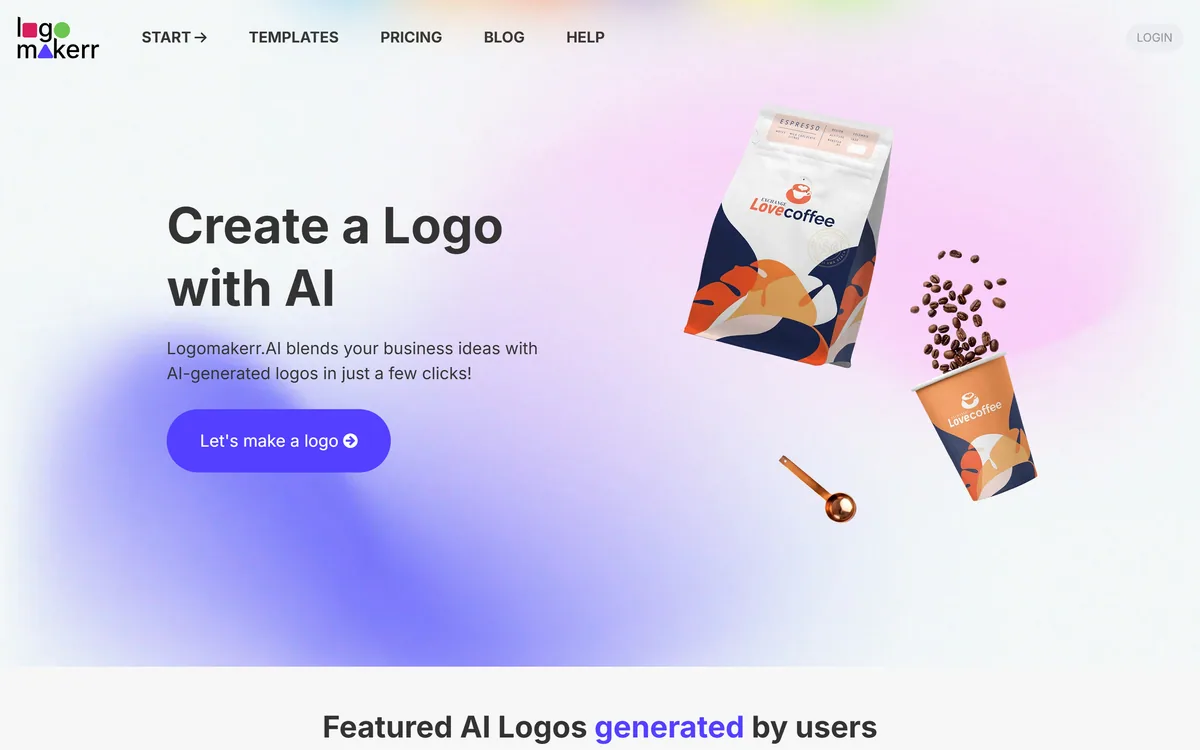
Logomakerr.ai's Brand Kit provides more than 200 branded templates covering business cards, PowerPoint presentations, flyers and social media posts.
This is the better half of the product, and the reason is that consistency does more work than the mark itself. A brand people recognise is one where the colours, type and layout look the same across everything — and that consistency is what small businesses reliably fail at.
The failure is not laziness. It is that applying a logo to a business card, a deck and an Instagram post correctly requires design decisions at each step, and someone without training makes those decisions differently each time.
Pre-built templates carrying the same palette and typography remove the decisions. The output is not what a designer would produce, and it is dramatically better than four documents that each look like a different company.
The presentation templates are the most valuable of the set for most businesses, simply because a deck is the artefact that reaches customers, investors and partners most often — and an inconsistent one undermines confidence in a way a business card never does.
If the deck itself is where your effort goes rather than the identity, a visual tool such as Napkin AI is solving the adjacent and often larger problem.
The site does not state licence or ownership terms for generated logos, and this is worth understanding as a category question rather than an accusation about this vendor.
There are three distinct issues, and they get conflated constantly. The first is what the platform grants you — commercial use, exclusivity, the right to modify — which is a contract question answered by the terms of service.
The second is whether anyone else can be given the same mark. Generators assembling from shared symbol libraries can produce very similar results for different customers, and a mark that is not exclusive is a weak foundation for a brand.
The third is trademark, which is entirely separate and applies regardless of who made the logo. Owning a design does not mean you may use it commercially in your category if it conflicts with an existing registered mark, and no generator checks that for you.
The practical sequence is short. Read the Refund Policy and Terms of Use pages, which the footer does provide. Do a reverse image search on your chosen mark. And if the business matters, get a trademark search done by someone qualified before the mark goes on anything permanent.
For an e-commerce brand the logo is rarely the asset that sells anything — product imagery from something like Pebblely does far more of that work, and carries its own licensing questions worth reading.
The mistake is generating a hundred options and picking the prettiest in isolation.
A logo is judged in use — tiny, in one colour, on a background you did not choose — and almost never at the size the generator shows it to you.
| Product type | AI logo generator with a brand kit |
|---|---|
| Generation | Logos created from a few inputs, then customisable |
| Customisation | Thousands of fonts, colours, symbols and layouts |
| Brand Kit | 200+ branded templates |
| Template types | Business cards, PowerPoint presentations, flyers, social media posts |
| Human help | Designer assistance offered for refining a logo |
| Footer — Product | Logo Maker, Logo Idea, How It Works, Pricing |
| Footer — Company | Affiliate, Terms of Use, Privacy Policy, Refund Policy |
| Footer — Support | Blog, FAQ, Contact Us, Site map |
Logo generation from a small number of inputs
Customisation across thousands of fonts, colours, symbols and layouts
Brand Kit containing more than 200 branded templates
Business card, presentation, flyer and social post templates
Optional designer assistance for refining a generated mark
A published Refund Policy alongside Terms of Use and Privacy Policy
FAQ, Blog and Contact pages for support
Logo tools differ mainly in what comes with the mark and how much of a brand system you get.
| Tool | What you get | Beyond the logo | Best for |
|---|---|---|---|
| Logomakerr.ai | Generated logo, customisable | 200+ brand templates, optional designer help | A founder who needs a mark and materials this week |
| Looka | Generated logo with brand identity tooling | Brand kit and marketing assets | The same job with a longer-established product |
| Brandmark | Generated logo with colour and type systems | Brand style guidance | Design-conscious founders |
| Tailor Brands | Logo alongside business formation services | Web, formation and marketing bundling | Starting a company, not just a brand |
| Napkin AI | Visuals and slides, not identity | Diagram and presentation generation | The documents the logo ends up on |
A mark is one part of an identity, and different tools cover different parts of it.
Last checked . Read from logomakerr.ai and its footer navigation, with the screenshot above captured in the same session.
What we could not confirm: which file formats are delivered, and specifically whether a vector file is included; whether editable source files are provided; licence and ownership terms for generated logos, including whether any exclusivity is offered; pricing; the operating company's legal name and location, with the site carrying a 2023 copyright reference; how designer assistance is scoped and delivered; and whether any check is made against existing trademarks. We did not generate a logo, so nothing here reflects tested output quality.
Logomakerr.ai is honest about what it is: a fast route to a serviceable mark for someone who was never going to commission one. The Brand Kit is the smarter half of the product, because a logo alone is not a brand and the templates are what turn a mark into something you can actually apply. It scores in the middle for two reasons that apply to the whole category rather than to this vendor. Generated logos draw on the same visual conventions everyone else's do, so distinctiveness is the thing you give up; and the site does not state output formats or ownership terms, which are the two facts that decide whether a mark is usable long-term. AInexfinder Editor Score: 3.4/5.
AInexfinder does not list plan prices or billing details. For current pricing, plans, and trials, visit the official Logomakerr.ai website.
Visit official website for pricingVendor pricing, credits, and billing policies change over time. Always confirm on the official site before you buy.
Log in to write a review.
No reviews yet. Be the first to share your experience with Logomakerr.ai.
Assigned reviewer
Daniel ReedSenior AI Tools Reviewer
Daniel reviews AI tools the slow way — by actually using them on real projects. His reviews cover what works, what breaks, and who each tool is genuinely a good fit for.
Daniel and the AInexfinder editorial team research Logomakerr.ai using public product information, listing evidence, and (when available) hands-on checks. Scores reflect listing completeness and transparency — not paid placement.
Logome review on AInexfinder — freemium AI tool for Image & Design. Features, pricing notes, and alternatives.

Pet Pic Portraits turns a pet photo into styled artwork — Royal King, Pop Art, Watercolour, Viking, Wizard and more — with an instant preview before ordering. Output is a digital download, a canvas print or framed wall art, and it includes a pet memorial option.

krea2.org is a browser image-generation workspace that runs several third-party models side by side, including Krea 2 tiers, FLUX.2, GPT Image 2, Nano Banana and Seedream 5.0, with reference uploads, six aspect ratios and live model switching.

Canva AI is the Magic Studio suite built into Canva — Magic Write for copy, Dream Lab for images, Magic Edit, Expand and Eraser for photos, Magic Switch for reformatting, Magic Charts for data, and Canva Code for interactive widgets.
Pixlr is a browser-based photo editor from Pixlr Pte Ltd with two editors and a generative AI layer — Generative Fill, Expand and Transform, background and object removal, Super Scale upscaling, face swap, plus image, video, and audio generation.
GenApe is an all-in-one AI platform covering writing, chat, image and video generation, image editing, product photography, translation, and research — with 145 free credits on signup and commercial rights granted to paid users.