Ask a company where its contracts are and you will get a list: a shared drive, somebody's email, a filing cabinet, the finance folder, and a system two people were trained on in 2022.
The consequence is not disorganisation so much as risk. Nobody knows which agreements auto-renew next month, what was actually agreed with the vendor who is now in dispute, or whether a clause you are relying on exists.
ContractSafe's argument is that this is fundamentally a findability problem rather than a workflow problem, and that solving findability is worth more than any amount of process sophistication.
ContractSafe: Find Any Contract Fast
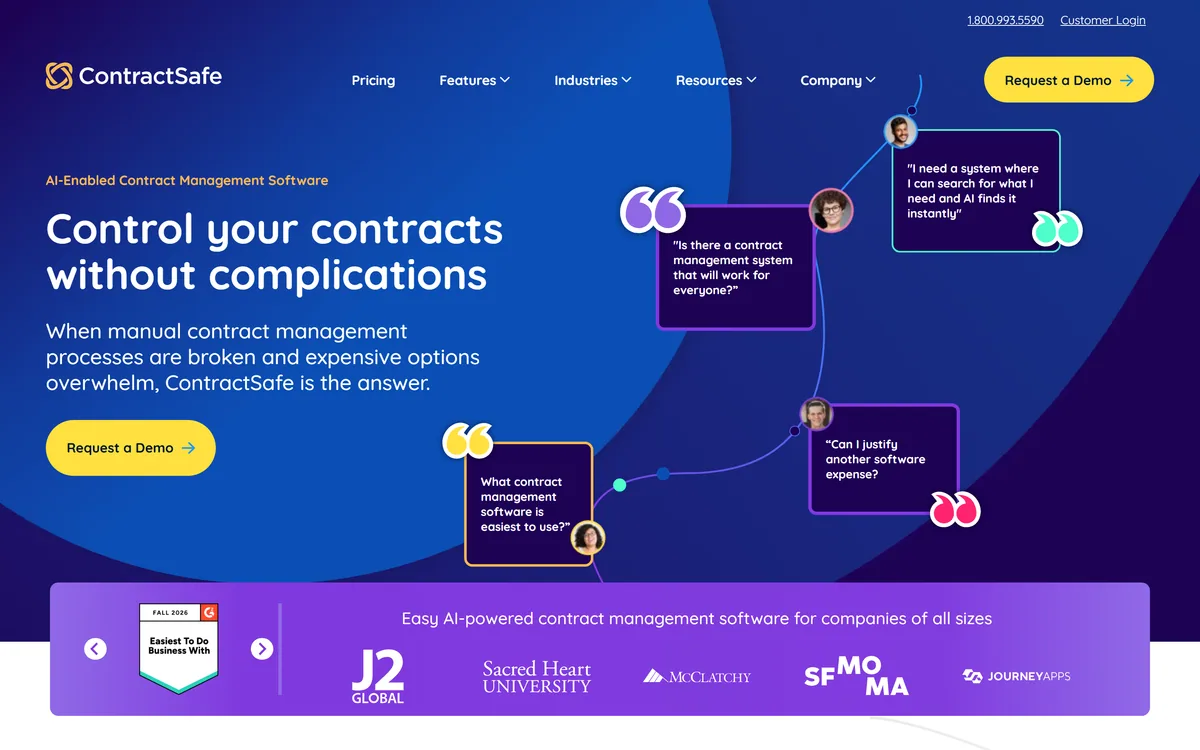
- Search is the core — the stated promise is a system where you search for what you need and AI finds it instantly.
- Unlimited users on every plan, with pricing based on how many contracts you store rather than how many people use it.
- Automated renewal alerts, which is the feature that pays for the software on its own.
- Create-to-sign in one flow: intake forms, templates, approvals and e-signature.
- ContractSafe LLC, at a published Malibu, California address, with a phone number on the page.
ContractSafe: Features And Operator
| Operating company | ContractSafe LLC |
|---|
| Address | 23823 Malibu Road, Suite 50-197, Malibu, CA 90265 |
|---|
| Product type | AI-enabled contract management |
|---|
| Positioning | Control your contracts without complications |
|---|
| Pricing basis | Number of active contracts, not seats |
|---|
| Users | Unlimited on every plan, per the site |
|---|
| Plan names | Organize, Finalize and Maximize |
|---|
| Core capabilities | Search, AI data extraction, automated alerts, lifecycle tracking |
|---|
| Create-to-sign | Intake forms, templates, approvals and e-signature in one flow |
|---|
| Editing | Microsoft Word or in-app, with version history |
|---|
| Integrations | CRM and other tools, set up by the vendor's team |
|---|
| Copyright | © 2026 ContractSafe LLC |
|---|
Why Do Contract Systems Fail To Get Used?
ContractSafe opens with questions in a customer's voice — needing a system where you can search and AI finds it instantly, wanting something that works for everyone, and asking whether another software expense can be justified.
That framing identifies the real failure mode accurately. Contract management projects rarely fail because the software could not do something; they fail because most of the organisation never used it.
Two things cause that. The system is complex enough to need training, so only a few people learn it. And it is priced per seat, so licences get rationed to those few people by a finance decision that makes perfect sense in isolation.
The result is that the system holds a partial truth. Legal's contracts are in it, sales agreements are in a folder, the office lease is in an email, and the system is now actively misleading because people believe it is complete.
Unlimited users addresses the second cause directly, and simplicity addresses the first. Neither is a technical achievement, and together they are the difference between a system of record and an expensive archive.
A contract system holding only some of the contracts is worse than no system, because people believe it is complete.
Search Is The Feature That Matters
The site leads with search and AI-powered data extraction, and that ordering is correct even though search is the least impressive-sounding capability in the category.
The reason is that nearly every real contract question is a retrieval question. What did we agree about liability, when does this expire, which agreements have this clause, what did the last version say.
Answering those from a filing system requires knowing where to look, which requires already knowing what you are looking for. Full-text search across every agreement, with the key terms extracted, changes that from a research task into a question.
Extraction is what makes search useful rather than merely possible. Knowing a document mentions a renewal date is not the same as knowing the date, and the difference is whether an alert can fire.
This is a different problem from clause review — assessing whether terms are acceptable, which is what tools like Ivo and LegalOn do at the negotiation stage. Storage answers what did we sign; review answers should we sign this.
Alerts And The Renewal You Forgot
ContractSafe describes automated alerts that keep you calm and confident about critical dates, with renewal notifications called out specifically.
This is the feature that justifies the purchase on its own, and it is worth being blunt about why: auto-renewing contracts nobody noticed are one of the most reliable sources of wasted spend in any organisation.
The mechanism is always the same. Someone signs a two-year agreement with a ninety-day notice period, that person leaves, the renewal window passes unremarked, and the company is committed for another two years to something it no longer uses.
The reason it keeps happening is not carelessness. It is that the obligation to act lives inside a document nobody re-reads, and human memory is a poor scheduler across two-year horizons.
An alert moves that obligation out of the document and into a calendar. It is unglamorous automation and it routinely pays for the software many times over — the same logic that makes obligation tracking valuable in adjacent finance systems such as Puzzle.
- Get every contract in, even badly, before worrying about workflow.
- Set renewal alerts with your notice period in mind, not the expiry date.
- Give everyone access — rationed licences are how these systems die.
- Test search against a question you actually had last quarter.
- Check whether extracted dates are accurate before trusting an alert.
What ContractSafe Deliberately Leaves Out
The positioning is explicit — easy and affordable contract management without a bell or whistle in sight — and taking that seriously means understanding what is absent.
Deep clause-level analytics are the first gap. Comparing thousands of agreements to find every non-standard indemnity is an enterprise CLM capability, and tools built for that scale of analysis such as Luminance exist for a reason.
Complex negotiation workflow is the second. Multi-party redlining with position tracking and playbook enforcement is a different product with a different price and a much longer implementation.
Obligation management is the third. Knowing a contract exists and knowing whether you are complying with its service levels are separate problems, and the second requires connecting to operational systems.
The judgement to make is honest rather than technical: does your organisation have those problems today, or does it have a findability problem that it has been solving with a much more expensive tool? Most companies are in the second category and have been sold the first.
Getting Contracts Into A System That Sticks
Contract system rollouts fail at the migration stage more often than at the software stage, usually because the perfect became the enemy of the loaded.
This sequence prioritises completeness over tidiness, because an incomplete system is the one failure you cannot recover from.
- Load everything you can find, even unlabelled and untagged, before organising anything.
- Ask each department for what they hold — the gaps are always outside legal.
- Verify extracted dates on your twenty highest-value agreements by hand.
- Set alerts using notice periods rather than expiry dates, so there is time to act.
- Give access to everyone who signs or manages anything, without exception.
- Only then introduce templates and approvals, once the archive is trusted.