
Conversational AI characters and NPCs for games Category: Emerging & Specialized.
Emerging & Specialized Review

FPVTune analyses Betaflight blackbox logs with a neural network and returns PID and filter settings as one-click CLI commands. It also offers free crash analysis, motor health checks and a flight time calculator, and charges only when you accept the tuning result.

Very good
FPVTune scores highly because it is honest about a genuinely hard problem and prices itself accordingly. Blackbox tuning is real engineering — gyro noise spectral analysis, filter shaping, thermal headroom — and the free crash analyser and motor health check give away enough for the tool to prove itself before asking for money. The pay-when-satisfied model on the paid tune is the strongest possible statement of confidence in a category full of guesswork. It is held back only by what any log-based tool cannot see: a bent motor bell, a loose arm bolt, or the flying style you are about to change. AInexfinder Editor Score: 4.2/5.
Best for: Pilots running copied tunes on hardware they were not built for; Diagnosing a crash from the log rather than guessing
The visit link goes to fpvtune.com, the official site. Paid placements on AInexfinder are always labelled. How we make money
Tuning a quadcopter well is the difference between a machine that tracks your inputs and one that fights them, and almost nobody does it properly.
The reason is not laziness. It is that doing it properly means reading blackbox logs — inspecting gyro noise in the frequency domain, judging step response, deciding which filters are earning their latency — and that is a genuinely technical skill most pilots never acquire.
So people copy tunes from forums, which is how a setting tuned for someone else's frame, motors and props ends up on hardware it was never meant for. FPVTune's proposition is that the log already contains the answer, and the analysis is a job a neural network can do.
FPVTune's core service analyses Betaflight blackbox logs, and understanding what is in one explains why this is a real analysis problem rather than a lookup.
A blackbox log is high-rate telemetry from the flight controller: gyro readings before and after filtering, motor outputs, RC commands, setpoint versus achieved rate, and voltage. It is a recording of exactly what the aircraft did and what it was asked to do, several thousand times a second.
The tuning signal lives in the relationship between those channels. Oscillation shows up as periodic error between setpoint and gyro. Noise shows up in the frequency spectrum of the unfiltered gyro trace, and its frequency tells you the source — motor RPM harmonics sit in one range, frame resonance in another, propeller wash somewhere else.
That last point is why FPVTune's gyro noise spectral analysis matters more than a PID number. Filters cost latency, and latency costs responsiveness, so the goal is never maximum filtering — it is the minimum that keeps the noise out of the motors. Knowing which frequencies actually need attenuating is what separates a good filter setup from a laggy one.
This is exactly the shape of problem machine learning suits: a large, structured signal with patterns that experienced humans learn to recognise but struggle to articulate as rules. The claim is plausible on its face, which is more than most AI tooling manages.
The pattern is familiar from other domains where a model reads machine output rather than prose. Gateways like Helicone do the same for application telemetry: the data was always there, and the work is entirely in reading it.
The goal is never maximum filtering. It is the minimum filtering that keeps noise out of the motors, because every filter you add costs you latency.
FPVTune gives away three tools — a crash analyser, a motor health check and a flight time calculator — while charging for the tune. That split is well chosen.
The crash analyser answers the question every pilot has immediately after a crash and usually cannot resolve: did something fail, or did I fly into something. A log frequently settles it. A motor that desynced, a battery that sagged, or an ESC that cut out all leave a signature, and so does the flat-line of an aircraft that was flying perfectly until it stopped.
The motor health check is the more valuable of the two in the long run. Motor thermal prediction and health analysis surface a failing bearing or a bent shaft before it takes an aircraft down, and the symptom in a log — one motor working measurably harder than its peers to hold the same attitude — is invisible from the bench.
Giving these away is good business as well as good practice. They prove the analysis works on your own data before any money is discussed, which is a far stronger argument than a testimonial.
The flight time calculator is the lightest of the three and still useful, since estimating endurance from battery capacity and current draw is arithmetic most pilots do badly or not at all.
A log-based tune is bounded by what a log records, and the gap between that and reality is where the failures live.
The biggest blind spot is mechanical. A log shows noise; it does not show that the noise comes from a props-nut that was not torqued, a bent motor bell, a cracked arm or a soft mount that has hardened with age. A tuner will filter that noise away and the aircraft will fly acceptably with a mechanical fault it is now masking.
The rule follows directly: fix the mechanics first, then tune. Filtering is not a substitute for balanced props and tight bolts, and a tune built on top of a mechanical problem becomes wrong the moment you fix it.
The second blind spot is the pilot. A log records how you flew during that flight, and a tune optimised for gentle cruising will not suit the same aircraft flown hard through a gap. Fly the log the way you intend to fly the aircraft.
The third is conditions. Temperature affects motors and batteries; wind loads the aircraft differently. A tune from a still, cold morning is not automatically the tune for a hot, gusty afternoon, though the difference is usually smaller than the previous two.
Automated analysis has this blind spot everywhere. A code scanner such as Codacy cannot see the requirement the code was meant to satisfy, and a log analyser cannot see the airframe.
The single most common way to waste a tuning session is to submit a log that does not contain the information the analysis needs.
Blackbox logging is off by default on many builds and has to be enabled with sufficient rate, and a hover in your garden tells the analysis very little about how the aircraft behaves under load.
FPVTune states support across Betaflight 4.5 and later, DShot150, DShot300 and DShot600 including bidirectional DShot, gyros including the MPU6000, ICM20689, ICM42688 and BMI270, and frame sizes from 2-3 inch through 10 inch and above.
That range covers effectively the whole current hobby, from tiny whoops to long-range cinelifters, and the gyro list spans several generations of flight controller hardware rather than only the newest.
Bidirectional DShot support is the detail worth noticing. It provides motor RPM telemetry back to the flight controller, which is what makes RPM filtering possible — the most effective noise-reduction technique available, because it filters exactly the frequencies the motors are producing at that instant rather than a fixed band.
A tool that understands bidirectional DShot can therefore reason about dynamic filter tuning properly, which is listed among its capabilities. On an aircraft without it, the analysis has less to work with and static filtering has to do more.
Practically, if you are running current hardware on Betaflight 4.5 or later with bidirectional DShot enabled, you are in the configuration this tool is built around.
Signal analysis follows the same shape wherever it appears — services like Deepgram extract structure from raw audio, and what comes out depends first on what went into the recording.
| Product type | Blackbox log analysis and PID tuning service |
|---|---|
| Paid service | AI PID tuning from uploaded logs |
| Free tools | Crash analyser, motor health check, flight time calculator |
| Analysis | Gyro noise spectral analysis, dynamic filter tuning, motor thermal prediction |
| Output | One-click CLI command export |
| Firmware | Betaflight 4.5 and later |
| ESC protocols | DShot150, DShot300, DShot600, including bidirectional DShot |
| Gyros | MPU6000, ICM20689, ICM42688, BMI270 |
| Frame sizes | 2-3 inch through 10 inch and above |
| Log formats | Betaflight .BBL and .BFL |
| Commercial model | Pay only when you are satisfied with the analysis results |
| Footer links | Privacy, Terms, Refund, Contact, WhatsApp, GitHub, Twitter |
Neural-network analysis of Betaflight blackbox logs for PID recommendations
Gyro noise spectral analysis identifying noise sources by frequency
Dynamic filter tuning rather than blanket filtering
Motor thermal prediction and health analysis
Free crash analyser that reads failure signatures from the log
Free flight time calculator for endurance estimation
One-click CLI command export for direct paste into the configurator
Support spanning current Betaflight hardware from whoops to 10-inch frames
Tools that read machine-generated telemetry share a shape: the data holds the answer, and the work is extracting it.
| Tool | Data it reads | Output | Best for |
|---|---|---|---|
| FPVTune | Betaflight blackbox flight logs | CLI-ready PID and filter settings | Pilots who want a real tune without learning log analysis |
| Helicone | LLM request telemetry | Cost, latency and failure visibility | The same idea applied to AI applications |
| Deepgram | Audio streams | Transcription and audio intelligence | A different signal, the same model-on-raw-data pattern |
| Codacy | Source code | Quality and security findings | Automated analysis of something humans read slowly |
| FPVTune free tools | The same logs | Crash cause and motor health | Diagnosing a failure before spending on a tune |
Last checked . Read from fpvtune.com, including its tools and footer pages, with the screenshot above captured in the same session.
What we could not confirm: the operating company, its location or the people behind it; what the tuning actually costs, since the site states a pay-when-satisfied model without our establishing the amount; how the neural network was trained or on what volume of logs; whether uploaded logs are retained, and for how long; any independent before-and-after benchmark of tune quality; and how the satisfaction judgement is administered in practice. We did not submit a log, so nothing here reflects tested tuning output.
AInexfinder does not list plan prices or billing details. For current pricing, plans, and trials, visit the official FPVTune website.
Visit official website for pricingVendor pricing, credits, and billing policies change over time. Always confirm on the official site before you buy.
FPVTune earns an AInexfinder Editor Score of 4.2/5 (very good). Best for: Pilots running copied tunes on hardware they were not built for; Diagnosing a crash from the log rather than guessing; Catching a failing motor before it takes an aircraft down.
Visit FPVTuneLog in to write a review.
No reviews yet. Be the first to share your experience with FPVTune.
Assigned reviewer
Daniel ReedSenior AI Tools Reviewer
Daniel leads AInexfinder's tool reviews. He researches each tool from its own pricing, documentation and policies, checks its claims against independent sources, and writes up what it does well, where it falls short and who it genuinely suits.
Daniel and the AInexfinder editorial team research FPVTune from its own website, pricing, documentation and policies, checked against independent sources. This review is research-based: unless its method note says otherwise, we have not bought a plan or run hands-on tests. The Editor Score is our editorial judgement, and payment never changes it.
Similar Tools
Conversational AI characters and NPCs for games Category: Emerging & Specialized.
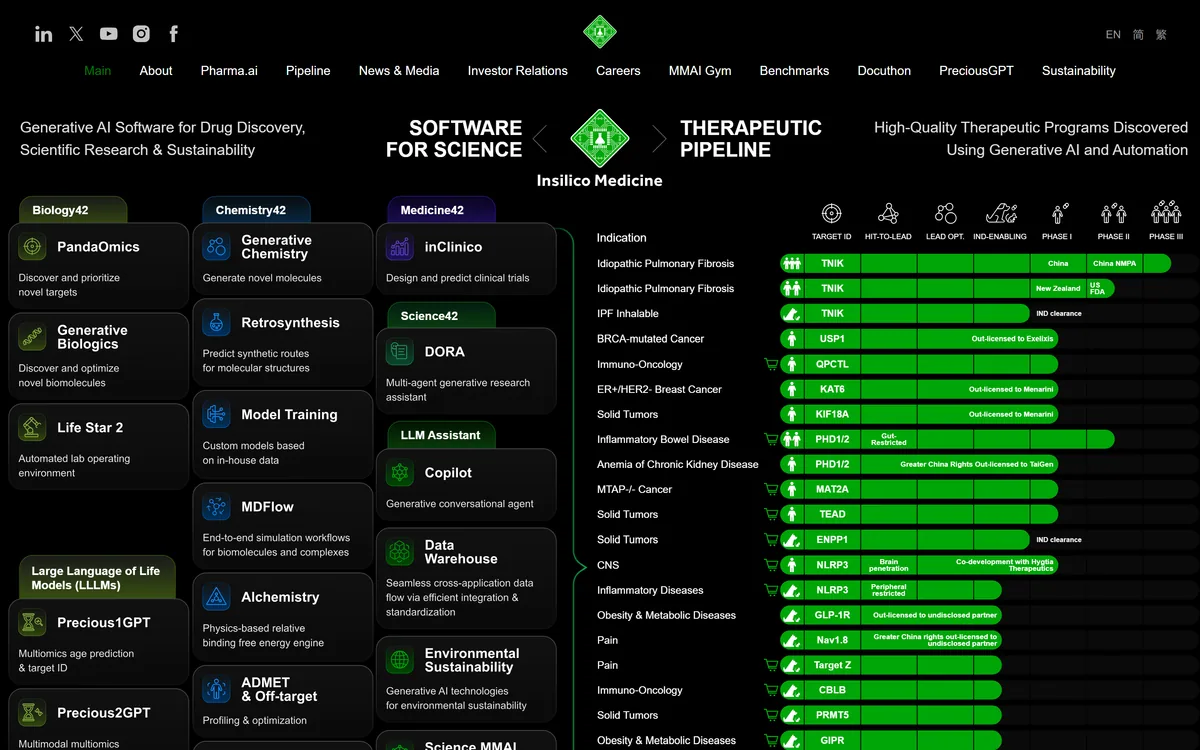
Insilico Medicine pairs the Pharma.ai software suite — PandaOmics, Chemistry42, inClinico and more — with its own clinical pipeline. Its lead candidate rentosertib, a TNIK inhibitor for idiopathic pulmonary fibrosis, has Phase IIa results published in Nature Medicine.

AI-powered stock scanning and trade idea generation platform Category: Emerging & Specialized.

AI digital accountant for bookkeeping and month-end close Category: Emerging & Specialized.


Harvey is an AI platform for legal and professional services — agents, a Vault for documents, Knowledge, Spaces, and Contract Intelligence — used by firms including A&O Shearman, Latham & Watkins, and Norton Rose Fulbright.

Automated crypto trading bots with AI strategy tools Category: Emerging & Specialized.
Related Pages