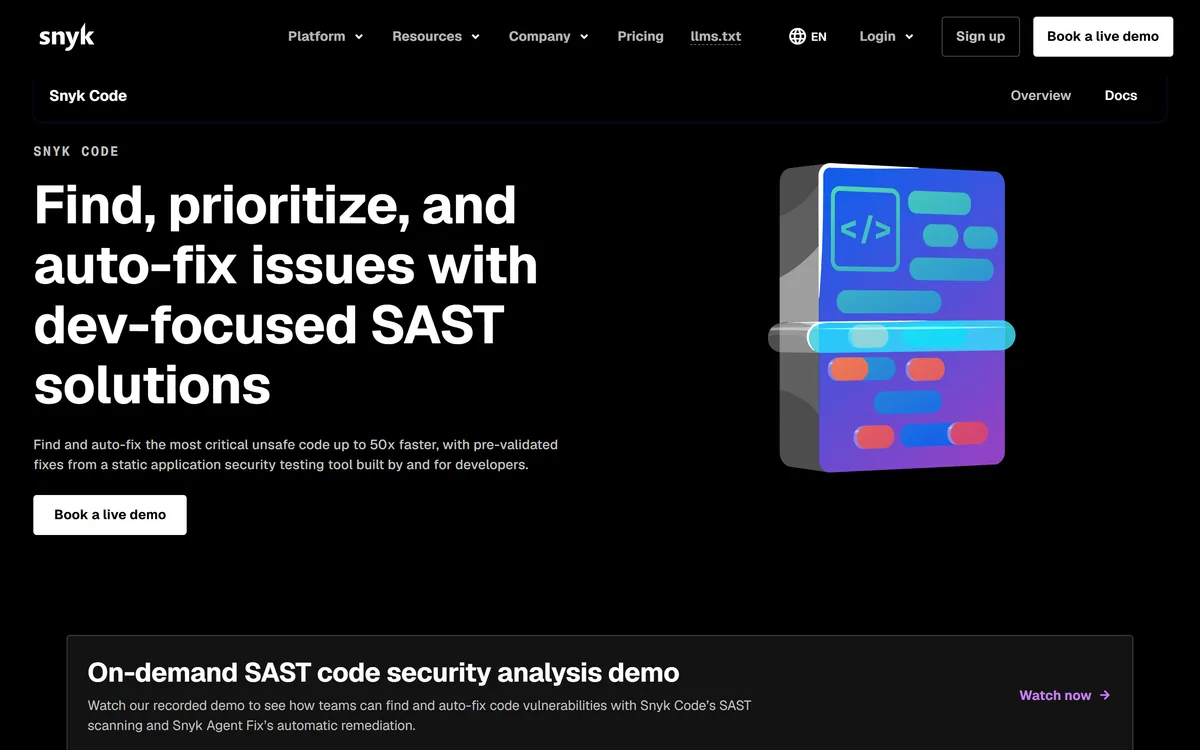
Snyk Code is a static application security testing tool built for developers, using DeepCode AI to find vulnerabilities in the IDE in real time and Snyk Agent Fix to propose pre-validated fixes, including coverage for AI-generated code.
Coding & Development Review
Greptile is an AI code reviewer that builds a graph index of your repo and runs a swarm of agents to review each pull request with full codebase context, learning your standards, enforcing custom rules and even running the branch in a sandbox (TREX) to catch runtime bugs. It suits engineering teams that want deeper, context-aware PR review, with the caveats that it reviews your source code and that AI review complements, not replaces, human review.

Very good
Greptile earns 4.0 as a strong, transparent AI code reviewer that does what diff-only tools can't: it builds a graph index of your whole codebase and runs a swarm of agents to review each pull request in full context, learns your standards from past PR comments, enforces plain-English custom rules, and with TREX even runs the branch in a sandbox to catch runtime bugs. For teams where reviewer context is the bottleneck, that's a genuinely more useful review. Two caveats matter: it reads your source code, though to its credit it offers a self-hosted and air-gapped option with SOC 2, SSO and audit logs you should confirm; and AI review complements rather than replaces human review, so a person should still own what merges. Its 'merge 4x faster' claim is a vendor figure to measure. For engineering teams that confirm the data path and keep humans on merges it's a capable choice. AInexfinder Editor Score: 4.0/5.
Best for: Context-aware PR review; Large-codebase review
The visit link goes to greptile.com, the official site. Paid placements on AInexfinder are always labelled. How we make money
Code review is where bugs get caught and where reviewers run out of time, especially on large pull requests in unfamiliar parts of a codebase. Greptile's pitch is an AI reviewer that understands the whole repo, not just the diff.
It builds a graph index of your codebase, runs a swarm of agents to review each PR, learns your standards, enforces custom rules and can run the branch in a sandbox to catch runtime bugs. It sits among code tools like Ellipsis, at the review end.
This review covers how Greptile reviews a PR, which engineering teams it suits, how it's priced, and the code-privacy and still-needs-humans caveats to weigh first.
| What it is | An AI code reviewer for pull requests |
|---|---|
| Company | Tabnam, Inc. (venture-backed; raised a Series B) |
| Core | Reviews and tests PRs with full codebase context |
| How | Graph index of the repo; a 'swarm of agents' per PR |
| Learns | Coding standards from PR comments; custom rules in plain English |
| TREX | Runs the PR branch in a sandbox to catch runtime bugs |
| Access | Free tier + per-seat + credits + enterprise (self-managed) |
| Sensitive | Code privacy — reviews source; self-hosted/air-gapped option |
Greptile's core idea is context. Rather than review a pull request as an isolated diff, it builds a graph index of your whole codebase and runs a 'swarm of agents' that reason about the change in the context of everything around it, so it can flag issues that only make sense when you know how the rest of the code behaves.
It learns: it picks up your team's coding standards from past PR comments, and you can write custom rules in plain English. Its TREX feature goes beyond static reasoning by running the PR branch in a sandbox to catch runtime bugs, not just ones visible in the code. It integrates widely, fix-in-IDE handoffs to Claude Code, Cursor, Codex and Devin, a Greptile MCP, a Claude Code plugin, and support for GitHub, GitLab, Bitbucket and enterprise self-managed (including Perforce), across a long list of languages.
It's aimed at engineering teams (the site cites 22,000+) including regulated sectors like defense, healthcare and financial services.
The honest framing is that Greptile is a strong, transparent code reviewer, and full-codebase context plus sandboxed runtime testing is a genuinely more useful review than diff-only tools. Its title claim, 'merge 4x faster, catch 3x more bugs', is a vendor claim to judge on your own repos. Two caveats matter. First, it reviews your source code; to its credit it offers a self-hosted and air-gapped option (use your own LLM providers), SOC 2, SSO and audit logs, and serves regulated sectors, but you should confirm the data path for your security needs. Second, AI review complements human review, it's excellent at catching what tired reviewers miss, but it shouldn't be the only gate, and a human should still own what merges.
Greptile reviews pull requests with full-codebase context and even runs the branch to catch runtime bugs; it reads your source (confirm the data path) and complements, rather than replaces, human review.
Greptile pairs context-aware PR review with learned standards and sandboxed testing.
It builds a graph index of the repo and runs an agent swarm to review each PR beyond the diff.
A security agent like Corgea focuses on finding and fixing vulnerabilities; Greptile's angle is general, context-aware code review, a broader review job.
TREX runs the branch in a sandbox to catch runtime bugs, and custom rules enforce your standards.
A scanner like Semgrep runs static rules; Greptile reasons across the whole codebase and runs the code, so match it to whether you want rules or contextual review, and keep a human on merges.
Greptile suits engineering teams that want deeper, context-aware PR review than diff-only tools provide, especially on large codebases where reviewer context is the bottleneck.
It suits teams that value learned standards and plain-English custom rules, and regulated organisations that need the self-hosted or air-gapped option and audit controls.
It suits less well solo developers on small projects who don't feel the review bottleneck, teams unwilling to let an AI reviewer read their source (even with self-hosting), and anyone expecting it to replace human review entirely.
A fair way to place it: if you're an engineering team that wants more thorough, context-aware reviews and can confirm the code-privacy path, Greptile is a strong choice, provided you keep a human owning merges and treat its speed/bug claims as things to measure on your repos; if you won't let a tool read your source or would drop human review, weigh it carefully. Start it on one repo, tune the custom rules and let it learn from your PR comments, and compare its findings against your reviewers before trusting it on critical paths.
Greptile is priced on a free tier plus a per-seat model with monthly review credits (reviews cost a number of credits by depth), additional credits available, and an enterprise tier, with free access for qualified open source and discounts for early-stage startups. We do not publish prices, which change; check the site and confirm the plan, credit model and enterprise terms.
The value question is reviewer time and caught bugs versus cost: for a team merging many PRs, faster, deeper review that catches issues earlier can easily justify the spend, while a small team may be served by the free tier.
The sensible approach is to run the free tier on a real repo, judge the review quality against your own reviewers, tune custom rules, confirm the code-privacy path and credit economics, and only scale seats once it's genuinely improving your reviews.
Because it reads your source and complements humans, trial Greptile on one repo first.
Codebase graph index
Agent-swarm review
Learned standards
Custom rules
TREX sandbox testing
IDE fix handoffs
MCP + plugin
Self-managed option
The useful comparison is with other AI code-review and scanning tools.
| Tool | Tool | Approach | Best for |
|---|---|---|---|
| Greptile | AI code reviewer | Context-aware PR review | Engineering teams |
| Ellipsis | Managed agent platform | Run agents on infra | Engineering orgs |
| Corgea | Security fix agent | Find + fix issues | AppSec |
| Semgrep | Static analysis | Rule-based scanning | Code scanning |
Last checked . Read from greptile.com during this check, with the screenshot above captured at the same time.
Greptile reviews your source code; to its credit it offers a self-hosted and air-gapped option (use your own LLM providers), SOC 2, SSO and audit logs, and serves regulated sectors — confirm the data path for your security needs. AI review complements human review and shouldn't be the only gate; a human should still own what merges. The 'merge 4x faster, catch 3x more bugs' title is a vendor claim to measure on your repos.
A managed agent platform, a security fix agent and a static analyser to weigh beside Greptile.
AInexfinder does not list plan prices or billing details. For current pricing, plans, and trials, visit the official Greptile website.
Visit official website for pricingVendor pricing, credits, and billing policies change over time. Always confirm on the official site before you buy.
Greptile earns an AInexfinder Editor Score of 4.0/5 (very good). Best for: Context-aware PR review; Large-codebase review; Enforcing coding standards.
Visit GreptileLog in to write a review.
No reviews yet. Be the first to share your experience with Greptile.
Assigned reviewer
Daniel ReedSenior AI Tools Reviewer
Daniel leads AInexfinder's tool reviews. He researches each tool from its own pricing, documentation and policies, checks its claims against independent sources, and writes up what it does well, where it falls short and who it genuinely suits.
Daniel and the AInexfinder editorial team research Greptile from its own website, pricing, documentation and policies, checked against independent sources. This review is research-based: unless its method note says otherwise, we have not bought a plan or run hands-on tests. The Editor Score is our editorial judgement, and payment never changes it.
Similar Tools
Snyk Code is a static application security testing tool built for developers, using DeepCode AI to find vulnerabilities in the IDE in real time and Snyk Agent Fix to propose pre-validated fixes, including coverage for AI-generated code.

Aikido Security is a developer-first all-in-one application security platform covering code, cloud and runtime, designed to cut false positives and autonomously find and fix vulnerabilities through to production. Made by Aikido Security in Belgium, it holds strong compliance and suits teams consolidating fragmented AppSec tools.

Sourcery is an AI code-review tool that reviews every pull request in minutes, catching bugs, edge cases and security issues with one-click fixes, plus codebase security scanning, with a strong stance on keeping your code private.
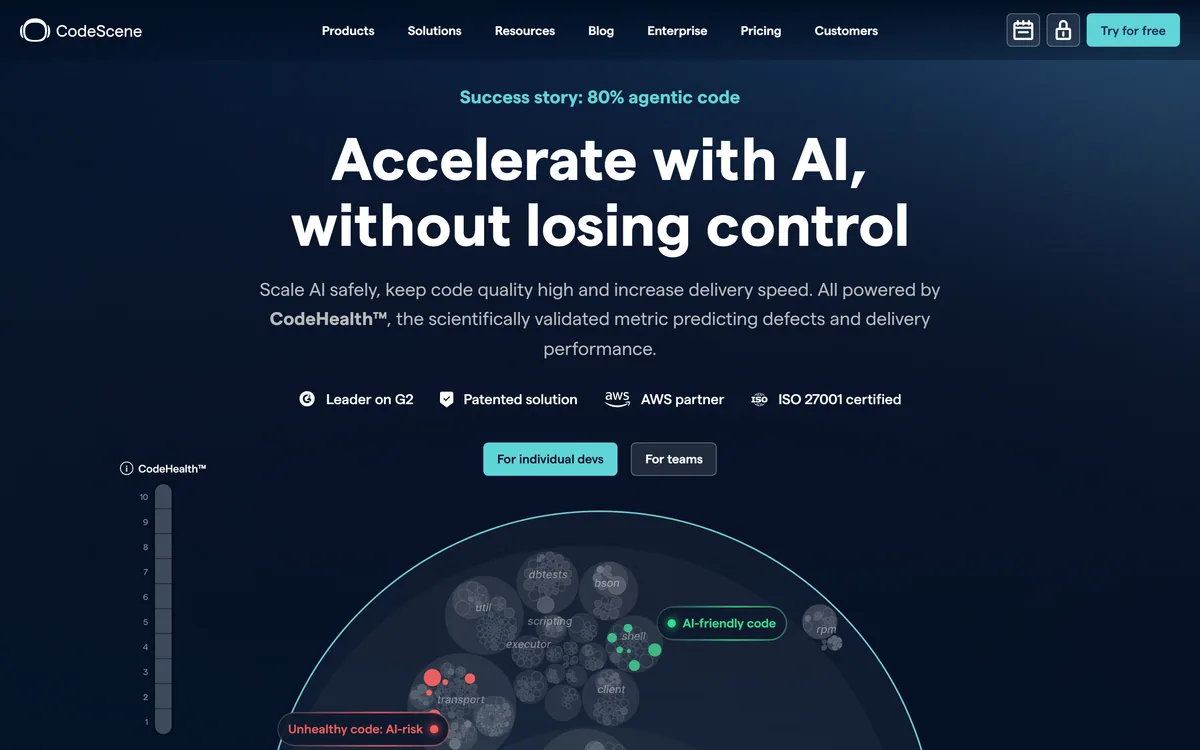
CodeScene measures code with CodeHealth, a validated metric predicting defects and delivery performance. It states the average enterprise codebase scores 5.15 out of 10 while AI needs 9.5 to work reliably, and offers an MCP server, automated reviews and IDE feedback. Operated by CodeScene AB.
cubic reviews pull requests in GitHub and your IDE, enforces rules written in plain English, and learns from senior engineers' PR comment history. It runs thousands of agents nightly to scan an entire codebase for bugs, pulls context from Linear, JIRA, Notion and Confluence, and is free for public repositories.
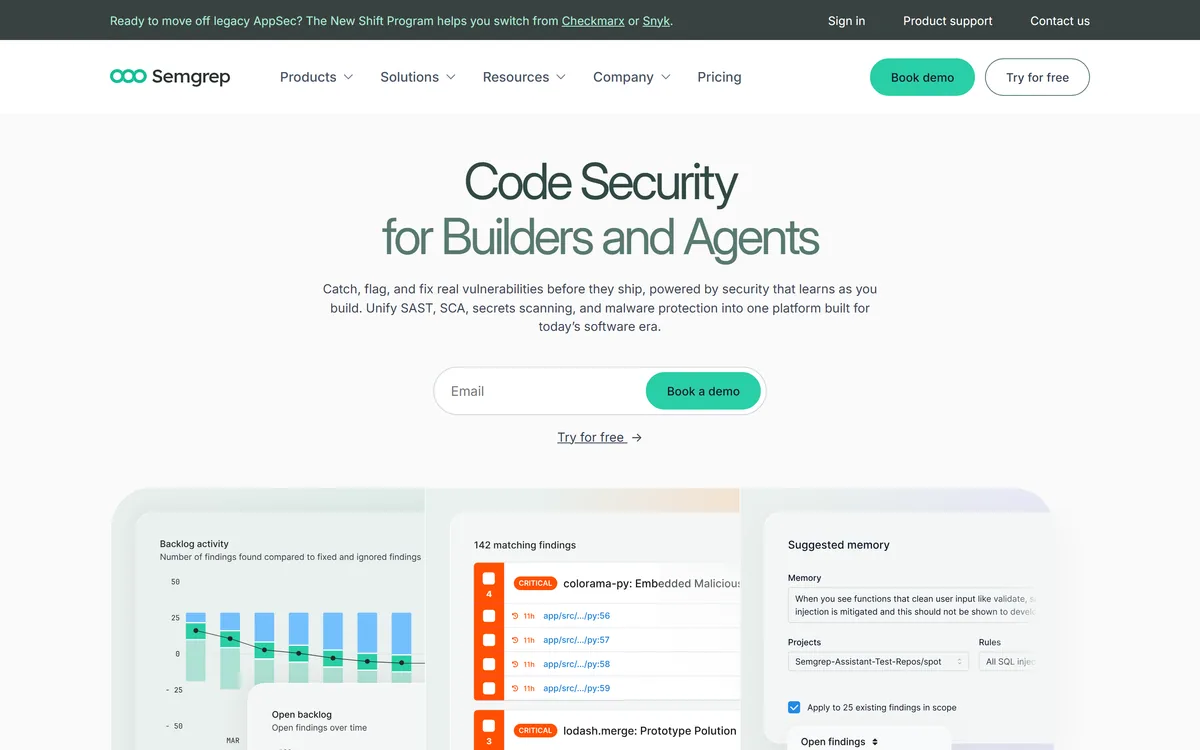
Semgrep is an AI-assisted application-security platform combining deterministic static analysis with AI reasoning to find and help fix vulnerabilities across SAST, SCA, secrets and supply-chain, with noise filtering and reachability prioritization. It has an open-source CLI core and suits developers and AppSec teams; findings still need triage.
Related Pages