Automated code review and quality analysis with AI. Every tool here has its own review, so you can check what it does and how it is priced before you choose a code review tool.
Qodo is an AI code review and governance platform that reasons across repositories rather than a single diff, mines enforceable rules from a team's own pull request history, and offers zero data retention, SOC 2 Type II certification and on-premises or single-tenant deployment.
Codacy combines static analysis, SAST, SCA, secret scanning, IaC checks and test coverage in one platform, and has repositioned around AI-assisted engineering — detecting AI policy violations and unapproved model calls, with Codacy Guardrails embedding checks inside agentic workflows.
Korbit AI is an automated code-review tool that reviews pull requests inside GitHub, GitLab and Bitbucket, flagging bugs, security and design issues with fix explanations, writing PR descriptions and summaries, and generating team insights, without training on your code.
Greptile is an AI code reviewer that builds a graph index of your repo and runs a swarm of agents to review each pull request with full codebase context, learning your standards, enforcing custom rules and even running the branch in a sandbox (TREX) to catch runtime bugs. It suits engineering teams that want deeper, context-aware PR review, with the caveats that it reviews your source code and that AI review complements, not replaces, human review.
Corgea is an AI-native application-security (AppSec) platform that detects vulnerabilities, including business-logic flaws traditional scanners miss, maps reachable risk, and proposes review-ready auto-fixes, with SCA, IaC, secrets scanning and SCM/IDE integrations. It suits dev and security teams, provided AI fixes and findings are human-reviewed before merge.
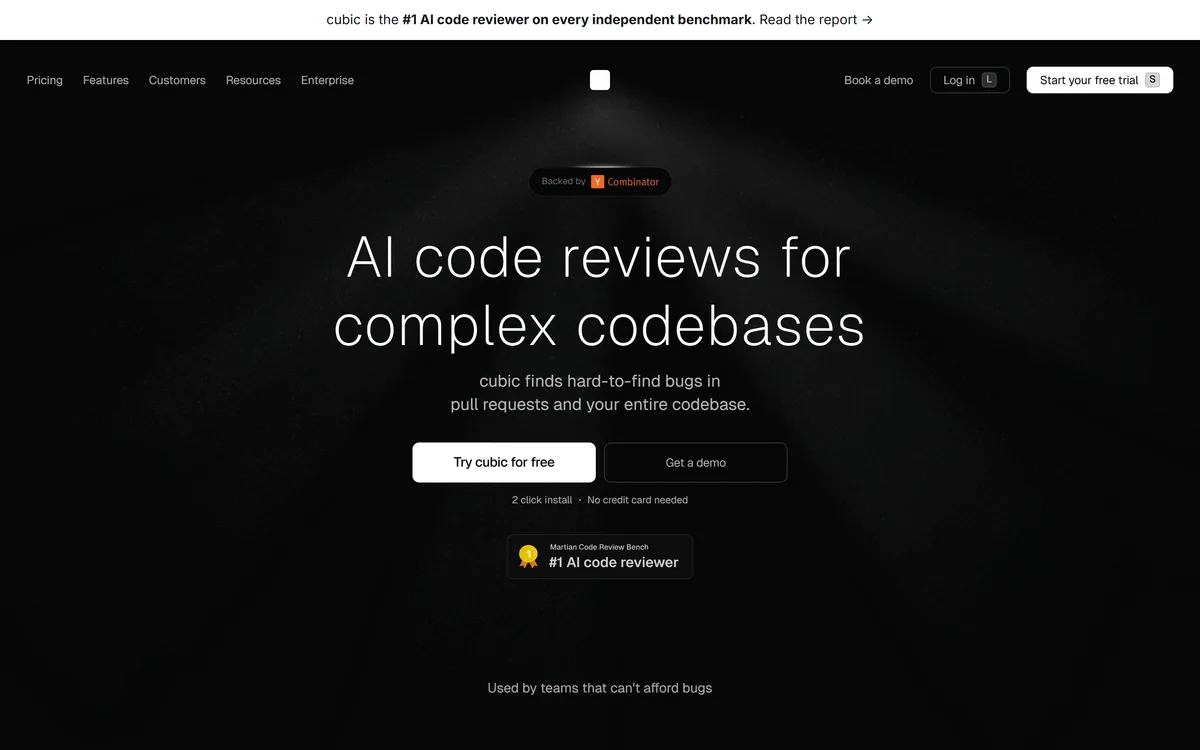
cubic reviews pull requests in GitHub and your IDE, enforces rules written in plain English, and learns from senior engineers' PR comment history. It runs thousands of agents nightly to scan an entire codebase for bugs, pulls context from Linear, JIRA, Notion and Confluence, and is free for public repositories.
Ellipsis is a managed platform for running coding, code-review and background AI agents on managed infrastructure, letting you choose the harness, model and tools while it handles VMs, permissions, budgets and logs. It suits engineering teams that want to run agents at scale with spend caps and audit trails, with the caveats that pricing isn't clearly public, source code is handled in sandboxes, and it is SOC 2 Type I with Type II in progress.
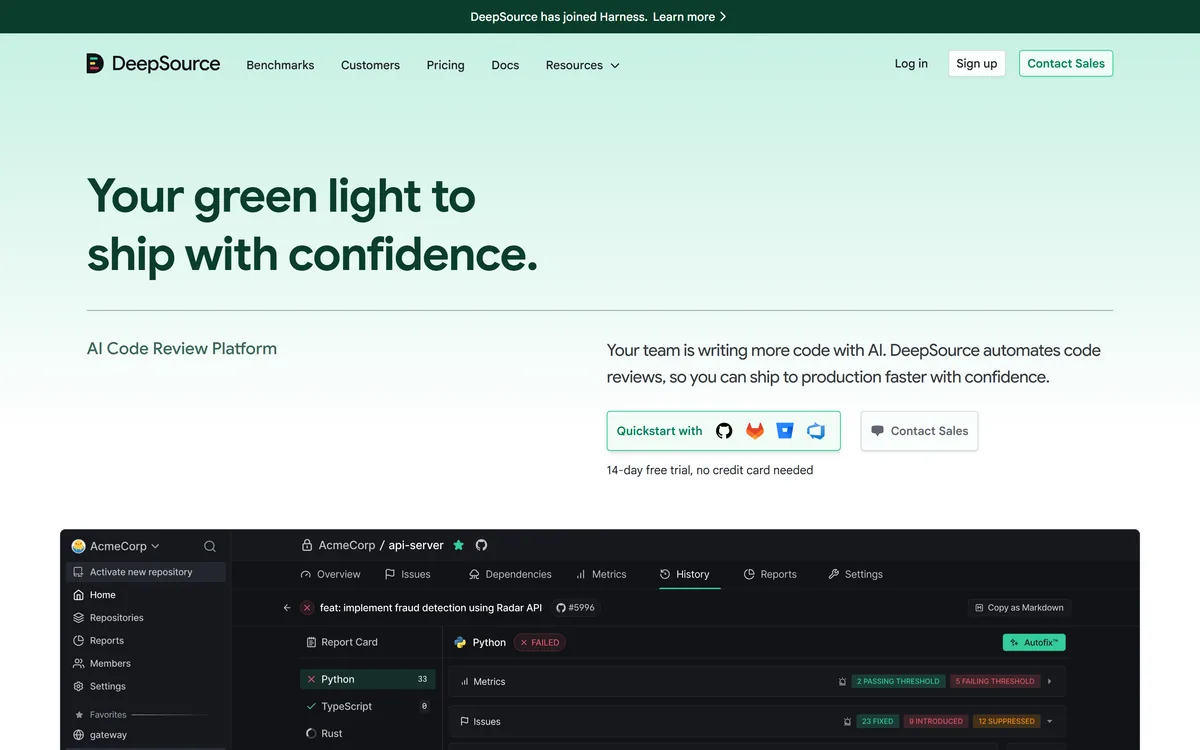
DeepSource is an AI code review platform combining over 5,000 deterministic static analysis rules with AI review agents, covering security, quality, complexity and coverage. It includes SAST, SCA, IaC security and Autofix, and the site states DeepSource has joined Harness.
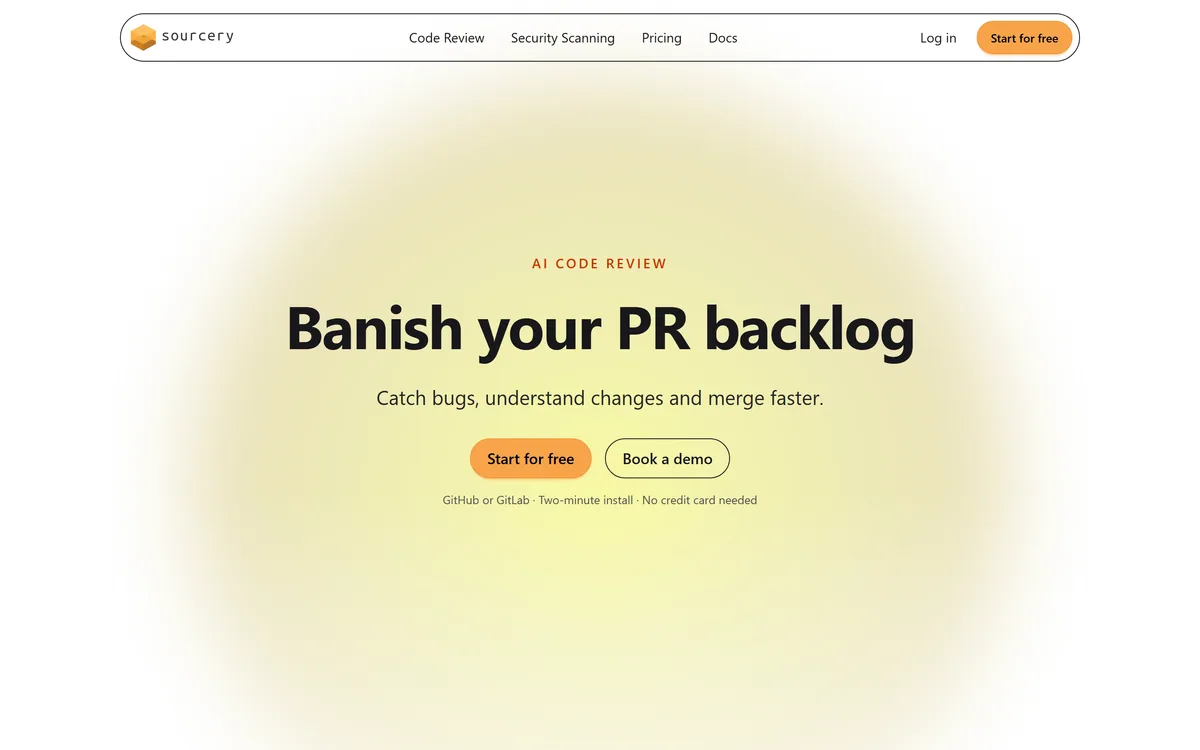
Sourcery is an AI code-review tool that reviews every pull request in minutes, catching bugs, edge cases and security issues with one-click fixes, plus codebase security scanning, with a strong stance on keeping your code private.
Aikido Security is a developer-first all-in-one application security platform covering code, cloud and runtime, designed to cut false positives and autonomously find and fix vulnerabilities through to production. Made by Aikido Security in Belgium, it holds strong compliance and suits teams consolidating fragmented AppSec tools.
Graphite is a code-review and collaboration platform built around stacked pull requests, a merge queue and AI review (its AI Reviews, plus a collaborative 'Graphite Chat'), integrating with GitHub to speed up how fast-moving engineering teams ship code. In December 2025 Cursor/Anysphere agreed to acquire Graphite; it is still sold standalone. It suits high-velocity dev teams, with workflow-change and AI-review caveats.
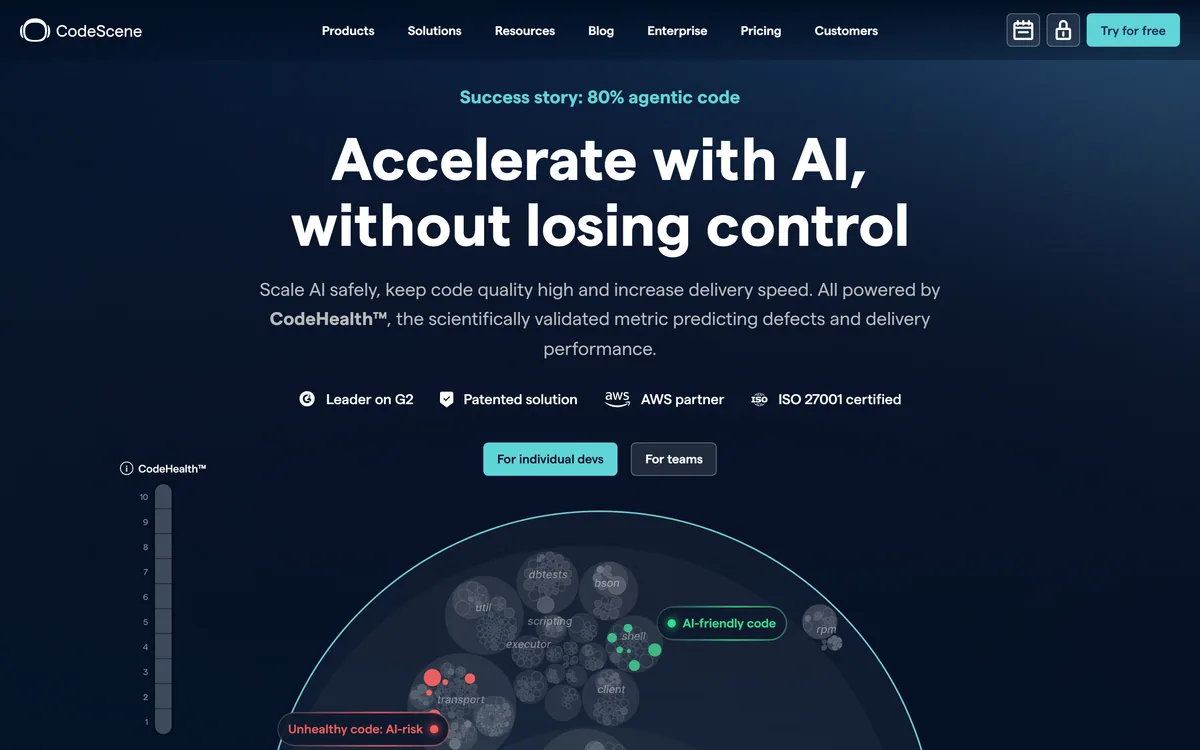
CodeScene measures code with CodeHealth, a validated metric predicting defects and delivery performance. It states the average enterprise codebase scores 5.15 out of 10 while AI needs 9.5 to work reliably, and offers an MCP server, automated reviews and IDE feedback. Operated by CodeScene AB.
Baz is an AI code review platform whose agents review plans, pull requests, security issues and merge readiness with context from your entire codebase, explaining their reasoning, suggesting fixes and learning from your team's feedback.
Snyk Code is a static application security testing tool built for developers, using DeepCode AI to find vulnerabilities in the IDE in real time and Snyk Agent Fix to propose pre-validated fixes, including coverage for AI-generated code.
Semgrep is an AI-assisted application-security platform combining deterministic static analysis with AI reasoning to find and help fix vulnerabilities across SAST, SCA, secrets and supply-chain, with noise filtering and reachability prioritization. It has an open-source CLI core and suits developers and AppSec teams; findings still need triage.
4.2/5Freemium
What Counts as a Code Review AI Tool?
Code Review AI tools are products whose core function applies AI to code review. A tool belongs here when that is the job it is built for, rather than a side feature.
Because this is a focused slice of coding & development, the tools below do broadly the same job — so compare them on what they actually produce and how they are priced. Each review shows the tool's pricing model and whether it has a free tier.
Code Review AI tools reviewed here include:
Qodo — Qodo is an AI code review and governance platform that reasons across repositories rather than a single diff, mines enforceable rules from a team's own pull request history, and offers zero data retention, SOC 2 Type II certification and on-premises or single-tenant deployment.
Codacy — Codacy combines static analysis, SAST, SCA, secret scanning, IaC checks and test coverage in one platform, and has repositioned around AI-assisted engineering — detecting AI policy violations and unapproved model calls, with Codacy Guardrails embedding checks inside agentic workflows.
Korbit AI — Korbit AI is an automated code-review tool that reviews pull requests inside GitHub, GitLab and Bitbucket, flagging bugs, security and design issues with fix explanations, writing PR descriptions and summaries, and generating team insights, without training on your code.
CodeAnt AI — CodeAnt AI review on AInexfinder — subscription AI tool for Coding & Development. Features, pricing notes, and alternatives.
CodeRabbit — CodeRabbit review on AInexfinder — freemium AI tool for Coding & Development. Features, pricing notes, and alternatives.
Code Review covers AI tools built for code review. Reviewed tools here include Qodo, Codacy, Korbit AI, each with its own review covering pricing, features and an Editor Score.
02Are There Free Code Review AI Tools?
Yes. Qodo, Codacy, Korbit AI, CodeRabbit all offer a free plan or free trial. Use the pricing filter above to see every code review tool with a free option.
03How Do I Choose the Right Code Review AI Tool?
Start with your main use case and budget, shortlist two or three tools above, and compare their reviews, pricing and free plans. Where a free plan or trial exists, run a real task of your own through it before committing.
04How Is Code Review Different From Other Coding & Development Tools?
Code Review tools focus specifically on automated code review and quality analysis with ai, so they usually go deeper on that job than a general coding & development tool.
Launching a New Code Review Tool?
Submit it for an editorial review and a page in front of people comparing code review tools before they buy.