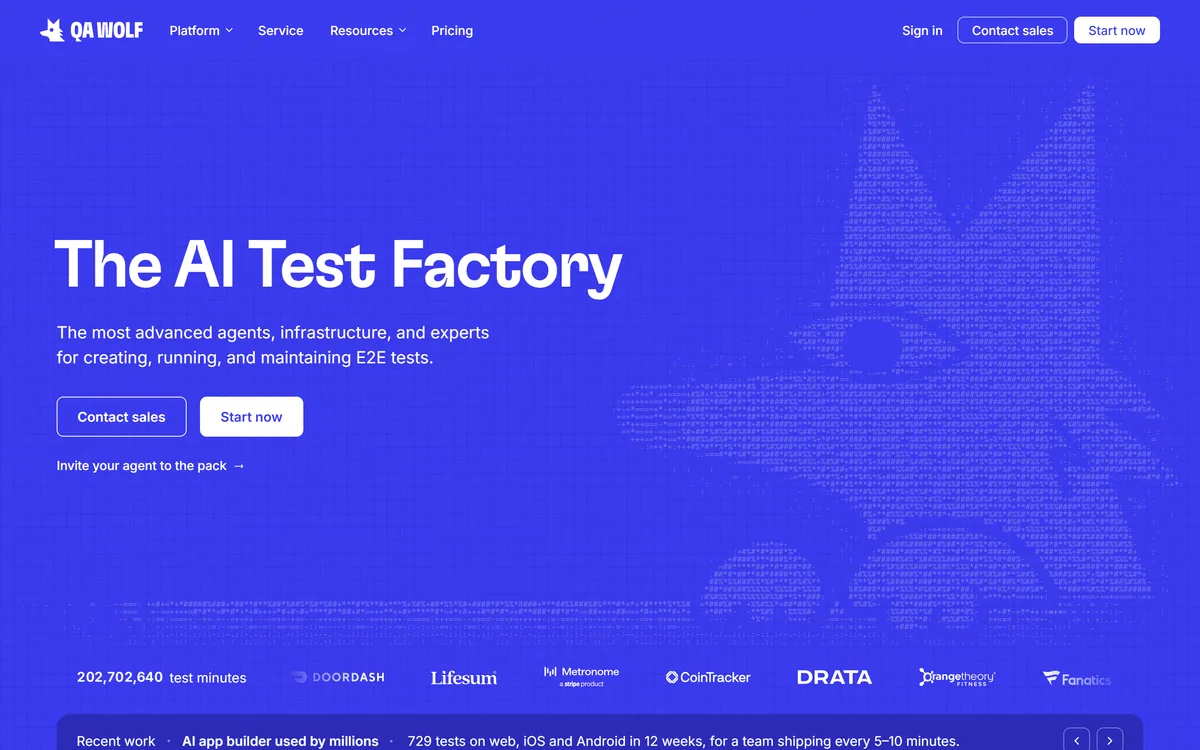
End-to-end tests are the ones teams most want and least maintain, they rot, they flake, and QA headcount is scarce. QA Wolf's pitch is to take the whole job off your plate: a managed service that builds, runs and maintains your E2E tests.
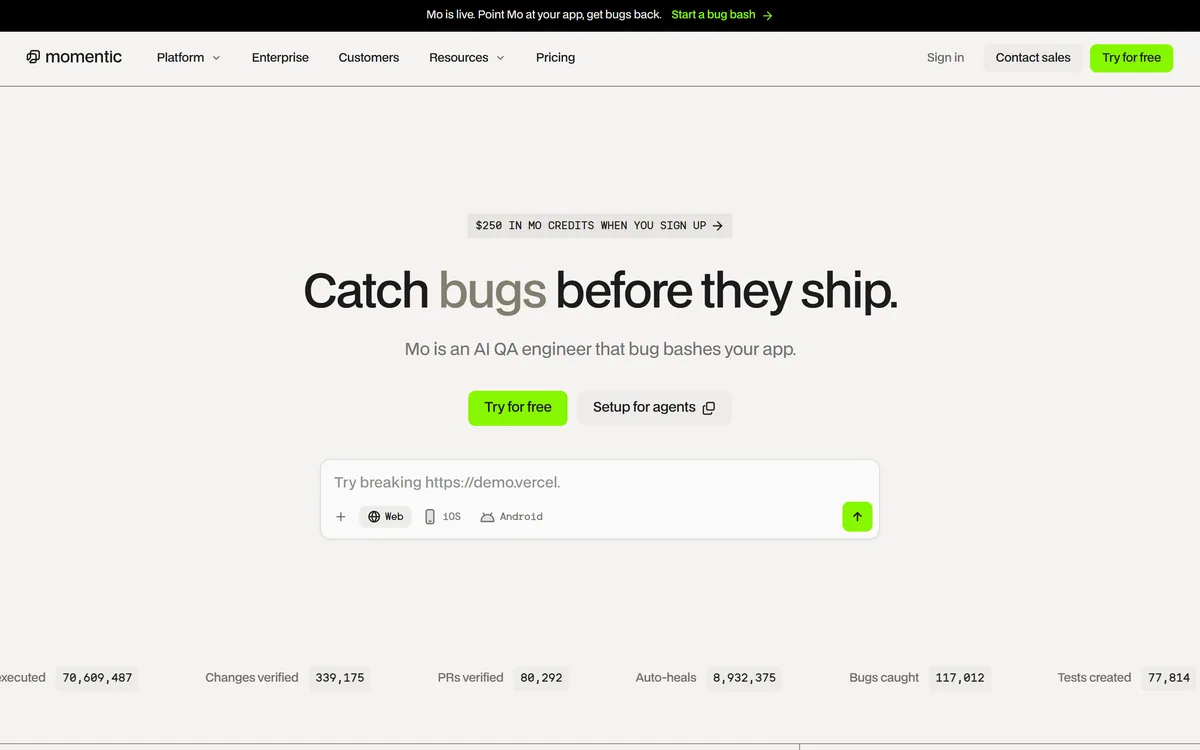
It combines AI agents that write tests with a human QA team that keeps them passing, running in parallel with flake triage. It's a different model from a DIY tool like Momentic, outsourced rather than in-house.
This review covers how QA Wolf builds and runs your tests, which teams it suits, how the service is packaged, and the trade-offs of handing testing to a managed partner.
QA Wolf, The Test-Coverage Brief
- QA Wolf is managed E2E testing: it builds, runs and maintains your end-to-end tests for you.
- AI plus humans: AI agents write tests and a human QA team keeps them green.
- It targets coverage: broad E2E coverage with parallel runs and flake triage.
- It's a service, not just a tool: you outsource test upkeep, with the cost and dependence that implies.
QA Wolf Testing-Service Facts
| What it is | A managed end-to-end (E2E) testing service |
|---|
| Company | QA Wolf |
|---|
| Model | AI agents plus a human QA team |
|---|
| Builds | E2E tests across web, mobile and desktop |
|---|
| Runs | Parallel test runs with flake triage |
|---|
| Maintains | The service keeps tests green, not you |
|---|
| Aim | High E2E coverage without in-house QA |
|---|
| Access | Sales-led/subscription (contact sales; free start option) |
|---|
Managed End-To-End Test Coverage, Built By AI And Humans
QA Wolf's core idea is that testing is a job, not just a tool, so it does the job for you. You tell it what your app does, and its AI agents write end-to-end tests, a human QA team reviews and maintains them, and the service runs them, so your engineers don't spend their time babysitting a test suite.
The AI-plus-humans model is the differentiator. AI drafts and updates tests at speed, while the human QA team catches what the AI misses and keeps the suite trustworthy, which is the part that breaks down when a busy dev team tries to maintain E2E tests alone.
It's built for reliability at scale: parallel runs so a big suite finishes fast, flake triage so you're not drowning in false failures, and coverage across web, mobile and desktop.
The honest framing is that QA Wolf is a genuinely useful managed service for teams who'd rather buy test coverage than build it. The trade-offs are inherent to the model: it's a service with ongoing cost and some dependence on an outside partner; it needs access to your app (and sometimes test data), a privacy consideration; and its coverage and reliability claims are vendor-stated, so judge them on your own app.
QA Wolf is a useful managed testing service; you outsource test upkeep, with the cost and dependence that implies.
How Does QA Wolf Build And Run Your Tests?
QA Wolf pairs AI-written tests with a human QA team and reliable infrastructure.
AI Agents Plus A Human QA Team
AI agents write and update your end-to-end tests, a human QA team reviews and maintains them, and the service runs them, so coverage grows without your engineers maintaining the suite.
A tool like Graphite speeds code review in-house; QA Wolf's angle is outsourcing the whole testing job, AI plus humans, which suits teams without QA capacity to spare.
Parallel Runs And Flake Triage
Parallel runs finish large suites fast and flake triage filters false failures, across web, mobile and desktop, so the signal you get is trustworthy.
An in-house review tool like Sourcery assists developers directly; QA Wolf is a managed partner, so match it to whether you want to own testing or hand it off.
Where QA Wolf Fits A Shipping Team
QA Wolf suits shipping teams, startups and scale-ups, that want reliable end-to-end coverage but don't have the QA headcount or appetite to build and maintain a suite themselves.
It suits teams that would rather buy maintained coverage than own it, and that value fast parallel runs and flake triage over the control of an in-house setup.
It suits less well teams with strong in-house QA who prefer to own their tests, very small projects that don't justify a managed service, and organisations that can't share app access or test data with an outside partner.
A fair way to place it: if testing is a genuine gap and you'd rather pay for coverage than hire and maintain QA, QA Wolf's AI-plus-humans model can deliver real coverage fast; if you want to own your tests or can't grant the access it needs, a DIY tool fits better, and either way you should confirm the coverage holds on your own app before relying on it.
How QA Wolf Packages Its Service
QA Wolf is a managed service with sales-led pricing and a start option, rather than a simple published self-serve price. We do not publish prices, which change; check the site and expect a conversation about scope and coverage.
The value question is coverage bought versus the cost of QA headcount: if the service delivers reliable coverage your team can't maintain itself, it can be worth it, but it's an ongoing cost and a dependence to weigh against hiring.
The sensible approach is to scope QA Wolf on a real part of your app, judge whether the AI-plus-human tests are reliable and the flake triage genuinely helps, confirm the access and data terms, and weigh the cost against building QA in-house.
Trialling QA Wolf On One App
Because QA Wolf is a managed service, scope it on a real part of your app first.
- Have it build E2E tests for a real, important flow, not a toy example.
- Judge whether the AI-plus-human tests actually catch regressions.
- Check that flake triage keeps false failures down to a trustworthy signal.
- Confirm what app access and test data the service needs.
- Weigh the ongoing cost against hiring and maintaining QA in-house.
- Pass/fail: QA Wolf is worth it if it delivers reliable coverage you couldn't maintain yourself.
- Treat vendor coverage and reliability figures as vendor-stated.
QA Wolf Test-Coverage Terms
- End-to-end (E2E) test
- A test that exercises a whole user flow through the real app, not just one function in isolation.
- Flake / flaky test
- A test that passes or fails inconsistently without a real code change; flake triage filters these out.
- Parallel runs
- Running many tests at once so a large suite finishes quickly rather than one test at a time.
- Test coverage
- How much of your app's behaviour the test suite actually exercises.