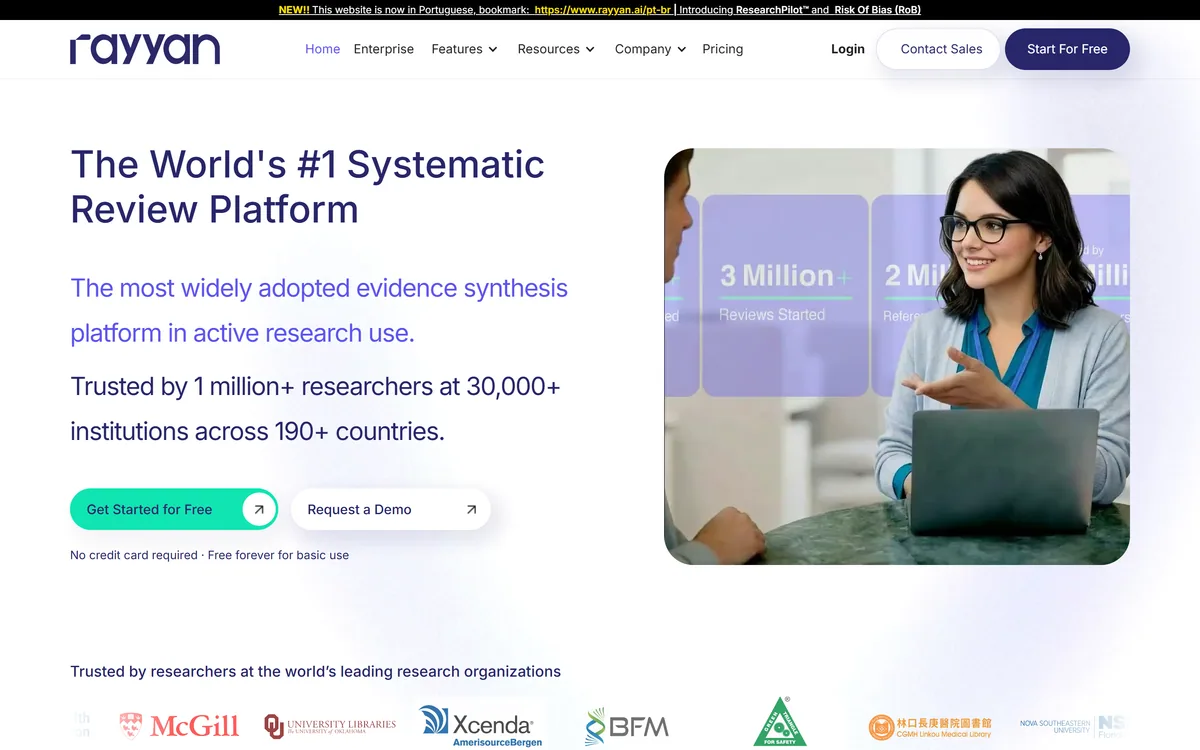
A systematic review can mean screening thousands of papers by hand, months of work. Rayyan's pitch is to speed that up with AI while keeping the rigour evidence synthesis demands.
It assists screening with AI relevance ratings, deduplicates references, generates PRISMA diagrams, keeps audit trails, and supports team collaboration across a review. It sits among research tools like Paperguide, at the systematic-review end.
This review covers how Rayyan speeds up a review, which researchers it suits, how it's priced, and the reviewer-still-decides caveat to weigh first.
Rayyan, The Evidence-Synthesis Brief
- Rayyan speeds up reviews: AI-assisted systematic-review screening.
- It's built for rigour: PRISMA diagrams, audit trails, reproducibility.
- It scales: dedup up to 200,000 references, team collaboration.
- Mind the basics: the AI supports screening; the reviewer still decides.
Rayyan Systematic-Review Facts
| What it is | An AI-assisted systematic-review / evidence-synthesis platform |
|---|
| Company | Rayyan Systems, Inc. (Cambridge, MA; CEO Robert Ayan) |
|---|
| Core | AI-assisted screening and deduplication for reviews |
|---|
| AI | ResearchPilot: zero-shot relevance ratings, AI Analyzer/Reviewer, auto-extract |
|---|
| Rigour | Auto PRISMA diagrams, audit trails, reproducible workflows |
|---|
| Also | Dedup up to 200,000 refs, mobile app, hotkeys, data sampling, RoB |
|---|
| Access | Freemium ('free forever for basic use', no card) + enterprise |
|---|
| Sensitive | AI predictions support, not replace, the reviewer's judgement |
|---|
AI-Assisted Screening For Systematic Reviews
Rayyan's core job is to accelerate the most laborious part of a systematic review, screening, without sacrificing rigour. Its AI gives zero-shot relevance ratings to prioritise the most likely-relevant records, and its Systematic Auto-Resolver can deduplicate up to 200,000 references with a click, turning months of screening into weeks. Its ResearchPilot adds an AI Analyzer, AI Reviewer and auto-extract to speed later stages.
Crucially for research, it's built around rigour: auto-generated PRISMA diagrams, complete audit trails, and structured, reproducible workflows, with six stated pillars of auditability, transparency, reproducibility, scalability, speed and ease of use. It supports team collaboration (data sampling to divide the workload, roles), a mobile app, programmable hotkeys, Risk of Bias (RoB), a PICO framework and API access.
It's aimed at researchers and systematic reviewers, and is very widely adopted, used, it states, by over a million researchers at 30,000+ institutions.
The honest framing is that Rayyan is a mature, trusted, rigour-first platform, and its combination of AI acceleration with auditable, reproducible, PRISMA-aligned workflows is exactly right for evidence synthesis, which is why it's so widely used. The main caveat is methodological and one Rayyan's own design respects: the AI assists and prioritises, it doesn't decide, the reviewer (and, in good practice, a second reviewer) still makes inclusion and exclusion decisions, and the audit trail exists precisely to keep that human judgement defensible. Treating an AI relevance rating as a final verdict would undermine the review. Its reach and time-saving figures (1M+ researchers, 3M+ reviews, up to 90% time saved) are vendor- or user-reported.
Rayyan pairs real AI screening acceleration with the auditable, reproducible, PRISMA-aligned rigour evidence synthesis demands; by design the AI prioritises, while the reviewer still makes the inclusion decisions.
How Does Rayyan Speed Up A Review?
Rayyan pairs AI-assisted screening with the rigour evidence synthesis requires.
Screening, Dedup And Prioritization
It prioritises records with AI relevance ratings and deduplicates up to 200,000 references.
A tool like Scholarcy summarises individual papers; Rayyan's angle is managing the whole systematic-review screening workflow, a process-first job.
PRISMA, Audit Trails And Teams
PRISMA diagrams, audit trails and team collaboration keep the review reproducible and defensible.
A tool like Afforai does citation-backed research broadly; Rayyan is purpose-built for systematic reviews, so match it to whether you need evidence synthesis, with the reviewer deciding.
Which Researchers Rayyan Fits
Rayyan suits researchers, academics, clinicians and teams conducting systematic reviews, meta-analyses or other evidence synthesis who want to accelerate screening without losing rigour.
It suits teams that need reproducible, auditable, PRISMA-aligned workflows and collaboration features (data sampling, roles), and anyone handling large reference sets where deduplication and prioritisation save real time.
It suits less well casual literature searches that don't need systematic-review rigour, and anyone who'd treat the AI relevance ratings as decisions rather than a prioritisation aid.
A fair way to place it: if you do systematic reviews and want AI acceleration within a rigorous, auditable workflow where the reviewer still decides, Rayyan is a strong, widely-trusted choice, and a free tier makes it easy to start; if you just need a quick literature scan, it's more than you need. Use the free tier on a real review, let the AI prioritise screening while you and a second reviewer make the inclusion calls, and lean on the PRISMA and audit features to keep the work defensible.
How Rayyan Charges Researchers
Rayyan is freemium: 'free forever for basic use' with no credit card, plus paid and enterprise tiers for teams and heavier use (the dump doesn't show amounts). We do not publish prices, which change; check the site and confirm what the free tier and paid plans include.
The value question is research time saved versus cost: for a team facing months of screening, even the paid tiers can be easily justified by the time saved, while an individual may get real value from the free tier.
The sensible approach is to use the free tier on a real review, judge how much the AI prioritisation and deduplication actually speed up screening, confirm the collaboration and export features you need, and only upgrade once it's clearly saving your team time.
Screening One Review With Rayyan
Because the AI assists but doesn't decide, use Rayyan with reviewers making the calls.
- Use the free tier on a real systematic review.
- Let the AI prioritise and deduplicate the screening workload.
- Have the reviewer (and a second reviewer) make inclusion decisions.
- Lean on the PRISMA diagrams and audit trail to keep it defensible.
- Confirm the collaboration and export features you need.
- Pass/fail: Rayyan is worth it if it speeds screening while keeping rigour.
- Treat the reach and time-saving figures as vendor-/user-reported.
Rayyan Evidence-Synthesis Terms
- Systematic review
- A structured, reproducible review of all relevant studies on a question, following a defined protocol.
- Screening
- Deciding which studies to include or exclude from a review, the most time-consuming stage.
- PRISMA
- A standard set of reporting guidelines (and flow diagram) for systematic reviews.
- Risk of Bias (RoB)
- An assessment of how likely a study's design is to have produced biased results.