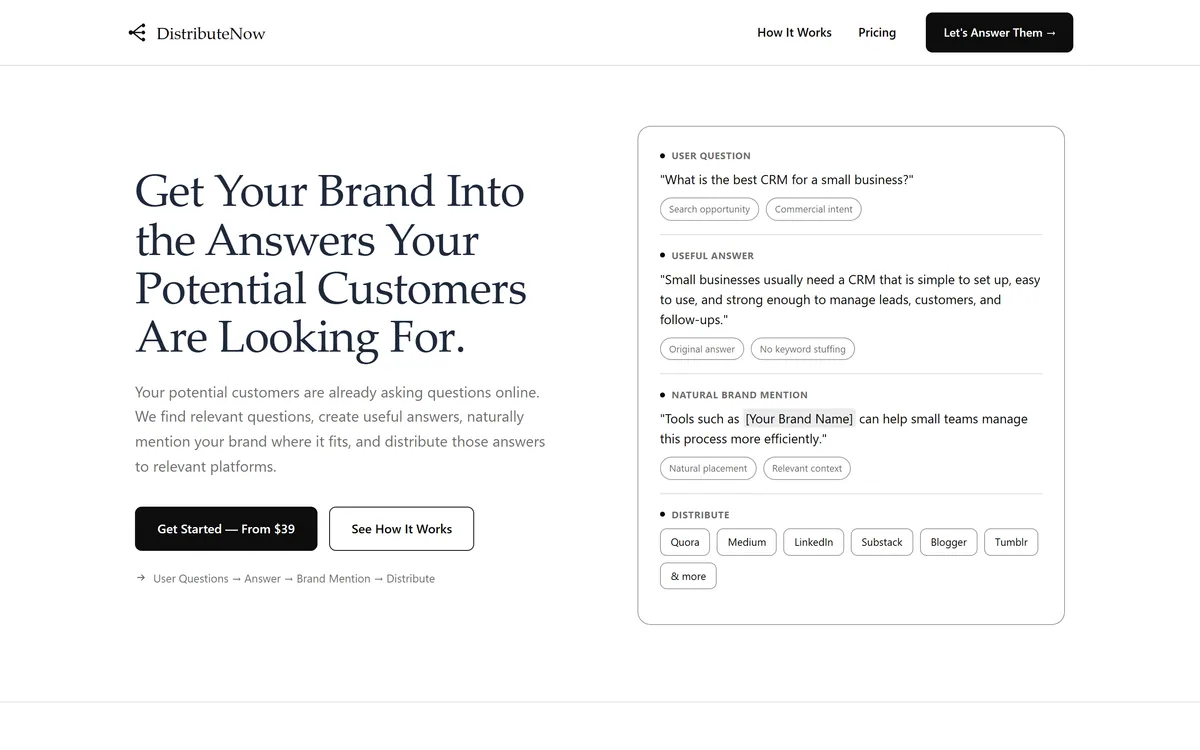
DistributeNow is a done-for-you answer distribution service, not a self-serve tool. You buy a fixed number of answers; its team researches questions people ask online, writes an answer to each, includes a mention of your brand where it fits, and posts the result to one relevant platform such as Quora, Medium, LinkedIn or Substack.
distributenow.online7 viewsAdded September 16, 2026
This is a managed service, not software. DistributeNow is not an application you log into or an AI tool you operate. You buy a fixed number of answers and its team carries out the work, with delivery quoted at up to seven days. It is listed here because it is marketed to the same buyers as AI content tools, and the comparison below is the one worth making.
There is a real insight underneath this product. Before people buy, they ask questions — on Quora, in communities, in search boxes — and the answers they find shape what they end up buying. Being present in those answers is worth more than most display advertising.
DistributeNow sells that presence as a finished piece of work. You buy a number of answers; its team finds relevant questions, researches each one, writes an answer, includes your brand where it genuinely fits, and posts it to one platform chosen to suit the question.
Whether that is content marketing or something else depends entirely on one detail the site does not discuss: whether the reader is told the mention was paid for. That question runs through this whole review, and it is the reason the score sits where it does rather than higher.
DistributeNow's own diagram of the service: question, answer, brand mention, platform placement. Captured September 2026.
What Is An Answer Distribution Service?
It is a placement service with a content step in front of it. The work is not automated and there is nothing to operate — closer to hiring a freelance writer with a distribution list than to buying a seat in a SaaS product.
DistributeNow's version runs in four stages it sets out plainly: find questions potential customers are asking; research and write a useful answer; include the brand only where it fits the answer; publish to one relevant platform. The named destinations are Quora, Medium, LinkedIn, Substack, Blogger and Tumblr.
One deliberate constraint deserves credit. Each answer goes to one platform — the same text is not sprayed across six sites, which is what separates this from the bulk posting the category is known for. That is a meaningful choice and it costs them margin.
We focus on answering the question first. Your brand becomes part of the answer only when it genuinely helps the reader. — DistributeNow, September 2026
Where Does The Disclosure Problem Sit?
Squarely between the buyer and the reader, and the site leaves it there unaddressed.
A paid brand mention is a paid brand mention however useful the surrounding paragraph is. When it appears as an ordinary community answer, the reader has no way to know a company paid for it to exist. That is the definition of an undisclosed paid endorsement, and it is the thing several of the named platforms have written rules about.
This is not an accusation about anyone's intentions. The service's own materials push hard on usefulness, the answers really are researched, and a buyer reading the site would have no particular reason to think about disclosure at all. That is precisely the problem — the topic is absent from a page that ought to raise it.
The Platform Policies This Runs Into
Quora's policies require people writing with a commercial interest to disclose that affiliation, and treat undisclosed promotional answers as spam. LinkedIn and Medium both carry rules against undisclosed commercial content. These are the platforms' own published terms, and an account found breaching them is the buyer's account, not the vendor's.
Beyond platform rules, paid endorsement disclosure is a regulatory matter in several markets — the FTC's Endorsement Guides in the United States and the CAP Code in the United Kingdom both require a material connection between an advertiser and content to be made clear to the audience.
The practical exposure sits with the brand being mentioned, not with the service doing the mentioning. That asymmetry is worth understanding before buying.
Where The Approach Is Genuinely Sound
Two of the six named destinations change the picture entirely. Publishing a researched answer on your own Medium publication, your own Substack or your own company LinkedIn page carries no disclosure difficulty at all — the audience can see whose channel it is. That is simply content marketing, and buying well-researched content for it is ordinary practice.
The research itself also has standalone value. Knowing which questions your buyers actually ask, with intent and demand attached, is useful whether or not anyone posts an answer anywhere — it is the same input a keyword tool like Semrush One or Surfer SEO would give you, arriving as a by-product.
And where a mention is disclosed — a clearly labelled contribution, or an answer on a channel that is visibly yours — the objection disappears. The model is not inherently unsound. It is unsound when the reader is not told.
How Does A Campaign Run From Brief To Placement?
There is no dashboard, so what follows is a description of what happens after you pay rather than a walkthrough of a product. Use it as a checklist of what to agree in advance.
Pick a package size — the tiers differ only in how many answers you get, with the per-answer figure falling as the count rises.
Supply the required information about your brand, product and market. Delivery is quoted at up to seven days from payment and receipt of this.
Before any work starts, settle the question the site does not raise: will the mentions be disclosed, and on which channels will they be posted? Ask for your own owned channels if you want the disclosure question to disappear.
The team researches candidate questions and selects the ones it judges relevant to your product and audience.
Each selected question is turned into one answer, with the brand mention included where it fits, and posted to one platform.
You receive a completed campaign report listing what was published and where.
Pass/fail check: open every placement in the report and read it as a stranger would. If you cannot tell from the page that the mention was paid for, you are looking at an undisclosed paid endorsement published under your brand's name — decide whether you are comfortable with that before you order a second package, not after.
What You Are Buying, And What You Are Not
You are buying a fixed quantity of finished work: research, writing, one placement each, and a report. That is a clear, bounded deliverable, and the site is refreshingly precise about the unit — one researched question, one answer, one platform placement.
You are not buying any of the following, and none of them are promised, so this is a note on expectations rather than a criticism:
Not software. Nothing here is self-serve, and there is no tool to keep using once the package is delivered.
Not guaranteed placement permanence. Community platforms remove content that breaches their policies, and a removed answer is a delivered answer that no longer exists.
Not link equity. Major platforms apply nofollow or sponsored attributes to outbound links as a matter of course, so this is a visibility play rather than an SEO backlink play.
Not ongoing presence. Packages are one-off quantities, not a retainer, so visibility stops when the answers run out.
Not an audience you own. Anything published on someone else's platform stays subject to their rules and their business decisions.
How DistributeNow Charges Per Answer
Per answer, in fixed packages — three published sizes, with the per-answer figure decreasing as the package grows, and custom arrangements above the largest tier by email. There is no subscription and no retainer. AInexfinder does not publish plan amounts because vendor pricing changes without notice; the site's pricing section is the current source.
The unit is unusually clear for this category: one researched question plus one answer plus one platform placement. Delivery is stated as completed within a maximum of seven days from payment and receipt of the information they need from you.
What the pricing page does not set out is what happens if a placement is removed by the platform, or whether a replacement is provided. A refund policy is published in the footer, and that is the document to read before buying — not the pricing section.
DistributeNow In Five Plain Lines
What it actually is: a managed writing-and-placement service with a person doing the work, not an AI tool you operate. Delivery is quoted at up to seven days.
What you get: a fixed number of researched answers, each posted to one platform — Quora, Medium, LinkedIn, Substack, Blogger or Tumblr — with your brand mentioned in context, plus a completed report.
The thing to settle first: whether those mentions will be disclosed as paid. The site does not raise it, several of the named platforms have rules about it, and the exposure sits with your brand.
Where it is clearly fine: placements on channels you own, and the question research itself, which has value regardless of where anything gets posted.
Credit where due: one answer goes to one platform rather than six, and the sample research tables on the site are labelled as illustrative rather than passed off as live data.
What One DistributeNow Package Contains
Type of offering
Managed done-for-you service, not self-serve software
Unit of work
One researched question, one answer, one platform placement
Package sizes
Three published tiers, plus custom volumes on request
Named platforms
Quora, Medium, LinkedIn, Substack, Blogger, Tumblr and others
Stated delivery
Up to seven days from payment and receipt of your information
Deliverable
Published answers plus a completed campaign report
Charging model
One-off package purchase, no subscription or retainer
Automation
None described — the work is carried out by the team
Link treatment
Not stated; major platforms apply nofollow or sponsored to outbound links by default
Disclosure of paid mentions
Not addressed anywhere in the published material
Published policies
Refund policy, privacy policy and terms, plus a named founder
Sample data on site
Explicitly labelled illustrative rather than live keyword research
Should You Hire An Answer Distribution Service?
It Could Fit If
You want the placements on channels you already own — your own Medium publication, Substack or company page — where the disclosure question does not arise.
You are prepared to require disclosure on any third-party placement, and to say so in writing before the work starts.
The question research is worth the money to you on its own, as an input to your own content planning.
You have no in-house writer and need researched, question-shaped content produced to a deadline.
You understand this is visibility rather than SEO link equity, and are buying it on that basis.
Walk Away If
You are buying this for backlinks. The major platforms involved apply nofollow or sponsored attributes as standard, so the SEO value is not what it may appear.
Your brand operates anywhere that enforces paid-endorsement disclosure strictly, or in a regulated sector such as finance, health or legal services.
You would not be comfortable if a customer discovered the mention was paid for. That is the only test that matters, and it is worth applying before the first package.
You want something durable. Packages are one-off quantities and community platforms remove content, so neither presence nor permanence is guaranteed.
You need an owned, compounding content asset — in which case publishing on your own site and promoting it with tools like Brand24 to find the conversations is the more solid route.
Key features of DistributeNow
Research into questions potential customers are asking across communities and Q&A platforms
One original written answer per selected question, shaped around the question rather than the brand
Contextual brand mention included only where the team judges it to fit the answer
Publication of each answer to one relevant platform — Quora, Medium, LinkedIn, Substack, Blogger or Tumblr
A completed campaign report listing what was published and where
Fixed package sizes with no subscription or retainer, and custom volumes available on request
Stated delivery within a maximum of seven days of payment and receipt of your brand information
Pros & cons
Pros
5
One answer goes to one platform rather than being duplicated across six, which is a deliberate and costly restraint
The answer-first framing is real — the site explicitly contrasts its output with advertising copy
Sample research tables are labelled as illustrative examples rather than presented as live keyword data
A clear, bounded deliverable with a stated delivery window and a campaign report at the end
Publishes a refund policy, privacy policy, terms and a named founder rather than operating anonymously
Cons
6
Disclosure of paid mentions is not addressed anywhere in the published material, and the exposure sits with the buyer's brand
Undisclosed commercial answers sit against the published policies of several of the named platforms
Not software — there is nothing to operate, and nothing remains once the package is delivered
Sold as an AI-adjacent product although no automation is described; the work is manual
Little SEO value from links, since the major platforms apply nofollow or sponsored attributes by default
No stated remedy if a platform removes a delivered answer
Best For
Businesses that want researched, question-shaped content published on channels they already own
Teams with no in-house writer who need question-led content produced to a fixed deadline
Marketers who want the underlying question research as an input to their own content planning
Brands willing to require written disclosure on every third-party placement before work begins
DistributeNow Beside Other Brand-Visibility Routes
Four ways to be present where buyers are asking questions, with very different risk profiles.
Tool
What you get
Who does the work
Main drawback
DistributeNow
Researched answers posted to third-party platforms with a brand mention
Their team, as a one-off package
Undisclosed paid mentions sit against platform policies, and the exposure is yours
Alerts when your brand or topic is discussed, so you can answer as yourself
You, replying openly under your own name
Takes ongoing time, and scales with your attention rather than with budget
How We Assessed DistributeNow
Last checked . Read from the service's own pages in a real browser, including the footer and the pricing section.
Home page, how-it-works flow, sample research tables and pricing section rendered in Chromium in September 2026.
Package structure, the one-question-one-answer-one-platform unit and the stated maximum seven-day delivery taken from the pricing section's own wording.
The named destination platforms taken from the site's own distribution graphic rather than inferred.
Footer checked: a refund policy, a privacy policy, terms, and a named founder are all published and reachable, alongside a separate service run by the same person.
The site's own disclaimers reviewed — its sample keyword tables carry an explicit note that the figures are illustrative examples rather than live keyword-tool data.
Platform policy positions on undisclosed commercial content checked against the platforms' own published rules, not against the vendor's description of them.
What we could not confirm: no published material addresses whether paid mentions are disclosed to readers, so we cannot tell you how any individual placement is presented — that is the single most important question for a buyer and it needs asking directly. Nothing on the site states what happens if a platform removes a delivered answer, or whether a replacement is provided; the refund policy is the document to read on that. We have not bought a package or inspected live placements, so this assesses the offer as published rather than the work as delivered, and none of the above is a judgement about the quality of the writing itself.
Other Ways To Earn Brand Mentions
Routes to the same visibility with the disclosure question already settled.
Brand24 — finds the conversations already happening about your category so you can answer openly as yourself.
Semrush One — the question and demand research in-house, without any third-party placement attached.
Surfer SEO — builds the same answers as content on a site you own and control.
Jasper AI — produces the writing at volume if the bottleneck is drafting rather than distribution.
Writesonic — question-shaped content at scale for your own channels.
Editor's Verdict
2.7/5
The craft on display is better than the category usually manages: the answers are genuinely researched, the site refuses to dress them as advertisements, and its sample data is labelled as illustrative rather than passed off as live research — a level of candour most competitors skip. What pulls the score down to 2.7 is structural rather than a matter of execution. A paid brand mention posted to a third-party community without saying it is paid sits against those platforms' own published policies and against paid-endorsement disclosure rules in several markets, and nothing on the site addresses how a buyer should handle that. AInexfinder Editor Score: 2.7/5.
DistributeNow pricing
AInexfinder does not list plan prices or billing details. For current pricing, plans, and trials, visit the official DistributeNow website.
Vendor pricing, credits, and billing policies change over time. Always confirm on the official site before you buy.
Frequently asked questions
What is DistributeNow?
DistributeNow is a managed answer distribution service. You buy a fixed number of answers; its team researches questions people are asking online, writes an answer to each, includes a mention of your brand where it fits, and publishes the result to one relevant platform such as Quora, Medium, LinkedIn or Substack.
Is DistributeNow an AI tool?
No. It is a done-for-you service with people doing the work, and no automation is described anywhere on the site. There is nothing to log into and nothing to operate. Delivery is quoted at up to seven days from payment, which is a service timeline rather than a software one.
Which platforms does DistributeNow post to?
Quora, Medium, LinkedIn, Substack, Blogger and Tumblr are the named destinations, with others implied. Each answer goes to one platform chosen to suit the question — the same text is not duplicated across all of them, which is a genuine distinction from bulk posting services.
Are DistributeNow's brand mentions disclosed as paid?
The published material does not say, and that is the most important question a buyer can ask before purchasing. Several of the named platforms require commercial affiliation to be disclosed, and paid-endorsement disclosure is a regulatory requirement in several markets. Ask directly, and get the answer in writing before work begins.
Will DistributeNow help my SEO?
Not through links, in all likelihood. Quora, Medium, LinkedIn and similar platforms apply nofollow or sponsored attributes to outbound links as standard, so link equity is not what you are buying. Treat it as brand visibility in front of people asking buying-stage questions, which is a real but different benefit.
How much does DistributeNow cost?
It sells fixed packages of answers, with three published sizes and larger volumes arranged by email. The per-answer figure falls as the package grows. There is no subscription. AInexfinder does not publish plan amounts because vendor pricing changes without notice — check the pricing section on the site.
What exactly counts as one answer?
One researched question, one written answer, and one platform placement. That is the unit the packages are priced in, and the site is unusually precise about it. Each package also includes a completed campaign report listing what was published and where.
What happens if a platform removes a published answer?
Nothing on the site addresses this, which matters because community platforms do remove content that breaches their policies. A refund policy is published in the footer and is the document to read before buying. Ask specifically whether a removed placement is replaced.
Is using an answer distribution service against platform rules?
Publishing a paid brand mention without disclosing it sits against the published policies of several of the platforms involved — Quora requires commercial affiliation to be disclosed, and LinkedIn and Medium both carry rules on undisclosed commercial content. Where a mention is clearly disclosed, or published on a channel you visibly own, that objection does not apply.
When does DistributeNow make sense?
Most clearly when the placements go on channels you already own, where the disclosure question disappears and you are simply buying well-researched content. It also makes sense if the underlying question research is worth the money to you as an input to your own planning, regardless of where anything is published.
What is a safer alternative to buying brand mentions?
Answering openly as yourself. Monitoring tools surface the conversations happening about your category so you can reply under your own name, with your affiliation visible — slower, but it carries no policy risk and builds a presence that is genuinely yours. Publishing the same answers on your own site is the other durable route.
Who runs DistributeNow?
The site names its founder and links to a separate service run by the same person, alongside a refund policy, a privacy policy and terms. That is more transparency than much of this category offers, and it means there is a named counterparty to put the disclosure question to.
Daniel reviews AI tools the slow way — by actually using them on real projects. His reviews cover what works, what breaks, and who each tool is genuinely a good fit for.
Daniel and the AInexfinder editorial team research DistributeNow using public product information, listing evidence, and (when available) hands-on checks. Scores reflect listing completeness and transparency — not paid placement.
Listings may include affiliate or sponsored placements, which are labeled when present. Editorial scores and cons are not sold. See our affiliate disclosure and review methodology.
Listomize is an Etsy SEO platform that generates titles, tags, and descriptions within Etsy's own limits, scores listings, optimises 100+ listings from a CSV, tracks competitors and trends, and auto-generates Pinterest pins.
Lahjty (لهجتي) is an Arabic-first marketing platform for MENA campaigns. From one brief it produces dialect-aware ad copy, headlines, campaign images with Arabic text rendered in, dialect-aware voice, and SEO articles grounded in your own brand sources — with a Partner API and an MCP server for teams that want it inside their own workflow.
MaxAEO is an answer engine optimisation platform from HIII PTE. LTD. It tracks how ChatGPT, Gemini, Claude, Perplexity, Copilot, Grok and Google's AI surfaces mention a brand, with sentiment, competitor benchmarking and citation tracing.
Mailjet is a Sinch-owned email platform handling both marketing campaigns and transactional sending from one account. It offers a collaborative drag-and-drop editor, an email API with SMTP relay, AI generation and segmentation, and EU-based data centres.
Outranking is an AI SEO content platform that writes briefs and first drafts and optimises them with real-time scoring, grounding content in live SERP data through its Concepts feature, with keyword clustering, internal linking and content workflows.
PitchBud is a press outreach tool that drafts a release with Claude Sonnet, publishes it to a newsroom URL with NewsArticle schema and RSS, matches relevant journalists by their recent work, and drafts personal pitches you review and send yourself.