
TubeMagic generates YouTube scripts matched to a channel's existing voice, letting creators choose the model, set script length by video duration and feed in top-performing reference videos, alongside tools for titles, tags, descriptions, ideas and keyword research in 95-plus languages.
FinalBit
Verified
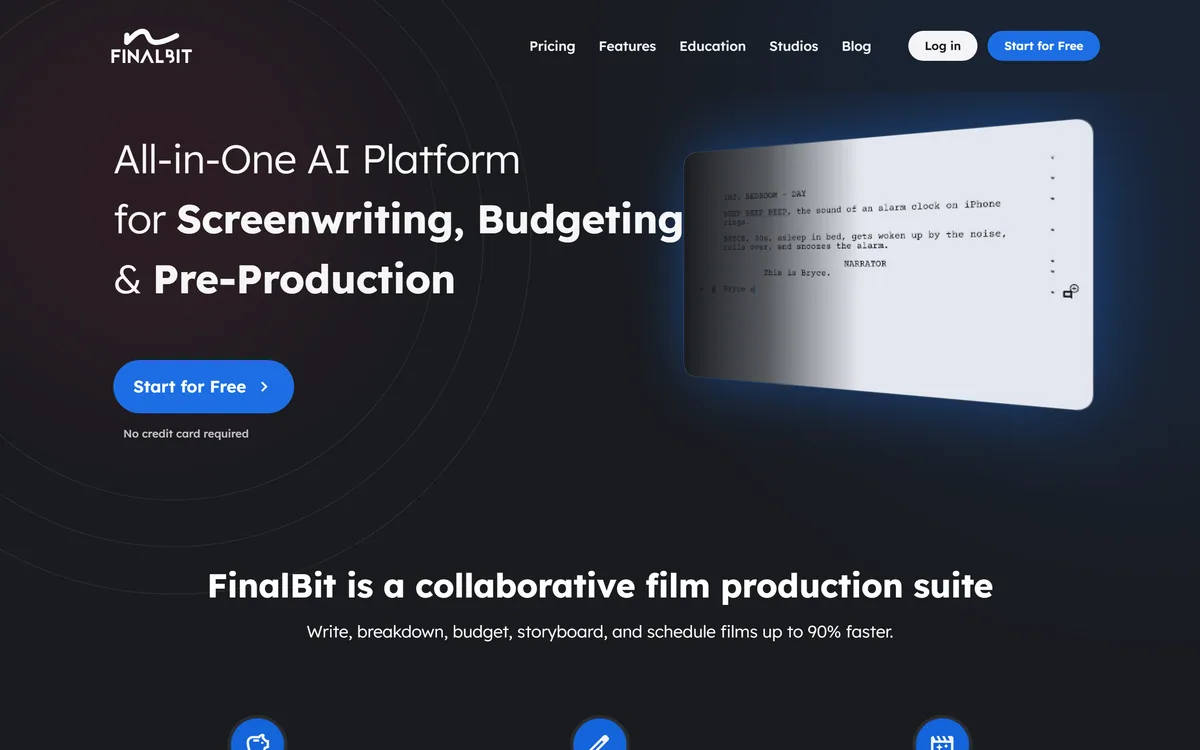
FinalBit is an AI film production platform organised around fourteen named agents, each handling one stage of production — screenwriting, coverage, storyboarding, video generation, script breakdown, budgeting, scheduling and pitch decks — rather than presenting a single general assistant.
3.8Editor Score
finalbit.ai9 viewsAdded December 13, 20253K visitors
Film production is not one job. It is a sequence of specialised jobs with different vocabularies, different deliverables and different people, and the handoffs between them are where projects break.
Most AI tools for filmmakers ignore that entirely and offer a single assistant, which reflects how the technology is built rather than how the work is done.
FinalBit takes the opposite approach. It names fourteen agents and gives each one a stage — one writes, one covers, one breaks down the script, one budgets, one schedules — which is a structural argument about the work rather than a cosmetic one about personality.
Why Fourteen Named Agents Instead Of One Assistant?
The named-agent structure is the first thing you notice and the thing worth thinking about hardest, because it changes how you use the tool rather than what the tool can do.
A single general assistant makes every request the same shape. You type into the same box whether you are drafting a scene or estimating a budget, and the tool has to infer what kind of task it is from your phrasing — which it does inconsistently, because those tasks share vocabulary but not structure.
Naming an agent per stage removes that inference. Going to the budgeting agent is a decision you make before you type, and it means the tool arrives already knowing what kind of output is expected. That is a real improvement in a workflow this segmented.
It also matches how production departments are organised. A line producer and a script supervisor are different people with different training for a reason, and software that mirrors that division is easier to slot into an existing process than software that flattens it.
The honest counterpoint is that names are cheap. Fourteen agents may be fourteen genuinely tuned specialists, or one model with fourteen prompts and fourteen labels. From outside you cannot tell, and the way to find out is to test whether the budgeting agent actually reasons about production costs differently from the screenwriting one.
Compare that with a single-stage specialist. LTX Studio does storyboarding and previs in more depth than any general platform manages, and choosing between them is really a question of how many stages you personally own.
Naming an agent per stage removes an inference step. You decide what kind of task this is before you type, rather than hoping the tool works it out.
Which Agent Handles Which Stage
The roster spans the pipeline: Kane, Blake, Neil, Juliet, Vox, Polish, Arc, Holly, Sterling, Beat, Reel, Akira, Thread and Slate.
The functions listed alongside them cover screenwriting, script coverage, storyboarding, AI video generation, script breakdown, budgeting, scheduling and pitch deck creation — which is close to the full arc from blank page to a schedule you could shoot against.
That breadth is unusual. Most tools in this space pick one stage: a screenwriting assistant, or a storyboard generator, or a scheduling tool. Covering the whole pipeline means the handoffs happen inside one system, which is where a great deal of production friction normally lives.
Breadth is also the risk. A platform doing eight things is rarely as good at any one of them as the specialist tool that does only that thing, and the question for any given user is whether the integration is worth more than the depth they give up.
The answer usually depends on scale. On a small production where one person does several of these jobs, integration wins easily. On a larger one where each stage has a dedicated specialist with an established tool, it wins much less often.
What Can Script Breakdown And Budgeting Honestly Do?
Two of FinalBit's listed capabilities — script breakdown and budgeting — are where the biggest genuine time savings sit, and also where the largest caveats belong.
Script breakdown is the process of reading a screenplay and extracting every element that has to be procured or scheduled: cast in each scene, props, wardrobe, locations, vehicles, special equipment. It is mechanical, exhaustive and enormously time-consuming, which makes it close to an ideal task for a language model.
It is also a task where a missed element becomes a problem on the day. An AI breakdown is a strong first pass that saves hours and still needs a human read, because the cost of an omission is not a bad sentence but a missing prop on set.
Budgeting is a harder case. The arithmetic is trivial and the assumptions are everything — day rates in your city, union terms, insurance, equipment packages, contingency. A generated budget is a structure with plausible numbers in it, and the numbers are the part that has to come from your actual quotes.
Used correctly, that is still valuable. A budget structure with every line item present and nothing forgotten is genuinely useful, and it beats starting from a blank spreadsheet. Used as a number to show a financier, it is a way to be wrong with confidence.
- Treat script breakdown as a strong first pass that still needs a human read before it goes to departments.
- Treat a generated budget as a complete structure with placeholder numbers, not an estimate.
- Replace every rate with a real quote from your own city and union situation before showing anyone.
- Use coverage as a second opinion on a script, never as the only one.
- Check whether the scheduling agent knows about real cast availability or is inferring it.
Where AI Video Generation Fits In A Real Production
FinalBit lists AI video generation alongside the planning agents, and its useful role is narrower than the phrase suggests.
Generated video is not going to be your film. Length, continuity, performance and the simple ability to shoot what the script says all remain out of reach for anything a production would deliver, and pretending otherwise wastes a director's time.
Where it earns its place is in pre-visualisation and in pitching. A moving animatic of a sequence communicates intent to a financier or a department head far better than a storyboard does, and it costs a fraction of what a previs house charges.
That fits the platform's shape well. Storyboarding, video generation and pitch decks are three views of the same job — showing someone what the film will be before it exists — and having them in one system where the script is already loaded is a genuine convenience.
The practical caution is expectation-setting with whoever sees the output. A generated sequence that looks polished can create an impression the finished film will look like that, and managing that impression is part of using the tool well.
For footage you intend to keep, a generation tool such as Runway ML is where the state of the art actually sits, and even there the honest use is inserts and plates rather than performances. Two stages sit outside this platform entirely: sound, where a specialist like Rebel Audio belongs, and the edit itself, where a browser cutting room such as Flixier takes over once you have material.
How To Test FinalBit On A Real Project
The way to evaluate a platform this broad is to run one script through the pipeline rather than sampling agents at random.
Use something you have already made, because you can check the output against what actually happened.
- Take a script you have already produced, so you know the real breakdown, budget and schedule it ended up with.
- Run the script breakdown agent and diff its element list against your actual one — count what it missed, not what it found.
- Run the budgeting agent and compare its structure to your real budget, ignoring the numbers and judging the line items.
- Ask the coverage agent for notes and check whether they surface anything a reader flagged at the time.
- Test whether two different agents actually behave differently on the same prompt, which tells you if the specialisation is real.
- Only then price it against what you currently spend on the same stages, since the subscription tiers are not published.
Fourteen Agents, In Brief
- Fourteen named agents, one per stage — Kane, Blake, Neil, Juliet, Vox, Polish, Arc, Holly, Sterling, Beat, Reel, Akira, Thread and Slate.
- It spans the whole pipeline: screenwriting, script coverage, storyboarding, AI video generation, script breakdown, budgeting, scheduling and pitch decks.
- The structure is the differentiator, not any single capability — naming the agent makes the stage explicit in a way a general assistant does not.
- An API catalogue exists with Agents, Features and Blog endpoints, which suggests the platform is built to be integrated rather than only visited.
- Subscription-based, with the tier structure not published on the pages we read.
FinalBit: Platform And Coverage
| Product type | AI film production platform |
|---|---|
| Structure | Fourteen named agents, one per production stage |
| Agent roster | Kane, Blake, Neil, Juliet, Vox, Polish, Arc, Holly, Sterling, Beat, Reel, Akira, Thread, Slate |
| Writing | Screenwriting and script coverage |
| Visual development | Storyboarding and AI video generation |
| Production planning | Script breakdown, budgeting and scheduling |
| Pitching | Pitch deck creation |
| API | API catalogue listing Agents API, Features API and Blog API |
| Pricing model | Subscription tiers, structure not published on the pages read |
Key features of FinalBit
Fourteen named agents covering distinct production stages
Screenwriting assistance and script coverage in one place
Storyboarding for visual development from the loaded script
AI video generation for pre-visualisation and pitching
Script breakdown extracting production elements scene by scene
Budgeting that produces a complete line-item structure
Scheduling built on the breakdown output
Pitch deck creation for financing conversations
API catalogue with Agents, Features and Blog endpoints
Pros & cons
Pros
6- The named-agent structure mirrors how production departments actually divide labour
- Choosing an agent removes the inference step a general assistant has to make
- Handoffs between writing, breakdown and scheduling happen inside one system
- Script breakdown is genuinely well suited to a language model and saves real hours
- Previs and pitch material sit next to the script rather than in separate tools
- An API suggests the platform is built for integration rather than only for visiting
Cons
6- Fourteen names may or may not mean fourteen genuinely distinct specialists
- Generated budgets carry plausible numbers that must be replaced with real quotes
- Breadth across eight stages usually costs depth against single-stage specialists
- Subscription tiers are not published on the pages we read
- No operating company, location or team is identified
- No production is named as having shipped using the platform
Best For
- Solo filmmakers and small production teams covering several roles
- Anyone whose script breakdown is currently done by hand
- Pitching a sequence to financiers before it is shot
- Producing a complete budget structure to fill with real quotes
- Teams wanting the whole pipeline in one system rather than five
FinalBit Against Other Film And Video Tools
Tools for filmmakers split between planning the production and generating the footage. FinalBit is unusual in attempting both.
| Tool | Stage covered | Structure | Best for |
|---|---|---|---|
| FinalBit | Script through schedule, plus generated video | Fourteen named stage-specific agents | Small productions where one person wears several hats |
| Runway ML | Generation and editing only | A creative suite | Actually producing footage |
| InVideo AI | Prompt to finished video | Single generation flow | Marketing and social video, not film |
| LTX Studio | Script to previs storyboard | Integrated storyboarding workspace | Visualising a sequence before shooting |
| Rebel Audio | Sound and audio post | Specialist tool | The stage FinalBit does not cover |
Which Productions FinalBit Fits
Right for your production when
- You are a small production or solo filmmaker doing several of these jobs yourself.
- Script breakdown is eating hours you would rather spend elsewhere.
- You need to show a financier what a sequence looks like before it exists.
- Handoffs between writing, breakdown and scheduling are where your process leaks time.
- You want a budget structure with nothing forgotten, and will supply your own rates.
Wrong fit for your production when
- You have dedicated specialists at each stage with established tools they know well.
- You need generated footage that will appear in a finished film, which no tool delivers.
- Your budget has to be defensible to investors from the numbers rather than the structure.
- You require published pricing before evaluating, since the tiers are not listed.
- Your scheduling depends on real cast and location availability the platform cannot see.
FinalBit: What We Verified
Last checked . Read from finalbit.ai and its product and API pages, with the screenshot above captured in the same session.
- Product positioned as an AI film production platform
- Fourteen named agents confirmed: Kane, Blake, Neil, Juliet, Vox, Polish, Arc, Holly, Sterling, Beat, Reel, Akira, Thread and Slate
- Screenwriting confirmed as a listed capability
- Script coverage confirmed as a listed capability
- Storyboarding confirmed as a listed capability
- AI video generation confirmed as a listed capability
- Script breakdown confirmed as a listed capability
- Budgeting confirmed as a listed capability
- Scheduling confirmed as a listed capability
- Pitch deck creation confirmed as a listed capability
- An API catalogue confirmed, listing an Agents API, a Features API and a Blog API
- A subscription pricing model confirmed as the commercial structure
What we could not confirm: which underlying models power the agents, or whether the fourteen are separately tuned rather than one model with fourteen prompts; the subscription tier structure; the operating company, its location or its size; whether generated budgets draw on any real rate data; the video generation model and its output length or resolution limits; and whether any production has shipped using the platform. We did not use the product, so nothing here reflects tested output quality.
Other Tools Across The Production Pipeline
FinalBit covers a lot but not everything, and the specialists are stronger inside their own stage.
- Runway ML — the reference point for AI video generation and editing
- LTX Studio — storyboarding and previs specifically, in more depth
- InVideo AI — for marketing video, which is a different job to film
- Rebel Audio — sound work, which sits outside FinalBit's coverage
- Flixier — browser-based editing once you have footage to cut
Editor's Verdict
3.8/5FinalBit's structural bet is the interesting part. Rather than one assistant that does everything adequately, it names fourteen agents and gives each a job — Kane writes, Blake covers, Sterling budgets, Slate schedules — which mirrors how a production department actually divides labour and makes it obvious which stage you are in. That is genuinely better product design than a single chat box for a workflow this segmented. It scores where it does rather than higher because the hard parts of production are the parts an AI cannot verify: a budget is only as good as its rate assumptions, and a schedule only as good as its availability data. AInexfinder Editor Score: 3.8/5.
FinalBit pricing
AInexfinder does not list plan prices or billing details. For current pricing, plans, and trials, visit the official FinalBit website.
Visit official website for pricingVendor pricing, credits, and billing policies change over time. Always confirm on the official site before you buy.
Frequently asked questions
What is FinalBit?
FinalBit is an AI film production platform organised around fourteen named agents, each handling one production stage. Between them they cover screenwriting, script coverage, storyboarding, AI video generation, script breakdown, budgeting, scheduling and pitch deck creation — close to the full arc from blank page to a shootable schedule.
Why does FinalBit use fourteen separate agents?
Because production is a sequence of specialised jobs rather than one job. A single assistant has to infer what kind of task you mean from your phrasing, which it does inconsistently when tasks share vocabulary but not structure. Choosing the budgeting agent before you type removes that inference and mirrors how production departments are actually organised.
What are the fourteen agents called?
Kane, Blake, Neil, Juliet, Vox, Polish, Arc, Holly, Sterling, Beat, Reel, Akira, Thread and Slate. The site names them individually against the platform's capabilities. What we could not establish is whether each is separately tuned or whether the roster is one model behind fourteen prompts — worth testing by checking if two agents genuinely behave differently on the same input.
Can FinalBit do script breakdown reliably?
Script breakdown — extracting cast, props, wardrobe, locations and equipment scene by scene — is mechanical and exhaustive, which makes it well suited to a language model and a genuine time saving. It still needs a human read, because a missed element is not a bad sentence but a missing prop on the day.
Should I trust an AI-generated budget?
Trust the structure, not the numbers. The arithmetic is trivial and the assumptions are everything — day rates in your city, union terms, insurance, equipment, contingency. A generated budget is a complete line-item skeleton with plausible figures in it, which beats a blank spreadsheet. Replace every rate with a real quote before showing anyone.
Is FinalBit's video generation good enough to use in a film?
No, and no current tool is. Length, continuity, performance and the ability to shoot what the script says are all out of reach for finished delivery. Where it earns its place is pre-visualisation and pitching — a moving animatic communicates intent to a financier far better than a storyboard, at a fraction of what previs normally costs.
How much does FinalBit cost?
It runs on a subscription model, but the tier structure was not published on the pages we read. That means you cannot compare it against your current spend without contacting them. If published pricing is a requirement for your evaluation process, that is a genuine obstacle to trialling it.
Does FinalBit have an API?
Yes — the site lists an API catalogue including an Agents API, a Features API and a Blog API. The Agents API is the significant one, since it implies the specialist agents can be called from your own systems rather than only through the interface, which matters for anyone building production tooling around them.
Is FinalBit better than a specialist tool for one stage?
Usually not on depth, and that is the trade. A platform covering eight stages is rarely as strong at any one as the tool that only does that. The question is scale: on a small production where one person handles several of these jobs, integrated handoffs win easily; where each stage has a dedicated specialist with an established tool, they rarely do.
What should I test first if I try it?
Run a script you have already produced through the pipeline, because you know what the real breakdown, budget and schedule turned out to be. Diff the breakdown against your actual element list and count what it missed. That single test tells you more about whether the platform is usable than any amount of sampling agents at random.
Reviews
Log in to write a review.
User Reviews
No reviews yet. Be the first to share your experience with FinalBit.
Reviewed by Daniel Reed
Assigned reviewer
Daniel ReedSenior AI Tools Reviewer
Daniel reviews AI tools the slow way — by actually using them on real projects. His reviews cover what works, what breaks, and who each tool is genuinely a good fit for.
Hands-on reviewsProduct testingAI software
Daniel and the AInexfinder editorial team research FinalBit using public product information, listing evidence, and (when available) hands-on checks. Scores reflect listing completeness and transparency — not paid placement.
- Last verified
- Methodology
- How we review AI tools
- Sources used
- finalbit.ai
- AInexfinder listing fields (features, pros/cons, description)
- Public vendor pages when available
- Editorial policy
- Listings may include affiliate or sponsored placements, which are labeled when present. Editorial scores and cons are not sold. See our affiliate disclosure and review methodology.
Related tools
ytZolo is an AI content studio for YouTube creators that generates thumbnails, titles, descriptions, tags and scripts across multiple models, plus a voice, music and dubbing audio studio, on a credit-based plan.
FreemiumWriting & Content

Copy.ai has become an AI-native go-to-market platform: workflows and agents that run prospecting, lead processing, deal coaching, ABM, and CRM enrichment across Salesforce, HubSpot, Gong, Outreach, and 2,000+ integrations.
FreemiumWriting & Content

Writesonic has become an AI search growth platform — tracking whether your brand appears across 10 AI platforms, running optimisation and citation work through an Action Center, and reporting results against traffic and revenue.
FreemiumWriting & Content
Talefy, from AIcberg Labs, is an interactive AI storytelling platform. Readers make choices that change the plot, and creators build characters, worlds and branching narratives across fantasy, sci-fi, romance, horror and comedy.
FreemiumWriting & Content
MailMaestro is an AI email assistant from Maestro Labs that drafts replies, summarizes threads and triages your inbox directly inside Outlook and Gmail, offering three drafts per request in your tone across 20+ languages, with enterprise-grade security.
FreemiumWriting & Content
Explore More
Embed this listing on your site
Featured on AInexfinder